10 Essential Jobs and Employment Stories for Canadian HR Leaders


Canada's labour landscape is shifting fast — from referendum staffing shortages to frontline strikes and trade-war impacts on hiring. According to Press Monitor's tracking of Canadian publications, here are the 10 defining stories shaping jobs and employment this week.
1. Elections Alberta Seeks Thousands of Referendum Workers
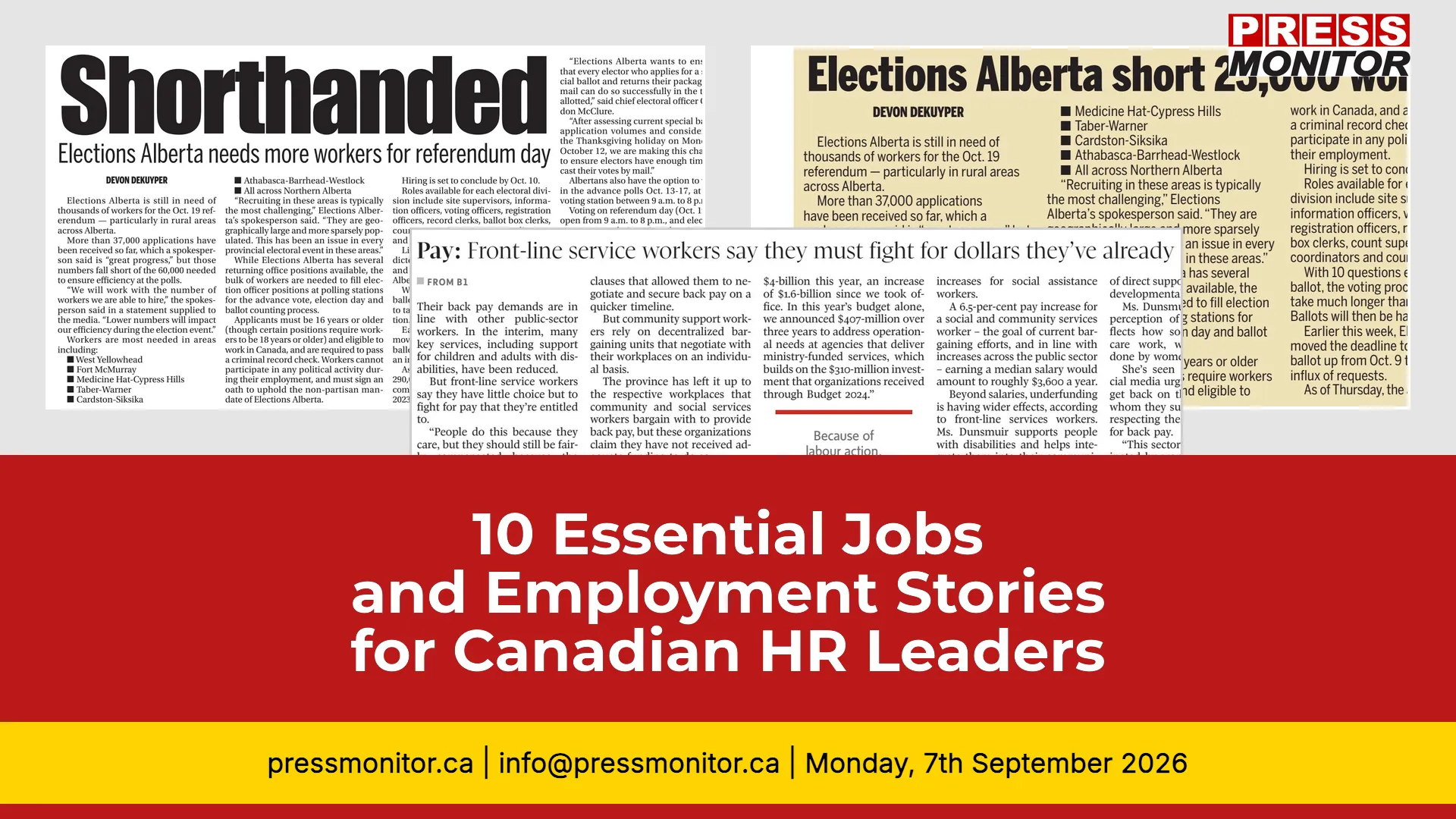
Calgary Sun reports that Elections Alberta is still in need of thousands of workers for the October 19 referendum, particularly in rural areas across Alberta. More than 37,000 applications have been received so far, but those numbers fall short of the 60,000 needed to ensure efficiency at the polls. Elections Alberta is still short thousands of workers for the October 19 referendum, having received 37,000 applications against a need for 60,000. Rural areas across Alberta are especially affected, with polling stations, voting, and ballot counting all understaffed. The agency moved the special ballot deadline to Sept. 25 after receiving 29,000 vote-by-mail requests. For HR teams in public administration, this signals a surge in temporary staffing demand across the province.
2. 23,000 Workers Still Needed for Alberta Referendum
Edmonton Sun reports that Elections Alberta is still short thousands of workers for the Oct. 19 referendum, having received 37,000 applications needing 60,000. The agency is recruiting mainly in rural Alberta areas such as West Yellowhead, Fort McMurray, and Medicine Hat-Cypress Hills, among others, to staff polling stations, voting, and ballot counting. It also moved the deadline for special ballot applications to Sept. 25 after receiving 29,000 vote‑by‑mail requests. The Edmonton Sun confirms that Elections Alberta remains thousands of workers short for the Oct. 19 referendum. Recruitment is focused on rural Alberta areas including West Yellowhead, Fort McMurray, and Medicine Hat-Cypress Hills. The shortfall highlights the ongoing challenge of filling essential democratic infrastructure roles, a key concern for workforce planners tracking temporary employment cycles.
3. Ontario Front-Line Workers Strike for Back Pay
The Globe And Mail reports that front-line service workers in Ontario are striking to recover pay increases they say they are entitled to after the province repealed a wage-cap law. Community support services for children and adults with disabilities have been temporarily halted due to labour action, while workers argue they remain among the lowest-paid in the public sector despite performing skilled care work. Front-line service workers in Ontario are striking to recover pay increases after the province repealed a wage-cap law. Community support services for children and adults with disabilities have been temporarily halted. These workers remain among the lowest-paid in the public sector despite performing skilled care work. HR leaders in social services and healthcare must prepare for potential bargaining disruptions and retention challenges.
4. Mayor Sutcliffe Pledges 350 First Responders
Ottawa Sun reports that Mayor Mark Sutcliffe pledged to hire 350 more first responders, including 200 police officers, if re-elected. The mayor unveiled 32 measures to improve citywide public safety at Fisher Park in Wellington Village on September 3. His challengers Neil Saravanamuttoo, Alex Lawson, and Jeff Leiper responded with critiques and their own public safety visions. Ottawa Mayor Mark Sutcliffe pledged to hire 350 more first responders, including 200 police officers, if re-elected. The announcement includes 32 measures to improve citywide public safety. For municipal HR and public safety staffing teams, this represents a significant pipeline of new hiring commitments ahead of the Ottawa mayoral race.
5. BCNU Nurses Strike for Better Care
Times Colonist reports that the British Columbia Nurses Union is thanking supporters after thousands of nurses in British Columbia joined the province's longest nursing strike this summer to defend workers' rights and support better care. The message, tied to Labour Day, says workers' rights are won through collective action, courage and solidarity. The British Columbia Nurses Union is thanking supporters after thousands of nurses joined the province's longest nursing strike this summer. The message, tied to Labour Day, emphasizes that workers' rights are won through collective action, courage, and solidarity. Healthcare HR directors should monitor bargaining outcomes closely, as nursing shortages compound workforce pressures across BC.
6. Trump Tariffs Threaten Canadian Economy and Jobs
The Toronto Star reports that the US government has signalled it will respond to Canadian retaliation, as Trump threatens to increase tariffs on Canadian autos on Jan. 1 in what experts warn could be catastrophic for the Ontario-based sector. Ottawa and provincial governments have pledged support for workers and businesses impacted by the trade war, including through a 7.5 billion dollar aid package that bolsters employment insurance and provides favourable loans to affected businesses. The Canadian economy grew at an annualized rate of 3.3 percent in the second quarter of this year, while University of Calgary economist Trevor Tombe predicts the new American tariffs could shave 0.4 percent off the country's gross domestic product. The Toronto Star reports that Trump threatens to increase tariffs on Canadian autos on Jan. 1, which experts warn could be catastrophic for the Ontario-based sector. Ottawa has pledged a 7.5 billion dollar aid package bolstering employment insurance and providing favourable loans. University of Calgary economist Trevor Tombe predicts the new tariffs could shave 0.4 percent off Canada's GDP. HR leaders in manufacturing and automotive must model workforce scenarios against these trade risks.
7. Trump Threatens Auto Tariffs on Canada
Toronto Star reports that the US government has signalled it will respond to Canadian retaliation, as Trump threatens to increase tariffs on Canadian autos on Jan. 1. Experts warn this could be cataclysmic for the Ontario-based sector, and the trade war could be entering a more damaging phase with further escalation. Toronto Star further details the US government's signal to respond to Canadian retaliation, with Trump threatening increased auto tariffs on Jan. 1. Experts warn the trade war could be entering a more damaging phase with further escalation. For talent acquisition teams in the auto sector, contingency planning for hiring freezes and layoffs is now urgent.
8. Sixty-One Percent of Canadian Small Businesses Cut Spending Amid Tariff Pressures
Winnipeg Sun reports that a recent Merchant Growth survey indicates Canadian small businesses are facing increased financial pressure ahead of new United States counter-tariffs taking effect September eighth. Over two thirds of respondents rely heavily on American suppliers and partners, prompting sixty-one percent to reduce spending, delay hiring, or cancel expansion plans. While weaker consumer demand remains the top concern, widespread economic uncertainty is driving businesses to seek government loan access and permanent tax relief. A Merchant Growth survey reported by the Winnipeg Sun shows that over two-thirds of Canadian small businesses rely heavily on American suppliers. Sixty-one percent have reduced spending, delayed hiring, or cancelled expansion plans. While weaker consumer demand remains the top concern, widespread economic uncertainty is driving businesses to seek government loan access and permanent tax relief. Small business HR leaders should anticipate reduced recruitment budgets and increased demand for reskilling programs.
9. WorksafeBC Four Steps to Managing Workplace Risks
Times Colonist reports that identifying and controlling hazards is a critical part of an occupational health and safety program tailored to each workplace. Employers and workers must collaborate to identify risks, implement control measures, communicate them, and monitor effectiveness. WorksafeBC states that improving health and safety does not have to be costly while offering a huge return on investment. WorksafeBC outlines identifying and controlling hazards as a critical part of an occupational health and safety program. Employers and workers must collaborate to identify risks, implement control measures, communicate them, and monitor effectiveness. Improving health and safety does not have to be costly while offering a huge return on investment. Safety officers and HR compliance teams can use this framework for workplace risk assessments.
10. Unifor: Canada's Largest Private Sector Union
Times Colonist reports that Unifor is Canada's largest private sector union, with more than 320,000 members across Canada, and outlines its mission to protect economic rights and improve workplace rights for members and non-unionized workers. Unifor was officially formed on August 31, 2013, at a founding convention in Toronto, Ontario, bringing together the Canadian Auto Workers union and the Communications, Energy and Paperworkers Union of Canada. Times Colonist reports that Unifor is Canada's largest private sector union, with more than 320,000 members across Canada. Formed on August 31, 2013, in Toronto, Unifor brings together the Canadian Auto Workers union and the Communications, Energy and Paperworkers Union of Canada. Its mission to protect economic rights and improve workplace rights for members and non-unionized workers makes it a key stakeholder for any HR team operating in Canada's private sector.
Which of these employment developments will have the greatest impact on your organization's workforce planning? Track the full story on Press Monitor for ongoing updates.