11 Defining Climate Stories for Risk Managers


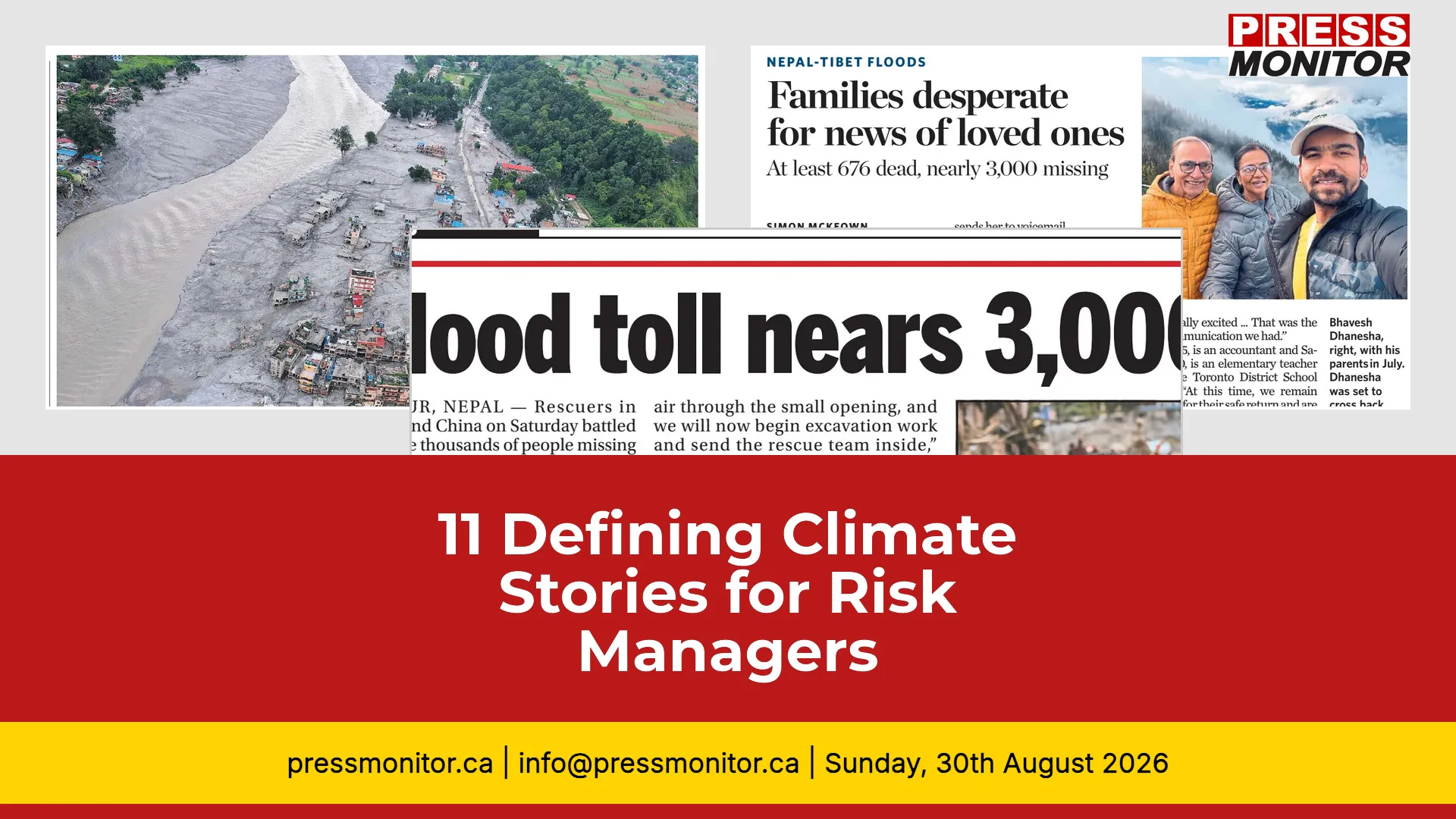
Climate change is no longer a distant threat — it's reshaping risk landscapes in real time. From catastrophic floods in Nepal to record ocean heat and innovative wildfire tech in B.C., here are the stories that demand your attention, according to Press Monitor's tracking of Canadian publications.
1. Catastrophic Flash Flooding Kills 676 in Nepal
The Times Colonist reports that flash flooding along the Trishuli and Tadi rivers in Nepal Saturday has killed 676 people, with over 3,700 lives rescued, as authorities struggle to manage the humanitarian crisis.
Why it matters: The deadliest climate disaster of the year underscores the human and economic toll of extreme weather.
Key detail: Over 3,700 lives rescued, but nearly 3,000 remain missing along the Trishuli and Tadi rivers.
Source: Times Colonist
Next step: Review your organization's exposure to supply chain disruptions in vulnerable regions.
2. Nepal-Tibet Floods Leave Hundreds Dead, Thousands Missing
Toronto Star reports that at least 676 dead, nearly 3,000 missing after flash floods ravaged the Nepal-China border region.
Why it matters: Cross-border disaster response coordination is critical for multinational operations.
Key detail: At least 676 dead, nearly 3,000 missing after flash floods ravaged the Nepal-China border region.
Source: Toronto Star, by Simon McKeown
Next step: Assess your crisis communication plans for cross-border incidents.
3. 100 Workers May Still Be Trapped in Nepal Tunnels
"Selon le Toronto Sun, plus de 100 travailleurs pourraient encore être vivants et piégés à l'intérieur de ces tunnels après la catastrophe. Les efforts de secours se concentrent sur les sites de Trishuli 3A et 3B. Une frange de glace a provoqué le torrent mortel mercredi à la frontière entre le Népal et la Tchetie, selon le Service Géologique Américain. Bien que la cause exacte de l'effondrement reste incertaine, le réchauffement climatique entraîne la fonte des glaciers à travers le monde, augmentant le risque de tels désastres,"
Why it matters: Infrastructure vulnerability in extreme weather events poses direct operational risks.
Key detail: Rescue efforts focus on Trishuli 3A and 3B sites; a glacial ice collapse triggered the torrent.
Source: Toronto Sun
Next step: Evaluate the resilience of your critical infrastructure to climate-related hazards.
4. Hope Fades for Flood Survivors in Nepal and Tibet
The scale of devastation in Nepal and Tibet following flash floods is growing, with nearly 3,000 still missing. Families are desperately searching for their loved ones as communication to hard-hit regions remains cut off.
Why it matters: The prolonged search and rescue phase highlights the need for robust emergency response frameworks.
Key detail: Nearly 3,000 still missing; communication to hard-hit regions remains cut off.
Source: The Province
Next step: Ensure your organization has redundant communication channels for crisis scenarios.
5. Nepal and China Rescue Efforts After Catastrophic Landslide
Toronto Sun reports that rescuers in Nepal and China are battling to locate thousands of people missing days after a deadly, tsunami-like wall of water and debris swept through the Himalayan region, engulfing entire villages. Figures from both countries put the number of missing close to 3,000, with 682 bodies recovered.
Why it matters: The scale of the disaster — 682 bodies recovered — demands a reassessment of regional risk models.
Key detail: A tsunami-like wall of water and debris swept through the Himalayan region, engulfing entire villages.
Source: Toronto Sun
Next step: Update your risk maps to include glacial lake outburst flood scenarios.
6. Massive Landslide in Nepal and China
Calgary Sun reports that rescuers in Nepal and China are struggling to locate thousands of missing people days after a deadly wall of water and debris swept through the Himalayan region. Figures from both countries put the number of missing close to 3,000, with 682 bodies recovered.
Why it matters: The disaster's transboundary nature complicates insurance claims and liability.
Key detail: Rescuers struggling to locate thousands of missing people days after the event.
Source: Calgary Sun
Next step: Review your insurance coverage for climate-related catastrophes across borders.
7. Deadly Heat Hits North America
Toronto Star reports that much of North America and Europe are currently enduring a severe and prolonged period of high temperatures. Natural disasters such as wildfires are being triggered by the record-breaking heat.
Why it matters: Record-breaking heatwaves are triggering wildfires and straining health systems.
Key detail: Much of North America and Europe enduring severe, prolonged high temperatures.
Source: Toronto Star
Next step: Implement heatwave contingency plans for your workforce and assets.
8. Record-Breaking Ocean Temperatures
The Toronto Star reports that the world’s oceans reached their hottest temperatures on record last weekend, driven by a growing El Nifio and human-caused climate change, according to the European climate service Copernicus.
Why it matters: Ocean heat drives more intense storms and disrupts marine ecosystems.
Key detail: World's oceans reached hottest temperatures on record, driven by El Niño and climate change.
Source: Toronto Star, citing Copernicus
Next step: Factor ocean temperature trends into your long-term climate risk assessments.
9. Wildfire Near Summerland Declared Held
The Times Colonist reports that the Bald Range wildfire, which forced the entire Summerland community to evacuate this month, is declared held. The fire has been among the most destructive in B.C. this season, destroying or damaging about 150 structures and forcing about 20,000 in Summerland and surrounding communities to evacuate.
Why it matters: The Bald Range wildfire destroyed about 150 structures and forced 20,000 to evacuate.
Key detail: The fire is now declared held after being among the most destructive in B.C. this season.
Source: Times Colonist, by Chuck Chiang
Next step: Review your wildfire evacuation plans and community engagement strategies.
10. Arctic Shrub Expansion Accelerates Warming
The Toronto Star reports that the Arctic region is experiencing shrubification, a process where taller plants move in and trap more heat, accelerating warming. University of Colorado ecologists explain that the taller shrubs absorb more sunlight than the snow, contributing to arctic amplification and climate change acceleration.
Why it matters: Shrubification amplifies Arctic warming, with global climate feedback loops.
Key detail: Taller shrubs absorb more sunlight than snow, accelerating arctic amplification.
Source: Toronto Star
Next step: Incorporate arctic amplification data into your climate scenario planning.
11. IntelliMass Develops Wildfire Road Tech
Times Colonist reports that IntelliMass Technologies Inc. has developed a sensor and mapping system to assist with wildfire evacuations. Founded by Ryan Gallagher and Chris Stewart after the 2023 West Kelowna fires, the company provides road-condition scoring for communities and First Nations.
Why it matters: Innovative technology can improve evacuation safety and reduce risk.
Key detail: IntelliMass provides hitch-mounted sensors and dashcam systems for $1,000/month.
Source: Times Colonist
Next step: Explore partnerships with tech startups to enhance your emergency response capabilities.
Closing: These stories are just a snapshot of the climate risks unfolding daily. How is your organization adapting? For deeper media intelligence on climate and other critical topics, Press Monitor's print media monitoring keeps you ahead of the curve.
