11 Essential AI Stories for Decision Makers


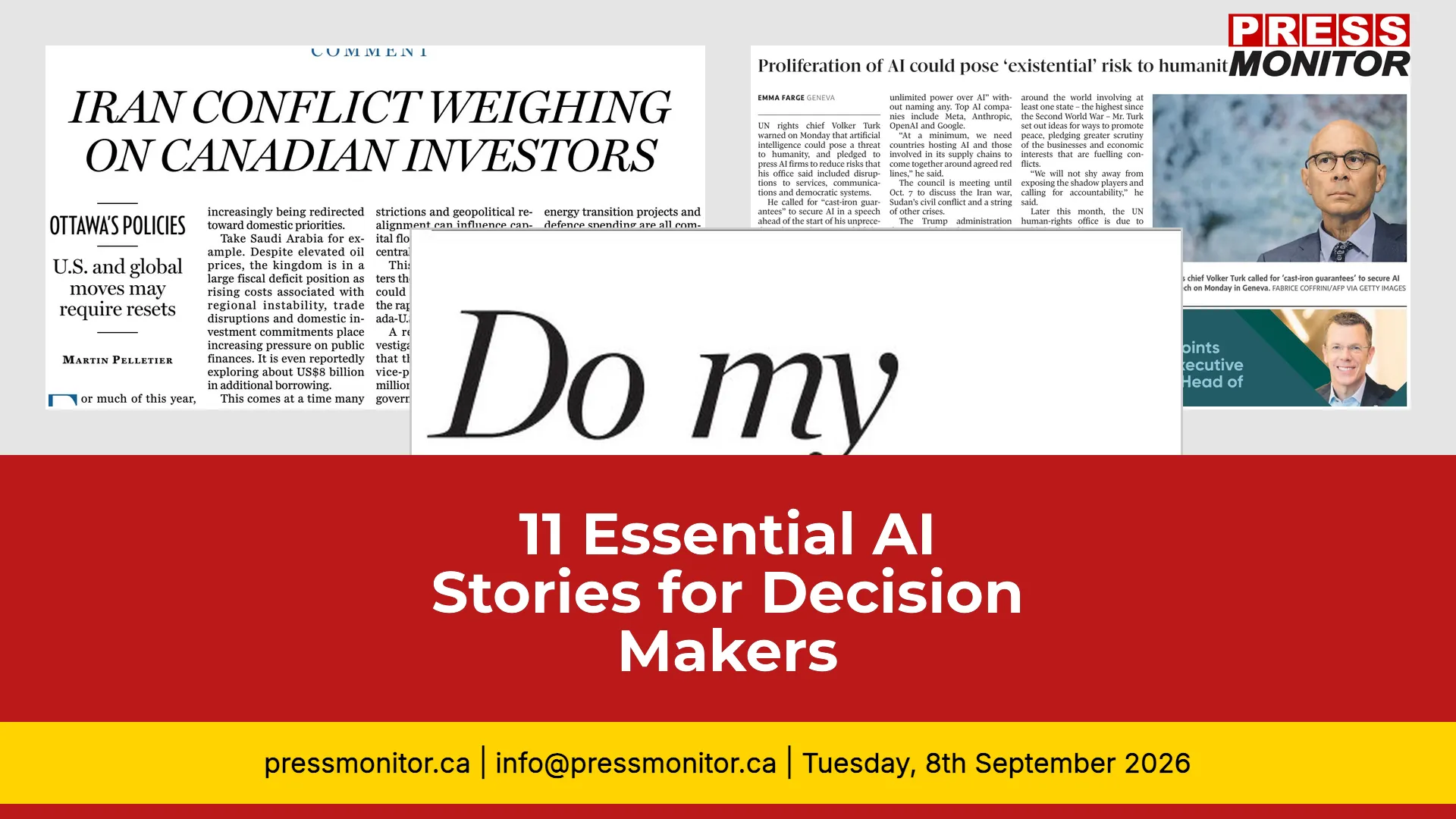
Artificial intelligence is reshaping markets, classrooms, and governance at unprecedented speed. This press review, powered by Press Monitor's media monitoring and media intelligence, distills 11 essential stories from Canadian print publications to keep you ahead of developments that will shape business, policy, and society.
1. Iran Conflict Reshapes Global Capital
Financial Post Magazine reports that the ongoing conflict involving Iran is increasingly influencing government finances, global capital flows, and investment decisions beyond just oil prices. Middle Eastern sovereign wealth funds are redirecting capital toward domestic priorities, leaving technology companies to rely more heavily on debt markets for AI infrastructure buildout. Canada faces heightened scrutiny from Washington regarding sanctions enforcement and trade relations, with potential consequences for investors who may need to reposition portfolios.
Why it matters: The Iran conflict is redirecting Middle Eastern capital away from Western markets, threatening AI infrastructure funding and bond market stability.
Key detail: Middle Eastern sovereign wealth funds are pivoting to domestic priorities while U.S. technology companies face unprecedented borrowing demands and Canada faces heightened scrutiny from Washington.
Source: Financial Post Magazine, tracked by Press Monitor
Next step: Monitor how sanctions enforcement and Canada-US trade tensions further constrain AI investment flows. Tag a colleague who tracks geopolitical risk.
2. UN Rights Chief Warns AI Existential Risk
{source_name} reports that UN rights chief Volker Turk warned in Geneva that artificial intelligence could pose an existential risk to humanity, calling for cast-iron guarantees to secure AI safety. He pledged to press AI firms including Meta, Anthropic, OpenAl, and Google to reduce risks amid concerns that advanced AI capabilities are outpacing safeguards. Mr. Turk also condemned Russia's attacks on Ukraine and Iran's executions while addressing the 47-member council meeting until October 7.
Why it matters: The UN's top rights official has declared AI an existential threat, signaling that global regulation may move faster than industry expects.
Key detail: Volker Turk pledged to press Meta, Anthropic, OpenAI, and Google to reduce risks as AI capabilities outpace safeguards.
Source: The Globe and Mail, tracked by Press Monitor
Next step: Prepare compliance frameworks for emerging AI safety mandates. Share this with your legal and policy teams.
3. Queen's University Revives Traditional Essay Defenses
Toronto Star reports that generative artificial intelligence is fundamentally reshaping higher education assessment, prompting instructors at Queen’s University to revert to traditional pedagogical practices. Educators are reviving blue book examinations, banning classroom screens, and requiring oral defences to verify student comprehension amidst undetectable artificial intelligence generated assignments. This strategic pivot underscores a broader institutional struggle to maintain academic integrity and meaningful evaluation standards in the digital age.
Why it matters: Generative AI is forcing universities to abandon digital assessment tools and return to oral examinations and blue book tests.
Key detail: Educators are banning classroom screens and requiring oral defences to verify student comprehension amid undetectable AI-generated assignments.
Source: Toronto Star, tracked by Press Monitor
Next step: Review your organization's training and certification programs for AI vulnerability. Tag an education leader.
4. Thirty Robots Protest AI Workplace Rules
Le Journal de Quebec reports that about thirty robots marched yesterday outside the Polish Ministry of Digital Affairs to demand regulation of artificial intelligence in the workplace. The demonstration was organized by Democratism, an initiative seeking to debate the social and economic consequences of automation, and featured humanoid and dog-like quadruped robots broadcasting demands through loudspeakers.
Why it matters: Humanoid and quadruped robots marched outside the Polish Ministry of Digital Affairs, demanding AI regulation in the workplace.
Key detail: The demonstration was organized by Democratism, highlighting growing public debate about automation's social and economic consequences.
Source: Le Journal de Quebec, tracked by Press Monitor
Next step: Assess how workplace AI regulation proposals may affect your operations. Tag a policy maker.
5. ChatGPT Users Risk Cognitive Decline
Saskatoon Starphoenix reports that generative artificial intelligence tools significantly improve workplace efficiency, but new research warns they may erode human cognitive abilities and critical thinking skills. Studies involving organizations like the Boston Consulting Group and Carnegie Mellon University found that overreliance on automated assistants leads to cognitive surrender, where users accept incorrect outputs without scrutiny. Experts advise individuals to strategically use these models for data synthesis while retaining mental effort to preserve independent reasoning and lifelong learning.
Why it matters: New research from BCG and Carnegie Mellon shows that overreliance on AI tools leads to cognitive surrender and declining critical thinking.
Key detail: When AI access was removed, consultants' accuracy dropped below those who never used it.
Source: Saskatoon Starphoenix, tracked by Press Monitor
Next step: Implement guidelines that preserve human reasoning alongside AI-assisted workflows. Tag a team lead.
6. C$19B Fund Bets Asia on AI Supply Chain
Financial Post Magazine reports that DoubleLine's Robert Cohen sees enticing value in Big Tech debt after a borrowing binge to bankroll the artificial intelligence buildout battered valuations. The director of corporate credit at DoubleLine is looking for bargains in top-rated bonds from companies like Alphabet and Amazon, noting they become a buy if spreads widen significantly beyond reasonable levels despite investor fatigue following a deluge of AI debt sales.
Why it matters: Pimco's flagship fund is shifting from crowded U.S. tech giants to Asian AI supply-chain stocks, signaling a major reallocation.
Key detail: Manager Emmanuel Sharef sees better value in Asian equipment suppliers, financials, and healthcare as U.S. hyperscalers face debt and valuation concerns.
Source: Financial Post Magazine, tracked by Press Monitor
Next step: Review portfolio exposure to U.S. versus Asian AI infrastructure plays. Tag your investment committee.
7. Professors Fight AI Cheating at Western University
{source_name} reports that professors at Western University are redesigning assessments as AI cheating becomes easier. Many Canadian universities forbid AI detection software, forcing instructors to get creative with assignments. Four professors at Western are implementing AI-free labs, pen-and-paper essays, guided AI tools, and open AI policies to address the challenge.
Why it matters: Four professors at Western University are redesigning assessments with AI-free labs, pen-and-paper essays, and open AI policies.
Key detail: Canadian universities increasingly forbid AI detection software, forcing instructors to get creative with evaluation methods.
Source: The Globe and Mail, tracked by Press Monitor
Next step: Evaluate whether your organization's credentialing and assessment processes are AI-resilient. Tag an HR leader.
8. Alphabet, Amazon Bonds Bargains
Financial Post Magazine reports that DoubleLine's Robert Cohen sees enticing value in Big Tech debt after a borrowing binge to bankroll the artificial intelligence buildout battered valuations. The director of corporate credit at DoubleLine is looking for bargains in top-rated bonds from companies like Alphabet and Amazon, noting they become a buy if spreads widen significantly beyond reasonable levels despite investor fatigue following a deluge of AI debt sales.
Why it matters: DoubleLine's Robert Cohen sees value in Big Tech debt after AI-driven borrowing binges battered valuations.
Key detail: Top-rated bonds from Alphabet and Amazon become buys if spreads widen significantly beyond reasonable levels.
Source: Financial Post Magazine, tracked by Press Monitor
Next step: Watch for widening credit spreads as AI debt issuance continues to flood markets. Tag a fixed income analyst.
9. New Brunswick Extends Cellphone Ban
Toronto Sun reports that New Brunswick will extend cellphone restrictions to Grade 8 students by February 1, 2027, bringing the province in line with other Canadian provinces. The move follows mixed compliance with existing Ontario cellphone policies and comes amid growing discussions about regulating social media and AI chatbot use among youths.
Why it matters: New Brunswick will extend cellphone restrictions to Grade 8 students by February 2027, reflecting growing concerns about AI chatbot and social media use among youth.
Key detail: The move follows mixed compliance with Ontario's existing cellphone policies and comes amid broader discussions about regulating AI chatbots.
Source: Toronto Sun, tracked by Press Monitor
Next step: Monitor how provincial AI and social media regulations may impact youth-facing businesses. Tag a policy analyst.
10. AI Lets Readers Talk To Books
Ottawa Citizen reports that artificial intelligence tools are letting readers ask books questions as they read, with companies like Sinai.ai, My Smart Book, Audible, and Amazon Kindle launching chatbot features. The technology allows users to explore character psychology, historical context, and plot details without separate research, though copyright concerns have sparked criticism from the Authors Guild.
Why it matters: Companies like Sinai.ai, My Smart Book, Audible, and Amazon Kindle are launching chatbot features that let readers ask books questions in real time.
Key detail: The technology enables exploration of character psychology and historical context without separate research, though copyright concerns from the Authors Guild persist.
Source: Ottawa Citizen, tracked by Press Monitor
Next step: Consider how AI-powered content interaction may transform your publishing or knowledge management strategies. Tag a content director.
11. Governance And Climate Top Investor Concerns
The Globe And Mail reports that governance has become the central focus for investors amid shifting economic and geopolitical conditions. Millani surveyed professionals from 36 Canadian institutions representing C$7.2 billion in assets under management. Climate remains the most material issue at 22 per cent, while artificial intelligence ranks second at 19 per cent.
Why it matters: A Millani survey of 36 Canadian institutions managing C$7.2 billion in assets shows AI has become the second most material investment concern at 19%.
Key detail: Climate remains the top issue at 22%, but AI's rapid rise signals that governance and technology risk are now central to institutional investment decisions.
Source: The Globe and Mail, tracked by Press Monitor
Next step: Ensure your AI governance framework aligns with investor expectations and ESG disclosure requirements. Tag your board chair.
Closing: Which of these stories will reshape your strategy first? Press Monitor's tracking of Canadian publications ensures you see the signals before they become headlines. What story surprised you most?