11 Essential Automotive & Vehicles Stories for Industry Leaders


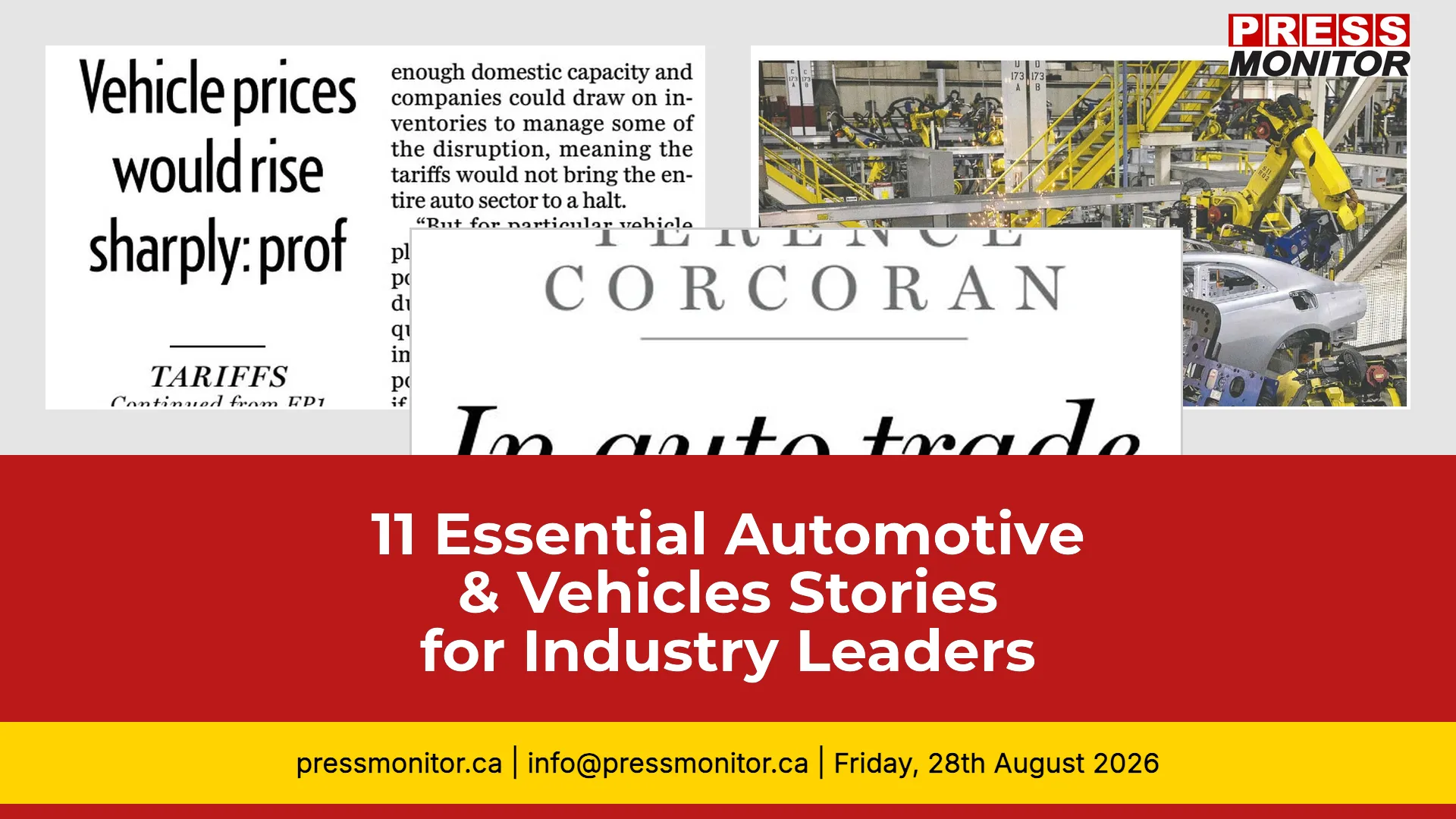
The automotive industry is facing unprecedented disruption, from trade wars to technological shifts. According to Press Monitor's tracking of Canadian publications, these are the top stories shaping the sector. Our media monitoring reveals critical insights for industry leaders.
1. Trump's 50% Tariff Threat Shakes North American Auto Production
Andreas Schotter, an international business professor at Western University’s Ivey Business School, noted that Canadian auto-parts exports to the US rose 2.3 per cent last year, highlighting the importance of Canadian manufacturers. Stephen Veldhuis emphasized that the U.S. could not quickly replace Canadian auto-parts production, and a 50 per cent tariff would likely disrupt North American vehicle production more than fostering reshoring. Both experts cited the complexities of automotive component manufacturing, including engineering specifications, tooling, and synchronized production schedules.
Why it matters: A 50% tariff on Canadian autos and parts would cripple integrated supply chains, harming both Canadian and U.S. automakers.
Key detail: Canadian auto-parts exports to the U.S. rose 2.3% last year, highlighting the sector's importance. Experts warn the U.S. cannot quickly replace Canadian production.
Source: National Post, with cross-reporting from Vancouver Sun, Calgary Herald, Montreal Gazette, Edmonton Journal, and others.
Next step: Companies should model supply chain scenarios and engage in trade advocacy.
2. Stellantis Windsor Plant Faces Robotization and Production Shift
Edmonton Journal reports that shifting Canadian production to the U.S. would require massive investments—costing billions and spanning years—resulting in significant job losses at the Stellantis Windsor Assembly Plant, as explained by a local professor.
Why it matters: Moving Canadian production to the U.S. would cost billions and displace thousands of jobs.
Key detail: A Windsor professor notes that robots are already replacing jobs at the plant, and relocation would take years of investment.
Source: Edmonton Journal, also covered by Vancouver Sun and Calgary Herald.
Next step: Monitor arbitration and workforce retraining programs.
3. Canada's Auto Industry Faces Uncertain Future Amid Trade Turmoil
A front-page report in National Post says Canadian labour economist Jim Stanford originally forecast strength in automotive manufacturing based on federal academic research comparing production metrics with Australia before shifting pessimism following domestic downturns mirroring Aussie declines. The analysis highlights North American trade negotiations' destabilizing effects on industry competitiveness across nations with Mexico benefiting from strategic partnerships. Economic contributions below one percent of Gross Domestic Product raise concerns about sector viability against dominant oil sands and energy fields.
Why it matters: Labour economist Jim Stanford's analysis shows the sector's contribution to GDP falling below 1%.
Key detail: The report compares Canada's auto manufacturing decline to Australia's, highlighting vulnerability to trade disruptions.
Source: National Post (front page).
Next step: Policymakers should consider targeted support for EV and battery manufacturing.
4. Chinese Firms' Strategic Investments Exploit Western Distractions
The Standard (st. Catharines) reports that Chinese firms are investing strategically, gaining scale, lowering costs, securing materials, and moving into markets that distracted western companies are leaving open. They will take advantage of every loss of North American competitiveness. Canada must defend its automotive industry firmly, without apology and without panic. We will trade, compete, and build with the US where our interests align. But Canadian sovereignty, industrial capacity, and economic security are not bargaining chips.
Why it matters: Chinese companies are gaining scale and securing materials in markets Western firms are leaving.
Key detail: Canada must defend its automotive industry without panic, maintaining sovereignty and industrial capacity.
Source: The Standard (St. Catharines).
Next step: Increase domestic investment in critical minerals and EV supply chains.
5. GM Exits Chinese Market, Retains Export Base
Ottawa Citizen reports that General Motors is ending Chevrolet new-vehicle sales in China, closing a retail presence that spanned more than two decades, but will keep local production operating as an export base.
Why it matters: GM ends Chevrolet new-vehicle sales in China after 20 years, but keeps local production for exports.
Key detail: The move reflects trade tensions and shifting global demand.
Source: Ottawa Citizen.
Next step: Monitor GM's export strategy for potential impacts on North American production.
6. U.S. Should Consider Bans on Canadian Goods: Greer
The Trump administration’s top trade negotiator suggested the U.S. ought to consider banning some Canadian goods, injecting another threat into a trade dispute between Washington and Ottawa.
Why it matters: Trump's top trade negotiator suggests banning some Canadian goods, escalating trade dispute.
Key detail: Adds another threat to the already tense Canada-U.S. trade relationship.
Source: Vancouver Sun.
Next step: Prepare for potential retaliatory measures and diversify export markets.
7. Chevrolet Bolt Production Ends After One Year—A ‘Colossal Misstep’
"Selon The Montreal Gazette, the 2027 Chevrolet Bolt will be one of few cars in history where an entire generation lasted one single model year. It’s a colossal and short-sighted misstep from General Motors. The new Bolt is a triumph; it bests the old car in almost every way," the article states. The small town of Deep River, Ontario, where the Bolt was built, is a unique place with identical houses and a high median income. The Bolt’s innovative battery technology, Tesla-style charge port, and Google-based infotainment system have proven popular, however, production has ended just one year after initial release due to tariff threats and reduced consumer interest.
Why it matters: The 2027 Bolt, built in Deep River, Ontario, was praised but halted due to tariff threats and low demand.
Key detail: The vehicle featured innovative battery tech and Google-based infotainment.
Source: Montreal Gazette.
Next step: Evaluate the impact on Ontario's EV manufacturing ecosystem.
8. Auto Thefts Decline 10% in First Half of 2026
The Canadian Press reports that auto thefts have continued trending downward across the country and the number of reported thefts over the first half of 2026 was 10 per cent lower than in the same period last year, says a new report from Equité Association.
Why it matters: Reported thefts dropped year-over-year, reversing a previous upward trend.
Key detail: Equité Association report shows continued downward trend.
Source: Times Colonist (Canadian Press).
Next step: Insurers should adjust risk models and anti-theft investments.
9. Gordie Howe International Bridge Opens Amid Revenue Controversy
The Gordie Howe International Bridge has opened to cars after months of cross-border controversy. The bridge, which cost $6.5-billion to build, was largely funded by Canada, leading some to argue that the deal unfairly gave away half of the toll receipts for the next 15 years to the US.
Why it matters: The $6.5B Canada-funded bridge grants half of toll receipts to the U.S. for 15 years.
Key detail: The bridge is now open to cars, easing cross-border trade.
Source: Toronto Star.
Next step: Logistics companies should assess new routing opportunities.
10. Nissan Updates Murano with Turbo Engine and Safety Tech
The Times Colonist reports that Nissan has updated its midsize Murano utility vehicle, featuring a new body design, a turbocharged 2.0-litre engine, and advanced safety technologies.
Why it matters: The midsize utility vehicle gets a redesign to compete in a crowded segment.
Key detail: Turbocharged 2.0L engine and advanced safety features.
Source: Times Colonist.
Next step: Dealers should prepare for updated inventory.
11. Lucid Gravity GT-S: ‘America’s Most Powerful Three-Row SUV’
Montreal Gazette reports that Lucid has unveiled its Gravity GT-S, its newest all-electric model that it claims is America’s most-powerful three-row SUV.
Why it matters: Lucid claims its all-electric SUV offers unparalleled power and range.
Key detail: The Gravity GT-S targets the premium EV SUV market.
Source: Montreal Gazette.
Next step: Monitor pre-orders and competitive response from Tesla and Rivian.
Closing: These stories represent just a snapshot of the dynamic automotive landscape. For a comprehensive press review tailored to your organization, leverage Press Monitor's print media monitoring to stay ahead. What industry trend are you tracking most closely?