11 Essential Climate Stories for Canadians


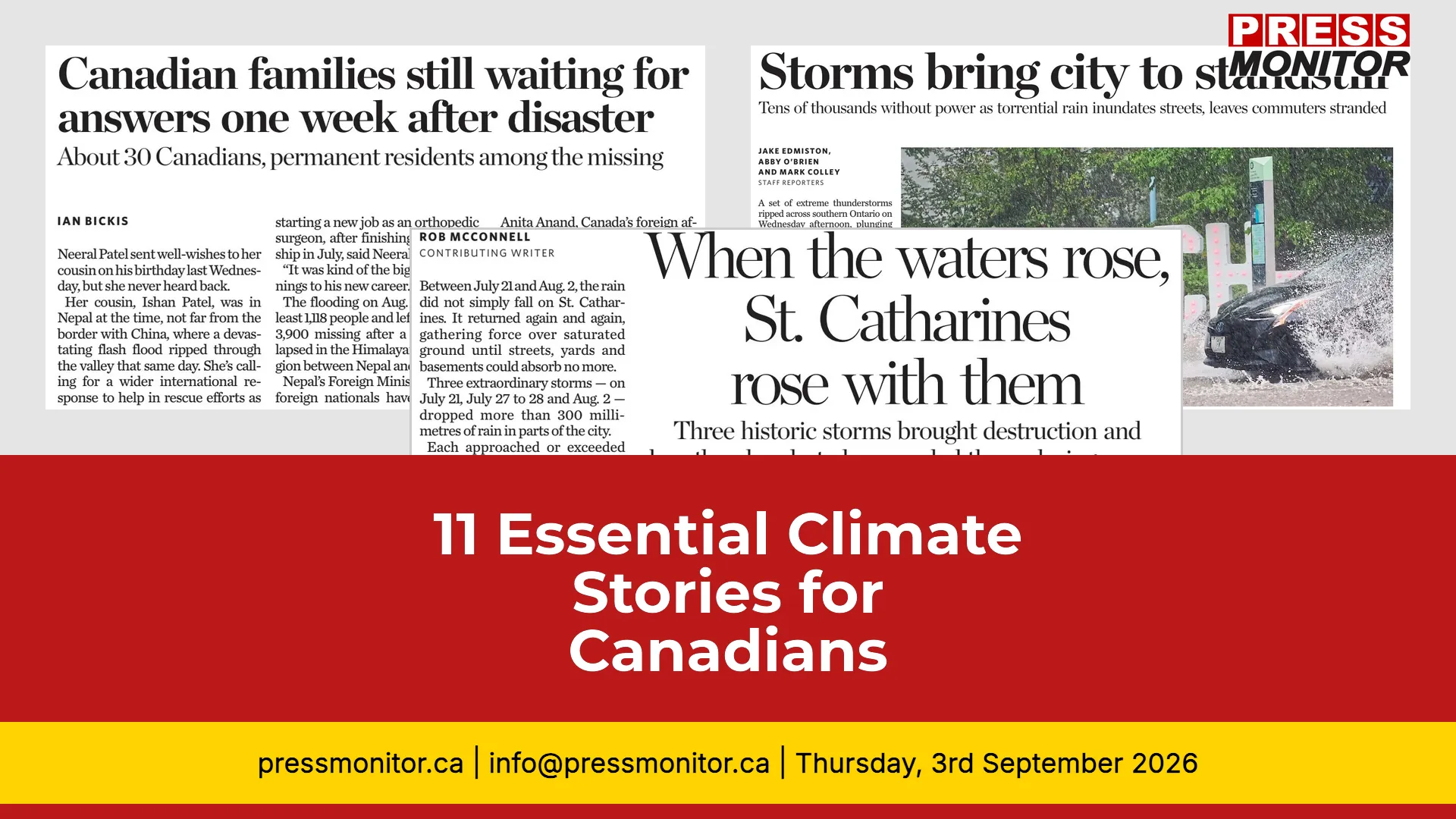
Through media monitoring of Canadian print publications, this press review highlights 11 essential climate stories shaping the nation — from devastating floods in St. Catharines and Nepal to severe storms battering the GTA. These stories represent the most consequential news on climate change for Canadians right now, offering print media monitoring and media intelligence on the events that matter most.
1. 30 Canadians Missing in Nepal Floods
The Standard (St. Catharines) reports that about 30 Canadians and permanent residents remain missing one week after a flash flood triggered by a glacier collapse near the Nepal-China border killed at least 1,118 people and left more than 3,900 others unaccounted for on August 26. Among the missing are Ishan Patel, an orthopedic surgeon set to begin a new job, along with his wife and two family members, who were on a long-planned pilgrimage to Mount Kailash. Ottawa has 10 government officials on the ground in Nepal, and Foreign Affairs Minister Anita Anand has spoken with her Nepali counterpart to express condolences.
Why it matters: A glacier collapse in the Himalayas has killed over 1,118 people and left 30 Canadians missing — one of the deadliest climate-related disasters this year.
Key detail: About 30 Canadians and permanent residents remain missing one week after the Aug 26 flash flood. Among them is Ishan Patel, an orthopedic surgeon, with his family on a pilgrimage to Mount Kailash.
Source: The Standard (St. Catharines), reported by Ian Bickis
Next step: Foreign Affairs Minister Anita Anand has 10 government officials on the ground in Nepal to support affected Canadians and help locate the missing.
2. Storm Chaos in Toronto
The Toronto Star reports that extreme thunderstorms ripped across southern Ontario, plunging Toronto's rush hour into chaos with cars trapped in flooded streets, tens of thousands without power and panicked commuters running for cover from hail and high winds.
Why it matters: Extreme thunderstorms plunged Toronto's rush hour into chaos, exposing the vulnerability of urban infrastructure to climate-driven weather events.
Key detail: Cars trapped in flooded streets, tens of thousands without power, panicked commuters running for cover from hail and high winds across southern Ontario.
Source: Toronto Star, by Jake Edmiston, Abby O'Brien and Mark Colley
Next step: Municipal governments must accelerate stormwater infrastructure upgrades to handle increasing extreme weather.
3. 300mm Rain Floods St. Catharines
The Standard reports that three extraordinary storms between July 21 and August 2 dropped more than 300 millimetres of rain on parts of St. Catharines, with each approaching or exceeding 100-year storm levels and damaging thousands of homes and businesses. Mayor Mat Siscoe declared a state of emergency on August 3 after the city activated its emergency operations centre on July 28. The floods strained roads, sewers and shoreline across the city, even as neighbours, firefighters and city staff rallied to help affected residents.
Why it matters: Three storms delivering over 300mm of rain — each approaching 100-year storm levels — devastated St. Catharines, forcing a state of emergency and damaging thousands of homes.
Key detail: The floods strained roads, sewers and shoreline across the city, with Mayor Mat Siscoe declaring a state of emergency on August 3.
Source: The Standard (St. Catharines), by Rob McConnell
Next step: The city's emergency response highlights the need for flood-resilient infrastructure investment across Ontario communities.
4. 60% of Canadians Hit by Climate Disasters
Toronto Star reports that more than 60 per cent of Canadians have been personally affected by climate disasters this year, according to a study by the Elbows Up For Climate campaign, with 934 communities representing over 26 million people hit — triple the number from 2025. Extreme heat, unsafe air quality, flooding, wildfires and drought have struck every province and territory, forcing 9,131 people from 81 First Nations since April, said David Miller, former Toronto mayor and campaign co-chair. The nearly 300 local leaders behind the campaign are calling for a clean electricity grid, energy-efficient affordable housing and an excess-profits tax on oil and gas companies, which stand to collect an estimated C$90 billion in windfall profits.
Why it matters: A new study shows 60% of Canadians — over 26 million people across 934 communities — have been personally affected by climate disasters this year, triple the number from 2025.
Key detail: Extreme heat, unsafe air quality, flooding, wildfires and drought have struck every province and territory since April, forcing 9,131 people from 81 First Nations.
Source: Toronto Star, by Marco Chown Oved, Elbows Up For Climate campaign
Next step: Nearly 300 local leaders are calling for a clean electricity grid, energy-efficient affordable housing and an excess-profits tax on oil and gas companies.
5. Earth to Breach 1.5-Degree Climate Limit
The Globe And Mail (ottawa/quebec Edition) reports that a United Nations Environment Program report says Earth will soon cross the 1.5-degree Celsius warming threshold set by the 2015 Paris climate accord, with the world already at 1.4 degrees above preindustrial levels. Under current policies, temperatures are projected to reach 2.6 degrees above preindustrial levels by 2100, though the report's most optimistic scenario sees warming peaking at 1.8 degrees around mid-century. UN Secretary-General António Guterres said humanity is speeding past the limit, and scientists now favour limiting the overshoot before cooling the planet back below the threshold.
Why it matters: A UN report confirms Earth will soon cross the 1.5°C warming threshold set by the Paris climate accord, with current policies projecting 2.6°C by 2100.
Key detail: The world is already at 1.4°C above preindustrial levels; the most optimistic scenario sees warming peaking at 1.8°C around mid-century.
Source: The Globe and Mail (Ottawa/Quebec Edition), by Seth Borenstein (Associated Press)
Next step: UN Secretary-General António Guterres urges humanity to slow the pace of warming before attempting to cool the planet back below the threshold.
6. Ottawa Says Climate Law Binds Nobody
Winnipeg Sun reports that the Carney government is arguing in Federal Court that the Canadian Net-Zero Emissions Accountability Act sets no binding obligations or penalties on Ottawa over its net-zero-by-2050 commitments. The editorial notes a December progress report shows Canada on track for roughly half of its 2030 target of cutting emissions 40 to 45 percent below 2005 levels, and Prime Minister Mark Carney has acknowledged the 2030 and 2035 targets will be missed. The Winnipeg Sun calls on Ottawa to either scrap the unenforceable act or table new targets it is prepared to defend in Parliament.
Why it matters: The Carney government argues in Federal Court that the Canadian Net-Zero Emissions Accountability Act sets no binding obligations or penalties, raising serious questions about accountability.
Key detail: Canada is on track for roughly half of its 2030 target; PM Mark Carney has acknowledged the 2030 and 2035 targets will be missed.
Source: Winnipeg Sun editorial
Next step: The Winnipeg Sun calls on Ottawa to either scrap the unenforceable act or table new targets it is prepared to defend in Parliament.
7. Tornado Strikes Near Maryfield
Regina Leader-post reports that heavy rainfall soaked several Saskatchewan communities, including Regina, as a weather system moved across central and southern parts of the province starting Sunday. It brought thunderstorms, hail and a confirmed tornado near Maryfield in the southeast, as well as other confirmed tornadoes across the Manitoba border.
Why it matters: A confirmed tornado near Maryfield, Saskatchewan, alongside other tornadoes across the Manitoba border, underscores the increasing volatility of Canadian weather patterns.
Key detail: Heavy rainfall soaked several Saskatchewan communities including Regina, with thunderstorms, hail and a confirmed tornado near Maryfield in the southeast.
Source: Regina Leader-Post, by Andrea Moss
Next step: Municipal emergency preparedness plans must account for tornado risk in traditionally non-tornado-prone regions.
8. Drought Impacts September Precipitation
The Province reports that September precipitation was significantly below normal, with only 0.0 mm recorded compared to the usual 60.3 mm, marking a stark difference of -60.3 mm and indicating a 0% percent of normal rainfall.
Why it matters: September precipitation was 0% of normal in parts of Canada, with 0.0 mm recorded compared to the usual 60.3 mm — a stark indicator of shifting climate patterns.
Key detail: The -60.3 mm difference from normal signals deepening drought conditions that affect agriculture, water resources and wildfire risk.
Source: The Province
Next step: Provincial governments should review water management strategies for drought-prone regions heading into fall.
9. Ottawa's Flood Woes
Ottawa reports that after the city experienced its wettest summer on record, many residents are questioning how the city and its infrastructure can become more flood resilient. In a municipal election year, this issue is prominent alongside transit, affordability, and housing for councillor candidates running in wards most heavily impacted by the summer storms.
Why it matters: After Ottawa's wettest summer on record, residents are questioning how the city can become more flood resilient — a pressing issue in a municipal election year.
Key detail: Flood resilience is now a prominent topic alongside transit, affordability and housing in councillor campaigns across wards most heavily impacted by summer storms.
Source: Ottawa Sun
Next step: Candidates must present concrete infrastructure upgrade plans to address stormwater management and flood preparedness.
10. Holt Launches Review Into Lifting Ban On Shale Gas Development
The Tribune (New Brunswick) reports that Premier Susan Holt has announced a five-month review to potentially lift the moratorium on shale gas development in New Brunswick, with a decision to be made in January. The move has drawn criticism from the opposition Progressive Conservatives and the Greens, who accuse Holt of prioritizing economic gain over environmental concerns.
Why it matters: Premier Susan Holt's five-month review to potentially lift New Brunswick's moratorium on shale gas development has drawn sharp criticism from environmental groups and the opposition.
Key detail: A decision is expected in January, with critics accusing Holt of prioritizing economic gain over environmental concerns.
Source: The Tribune (New Brunswick), by Andrew Waugh
Next step: The review raises fundamental questions about Canada's energy transition timeline and provincial-federal climate policy alignment.
11. Canada Records Extreme Weather Temperatures
Regina Leader-post reports that Canada experienced extreme weather temperatures with Windsor Airport, ON reaching a hot spot of 31°C [88°F], while CFS Alert, NU recorded the cold spot at -31°C [-24°F].
Why it matters: Canada experienced extreme temperature contrasts this period, with Windsor Airport reaching 31°C while CFS Alert, Nunavut recorded -31°C — a 62-degree spread illustrating the volatility of a warming climate.
Key detail: These extremes highlight the growing frequency of temperature anomalies across Canadian communities.
Source: Regina Leader-Post
Next step: Infrastructure planning must account for both extreme heat and extreme cold events across all regions.
Closing: As these 11 stories show, climate change is no longer a distant threat — it is reshaping Canadian communities right now. Which of these developments will you be tracking most closely? Share your thoughts in the comments.