11 Essential Climate Stories for Decision Makers


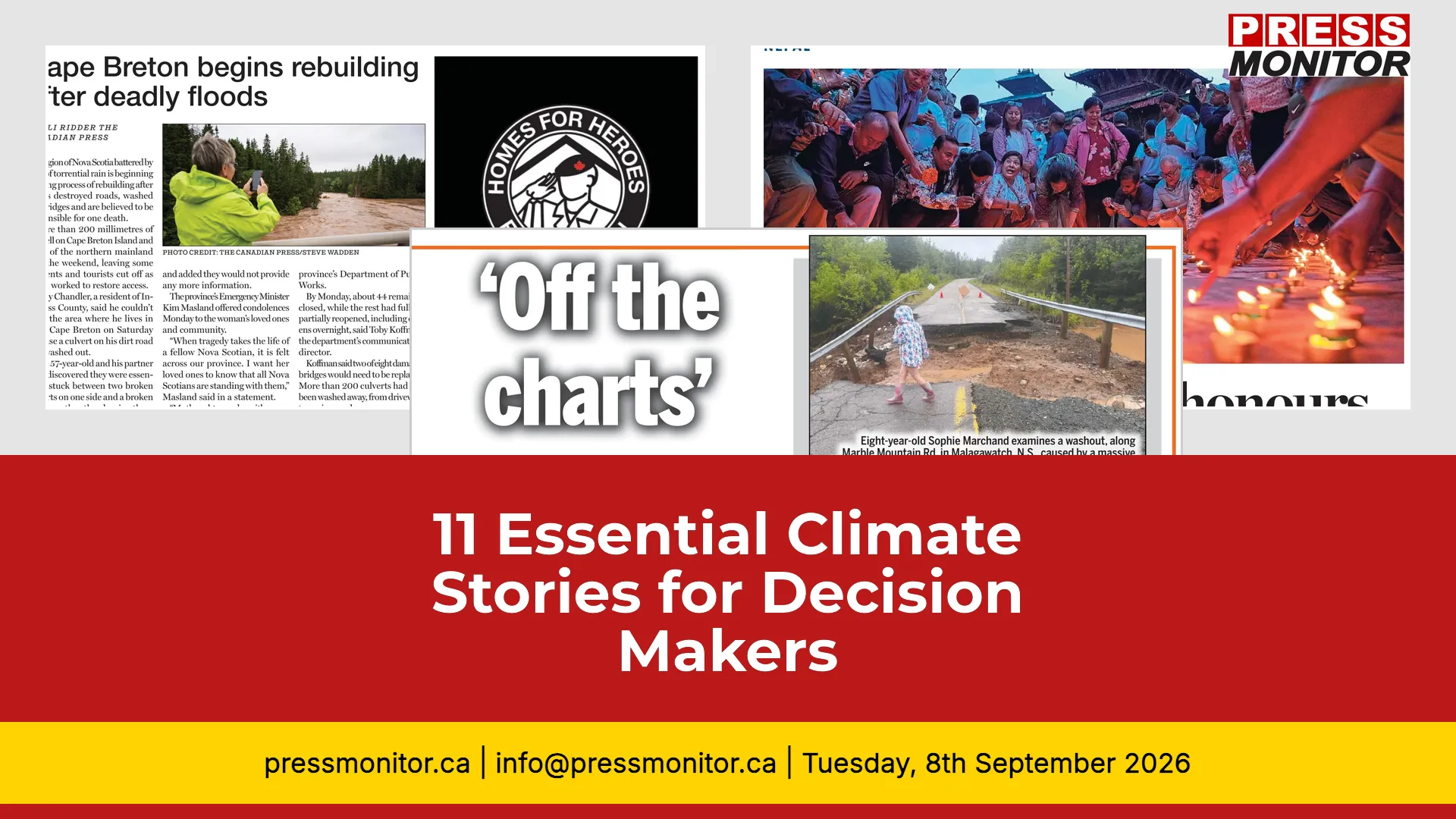
From Cape Breton's devastating floods to Nepal's day of mourning, from El Nino's forecast to EU diplomacy over Greenland, Canada's print media delivers the climate stories that shape our future. According to Press Monitor's media monitoring of Canadian publications, this media intelligence review covers 11 essential stories for anyone tracking news on climate change.
1. Nova Scotia Floods Claim One Life
Winnipeg Sun reports that torrential rain and flooding in Nova Scotia's Cape Breton Island and the northern mainland destroyed roads and bridges over the weekend, stranded residents and tourists, and killed a 46-year-old woman from Richmond County. By Monday, about 44 of more than 120 roads remained closed while emergency crews restored culverts and bridges, and provincial officials offered condolences and safety guidance. Residents described unprecedented rainfall in the Saint George's Channel area, with a device recording 230 millimetres before it broke.
Why it matters: Catastrophic flooding in Cape Breton has killed one person and destroyed critical road infrastructure, leaving residents isolated and emergency crews working around the clock.
Key detail: Over 200 millimetres of rain fell, with a recording device capturing 230mm before it broke. More than 120 roads were closed, with 44 still blocked by Monday. A 46-year-old woman from Richmond County lost her life.
Source: Winnipeg Sun, reported by The Canadian Press. Cross-referenced across Toronto Star, Cape Breton Post, Chronicle Herald, and Globe and Mail.
Next step: Provincial crews aim to restore Cape Breton's full road network within days. Residents should follow emergency guidance and avoid low-lying areas. Tag someone in Nova Scotia who needs this update.
2. Nepal Mourns Flood Victims After 1,300 Dead
The Toronto Star reports that Nepal held a day of mourning Monday to remember those killed in the Aug. 26 floods, with over 1,300 people dead and some 5,000 missing. Relatives of the missing urged authorities to speed up rescue efforts, particularly at hydropower plants where workers were swept away or buried under debris.
Why it matters: Nepal observed a national day of mourning for victims of the Aug. 26 floods, which killed over 1,300 people and left 5,000 missing across Nepal and Tibet.
Key detail: Rescue efforts continue at hydropower plants where workers were swept away or buried under debris. International teams from India, China, South Korea, and the U.S. are searching through debris and tunnels.
Source: Toronto Star, reported by Binaj Gurubacharya. Cross-referenced across The Hamilton Spectator and The Standard.
Next step: Relatives in Kathmandu are demanding faster search operations. The international community must sustain rescue momentum. Share this story to keep global attention on Nepal.
3. El Nino to Bring Warmest 2027, Milder Canadian Winter
The Toronto Sun reports that a strong El Nino weather pattern could make 2027 the warmest year globally and bring milder winters to Canada, with the UN weather agency predicting it will last until at least February. While Canadian homeowners may save on heating bills and Atlantic Canada could see fewer storms, the phenomenon has already caused deadly rains in Chile and drought emergencies in Central America, and is expected to bring less snow, more rain, and potential spring drought to Western Canada and the Prairies. Environment and Climate Change Canada climatologist Dave Phillips described the event as a supercharged El Nino occurring against a backdrop of unprecedented ocean warmth, with U.S. forecasters giving a seventy percent chance it will exceed the strength of all previous El Ninos since 1950.
Why it matters: A supercharged El Nino could make 2027 the warmest year globally, with Environment and Climate Change Canada climatologist Dave Phillips calling it unprecedented.
Key detail: 70% chance of exceeding all El Ninos since 1950. Canadian homeowners may save on heating, but Western Canada faces spring drought and wildfire risks. Less snow, more rain, and potential spring drought expected.
Source: Toronto Sun, reported by Jane Stevenson. Cross-referenced across Winnipeg Sun and Calgary Sun.
Next step: Canadians should prepare for milder winters but also for drought, reduced snowpack, and potential agricultural impacts in Western provinces. Tag a farmer who needs to plan ahead.
4. Extreme Wildfires Pose Major Health Risks
Le Journal de Montreal reports that the World Meteorological Organization has issued an annual air quality bulletin warning about the increasing number of extreme forest fires and their major health impacts due to toxic smoke. The report highlights that fine particles from wildfires are far more toxic than those from vehicles and can travel long distances through the wind, affecting populations far from fire zones. It also notes that rising temperatures and atmospheric conditions are worsening ground-level ozone formation during heat waves.
Why it matters: The World Meteorological Organization's annual air quality bulletin warns that wildfire smoke particles are far more toxic than vehicle emissions and can travel long distances.
Key detail: Fine particles from forest fires can affect populations far from fire zones. Rising temperatures and atmospheric conditions are worsening ground-level ozone formation during heat waves.
Source: Le Journal de Montreal. Cross-referenced across Le Journal de Quebec.
Next step: Public health agencies must issue stronger air quality advisories as wildfire seasons intensify. Share with anyone in affected regions.
5. Canada Warns Of Climate Crisis
The Toronto Star reports that tens of thousands lost power in Toronto and southern Ontario as violent storms struck on Sept. 2. On the same day, the UN Environment Programme warned the world will permanently breach the 1.5°C threshold within the next few years. The Star also analyzes Canada's $43-billion Alberta pipeline proposal as a high-risk misstep amid global shifts toward renewable energy.
Why it matters: The UN Environment Programme warned the world will breach the 1.5C threshold within years, while Toronto faced violent storms and tens of thousands lost power on the same day.
Key detail: The Toronto Star also analyzes Canada's $43-billion Alberta pipeline proposal as a high-risk misstep amid global shifts toward renewable energy.
Source: Toronto Star, reported by Cathy Orlando.
Next step: Canada must reconcile its energy infrastructure investments with its climate commitments. This story demands attention from policymakers and industry leaders.
6. Tens of Thousands Without Power
Toronto Star reports that violent storms knocked out power across Toronto and southern Ontario on Sept. 2. The United Nations Environment Programme warned the world will permanently breach the 15 degrees Celsius safe upper limit within the next few years. A powerful El Nino that formed months ago could become one of the strongest on record.
Why it matters: Violent storms knocked out power across Toronto and southern Ontario, compounding concerns about extreme weather and infrastructure vulnerability.
Key detail: The UNEP warned the world will breach the 1.5C safe upper limit. A powerful El Nino could become one of the strongest on record.
Source: Toronto Star.
Next step: Urban infrastructure must be hardened against increasingly frequent severe weather events. Tag your local utility or city councillor.
7. El Nino Strengthens in Canada
Toronto Sun reports that the current El Nino, beginning late last spring, is projected to intensify and last through February, making it the strongest event since one thousand nine hundred ninety-five. Environmental officials say it will bring warmer, wetter weather across Canada, reduce snow for skiers and increase spring fires while also triggering storms in Chile and droughts in Central America. Experts warn the pattern will likely remain in effect until next spring, affecting global climate patterns.
Why it matters: The current El Nino is projected to intensify and last through February, making it the strongest event since 1995.
Key detail: Warmer, wetter weather across Canada, reduced snow for skiers, increased spring fires, and storms in Chile and droughts in Central America. Experts warn the pattern will likely remain in effect until next spring.
Source: Toronto Sun.
Next step: Businesses and governments should plan for disrupted seasonal patterns affecting agriculture, energy, and emergency services.
8. EU Promises Greenland 200 Million Euros
The Toronto Star reports that the European Union sought to reassure a jittery Greenland on Monday with the promise of a stronger partnership and hundreds of millions of euros in investment following repeated threats from US President Donald Trump to take control of the island. European Commission President Ursula von der Leyen offered 200 million euros in support over the next two years during a visit to the capital Nuuk to help Greenland tackle climate change, boost internet connections and improve hydropower plants, fisheries and education.
Why it matters: The European Union offered 200 million euros to Greenland to counter US President Donald Trump's threats to take control of the island.
Key detail: European Commission President Ursula von der Leyen made the offer during a visit to Nuuk, focusing on climate change, internet connections, hydropower, fisheries, and education.
Source: Toronto Star, reported by Lorne Cook.
Next step: Arctic sovereignty and climate adaptation funding are becoming central to international diplomacy. This story has implications for global climate cooperation.
9. Panama Canal Faces More Transit Limits
Le Journal de Quebec reports that the Panama Canal in Panama began reducing daily passages from 36 to 32 on September 15, while administrator Ilya Espino de Marotta said new restrictions could follow as drought worsened by El Niño lowers reservoir levels. The canal, which connects the Atlantic and Pacific Oceans and carries 5 percent of global maritime trade, has already lost 2,700 ship passages from 2023 to 2024 because of Niño-related restrictions.
Why it matters: The Panama Canal is reducing daily passages due to drought worsened by El Nino, affecting 5% of global maritime trade.
Key detail: Already lost 2,700 ship passages from 2023 to 2024. New restrictions could follow as reservoir levels drop further. Administrator Ilya Espino de Marotta warned of additional cuts.
Source: Le Journal de Quebec, reported by AFP.
Next step: Global supply chains must plan for continued canal disruptions and rising shipping costs. Tag a logistics or supply chain leader.
10. Danish Delegation Visits Alberta for Carbon Capture Partnerships
Edmonton Journal reports that a Danish delegation will visit Alberta this month to meet with Alberta companies and educational institutions on carbon-capture partnerships. Green Hub Denmark and Clean, along with the Triangle Energy Alliance, will meet with Edmonton Global and Alberta Innovates and host a pavilion at the Carbon Capture Conference on September fifteen and sixteen at the Edmonton Convention Centre. While President Trump's tariffs on Canada and threats to Denmark's control over Greenland have accelerated the talks, the partnerships were seeded while Joe Biden was in the White House.
Why it matters: A Danish delegation is visiting Alberta to explore carbon-capture partnerships, signaling growing international interest in Canadian clean technology.
Key detail: Green Hub Denmark, Clean, and the Triangle Energy Alliance will meet with Edmonton Global and Alberta Innovates at the Carbon Capture Conference on September 15-16 at the Edmonton Convention Centre.
Source: Edmonton Journal, reported by Steven Sandor.
Next step: These partnerships could position Canada as a leader in carbon capture technology despite trade tensions. Tag Alberta business or energy leaders.
11. Millani Survey Highlights Canadian Climate Shift
The Globe and Mail reports that Canadian institutional investors continue to view climate change as a significant business risk, though their approach is evolving. A recent survey by Millani Incorporated indicates a strategic pivot away from strict net zero targets toward integrating climate impacts directly into corporate business planning. This shift reflects how sustainable finance lessons are now being applied to emerging threats such as artificial intelligence, sovereignty concerns, and trade disruptions.
Why it matters: Canadian institutional investors are pivoting from strict net zero targets toward integrating climate impacts into corporate business planning.
Key detail: Millani Incorporated's survey shows sustainable finance lessons are being applied to emerging threats like artificial intelligence, sovereignty concerns, and trade disruptions.
Source: The Globe and Mail, reported by Jeffrey Jones.
Next step: Corporate boards must adapt their climate strategies to reflect evolving investor expectations and practical business realities. Tag a CFO or board member.
Closing: These 11 stories, tracked through print media monitoring by Press Monitor, show that climate is no longer a distant concern — it is reshaping infrastructure, trade, energy, and diplomacy right now. Which of these stories will have the biggest impact on your sector? Share your thoughts in the comments.