11 Essential Electricity and Power Generation Stories for Energy Executives


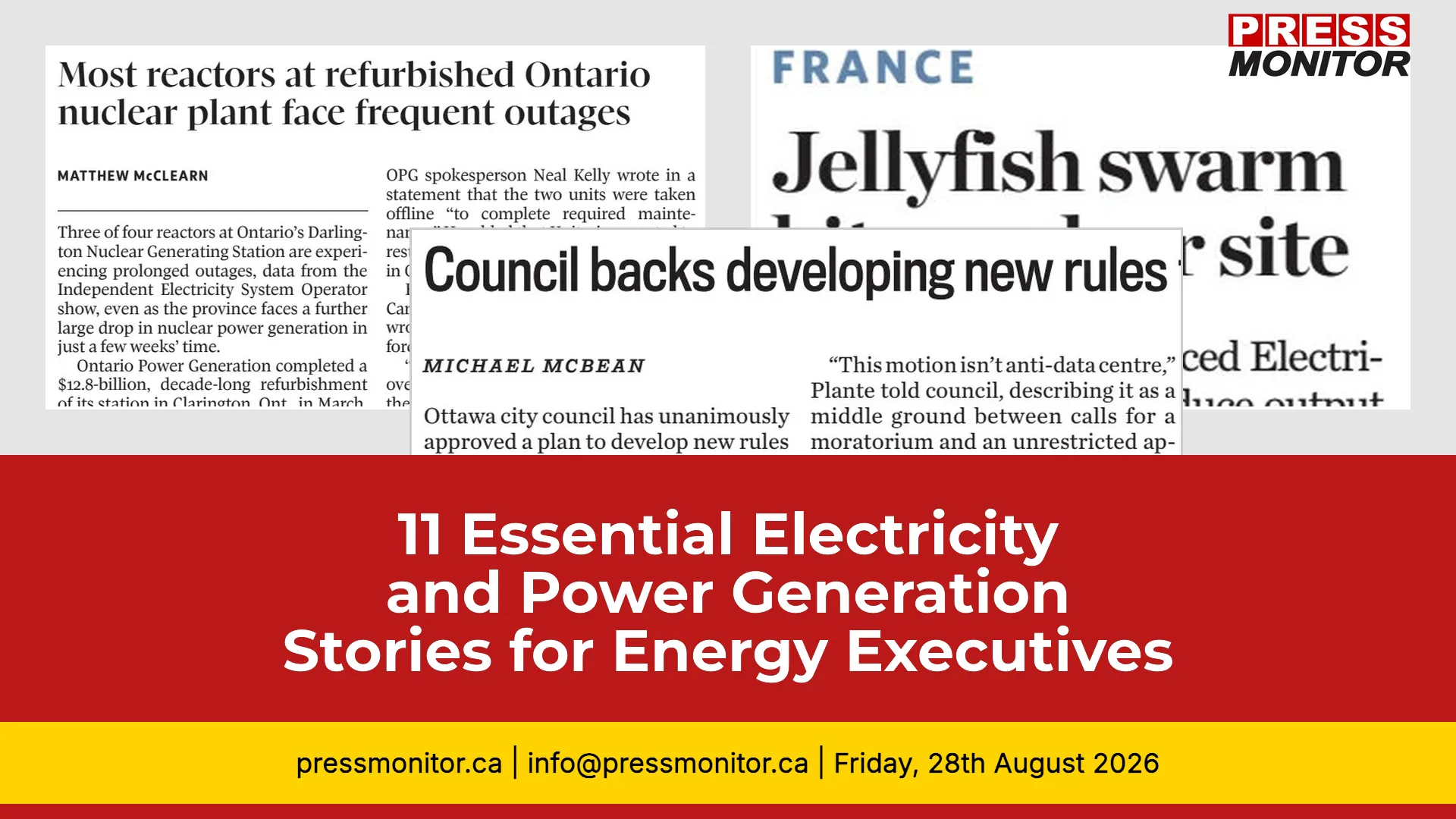
In today's fast-moving energy landscape, staying ahead of the latest developments in electricity and power generation is critical. According to Press Monitor's tracking of Canadian publications, here are the 11 most important stories shaping the sector. This media monitoring roundup covers everything from nuclear outages to data centre electricity costs, providing you with the essential intelligence you need.
1. Darlington Nuclear Plant Faces Frequent Outages Despite Refurbishment
Ontario Power Generation’s refurbished Darlington Nuclear Generating Station is experiencing persistent outages, even as the province anticipates a significant drop in nuclear power generation. Three of the four reactors have suffered forced shutdowns since the $12.8-billion overhaul was completed in March. Officials have provided limited details about the causes of these outages, citing ‘required maintenance’, and offered timelines for the reactors' return to service. The station, the province’s second-largest, is facing challenges despite its importance to Ontario’s energy supply.
Why it matters: Ontario Power Generation's refurbished Darlington station is experiencing persistent forced shutdowns, threatening the province's electricity supply reliability. Three of four reactors have shut down since the $12.8-billion overhaul.
Key detail: OPG has forecast 286 outage days in 2026, with limited details on cause.
Source: The Globe and Mail
Next step: Monitor the return-to-service timelines and potential impact on Ontario's grid.
2. Jellyfish Impact on Gravelines Nuclear Plant
The Standard (st. Catharines) reports that a swarm of jellyfish has forced EDF to reduce output at its Gravelines nuclear power plant, adding to supply concerns that are pushing French power prices higher. The jellyfish, which forced some reactors to shut down at the site earlier this month, have now affected at least three reactors. Coastal nuclear plants such as Gravelines rely on seawater for cooling, leaving their pumping systems vulnerable to marine life.
Why it matters: A swarm of jellyfish has forced EDF to reduce output at its Gravelines nuclear plant, adding to French power price pressures. Coastal plants rely on seawater for cooling, making them vulnerable to marine life.
Key detail: At least three reactors have been affected, with some forced to shut down.
Source: The Standard (St. Catharines), The Welland Tribune
Next step: Track the recovery timeline and broader implications for coastal nuclear operations.
3. Ottawa City Council Approves Plan for New Data Centre Rules
Ottawa city council has unanimously approved a plan to develop new rules for large-scale data centres, but what those rules will look like has yet to be decided. Council approved a motion from Rideau-Vanier Coun. Stéphanie Plante directing city staff to develop a framework for assessing data centre proposals based on their size and potential impacts, including environmental considerations. The proposed framework will come back to council next year for approval.
Why it matters: As data centre demand surges, Ottawa is developing a framework to assess proposals based on size and environmental impact. The outcome could set a precedent for other municipalities.
Key detail: Council unanimously approved the motion from Coun. Stéphanie Plante; framework due next year.
Source: Ottawa Citizen, Ottawa Sun
Next step: Engage with city staff during the consultation phase.
4. Cutting Off Electricity to Our Southern Neighbour
Regina Leader-post reports that cutting off electricity to our southern neighbour would have been a far more dire threat 40 years ago, when Canada was a vital supplier of energy to the U.S.
Why it matters: A historical perspective on Canada's energy exports to the U.S. — once a vital supplier, the leverage has diminished.
Key detail: Peter J. Thompson notes the threat would have been far more dire 40 years ago.
Source: Regina Leader-Post
Next step: Consider the strategic value of energy exports in current trade negotiations.
5. Massive Meta Data Centre Could Drive Up Province's Electricity Prices
Edmonton Journal reports that Meta Platforms Inc.’s massive data centre northeast of Edmonton could add up to $39 a month to the average household bill between 2O27 and 2O3l, oras muchas $462 ayear, the Pembina Institute estimates.
Why it matters: Meta's data centre northeast of Edmonton could add up to $39/month to average household bills, according to the Pembina Institute.
Key detail: The estimated cost increase is between 2027 and 2031, totaling up to $462/year.
Source: Edmonton Journal
Next step: Utilities and regulators should assess the long-term rate impact.
6. Cutting Off Canadian Electricity Exports
Regina Leader-post reports that Ontario Premier Doug Ford and Toronto Mayor Olivia Chow have threatened to cut off Canadian electricity exports to the U.S., but this move may not have the intended effect as Canada is no longer a critical supplier of electricity to the U.S.
Why it matters: Ontario Premier Doug Ford and Toronto Mayor Olivia Chow threatened to cut electricity exports to the U.S., but Canada is no longer a critical supplier.
Key detail: The move may not have the intended effect given current trade flows.
Source: Regina Leader-Post
Next step: Monitor the political rhetoric and actual policy changes.
7. Canada Electricity Exports Now Minimal
Saskatoon Starphoenix reports that threats by Canadian officials to cut electricity exports to the U.S. in response to tariffs may be ineffective. Canada has transitioned from a major exporter to a net consumer of American power as domestic demand rises and U.S. production hits record highs.
Why it matters: Canada has transitioned from a major exporter to a net consumer of American power, undermining tariff threats.
Key detail: Domestic demand and U.S. production records have shifted the balance.
Source: Saskatoon StarPhoenix
Next step: Revisit energy trade strategies in light of new data.
8. Russia Bombards Nine Ukrainian Cities
The Globe And Mail reports that Russia launched a massive overnight strike using missiles and drones against nine Ukrainian cities, targeting military infrastructure and industrial facilities. The attacks killed at least two people and caused significant damage to civilian areas and the power grid.
Why it matters: A massive overnight strike targeted military and industrial infrastructure, including the power grid, causing casualties and damage.
Key detail: Missiles and drones hit nine cities, killing at least two people.
Source: The Globe and Mail (Associated Press)
Next step: Track the impact on Ukraine's energy resilience and global energy markets.
9. Canada Considers Energy Tariffs Against US
Saskatoon Starphoenix reports that Canada has the economic leverage to respond to the Trump administration's tariffs by potentially blocking energy and electricity exports. Expert Manak suggests the government may use these measures as leverage while avoiding severe actions that could heighten tensions with Alberta.
Why it matters: Canada may block energy and electricity exports as leverage against Trump's tariffs, with expert Manak advising caution to avoid Alberta tensions.
Key detail: The government is exploring options without escalating conflict.
Source: Saskatoon StarPhoenix
Next step: Watch for official announcements on energy trade measures.
10. Canada Has Economic Arsenal
Regina Leader-post reports that Minister Manak claims Canada has the economic arsenal to respond to Trump administration's tariffs on potash, critical minerals, and energy, noting the economic reliance of the U.S. on Canadian resources.
Why it matters: Minister Manak asserts Canada has the economic tools to respond to U.S. tariffs on potash, critical minerals, and energy.
Key detail: The U.S. reliance on Canadian resources provides leverage.
Source: Regina Leader-Post
Next step: Assess the credibility of the threat based on actual trade data.
11. U.S. Dependence on Canada
The article reports that U.S. President Donald Trump’s social media post this week was a continuation on a theme he’s maintained throughout the trade war: that his country doesn’t need anything from Canada. Experts and exports say that’s not the case.
Why it matters: Despite Trump's claims, experts say the U.S. still needs Canadian energy and resources.
Key detail: The article counters the narrative that the U.S. can go it alone.
Source: Times Colonist (Canadian Press)
Next step: Use this data to inform cross-border energy policy discussions.
Closing: These stories highlight the complex dynamics of electricity and power generation. Stay informed with Press Monitor's daily print media monitoring for the energy sector. What trend do you see impacting your operations most?