11 Essential Environment & Conservation Stories for Canadian Stakeholders


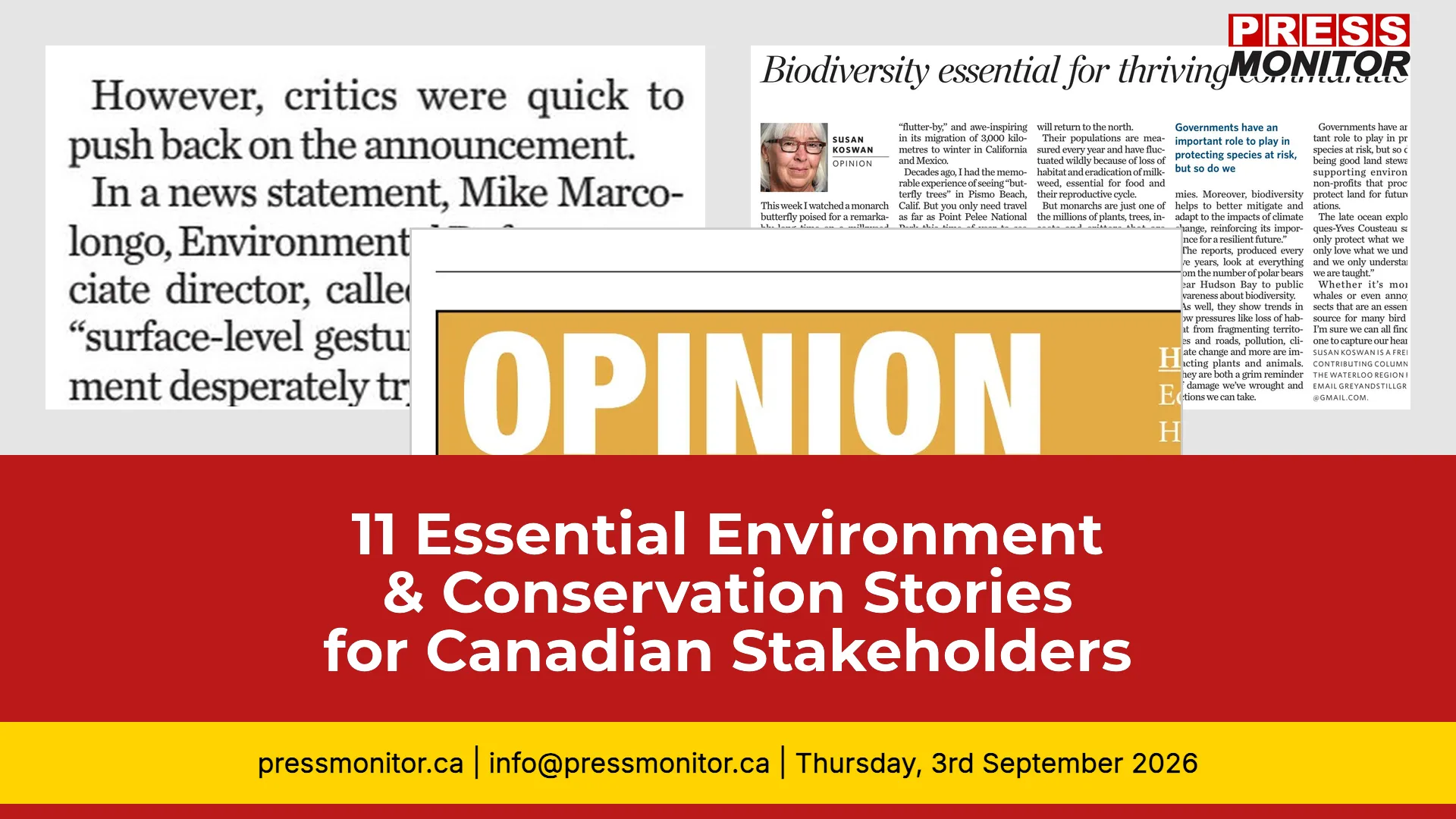
From highway debates in Ontario to biodiversity crises across the country, Canada's environment and conservation landscape is evolving rapidly. This press review delivers 11 essential stories on news on environment & conservation, drawing from Press Monitor's print media monitoring of Canadian publications. Whether you are a policy officer, corporate sustainability lead, or government relations specialist, these stories provide the media intelligence you need to stay ahead.
1. Ontario Highway Plan Draws Environmental Backlash
The Welland Tribune reports that Environmental Defence associate director Mike Marcolongo called the Ontario government's highway milestone surface-level gestures, saying the estimated C$14 billion to C$18 billion project would pave over 400 acres of Greenbelt and 2,000 acres of prime farmland. Ontario Greens leader and Guelph MPP Mike Schreiner also criticized Premier Ford for pushing ahead with the highway amid a trade war and affordability crisis. Critics argue the money could move twice as many people per hour if spent on transit instead, in a region where congestion already costs Ontarians C$45 billion a year.
Why it matters: This project represents one of the largest infrastructure-environment clashes in Canadian history, pitting billions in spending against Greenbelt protection and farmland preservation.
Key detail/stat: The estimated C$14 billion to C$18 billion project would pave over 400 acres of Greenbelt and 2,000 acres of prime farmland. Congestion already costs Ontarians C$45 billion a year.
Source: The Welland Tribune, The Hamilton Spectator, The Standard (St. Catharines)
Next step: Track how Premier Ford's office responds to the mounting criticism from Environmental Defence and the Ontario Greens.
2. Monarch Butterflies Spotlight Biodiversity Crisis
The Welland Tribune reports that columnist Susan Koswan watched a monarch butterfly poised on a milkweed plant, calling the easily recognizable species a poster child for protecting plants and animals on Earth. The Ontario Biodiversity Council's most recent report, released in 2025, says healthy ecosystems are the foundation of thriving communities and help mitigate climate change, while habitat loss, pollution and the eradication of milkweed threaten species. Koswan urges governments and citizens to be good land stewards and support environmental non-profits that protect land for future generations.
Why it matters: Biodiversity loss directly impacts ecosystem services worth billions, and the monarch butterfly has become a symbol of the broader species-at-risk crisis.
Key detail/stat: The Ontario Biodiversity Council's 2025 report confirms that habitat loss, pollution, and the eradication of milkweed are threatening monarch populations and broader ecosystem health.
Source: The Welland Tribune (columnist Susan Koswan)
Next step: Watch for provincial biodiversity action plans that follow the council's recommendations.
3. Ottawa Argues Climate Law Binds Nobody
Winnipeg Sun reports that the Carney government is arguing in Federal Court that the Canadian Net-Zero Emissions Accountability Act sets no binding obligations or penalties on Ottawa over its net-zero-by-2050 commitments. The editorial notes a December progress report shows Canada on track for roughly half of its 2030 target of cutting emissions 40 to 45 percent below 2005 levels, and Prime Minister Mark Carney has acknowledged the 2030 and 2035 targets will be missed. The Winnipeg Sun calls on Ottawa to either scrap the unenforceable act or table new targets it is prepared to defend in Parliament.
Why it matters: The federal government's legal position on the Net-Zero Emissions Accountability Act could reshape how Canada is held accountable for its climate commitments.
Key detail/stat: Canada is on track for roughly half of its 2030 target of cutting emissions 40 to 45 percent below 2005 levels. PM Carney has acknowledged the 2030 and 2035 targets will be missed.
Source: Winnipeg Sun editorial
Next step: Monitor Federal Court proceedings and any parliamentary response to the court challenge.
4. New Brunswick Premier Holt Launches Shale Gas Review
The Tribune (New Brunswick) reports that Premier Susan Holt has announced a five-month review to potentially lift the moratorium on shale gas development in New Brunswick, with a decision to be made in January. The move has drawn criticism from the opposition Progressive Conservatives and the Greens, who accuse Holt of prioritizing economic gain over environmental concerns.
Why it matters: This review could reshape New Brunswick's energy landscape and set a precedent for other provinces considering similar moves.
Key detail/stat: The five-month review will decide whether to lift the moratorium on shale gas development, with a final decision expected in January.
Source: The Tribune (New Brunswick)
Next step: Watch for opposition reactions and environmental group responses as the review progresses.
5. Industrial Pollution Concerns in Hamilton
The Hamilton Spectator reports that a Hamilton Spectator subscriber and East Hamilton resident worries about the persistent smell of industrial pollution that many residents experience throughout the year. The odour raises legitimate questions about air quality and potential health impacts, particularly for children, seniors, and individuals with respiratory conditions.
Why it matters: Persistent industrial odours raise legitimate questions about air quality and public health, particularly for vulnerable populations.
Key detail/stat: Residents in East Hamilton report experiencing industrial smells throughout the year, with heightened risks for children, seniors, and those with respiratory conditions.
Source: The Hamilton Spectator (subscriber letter by Grant Piett)
Next step: Follow Hamilton city council and provincial environmental regulators for any air quality investigations.
6. C$43-Billion Pipeline Investment Questioned
Toronto Star reports that Barrie reader Gwen Petreman, in a letter to the editor, questions Canada's C$43 billion pipeline investment while championing Bill McKibben's book "Here Comes The Sun." The letter argues that embracing solar power could eliminate excess greenhouse gases in 15 to 20 years and stabilize the climate, noting that China now leads the world in solar generation and panel manufacturing. Petreman calls oil a finite resource that will become too costly and too environmentally damaging, asking why Canada is spending C$43 billion on a pipeline that will be a useless eyesore in 40 to 50 years.
Why it matters: As renewable energy costs plummet, fossil fuel infrastructure investments face growing scrutiny from investors and citizens alike.
Key detail/stat: Letter writer Gwen Petreman argues that solar power could eliminate excess greenhouse gases in 15 to 20 years, while China now leads the world in solar generation and panel manufacturing.
Source: Toronto Star (letter to the editor by Gwen Petreman)
Next step: Watch for shifts in federal energy policy as solar economics continue to improve.
7. Montreal Biweekly Garbage Pickup Sparks Complaints
Montreal Gazette reports that the switch to biweekly garbage pickup in densely populated areas has led to complaints about improper disposal and unpleasant odors. The city plans to extend the change across the island by the end of 2027, aiming to encourage composting and recycling.
Why it matters: Urban waste management policies directly affect quality of life and environmental outcomes for millions of Montreal residents.
Key detail/stat: The city plans to extend biweekly pickup across the island by the end of 2027, aiming to encourage composting and recycling.
Source: Montreal Gazette (by Jesse Feith)
Next step: Monitor Montreal city council for adjustments to the pickup schedule based on resident feedback.
8. Air Quality Health Index Forecasts Vary Across BC
The Times Colonist reports that Thursday's forecast peak air quality health index in various regions of British Columbia ranges from low to very high. The higher the number, the greater the health risk from air pollution. Source: Environment Canada.
Why it matters: Real-time air quality data is essential for public health planning, especially for vulnerable populations in British Columbia.
Key detail/stat: Thursday's forecast peak air quality health index in various BC regions ranges from low to very high, with higher numbers indicating greater health risk.
Source: Times Colonist (via Environment Canada)
Next step: Check Environment Canada's daily AQHI updates during wildfire season and industrial emission periods.
9. Buy Local Produce to Support Sustainable Farming
The Standard (st. Catharines) reports that purchasing sustainably grown produce helps to reduce the environmental impact caused by long-haul food items.
Why it matters: Consumer choices in food sourcing directly influence agricultural sustainability and carbon footprints across Canada.
Key detail/stat: Purchasing sustainably grown produce helps reduce the environmental impact caused by long-haul food items.
Source: The Standard (St. Catharines)
Next step: Look for local food policy initiatives and farmers' market expansion programs in your region.
10. New Conservation Area Series Goes Onscreen
The Hamilton Spectator reports that a new series will focus on putting a conservation area onscreen, highlighting its importance and the efforts to protect it.
Why it matters: Media coverage of conservation areas raises public awareness and can drive policy support for protected lands.
Key detail/stat: The Hamilton Spectator reports on a new series putting a conservation area onscreen, highlighting protection efforts.
Source: The Hamilton Spectator
Next step: Follow the series for updates on conservation area funding and policy developments.
11. Saskatoon's 1980 Uranium Refinery Vote Revisited
Saskatoon StarPhoenix reports that a Throwback Thursday archive feature revisits September 3, 1980, when Saskatoon city council voted 6-5 to support Eldorado Nuclear Ltd.'s plan to build a uranium refinery near Warman. Mayor Cliff Wright cast the deciding vote after aldermen, anti-nuclear residents, church groups and business organizations weighed the economic benefits against environmental and social risks.
Why it matters: Historical environmental decisions continue to inform current nuclear energy debates across Canada.
Key detail/stat: Saskatoon city council voted 6-5 in 1980 to support Eldorado Nuclear Ltd.'s plan to build a uranium refinery near Warman, with Mayor Cliff Wright casting the deciding vote.
Source: Saskatoon StarPhoenix (by Jocelyn Bennett)
Next step: Consider how this archival decision echoes in today's nuclear energy discussions in Saskatchewan.
Closing: These 11 stories reflect the breadth of environmental and conservation challenges facing Canada today — from infrastructure and energy to biodiversity and waste. Which story resonates most with your work? Follow Press Monitor for ongoing media monitoring of Canadian print coverage on environment and conservation topics.