11 Essential Environment & Conservation Stories for Policymakers


According to Press Monitor's tracking of Canadian publications, this media monitoring roundup delivers 11 essential stories on environment and conservation — from wildlife protection to industrial oversight. This press review covers the developments that matter most for anyone following Canadian environmental policy, combining print media monitoring with media intelligence to surface the stories that shape our natural world. Here is the news on environment and conservation from Canada's print media.
1. Bear Feeding Fine in West Vancouver
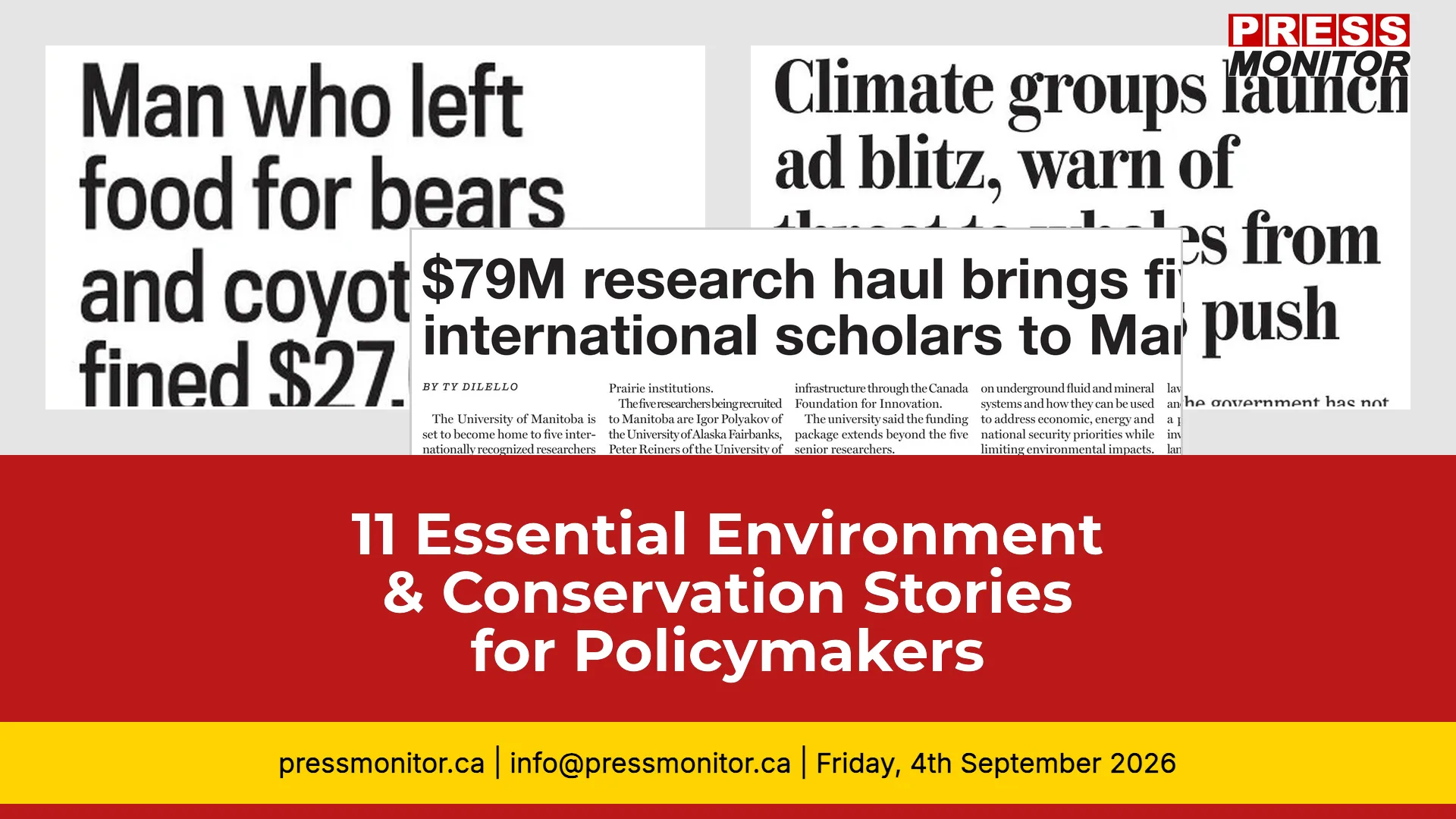
Vancouver Sun reports that Kenneth Amaral, sixty, has been sentenced in his absence to a twenty seven thousand dollar fine for intentionally leaving food scraps along North Shore trails in West Vancouver. Conservation officers discovered through motion triggered cameras that he left sausages, chicken, and desserts near homes and recreational paths, attracting bears and coyotes. Despite knowing it violated the British Columbia Wildlife Act, Amaral continued the illegal practice after being confronted and remains at an unknown location with an active arrest warrant. Kenneth Amaral faces a C$27,000 fine for intentionally leaving food scraps along North Shore trails, attracting bears and coyotes. Conservation officers used motion-triggered cameras to document the violations. Despite knowing it breached the British Columbia Wildlife Act, Amaral continued the practice and remains at large with an active arrest warrant. Why it matters: Illegal bear feeding creates dangerous human-wildlife conflicts in urban corridors. Source: Vancouver Sun.
2. Environmental Groups Urge Ottawa to Protect Orcas
The Times Colonist reports that some of Canada's leading environmental groups are pushing the federal government to change aspects of proposed legislation to speed up development of major projects before it's tabled this fall. Environmental Defence has launched an ad campaign to draw attention to the potential fate of the Southern Resident Orcas, saying the whales are at risk if Ottawa moves ahead with a bill changing how major projects are reviewed. The group is concerned about Ottawa's plan to establish economic zones for transportation corridors, telecommunications networks, and energy production and transmission, which would allow the federal cabinet to decide which activities would be allowed in them and give ministers the power to preapprove projects. Leading environmental groups are pushing the federal government to modify proposed legislation that could accelerate major project development at the expense of species protections. Environmental Defence warns that Southern Resident Orcas face extinction risk if tankers are allowed through their Salish Sea habitat under the Building Canada Act. The government plans to table the legislation during the fall sitting beginning September 21. Why it matters: Economic zones for transportation and energy corridors could override species-at-risk protections. Source: Times Colonist.
3. C$79 Million for University of Manitoba Research
Winnipeg Sun reports that the University of Manitoba has secured a C$79 million federal investment to attract five internationally recognized researchers. The funding, through the Canada Global Impact+ Research Initiative, will support projects in public health, Arctic security, mining, advanced technology, energy, food security and environmental law. The university ranked fifth nationally in the competition and was the top-performing Prairie institution. The University of Manitoba has secured C$79 million in federal funding through the Canada Global Impact+ Research Initiative to attract five internationally recognized researchers. Projects span public health, Arctic security, mining, advanced technology, energy, food security, and environmental law. The university ranked fifth nationally and was the top-performing Prairie institution. Why it matters: Research investment drives innovation in critical areas like Arctic security and environmental law. Source: Winnipeg Sun.
4. New Alberta Licence Plate Supports Wildlife Conservation
The Calgary Sun reports that a new specialty licence plate featuring Mount Lougheed and bighorn rams has been introduced in Alberta to raise money for the Alberta Conservation Association. Registering the plate costs $55 in addition to the regular fee, with proceeds earmarked for the association. The design was created by Grand Prairie artist Des McCaffrey. Alberta has introduced a new specialty licence plate featuring Mount Lougheed and bighorn rams, with proceeds going to the Alberta Conservation Association. Registration costs C$55 in addition to the regular fee. The design was created by Grand Prairie artist Des McCaffrey. Why it matters: Specialty plates offer a new revenue stream for conservation funding. Source: Calgary Sun.
5. C$130 Million for Cape Breton Heritage
Cape Breton Post reports that the Canadian government has announced C$130 million in funding for heritage asset improvements and critical infrastructure at Parks Canada sites in Cape Breton. The funding supports projects at the Fortress of Louisbourg, Alexander Graham Bell Museum, St. Peter's Canal National Historic Sites, Cape Breton Highlands National Park, and Canso Islands National Historic Site, focusing on conservation and public experience. Since 2015, approximately C$296 million has been allocated to infrastructure projects in Cape Breton-Canso. The Canadian government has announced C$130 million in funding for heritage asset improvements and critical infrastructure at Parks Canada sites in Cape Breton. Projects include the Fortress of Louisbourg, Alexander Graham Bell Museum, St. Peter's Canal, Cape Breton Highlands National Park, and Canso Islands National Historic Site. Why it matters: Heritage infrastructure investment supports conservation and public experience. Source: Cape Breton Post.
6. Donkin Mine Noise Oversight Fails Residents
The Cape Breton Post reports that Donkin mine residents near Cape Breton have endured years of disruptive low-frequency noise impacting sleep and health, with sustained concerns raised to local council, MLA Kendra Coombes, and Nova Scotia Environment Department officials, yet meaningful action and credible assessment processes remain absent despite documented efforts and meetings. Residents near the Donkin coal mine in Cape Breton have endured years of disruptive low-frequency noise impacting sleep and health. Requests for independent acoustic engineering and event-based monitoring were rejected in favour of an environmental engineer contracted by the coal company. Community trust in regulatory oversight continues to erode. Why it matters: Mining noise pollution poses serious public health risks when oversight is deferred to industry. Source: Cape Breton Post.
7. Welland Seeks Provincial Help for Toxic Park
The Welland Tribune reports that Welland wants the provincial government to help clean up the contaminated site of a former automotive plastics plant on Major Street and transform the property into a neighbourhood park. During the recent Association of Municipalities of Ontario conference, the city asked the Ministry of the Environment, Conservation and Parks for help finding funds and programs to remediate the land. Chief administrative officer Jessica Ruddell noted the site has been subject to ongoing property standards enforcement and significant tax arrears, with concerns about environmental remediation costs for the 0.4-hectare former industrial site. Welland is seeking provincial assistance to clean up the contaminated site of a former automotive plastics plant on Major Street and transform it into a neighbourhood park. The city raised the issue at the Association of Municipalities of Ontario conference, asking the Ministry of the Environment, Conservation and Parks for help with remediation funding. Why it matters: Brownfield redevelopment into green space addresses both environmental and community health needs. Source: The Welland Tribune.
8. Alberta's C$14 Solar Panel Recycling Fee
The Globe And Mail reports that Alberta will begin charging a fourteen-dollar recycling fee on all new solar panels starting October first to fund North America's first solar-panel recycling program. Industry players say the fee, which is up to three thousand five hundred percent higher than other jurisdictions, adds another burden on top of onerous new rules that have collapsed renewable energy project deals by ninety-nine percent since 2023. Alberta will begin charging a C$14 recycling fee on all new solar panels starting October first, funding North America's first solar-panel recycling program. Industry players say the fee is up to 3,500% higher than other jurisdictions and adds another burden on top of rules that have collapsed renewable energy project deals by 99% since 2023. Why it matters: Recycling infrastructure is essential for renewable energy sustainability, but costs must be balanced with industry viability. Source: The Globe And Mail.
9. Gatineau Park Motorboat Ban Uncertainty
Ottawa Citizen reports that Transport Canada confirmed Gatineau Park lakes are not currently covered by federal vessel restrictions, despite the National Capital Commission website saying motorboats are prohibited. The National Capital Commission says Transport Canada has jurisdiction over navigable waters and will amend its website to clarify policy, while Transport Canada says the commission qualifies as a local authority that could seek restrictions on individual lakes. The National Capital Commission promised in 2005 to phase out motorized boats by 2010, and Gatineau Park advocate Jean-Paul Murray wants the commission to pursue limits while preserving emergency, rescue and enforcement exemptions. Transport Canada confirmed that Gatineau Park lakes are not currently covered by federal vessel restrictions, despite the National Capital Commission website stating motorboats are prohibited. The NCC says Transport Canada has jurisdiction over navigable waters and will amend its website, while Transport Canada says the NCC qualifies as a local authority that could seek restrictions. Why it matters: Jurisdictional ambiguity leaves conservation protections unclear for popular recreational waterways. Source: Ottawa Citizen.
10. CRD Closes Trails Over Cougars
Times Colonist reports that the Capital Regional District has closed several mountain bike trails in Mount Work Regional Park due to increased cougar activity. The CRD said it made the decision to temporarily close sections of five trails in the Hartland area after consulting with the B.C. Conservation Officer Service. Riders and hikers are being asked to stay off Inventive, The Plunge and Plunge Extension, Little Face and Easy Rider trails until further notice. The Capital Regional District has closed several mountain bike trails in Mount Work Regional Park due to increased cougar activity. The CRD made the decision to temporarily close sections of five trails in the Hartland area after consulting with the B.C. Conservation Officer Service. Riders and hikers are being asked to stay off Inventive, The Plunge and Plunge Extension, Little Face and Easy Rider trails until further notice. Why it matters: Human-wildlife conflict management requires balancing public safety with recreational access. Source: Times Colonist.
11. Victoria Air Quality Health Index Forecast
Times Colonist reports that Environment Canada forecasts low air quality health index peaks for Victoria/Saanich, West Shore, Duncan, Nanaimo/Parksville, Comox Valley, Vancouver, Kelowna, and Kamloops on Friday. The index ranges from one to three for low risk, four to six for moderate, seven to ten for high, and above ten for very high, with higher numbers indicating greater health risk from air pollution. Environment Canada forecasts low air quality health index peaks for Victoria/Saanich, West Shore, Duncan, Nanaimo/Parksville, Comox Valley, Vancouver, Kelowna, and Kamloops. The index ranges from one to three for low risk to above ten for very high risk, with higher numbers indicating greater health risk from air pollution. Why it matters: Air quality monitoring is critical for public health, especially in communities near industrial and wildfire-affected areas. Source: Times Colonist.
What environmental story from today's print media surprised you most? Share your thoughts in the comments.