11 Essential Environment and Conservation Stories for Sustainability Leaders


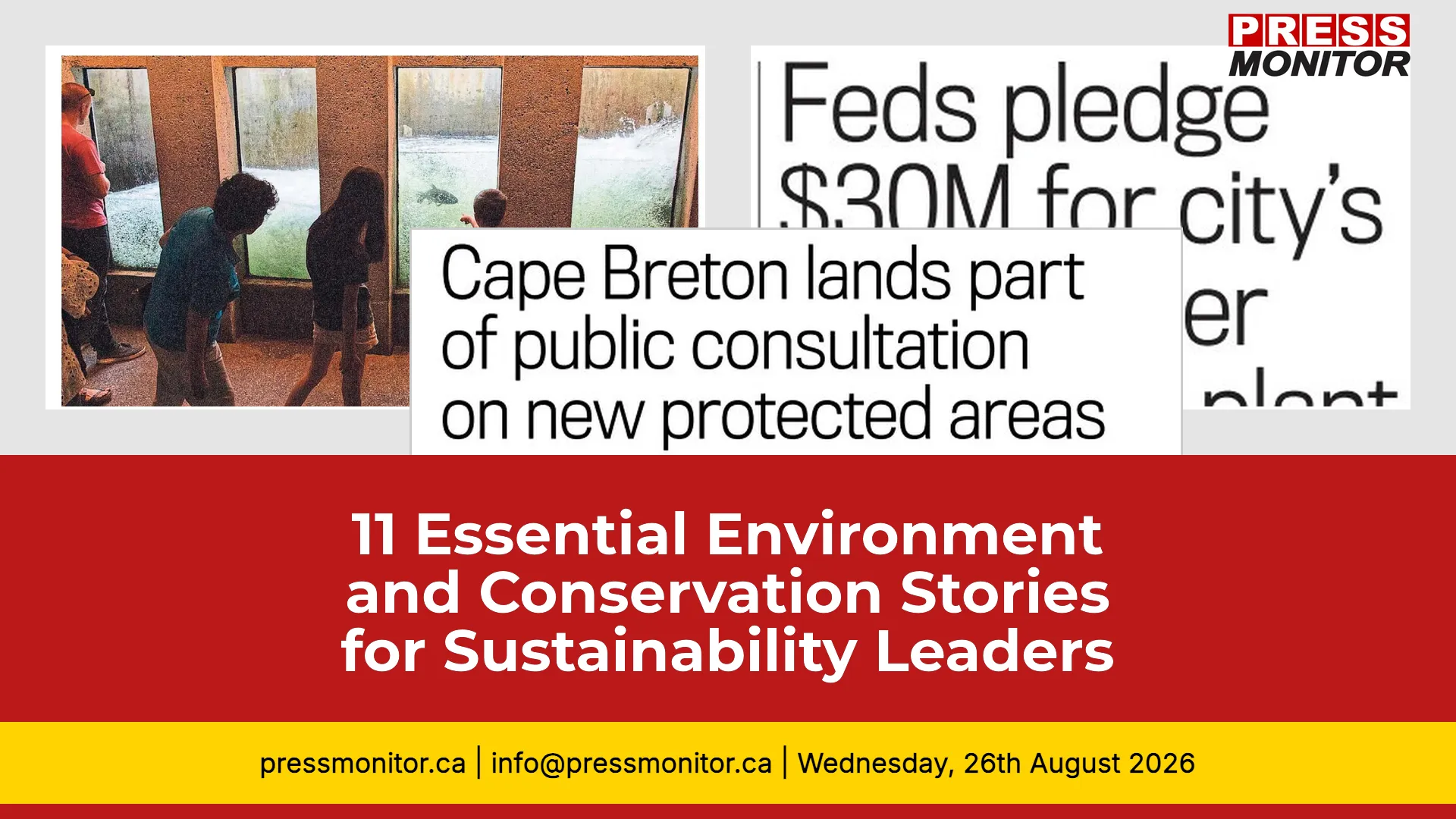
Stay ahead of the curve with Press Monitor's curated press review of today's most impactful environment and conservation stories from Canadian print media monitoring. According to Press Monitor's tracking of Canadian publications, these 11 stories cover critical developments in conservation funding, wildlife protection, and environmental policy. Whether you're tracking news on environment and conservation for strategic planning or media intelligence, this roundup delivers actionable insights.
1. Canada Invests $50M+ in B.C. Salmon Hatcheries
The Canadian government reports that it has announced over $50 million in contracts for constructing three hatcheries in British Columbia aimed at salmon conservation. The projects will be on traditional First Nations territory or operated by a local nation. The largest contract is worth $38 million for the Upper Fraser River Salmon Conservation Hatchery near Prince George, B.C.
Why it matters: This federal investment signals a major commitment to salmon conservation and reconciliation with First Nations.
Key detail: The largest contract, $38 million, is for the Upper Fraser River Salmon Conservation Hatchery near Prince George.
Source: Toronto Star, Times Colonist
Next step: Monitor contract awards and community consultations for partnership opportunities.
2. $30M for Ottawa Wastewater Resilience
Ottawa Citizen reports that the federal government is investing more than C$30 million to upgrade the Robert O. Pickard Environmental Centre. The funding aims to make the central wastewater treatment facility more resilient against extreme weather and support the city's growing population.
Why it matters: Climate adaptation infrastructure is a growing priority for municipalities.
Key detail: The funding upgrades the Robert O. Pickard Environmental Centre against extreme weather.
Source: Ottawa Citizen, Ottawa Sun
Next step: Assess similar funding opportunities for your region.
3. Nova Scotia Proposes Major Land Protection
According to a front-page report in the Cape Breton Post, Nova Scotia is seeking public input for new conservation efforts to safeguard an additional 9% of the province's land and water. If implemented, these measures will bring the total protected area to 15% of Nova Scotia's territory, encompassing expansions to seven existing wilderness regions and the creation of three new ones. Proposed protection includes the Herring Cove Backlands in Halifax and the Masons Mountain Wilderness Area in Inverness County.
Why it matters: The province aims to reach 15% protected area by year-end.
Key detail: Public consultation is open for 5,100 hectares including Herring Cove Backlands and Masons Mountain.
Source: Cape Breton Post
Next step: Submit comments during the consultation period.
4. Aerial Pesticide Approved in Nova Scotia
Oversite Aerial Intelligence Ltd. has received a pesticide approval from Nova Scotia Environment and Climate Change for treatment across Colchester, Pictou, and Lunenburg counties. The program, approved under Reference Number 2O26-4638573, involves aerial application of VisionMax to support conifer seedling growth. Scheduled from September 17 to 30, 2026, residents within 500 meters of treatment areas will be notified in advance.
Why it matters: Forestry management practices face scrutiny.
Key detail: VisionMax will be applied across 192 hectares in three counties from Sept 17-30.
Source: Chronicle Herald
Next step: Residents within 500m will be notified; review environmental impact.
5. B.C. Fishing Industry Eyes New Fund
According to a report in the Times Colonist, the province’s fishing industry appears cautiously optimistic about a new joint federal-provincial funding program, despite a lack of details on its implementation. The $106.5-million B.C. Fisheries Fund program, announced last week, aims to provide a boost to the sector. While many in the industry express concerns about the lack of specifics, they are willing to give it a chance, with plans for market development, innovation, and infrastructure improvements, as well as scientific partnerships to help the industry adapt to changing environmental conditions.
Why it matters: The $106.5M B.C. Fisheries Fund could reshape the sector.
Key detail: Industry is cautiously optimistic despite lack of implementation details.
Source: Times Colonist
Next step: Engage with program design to ensure your interests are represented.
6. Waste Disposal at Sea Application
The Province reports that Heavy Metal Marine Ltd. intends to apply to Environment and Climate Change Canada for a Disposal At Sea Permit to dispose of 16,000 cubic meters of dredged material at sea at Point Grey and Cape Lazo sites.
Why it matters: Marine disposal permits affect coastal ecosystems.
Key detail: Heavy Metal Marine Ltd. seeks to dump 16,000 cubic meters of dredged material at Point Grey and Cape Lazo.
Source: The Province
Next step: Public comment period may be available; check Environment Canada.
7. Dutch Elm Disease in Edmonton
The City of Edmonton reports that a new case of Dutch elm disease has been detected in a tree in Downtown Edmonton, marking the 17th case detected since 2024. The tree was located within the one-kilometer disease protocol zones established around previously confirmed cases.
Why it matters: Urban tree health is a growing concern.
Key detail: 17th case since 2024; tree removed proactively.
Source: Edmonton Sun
Next step: Report any suspicious symptoms to city forestry.
8. Ancient Maple in St. Catharines
The Standard reports that an ancient maple tree, estimated to be over 500 years old, sits on Metler Road in St. Catharines. The tree is named after the Comfort family, who owned the property and cared for it for generations.
Why it matters: Heritage trees connect communities to natural history.
Key detail: The Comfort family maple is estimated over 500 years old.
Source: The Standard
Next step: Consider local heritage designation for protection.
9. Citizen Urges Native Plant Integration
{The Hamilton Spectator reports that} a frustrated letter writer stresses the urgent need to integrate native plants and pro-environmental initiatives into municipal and professional planning to preserve ecosystems and prevent environmental decline.
Why it matters: Grassroots pressure influences municipal planning.
Key detail: Letter writer calls for native plants in professional planning.
Source: Hamilton Spectator
Next step: Incorporate native species in upcoming projects.
10. Manitoba Ranch Tour Highlights Sustainable Beef
Winnipeg Sun reports that Manitoba ranchers, conservation groups, policymakers, media and industry representatives gathered during a tour of beef cattle farms near Arnes and Stead marking the United Nations’ International Year of Rangelands and Pastoralists.
Why it matters: Rangeland conservation and food security intersect.
Key detail: Tour marked UN International Year of Rangelands and Pastoralists.
Source: Winnipeg Sun
Next step: Explore partnerships between ranchers and conservation groups.
11. Vancouver Launches Newspaper Recycling
«Selon The Vancouver Sun, a new initiative has been launched to recycle newspapers throughout the city. The program aims to significantly reduce waste and promote environmental sustainability. The Vancouver Sun reports that the initiative will involve collecting used newspapers from homes and businesses for recycling into new paper products.»,
Why it matters: Circular economy initiatives reduce waste.
Key detail: Program collects used newspapers for recycling into new products.
Source: Vancouver Sun
Next step: Participate in the program to support sustainability.
Closing: Which of these stories will impact your organization most? Press Monitor's media monitoring ensures you never miss a critical development. Stay informed with our daily press review.