11 Essential Infrastructure Stories for Public Works Leaders


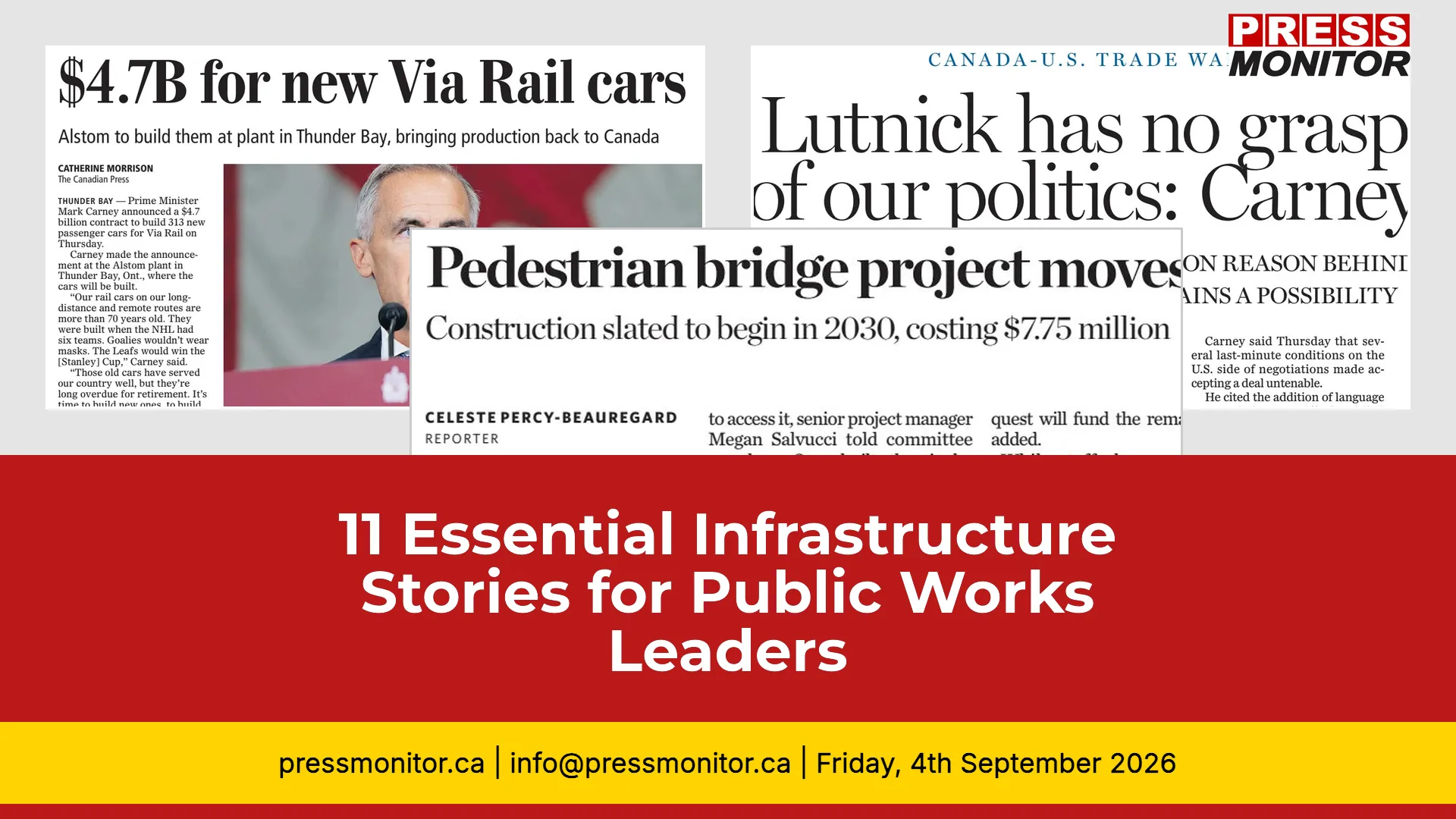
Canada's infrastructure landscape is shifting fast this week — from a historic rail investment to trade tensions reshaping supply chains, and local projects facing new funding realities. According to Press Monitor's tracking of Canadian publications, this media monitoring roundup covers the 11 essential infrastructure and public works stories driving the news on infrastructure today.
1. Via Rail Awards $4.7 Billion Contract for 313 New Passenger Cars
Times Colonist reports that Prime Minister Mark Carney announced a $4.7 billion contract to build 313 new passenger cars for Via Rail at the Alstom plant in Thunder Bay, Ontario. Transport Minister Steven MacKinnon said the project will create 700 new jobs and is the single largest investment in Via Rail's history, with the first new car expected to be delivered in 2031. The government emphasized this marks the first time in four decades that these rail cars will be produced and assembled in Canada.
Why it matters: The single largest investment in Via Rail's history marks a pivotal shift toward domestic manufacturing and away from reliance on imported rolling stock.
Key detail: 313 new passenger cars, 700 new jobs in Thunder Bay and Montreal, first production in Canada in four decades, first deliveries expected in 2031.
Source: Times Colonist, cross-referenced by Toronto Sun, Calgary Sun, Toronto Star, Globe and Mail, Le Journal de Montreal.
Next step: Watch for the September 8 retaliatory tariff deadline and how it affects procurement timelines.
2. Carney Rejects Lutnick's Canada-U.S. Trade War Claims
The Ottawa Citizen reports that Prime Minister Mark Carney rebuffed U.S. Commerce Secretary Howard Lutnick's recent comments that Canada pulled out of trade talks with the United States for political reasons. Carney stated that several last-minute conditions on the U.S. side, including auto industry tariffs and restrictions on language and cultural protections, made accepting a deal untenable. The breakdown in negotiations last month resulted in new fifty per cent U.S. tariffs on twenty-eight billion dollars worth of Canadian goods, with Canada promising retaliatory tariffs on twenty-seven point six billion dollars worth of U.S. products.
Why it matters: The breakdown in trade negotiations threatens to escalate tariffs on billions in cross-border goods, directly impacting infrastructure supply chains.
Key detail: Canada imposed 15-50% tariffs on $28B in U.S. goods; retaliatory tariffs on $27.6B in U.S. products effective Tuesday; Carney cited last-minute U.S. conditions including auto tariffs and language protections.
Source: Ottawa Citizen, cross-referenced by Montreal Gazette, Calgary Herald.
Next step: Monitor whether the September 8 retaliatory tariffs take effect and how they reshape infrastructure procurement.
3. Pedestrian Bridge Project Moves Closer to Construction in Hamilton
The Hamilton Spectator reports that a planned pedestrian bridge over the Lincoln M. Alexander Parkway moves closer to construction, with work slated to begin in 2030. The single-span bridge will stretch approximately eighty metres long, connecting T.B. McQuesten Community Park to Lime Ridge Mall, and carries a price tag of seventy-seven hundred fifty thousand dollars, with around seventy-seven per cent covered by federal infrastructure funding.
Why it matters: The $7.75 million bridge over the Lincoln M. Alexander Parkway represents a growing trend in urban pedestrian infrastructure investment.
Key detail: Single-span bridge, 80 metres long, connecting T.B. McQuesten Community Park to Lime Ridge Mall; 77% federally funded; construction slated for 2030.
Source: The Hamilton Spectator.
Next step: Follow the 2030 construction timeline and potential for similar pedestrian bridge projects across Ontario.
4. Canada's Water Infrastructure Bottleneck Threatens Housing Growth
The National Post reports that more than eleven per cent of Canada's water and wastewater infrastructure was in poor condition in 2022, creating a bottleneck for home construction as municipalities struggle to handle growth. Federation of Canadian Municipalities president Tim Tierney stated that infrastructure ranks as the top obstacle for member municipalities, while cities like Winnipeg and Airdrie face capacity limits threatening new housing development.
Why it matters: Aging water and wastewater systems are becoming the primary obstacle to housing development nationwide, with over 11% of infrastructure in poor condition.
Key detail: 107 billion Canadian dollars in estimated replacement value; municipalities like Winnipeg and Airdrie facing capacity limits; Federation of Canadian Municipalities president Tim Tierney calls infrastructure the top obstacle.
Source: National Post.
Next step: Watch for federal infrastructure funding announcements targeting water systems in the next budget cycle.
5. Toronto Issues C$19 Billion Bike Lane RFP
Toronto Star reports that the province issued a request for proposals on Tuesday, asking contractors to bid on the removal or reconfiguration of more than 19 kilometres of protected bike lanes along Bloor, Yonge, and University streets. The Ford government has blamed bike lanes for congestion and wants to restore vehicle lanes where possible, while the province also asked for options to keep bike lanes and add back traffic. The RFP includes design work for specific street segments and a study of alternative bike routes, with a bid closing date of Dec. 2 and an estimated completion date of December 2028.
Why it matters: The Ford government's move to reconfigure protected bike lanes along major Toronto streets signals a shift in urban transportation priorities.
Key detail: 19+ kilometres of bike lanes along Bloor, Yonge, and University streets; RFP bid closing December 2; estimated completion December 2028; options include removal, reconfiguration, or retention with added traffic.
Source: Toronto Star.
Next step: Track the December 2 bid deadline and which contractors emerge as finalists.
6. Charles St-Arnaud Urges Export Infrastructure Investment
National Post reports that investing in export infrastructure such as pipelines, rail, and ports is necessary for Canada to reduce its dependence on the U.S. and preserve its sovereignty, according to Charles St-Arnaud.
Why it matters: Investing in pipelines, rail, and ports is positioned as essential for reducing U.S. dependence and preserving Canadian sovereignty.
Key detail: St-Arnaud argues export infrastructure is critical for economic independence amid trade tensions.
Source: National Post.
Next step: Watch for policy proposals around export corridor development in upcoming federal infrastructure plans.
7. Calgary Names Water Utility Oversight Board Chair
Calgary Herald reports that Stephen Stanley, a retired Edmonton water utility executive and University of Alberta engineering professor, has been appointed chair of Calgary's new water utility oversight board. The board was created following an independent review into the 2024 rupture of the Bearspaw South feeder main, which found systemic gaps and decades of deferred maintenance. Stanley's immediate priorities are recruiting four additional board members and developing a work plan, with the full board expected by year-end.
Why it matters: Following the 2024 Bearspaw South feeder main rupture, Calgary is establishing new governance for water utility oversight.
Key detail: Stephen Stanley, retired Edmonton water utility executive and University of Alberta engineering professor, appointed chair; board must be fully staffed by year-end; independent review found systemic gaps and decades of deferred maintenance.
Source: Calgary Herald.
Next step: Monitor the board's work plan development and recruitment of four additional members.
8. Short Hills Park Trail Closures Highlight Infrastructure Vulnerability
The Welland Tribune reports that flooding after August rainfall has caused severe trail and bridge damage at Short Hills Provincial Park, leaving the Swayze Falls trail bridge structurally failed and Terrace Creek Trail closed until replacements are completed. Friends of Short Hills member Kubu said the park has never seen damage on this scale before, with the substantial Swayze bridge in a remote location requiring a full replacement after other washed-out trails are repaired.
Why it matters: Severe flooding damage to park infrastructure underscores the need for resilient public asset management in the face of extreme weather.
Key detail: Swayze Falls Trail bridge structurally failed; Terrace Creek Trail closed; Friends of Short Hills member Kubu notes unprecedented damage scale; full bridge replacement required.
Source: The Welland Tribune.
Next step: Follow Ontario Parks' damage assessment and restoration timeline.
9. Manitoba Adjusts Highway Speed Limits Near Lockport
Winnipeg Sun reports that Manitoba Transportation and Infrastructure will implement new speed zones on provincial highways twelve and forty-four near Lockport and Grand Marais following municipal safety and traffic volume concerns. Local officials and Transportation Minister Lisa Naylor have welcomed the provincial initiative to improve roadway safety along these critical municipal corridors.
Why it matters: Provincial speed limit changes on PTH 12 and PTH 44 reflect ongoing infrastructure safety improvements driven by municipal requests.
Key detail: New speed zones near Lockport and Grand Marais; Transportation Minister Lisa Naylor approved changes; longer transition zones created for safety.
Source: Winnipeg Sun.
Next step: Watch for additional municipal speed limit requests across Manitoba.
10. Ottawa Pledges $3 Billion for Food Terminals Under National Food Security Strategy
The Globe And Mail (ottawa/quebec Edition) reports that British Columbia and Manitoba terminal proposals aim to strengthen supply chains and boost competition in response to Ottawa's National Food Security Strategy launched in June. The strategy pledged 3 billion over 10 years to expand domestic processing and production, make supply chains more efficient and improve grocery competition amid rising food costs and trade tensions with the U.S. James Donaldson, chief executive officer at BC Food & Beverage, said the B.C. concept, dubbed the Pacific Gateway, could become a regional trade hub leveraging international trade.
Why it matters: The 10-year, $3 billion investment in domestic food processing and production infrastructure aims to strengthen supply chains and grocery competition.
Key detail: BC Food & Beverage CEO James Donaldson says the Pacific Gateway concept could become a regional trade hub; strategy launched in June amid rising food costs and trade tensions.
Source: The Globe and Mail (ottawa/quebec Edition).
Next step: Monitor which provinces and terminal projects receive funding in the first allocation round.
11. Galloping Goose Trail Detour Begins September 23 in Victoria
Times Colonist reports that the Galloping Goose Regional Trail near Viaduct Park and Cecelia Ravine will implement new detour routes for cyclists and pedestrians effective Sept. 23, due to sanitary-sewer replacement by the City of Victoria and trail widening and lighting by the Capital Regional District; the pedestrian route features more sidewalks to keep users separate, while another change is expected later in the fall and the section between Viaduct Park and Dupplin Road remains closed until next spring.
Why it matters: The detour for cyclists and pedestrians near Viaduct Park reflects ongoing investment in regional trail infrastructure and active transportation networks.
Key detail: Detour effective September 23 due to sanitary-sewer replacement by City of Victoria and trail widening by Capital Regional District; pedestrian route includes more sidewalks; section between Viaduct Park and Dupplin Road closed until next spring.
Source: Times Colonist.
Next step: Watch for the fall trail change and the spring reopening of the Viaduct Park to Dupplin Road section.
Closing: This media intelligence briefing, drawn from print media monitoring across Canadian publications, reflects the depth of coverage that Press Monitor delivers daily. Which of these developments will have the most impact on your sector? Let us know in the comments.