11 Key Social Media Stories for Communications Professionals


Stay ahead with the latest news on social media, from platform regulation to viral trends. According to Press Monitor's tracking of Canadian publications, these 11 stories highlight the opportunities and risks of platform engagement. Here's your essential media monitoring roundup for August 22, 2026.
1. Toronto Zoo Names Baby Pygmy Hippo 'Maple'
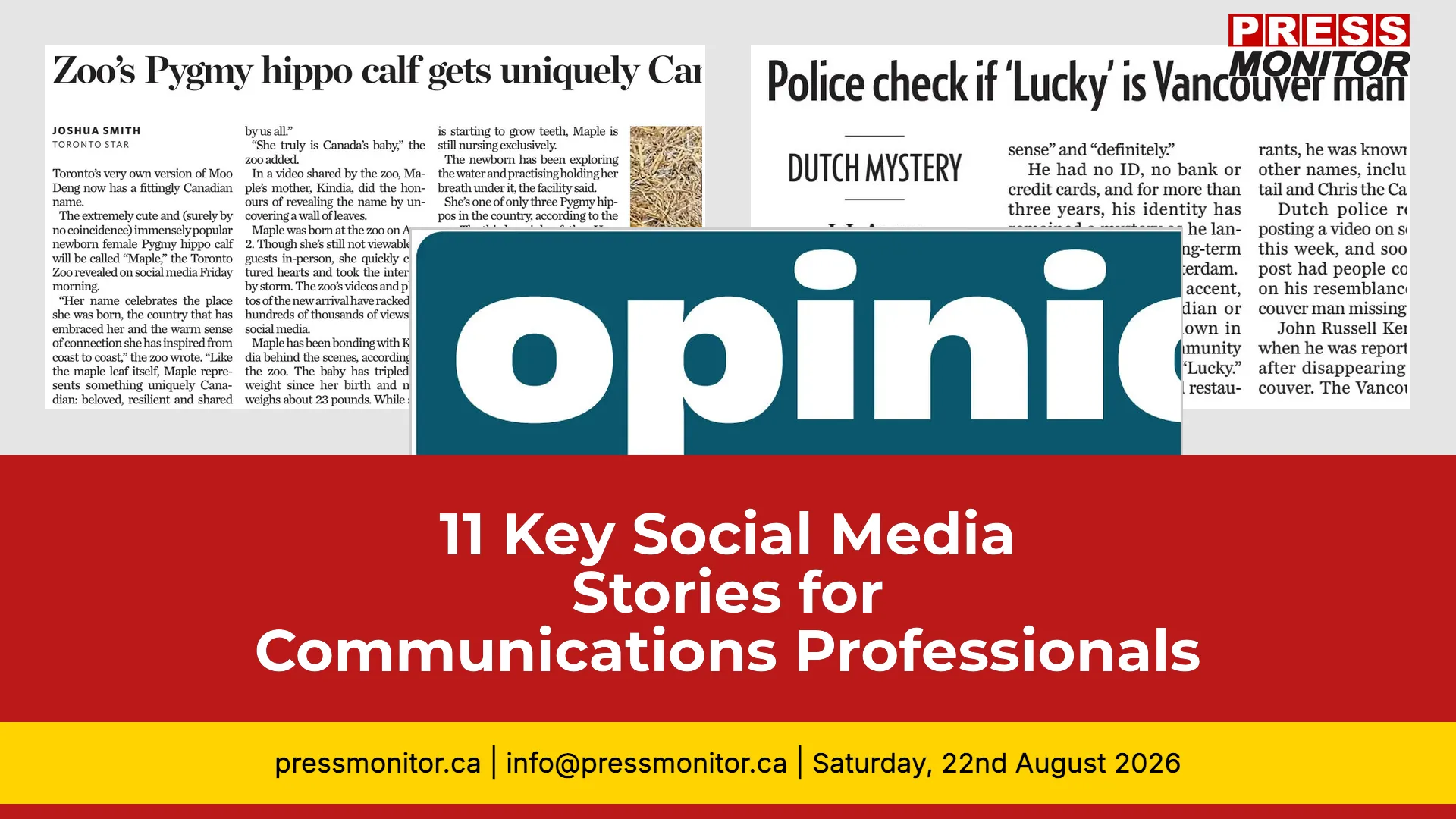
{source_name} reports that Toronto’s Toronto Zoo named its newborn female Pygmy hippo calf “Maple,” celebrating her birth, country, and the collective sense of connection she inspired across Canada. Born to mother Kindia on August 2, Maple dives into resplendent warmth—weighting around 23 lbs—while training breath and eagerly nursing. A critically endangered species, Pygmy hippos are rare, only three of which exist in Canada, including Maple’s father, Harvey. This heartwarming narration follows generosity in animal fate, reminiscent of a Canadian Moo Dengonasque honor, infused with ecstatic trends on social platforms, immensely popularizing the Canada-born calf swiftly.
Why it matters: Viral animal stories dominate social feeds and drive engagement for brands and institutions.
Key detail: The newborn pygmy hippo, named Maple, became an instant social media sensation, drawing attention to conservation efforts.
Source: The Welland Tribune (cross-covered by The Standard and The Hamilton Spectator)
Next step: Monitor how visitor sentiment and engagement metrics evolve for the Toronto Zoo's social channels.
2. Police Use Social Media to Identify Missing Vancouver Man
Saskatoon Starphoenix reports that in May 2023, an unknown man suffered a stroke and collapsed on the streets of Amsterdam. It left him in hospital with severe aphasia — reportedly unable to speak beyond the words “nonsense” and “definitely.” He had no ID, no bank or credit cards, and for more than three years, his identity has remained a mystery as he languished in a bed at a long-term care home outside Amsterdam. The only clues: His accent, which sounded Canadian or American. He was known in the local Buddhist community he frequented only as ‘Lucky.’ At a nearby market and restaurants, he was known by several other names, including Ponytail and Chris the Canadian. Dutch police resorted to posting a video on social media this week, and soon the viral post had people commenting on his resemblance to a Vancouver man missing since 1993.
Why it matters: Law enforcement increasingly relies on social media crowdsourcing to solve cold cases.
Key detail: A Dutch police video went viral, leading to speculation that a man with aphasia might be John Russell Kenny, missing since 1993.
Source: Saskatoon StarPhoenix (also covered by Regina Leader-Post)
Next step: Track the case's digital footprint for insights into viral investigative techniques.
3. Risky Politics on Social Media: Politicians Share Private Lives
Le Journal de Montreal reports that a growing number of elected officials are choosing to expose their private lives on social media, with figures like Montreal Mayor Valerie Plante, Quebec City Mayor Bruno Marchand, and Longueuil Mayor Catherine Fournier frequently sharing personal content ranging from family vacations to parenthood, sparking debates about a trend known as political peopolization.
Why it matters: The 'peopolization' trend blurs personal and professional boundaries, risking public trust.
Key detail: Montreal Mayor Valerie Plante and Quebec City Mayor Bruno Marchand frequently share family content, sparking debate.
Source: Le Journal de Montreal
Next step: Assess how this trend affects political communication strategies and media intelligence.
4. Women Protested, Hate Followed: Online Harassment After Protests
The Hamilton Spectator reports that thousands of young women have participated in nationwide protests over a flawed education system. But they have been bombarded online by people who have called them immoral, threatened sexual abuse and acid attacks, and used artificial intelligence to create demeaning images.
Why it matters: Social media platforms struggle to curb gender-based hate, impacting brand safety and user trust.
Key detail: Thousands of young women faced threats, sexual abuse imagery, and AI-generated demeaning content after protesting education reform.
Source: The Hamilton Spectator
Next step: Evaluate content moderation policies and their effectiveness in protecting users.
5. Can I Publish Child Photos Without Consent? Legal Boundaries
Le Journal de Montreal - Salut Bonjour Magazine reports that parents must generally obtain unanimous consent from both spouses to publish a photo or video of their child on social media, even if the authority is shared. The decision must solely protect the child's right to image, privacy, and dignity.
Why it matters: Clear consent rules are essential for family influencers and brands using user-generated content.
Key detail: Under Quebec law, both parents must consent to publish a child's image on social media, prioritizing the child's privacy.
Source: Le Journal de Montreal – Salut Bonjour Magazine
Next step: Review your organization's user-generated content policies for compliance.
6. Élus Exposant Leur Vie Privée: Quebec Politicians Going Personal
Le Journal de Quebec reports that an increasing number of elected officials are choosing to expose their private lives on social media, a trend that can blur the line between public communication and personal self-promotion.
Why it matters: Similar to the Montreal story, this trend spans Quebec, affecting public perception and media coverage.
Key detail: An increasing number of elected officials are exposing private lives, blurring lines between communication and self-promotion.
Source: Le Journal de Quebec
Next step: Monitor regional variations in political communication strategies.
7. BTS Arrives in Toronto: Fan Frenzy on Social Media
The Hamilton Spectator reports that BTS devotees are counting down to the K-pop superstars’ arrival in Toronto this weekend. The group is bringing their sold-out world tour to Rogers Stadium for their only Canadian dates.
Why it matters: K-pop fan communities drive massive social engagement, offering lessons for brand loyalty.
Key detail: BTS's sold-out Toronto shows sparked fan-organized events and trending hashtags, amplifying local businesses.
Source: The Hamilton Spectator
Next step: Analyze fan community dynamics for influencer marketing strategies.
8. BTS Tour Sparks Toronto Fan Fever: Economic Impact
The Hamilton Spectator reports that K-pop group BTS is bringing its Arirang tour to Toronto, sparking a wave of fan-organized events and themed products. Local businesses and fans are preparing for the band's arrival with tailored recommendations and sold-out parties.
Why it matters: Major events generate measurable social media buzz that translates to tourism revenue.
Key detail: Local businesses and fans prepared tailored recommendations and sold-out parties for the band's arrival.
Source: The Hamilton Spectator
Next step: Use social listening to quantify event-driven economic impact.
9. 'I Don't Think It Works For Someone My Age' – Dating Advice on Social Media
According to a Cape Breton Post report, a woman is taking dating advice from her son, but believes it’s unsuitable for her age. She has faced ridicule, rejection, and unfollowing on social media, leading her to question her experiences. She is seeking advice on how to navigate these challenges.
Why it matters: Age-related social media challenges reflect broader issues of inclusivity and platform design.
Key detail: A woman faces ridicule and rejection after seeking dating advice from her son, sparking a discussion on ageism.
Source: Cape Breton Post
Next step: Examine how different demographics experience social media platforms.
10. Big Tech Data Mining Raises Privacy Concerns
The Globe And Mail reports that tech oligarchs and data-mining operations are leveraging artificial intelligence to profit from personal information. Experts warn that this data is used for surveillance pricing and social engineering, while Canadian legislative efforts like Bill C-36 are criticized as inadequate.
Why it matters: Data mining for surveillance pricing and social engineering threatens user privacy and regulatory compliance.
Key detail: Experts warn that AI-driven data mining is used for price discrimination, while Canadian Bill C-36 is seen as inadequate.
Source: The Globe and Mail
Next step: Advocate for stronger data protection policies and monitor legislative updates.
11. Canadians Threaten to Egg Those Buying American Alcohol Again
The Toronto Sun reports that in Canada, people wanting to buy their bottle of Jack Daniels or Jim Beam again find themselves being pelted with eggs. Social media comments suggest people will have egg on their face for buying re-stocked Yankee booze, and will deserve to have an egg used on them as a weapon as well.
Why it matters: Social media amplifies consumer boycotts and cultural tensions, with real-world consequences.
Key detail: Online comments threaten egg-throwing at shoppers buying American alcohol, reflecting resurgent trade disputes.
Source: Toronto Sun
Next step: Track social sentiment around cross-border consumer behavior.
These stories underscore the power of social media in shaping public opinion and business outcomes. Press Monitor delivers the intelligence you need to stay ahead of platform trends. What trend will you track next?