11 Pivotal Geopolitics Stories for Global Strategists


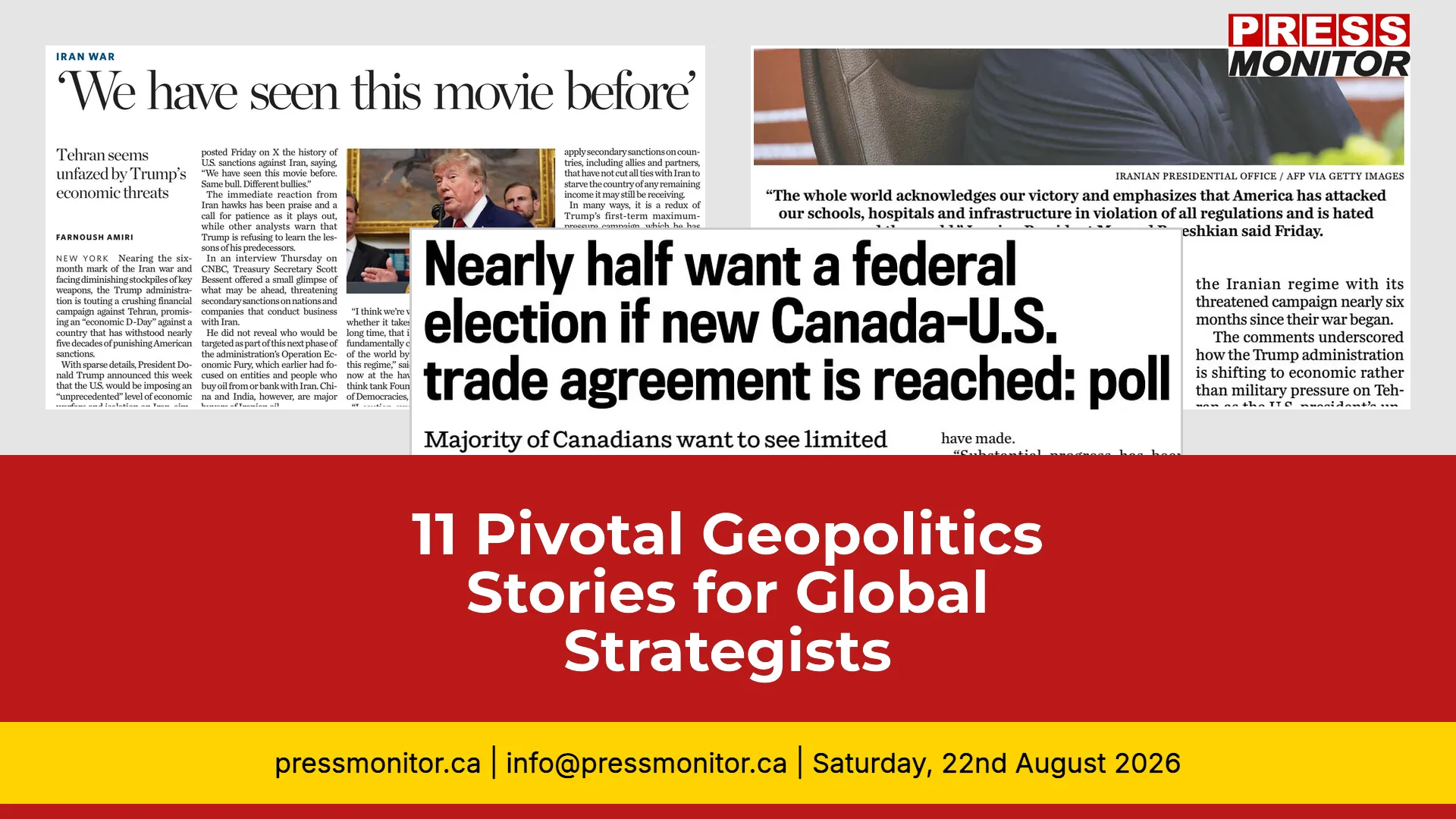
Welcome to today’s press review. Our media monitoring framework tracks Canadian print coverage revealing shifting fault lines in global diplomacy. This edition delivers essential news on geopolitics and international relations, grounded in verified reporting from coast to coast. According to Press Monitor's tracking of Canadian publications, decision-makers must navigate these developments before markets react. Our print media monitoring framework ensures you receive media intelligence before headlines trend elsewhere. Here are the eleven defining stories shaping the agenda today.
1. US Launches Maximum Economic Pressure Campaign Against Iran
Toronto Star reports that the Trump administration is launching an unprecedented campaign of economic warfare and isolation against Iran to force the end of its nuclear program. The strategy involves secondary sanctions on any nation or company continuing business with Tehran, including major oil buyers like China and India.
Why it matters: Treasury Secretary Scott Bessent and the White House are coordinating unprecedented secondary sanctions targeting any nation continuing business with Tehran, directly challenging China and India’s energy imports.
Key detail: The campaign aims to force nuclear program concessions and reopen the Strait of Hormuz, marking a decisive shift from military posturing to financial warfare.
Source: Toronto Star
Next step: Track compliance risks across supply chains and monitor secondary sanction enforcement mechanisms. Question: How will allied economies adapt to coordinated financial isolation tactics?
2. Iranian President Pezeshkian Seeks Diplomatic Off-Ramp
According to A front-page report in {source_name} says, Iranian President Masoud Pezeshkian stated Friday that his country is in a stronger position than Washington and should end the months-long Middle East war. He asserted the world acknowledges Iran’s victory and that America has attacked its schools, hospitals, and infrastructure. Pezeshkian also defended a memorandum of understanding with the US, claiming it did not signal a defeat, and criticized the U.S.'s intensified economic sanctions.
Why it matters: Tehran’s leadership publicly acknowledges the strain of prolonged confrontation while positioning itself as holding strategic leverage over Washington.
Key detail: President Masoud Pezeshkian defended recent diplomatic memoranda as victories rather than capitulations, signaling openness to negotiated de-escalation.
Source: National Post
Next step: Watch for backchannel communications and UN-mediated ceasefire frameworks. Question: Can economic exhaustion translate into genuine diplomatic flexibility?
3. Ottawa Faces Domestic Reckoning Over Renewed US-Canada Trade Pact
The Leger poll reports that nearly half of Canadians surveyed (47 per cent) believe a federal election should be called if a new Canada-U.S. trade agreement is reached, so voters can express their opinion on the deal.
Why it matters: A new Leger poll reveals nearly half of Canadians demand a federal election to ratify any fresh bilateral trade agreement, highlighting deep public scrutiny over sovereignty and economic alignment.
Key detail: The political calculus intersects with proposed tariff adjustments and infrastructure commitments, testing parliamentary majority stability.
Source: Cape Breton Post
Next step: Monitor polling shifts and opposition framing ahead of potential legislative votes. Question: Will electoral mandates become the standard for major trade ratification?
4. Washington-Seoul Diplomacy Shifts Ahead of Trump-Kim Summit
"Selon The Chronicle Herald, le président américain Donald Trump a déclaré qu'il se réunirait avec le leader nord-coréen Kim Jong Un plus tard cette année, ce qui serait leur première rencontre de son second mandat. Trump a également déclaré que la Corée du Nord possédait 57 armes nucléaires "très puissantes", une évaluation inhabituellement spécifique de l'arsenal atomique de Kim par un président américain. Trump a donné des détails.
Why it matters: The Trump administration confirmed plans for a direct meeting with Kim Jong Un later this year, accompanied by a premature conclusion to joint US-South Korean military exercises.
Key detail: Pyongyang dismissed the tactical pause as insufficient, maintaining hardline stances despite explicit references to expanded North Korean nuclear capabilities.
Source: The Chronicle Herald
Next step: Track denuclearization talking points and alliance coordination protocols. Question: Can confidence-building measures overcome decades of mutual distrust?
5. Warsaw-Berlin Deploy 'Eastern Shield' Along Kaliningrad Frontier
Poland and Germany have spent five weeks building fortifications along the Polish border with Russia's Kaliningrad exclave, deploying concrete hedgehogs as part of the 'Eastern Shield' program. The initiative aims to deter Russian threats amid the war in Ukraine, with around 10 billion euros allocated to the project.
Why it matters: NATO’s eastern flank is undergoing rapid physical fortification, allocating approximately €10 billion to concrete barriers and defensive infrastructure facing Russian exclave territory.
Key detail: The initiative responds directly to hybrid threat assessments and ongoing kinetic operations in Ukraine, formalizing forward defense postures.
Source: National Post
Next step: Assess engineering procurement cycles and allied burden-sharing commitments. Question: How will hardened borders reshape European deterrence doctrines?
6. Jerusalem Blocks Criminal Probe into Deadly Aid Worker Strike
"Selon The Toronto Star, le Canada, l’Australie et le Royaume-Uni ont dénoncé vendredi la décision d’Israël de ne pas poursuivre des poursuites pénales concernant un tir militaire qui a tué une colonne de travailleurs humanitaires. La colonne a tué sept travailleurs humanitaires, dont trois ressortissants britanniques, un ressortissant australien et un ressortissant binational américain et canadien, tous travaillant pour l’organisation World Central Kitchen à l’époque. Un Palestinien et un national polonais ont également été tués dans l’explosion. Un communiqué conjoint publié vendredi par les ministères des Affaires étrangères du Canada, de l’Australie et du Royaume-Uni a déclaré que la décision d’Israël’s military prosecutor against a criminal in-vestigation into the deadly strike, without offering further explana-tion, is "shameful". "Announcing this decision on World Humanitarian Day, while the world honoured the courage and sacrifice of humanitarians, was particularly egregious. This decision is both too little and too late," the joint statement said. "The victims of this incident and their families deserve justice and accountability, and we will continue to seek answers on their behalf." Il further said this is just one of many incidents in Gaza where there has been no accountability and that Israel "must do more to ensure that humanitarian staff can carry out their work safely". It noted some l86 humanitarian workers were killed in Gaza in 2O25."
Why it matters: Canada, Australia, and the UK jointly condemned Israel’s decision to halt criminal investigations following a military strike that killed seven humanitarian personnel, including dual nationals.
Key detail: The joint statement emphasized accountability gaps and called for safer operational corridors for aid delivery in Gaza.
Source: Toronto Star
Next step: Monitor ICJ advisory proceedings and NGO access negotiations. Question: Will diplomatic pressure compel independent judicial oversight?
7. West Bank Settler Assaults Hit Two-Decade Peak
The Hamilton Spectator reports that violent Israeli settler attacks have reached a twenty-year high, averaging six incidents per day in the West Bank with over one thousand Palestinians killed since October seven, two thousand and twenty-three, fueling international condemnation of the Netanyahu government.
Why it matters: Violent incidents involving Israeli settlers have escalated to an average of six daily attacks, contributing to over one thousand Palestinian casualties since October 2023.
Key detail: International condemnation is mounting against the Netanyahu government’s perceived tolerance of extrajudicial violence in occupied territories.
Source: The Hamilton Spectator
Next step: Track UN special rapporteur reports and EU sanction listings. Question: Can international legal mechanisms curb localized escalation?
8. Global South Embraces Cost-Effective Chinese AI Infrastructure
Why it matters: Developers across Kenya and Uganda are rapidly adopting Chinese artificial intelligence models via platforms like OpenRouter, citing ninety percent cost reductions compared to Western alternatives.
Key detail: This technological pivot reduces dependency on Silicon Valley ecosystems while raising questions about data governance and algorithmic bias.
Source: The Hamilton Spectator
Next step: Evaluate digital sovereignty strategies and local model training investments. Question: Will open-weight architectures democratize innovation or entrench new dependencies?
9. Moscow Signals Conditional Flexibility on Ukraine Peace Framework
Thed Globe and Mail reports that Russia is open to listening to new proposals for settling the conflict with Ukraine, a senior diplomat said. Sergei Ryabkov stated that any proposals must reflect the reality on the ground and require the Kyiv regime to abandon its goal of a strategic defeat of Russia.
Why it matters: Senior diplomat Sergei Ryabkov indicated willingness to consider new settlement proposals, provided they acknowledge territorial realities and reject Kyiv’s objective of strategic military victory.
Key detail: The stance reflects entrenched negotiation positions while leaving narrow pathways for third-party mediation.
Source: The Globe and Mail
Next step: Analyze ceasefire verification mechanisms and reconstruction financing pledges. Question: Can mutually acceptable ground rules emerge from asymmetric war aims?
10. Kremlin Expands Hybrid Tactics to Destabilize Pro-EU Moldova
The Hamilton Spectator reports that Russia is attempting to destabilize Moldova by orchestrating protests and training Moldovan operatives to undermine the pro-Western government.
Why it matters: Russian operatives are allegedly orchestrating street protests and training local actors to undermine Chisinau’s pro-Western trajectory, escalating information and covert influence campaigns.
Key detail: The interference threatens EU integration milestones and tests Moldova’s institutional resilience against foreign subversion.
Source: The Hamilton Spectator
Next step: Monitor cybersecurity advisories and democratic support funding allocations. Question: How can small states fortify electoral and informational sovereignty?
11. Canadian Maritime Capabilities Lag Behind Chinese Naval Expansion
The Globe And Mail reports that Western naval and maritime capabilities have regressed, facing challenges from maintenance issues, aging fleets, and geopolitics. As China accelerates shipbuilding and ocean mapping, Canada's administrative moves to revert to steam catapults on aircraft carriers highlight a lack of urgency in modernizing maritime infrastructure.
Why it matters: Western naval modernization faces maintenance backlogs and aging fleets, while Beijing accelerates shipbuilding, ocean mapping, and dual-use vessel deployment.
Key detail: Canada’s administrative reversals on carrier catapult systems underscore broader strategic hesitation in securing Indo-Pacific shipping lanes.
Source: The Globe and Mail
Next step: Review defense budget reallocations and allied port access agreements. Question: Will industrial policy finally prioritize blue-water readiness?
This press review synthesizes verified reporting to help you anticipate market and policy shifts. Stay ahead of volatility by leveraging professional media monitoring to track regulatory shifts and diplomatic signals. Which development requires immediate boardroom attention?
