11 Pivotal Geopolitics Stories for Global Strategists


Welcome to today’s press review. As global alliances shift and trade tensions mount, staying ahead requires precise media intelligence. According to Press Monitor's tracking of Canadian publications, here are 11 pivotal developments shaping international relations right now. For executives relying on media monitoring, these verified reports cut through digital noise. Read on for news on geopolitics that directly impact policy and markets.
1. Russia Strikes Ukraine Security Headquarters
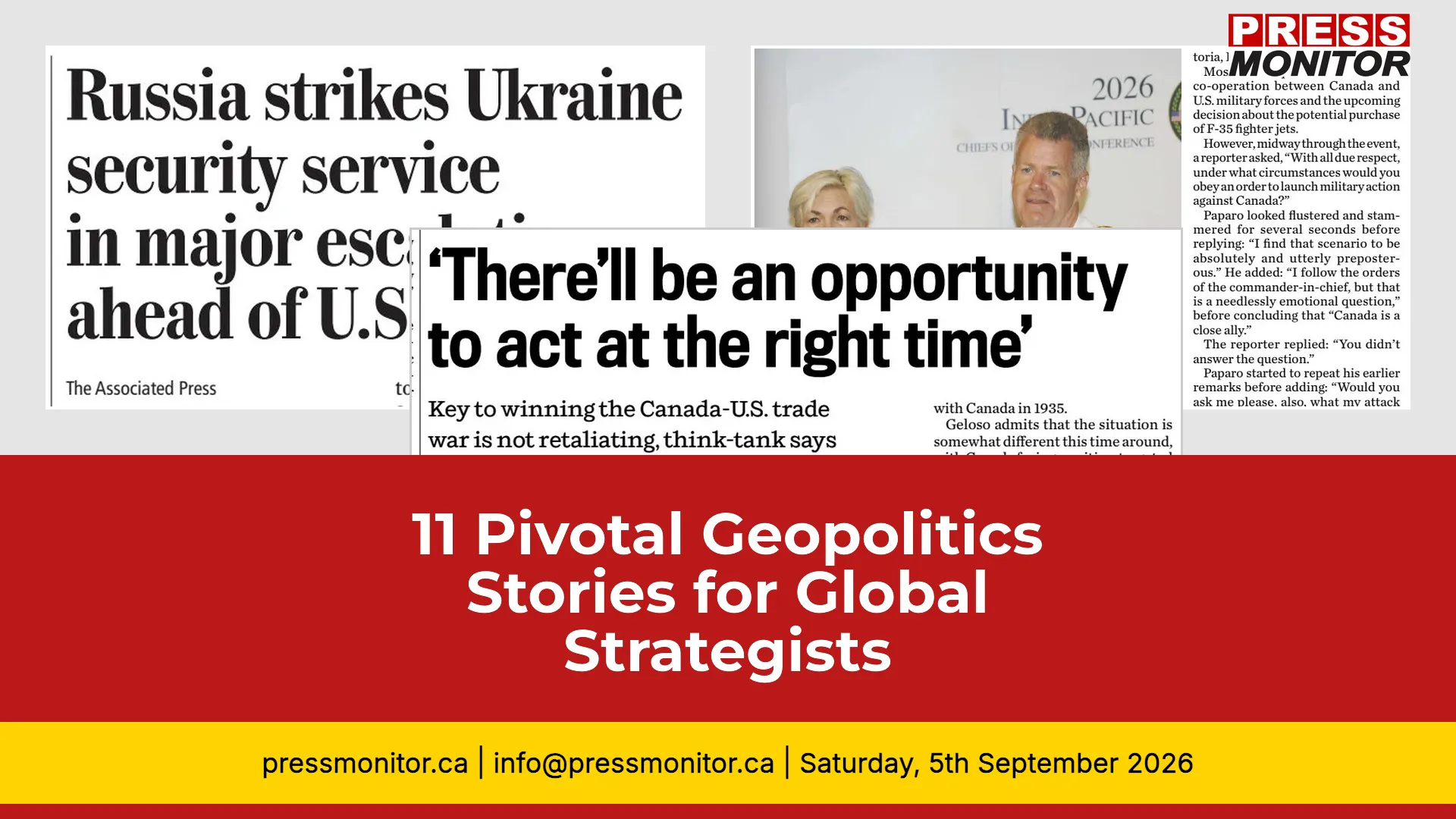
Times Colonist reports that a Russian drone struck the headquarters of Ukraine's security service in central Kyiv on Friday, wounding twelve people in a major escalation ahead of diplomatic talks with U.S. officials. President Volodymyr Zelenskyy said the drone was deliberately targeted at the head of the SBU's office, while Ukrainian Foreign Minister Andrii Sybiha called the strike a rejection of diplomacy. U.S. President Donald Trump confirmed that envoys Steve Witkoff and Jared Kushner will travel to Moscow and then Kyiv over the weekend with a proposal to end the war.
Why it matters: Direct escalation ahead of critical diplomatic talks.
Key detail: A drone strike wounded twelve people at the SBU headquarters in Kyiv. U.S. envoys Steve Witkoff and Jared Kushner are still scheduled to visit Moscow and Kyiv with a peace proposal.
Source: Times Colonist
Next step: Monitor envoy statements for ceasefire frameworks.
2. US Admiral Rejects Canada Attack Query
The Chronicle Herald (provincial) reports that during a joint news conference in Victoria, British Columbia, United States Pacific Command Admiral Samuel Paparo dismissed a reporter's question about launching military action against Canada as preposterous. Facing pressure from the journalist to address hypothetical threats of annexation, Paparo emphasized the strong alliance between the two nations before concluding the discussion. The event took place alongside Canada's chief of defence staff, General Jennie Carignan.
Why it matters: Reinforces the stability of North American defense partnerships.
Key detail: During the Indo-Pacific Chiefs of Defence conference, Admiral Samuel J. Paparo dismissed hypothetical annexation questions as preposterous, emphasizing strong allied cooperation.
Source: Chronicle Herald
Next step: Track joint military exercises in Victoria.
3. Canada Calls for Patience in Trade War
The Chronicle Herald reports that a free-market think tank, led by senior economist Vincent Geloso of the Montreal Economic Institute, recommends that Canadian policymakers exercise patience instead of retaliating against U.S. tariffs imposed under Section 338 of the Tariff Act. The article notes that Carney has announced counter-tariffs on $276 billion of U.S. imports and that historical evidence from the 1930s Great Depression shows that extending patience can break a tariff standoff.
Why it matters: Economic strategy could define bilateral relations for years.
Key detail: The Montreal Economic Institute advises Ottawa to avoid retaliating against U.S. tariffs, citing 1930s historical precedents where patience broke tariff standoffs.
Source: Chronicle Herald
Next step: Watch for domestic reform announcements instead of counter-tariffs.
4. Miliband Reaffirms UK Sovereignty Over Falklands
The Hamilton Spectator reports that British Foreign Secretary Ed Miliband has firmly reaffirmed the United Kingdom's sovereignty over the Falkland Islands, pushing back against renewed territorial claims by Argentine President Javier Milei. Milei recently threatened economic sanctions on oil operations in the South Atlantic following remarks from US President Donald Trump indicating Washington would not intervene in a potential conflict. The exchange underscores escalating diplomatic friction between the two nations over the strategically significant archipelago.
Why it matters: Tests diplomatic resilience in the South Atlantic.
Key detail: British officials firmly rejected Argentine President Javier Milei’s territorial claims and threatened sanctions on offshore oil operations.
Source: Hamilton Spectator
Next step: Observe EU and UN responses to the dispute.
5. Carney tells Putin to leave Ukraine
The Standard (st. Catharines) reports that Prime Minister Mark Carney will deliver a direct message to Vladimir Putin at the upcoming Group of Twenty leaders summit in Florida, urging him to withdraw from Ukraine and end the ongoing war. Carney emphasized that strength and directness are necessary when dealing with the Russian president, noting the conflict causes thirty thousand casualties every single month. While United States President Donald Trump plans to host world leaders in Miami and has invited Russia despite an International Criminal Court arrest warrant, Canadian officials expressed discomfort with Moscow attendance.
Why it matters: Signals a hardened Canadian stance at major multilateral forums.
Key detail: Prime Minister Mark Carney plans to deliver a direct message to Vladimir Putin at the G20 summit in Florida, emphasizing that strength and directness are required.
Source: The Standard (st. Catharines)
Next step: Follow G20 agenda releases for diplomatic outcomes.
6. Russia And Allies Escalate Global Conflict Fears
The Hamilton Spectator reports that columnist Bret Stephens draws parallels between the prelude to World War Three and current geopolitical tensions, warning that spheres of conflict are merging across Eastern Europe, the Middle East, and Asia. He argues that while Ukraine has resisted like wartime Britain, an operational authoritarian alliance between Russia, China, North Korea, and Iran poses unprecedented strategic challenges. Stephens further highlights Western political fragmentation, American military unpreparedness, and looming economic downturns as factors that could accelerate the drift toward a broader global confrontation.
Why it matters: Highlights merging spheres of conflict across multiple continents.
Key detail: Columnist Bret Stephens warns that an operational authoritarian alliance between Russia, China, North Korea, and Iran poses unprecedented strategic challenges to Western cohesion.
Source: Hamilton Spectator
Next step: Assess defense budget allocations and alliance commitments.
7. Modi Hedges Against Trump With Global Deals
The Hamilton Spectator reports that Prime Minister Narendra Modi of India has been zigzagging around the world, visiting at least 20 countries since August 2025 to fortify India's economy against global turbulence unleashed by President Donald J. Trump. Modi's diplomacy seeks defense technology, submarine technology from Germany, student visas from France, and cheaper Scotch whisky from the United Kingdom, while India signed a major free trade agreement with the European Union in January. The U.S. slapped India with an additional 25 percent tariff for buying Russian oil, and Modi aims to build strategic autonomy through economic corridors.
Why it matters: Demonstrates strategic autonomy amid shifting U.S. trade policies.
Key detail: Indian PM Narendra Modi has visited over twenty countries to secure defense tech, energy deals, and free trade agreements, countering new U.S. tariffs on Russian oil purchases.
Source: Hamilton Spectator
Next step: Track EU-India supply chain integrations.
8. Trump Netanyahu Elections Military
The Standard reports that a prior prediction outlined a volatile few months ahead, with ceasefires on the US-Tran front and Gaza deteriorating. The article notes that September will bring national elections in Israel and the United States, creating deadlines that could lead to military enterprises.
Why it matters: Election deadlines in Israel and the U.S. could trigger rapid military escalations.
Key detail: Analysts predict deteriorating conditions in Gaza and potential Strait of Hormuz disruptions as political calendars force decisive action.
Source: The Standard (st. Catharines)
Next step: Monitor shipping routes and regional ceasefire negotiations.
9. Canadian Intern Espionage Charges In Belgium
{source_name} reports that a Canadian intern charged with espionage at NATO headquarters in Belgium was found near the office of the alliance's supreme commander after a fire alarm was pulled. Biwei Zhang faces espionage charges on suspicion of spying for a third country, with sources indicating China. The investigation is probing whether she was aided by accomplices both inside and outside NATO.
Why it matters: Raises national security concerns around foreign infiltration of defense alliances.
Key detail: Biwei Zhang faces espionage charges at NATO headquarters after being found near the supreme commander’s office following a fire alarm.
Source: Globe And Mail
Next step: Review corporate vetting protocols and alliance security audits.
10. PM Carney Trade Talk Breakdown
National Post reports that the breakdown in trade talks between Canada and the United States hinges on conflicting accounts of last-minute changes to agreement terms, with Prime Minister Mark Carney accused by some of using the dispute for political gain. The article examines how this disagreement could impact Carney's popularity and the upcoming American midterm elections, while also discussing potential retaliatory measures and the long-term outlook for Canadian-American relations.
Why it matters: Internal political dynamics may influence future negotiation tactics.
Key detail: Conflicting accounts of last-minute agreement terms have stalled talks, with critics accusing Carney of leveraging the dispute for domestic political gain.
Source: National Post
Next step: Analyze parliamentary debates on trade sovereignty.
11. Dollar Dominance Erodes Under Trump
The Hamilton Spectator reports that US dollar dominance faces erosion from Trump administration actions against political and financial institutions. Alliances NA...
Why it matters: Currency shifts impact global reserves and emerging market stability.
Key detail: Economic analysts warn that administration actions against financial institutions are accelerating the decline of U.S. dollar hegemony worldwide.
Source: Hamilton Spectator
Next step: Diversify currency exposure and monitor central bank reserve reports.
Closing: This press review highlights how print media monitoring remains the bedrock for serious geopolitical analysis. How do you track these shifting alliances? Share your thoughts below. Tracked by Press Monitor.