11 Pivotal Health Stories for Canadian Leaders


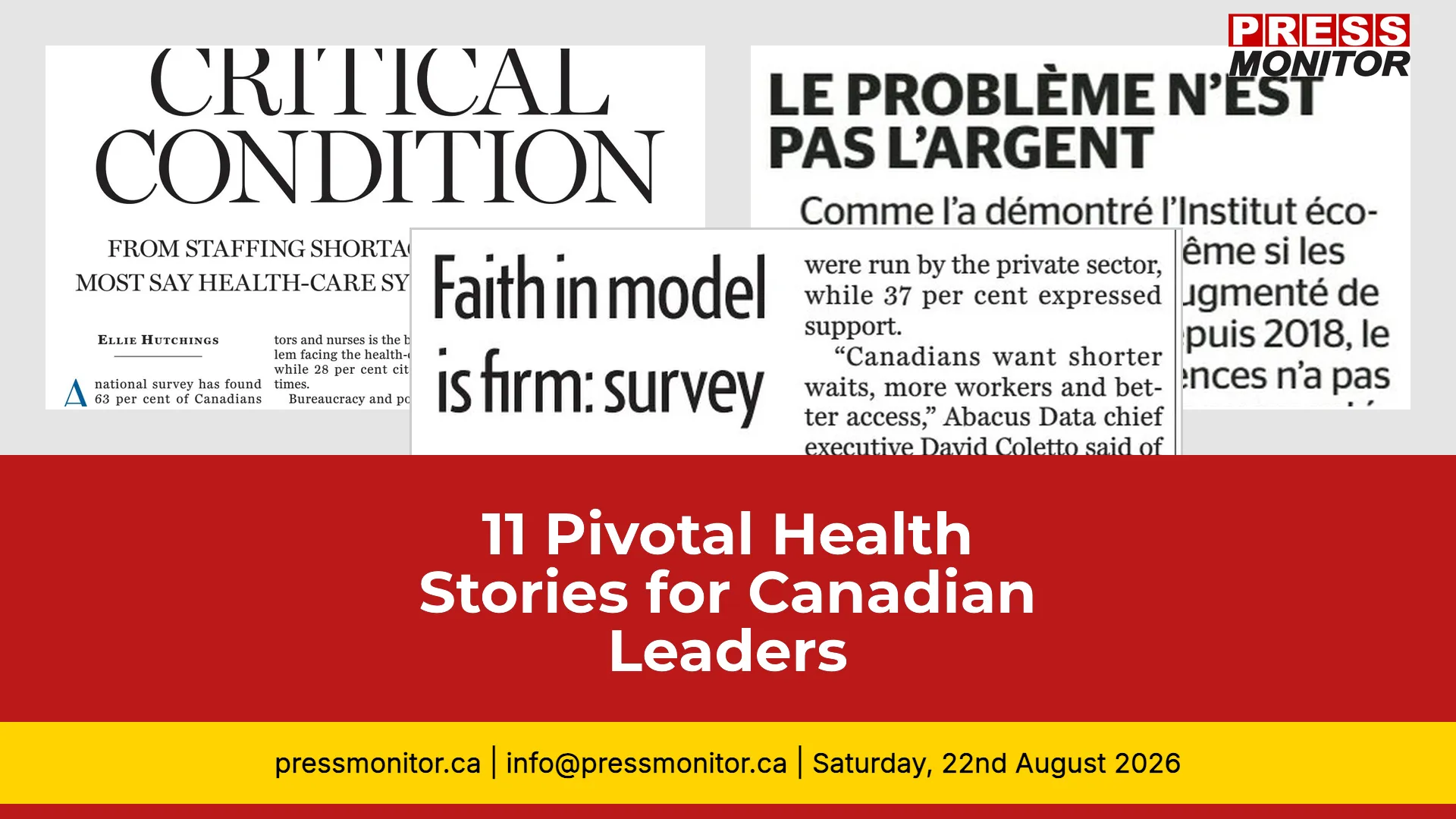
Tracking real-time developments across Canada’s print landscape requires precise media monitoring. This press review distills the most critical health sector movements into actionable insights for executives, policymakers, and communications leaders. According to Press Monitor's tracking of Canadian publications, here are eleven defining stories shaping the national health conversation today. Leveraging advanced media intelligence ensures your team stays ahead of systemic shifts.
1. Health-Care System in Crisis: Polls
Canadian polls reveal 60 per cent of respondents describe health care in their province as in crisis, with 55 per cent saying it has worsened over the past five years. Shortages of doctors and nurses are cited as the biggest problem by 31 per cent of Canadians, while 28 per cent point to long wait times.
Why it matters: Public confidence is fracturing as systemic pressures mount nationwide.
Key detail/stat: 63% of Canadians describe their provincial health care as being in crisis, with 55% reporting deterioration over five years.
Source: Calgary Herald, National Post, Ottawa Citizen
Next step: Review provincial response strategies and prepare stakeholder communications ahead of budget cycles.
2. LE PROBLÈME N’EST PAS L'ARGENT
Le Journal de Quebec reports that despite a 24 billion dollar increase in health spending since 2018, the waiting time in emergency rooms has not decreased but has instead increased by 41 minutes. This indicates that simply adding more money is not a magic solution to all our problems.
Why it matters: Fiscal debates are shifting from pure funding increases to efficiency and structural reform.
Key detail/stat: Despite a $24 billion spending increase since 2018, emergency room wait times have risen by 41 minutes.
Source: Le Journal de Quebec, Le Journal de Montreal
Next step: Audit operational workflows and benchmark against peer jurisdictions for cost-effectiveness metrics.
3. 49% favor public healthcare, private rejected
National Post reports that 49 per cent of Canadians want medically necessary health care to remain publicly funded, while only 11 per cent favour purchasing private insurance. Surveys show strong resistance to the private sector running health care.
Why it matters: Market-based reforms face steep public resistance, influencing legislative feasibility.
Key detail/stat: 49% want medically necessary care to remain publicly funded, while only 11% support private insurance expansion.
Source: Calgary Herald, National Post
Next step: Align corporate advocacy messaging with public sentiment to maintain policy stability.
4. 12% Population Growth in Southern Manitoba Strains Health Systems
Winnipeg Sun reports that Southern Health-Santé Sud is experiencing heightened demand across health services due to a 12 percent population increase between 2020 and 2025, projected to rise by another 19 percent by 2035, resulting in pressures on existing healthcare access and systems, particularly in rural areas with poorer health outcomes.
Why it matters: Demographic booms are outpacing infrastructure planning in rural and semi-rural regions.
Key detail/stat: Southern Manitoba saw a 12% population surge between 2020 and 2025, with projections hitting another 19% by 2035.
Source: Winnipeg Sun
Next step: Stress-test capacity models and accelerate telehealth deployment for underserved corridors.
5. Ontario plans to expand 78 family health teams
Radio-canada Info reports that the Ontario province is launching a request for proposals to expand up to 78 primary care teams to increase patient capacity. Sylvia Jones, Ontario's Health Minister, announced the 250 million dollar investment during the annual conference of the Association of Municipalities of Ontario (AMO). The funding aims to ensure access to a family doctor or primary care provider for approximately 600,000 Ontarians.
Why it matters: Primary care access remains the cornerstone of preventative health strategy.
Key detail/stat: Ontario is investing $250 million to expand primary care teams, aiming to connect 600,000 Ontarians with family doctors.
Source: Radio-canada Info
Next step: Evaluate partnership opportunities with newly funded clinics for employer wellness programs.
6. Few Quebecers Getting Vaccinated
Le Journal de Montreal reports that few Quebecers are getting vaccinated even though vaccines help chronic disease patients avoid heart problems and other fatal illnesses. With flu and COVID-19 season approaching, unvaccinated elderly and chronic patients risk hospitalization or death and can endanger others.
Why it matters: Preventable disease risks are climbing as seasonal flu and COVID seasons approach.
Key detail/stat: Less than 12% of adults are vaccinated against influenza, with experts warning 25-30% of hospital beds could fill with preventable cases.
Source: Le Journal de Montreal, Le Journal de Quebec
Next step: Launch targeted internal communication campaigns highlighting vaccination benefits for chronic conditions.
7. Unlicensed Doctor Warned in Alberta
“Selon Edmonton Journal, le gouvernement provincial a émis une alerte à la population concernant toute personne ayant reçu des « services médicaux esthétiques » d’un résident d’Edmonton se présentant comme un médecin avec une entreprise à domicile. Les membres du public qui ont reçu ce type de service de Max F. Klein, un homme non agréé se présentant comme médecin, risquent des blessures et de la transmission de maladies contagieuses, selon un communiqué de presse de vendredi. Klein a perdu sa licence après avoir drogué un collègue sans connaissance en 2015, selon le College of Physicians and Surgeons of Alberta. Il n'a pas exercé de permis de pratique en Alberta depuis 2015. Son enregistrement CPSA a été annulé en 2022 après qu'il a été reconnu coupable par un tribunal d'audiences CPSA de l'administration d'une substance illicite à un collègue sans leur connaissance ni consentement. À l'époque de l'incident de 2015, M. Klein était un stagiaire médical à l'Université d'Alberta. Le ministère des Services de santé et de prévention a émis une alerte vendredi, affirmant que Klein a été signalé à fournir des services médicaux esthétiques à domicile tout en n'étant pas agréé pour exercer la médecine en Alberta et en se présentant comme un médecin. Les individus ayant reçu un traitement médical, des injections, des procédures esthétiques ou d'autres services de santé de M. Max Klein pourraient avoir été exposés à des pathogènes transmissibles par voie sanguine, notamment l'hépatite B, l'hépatite C et le VIH, et pourraient être à risque accru de blessures ou d'autres complications de santé. Les activités signalées pourraient augmenter le risque de blessures et de transmission de maladies contagieuses. Ceux qui ont reçu un traitement médical, des injections, des procédures esthétiques ou d'autres services de santé de Klein devraient appeler Health Link à 811 et/ou parler à leur fournisseur de soins de santé pour déterminer si d'autres tests, un suivi ou des soins de suivi peuvent être nécessaires.
Why it matters: Patient safety regulations require rigorous credential verification across all service providers.
Key detail/stat: Alberta Health issued a public alert regarding Max F. Klein, who practiced aesthetics without a license after his CPSA registration was cancelled in 2022.
Source: Edmonton Journal
Next step: Conduct immediate audits of contracted medical vendors and update vendor compliance protocols.
8. Canada’s Altruistic Surrogacy System Faces Legal Challenges
According to a front-page report in The Globe And Mail, Canada’s altruistic surrogacy system, while founded on good intentions, is increasingly strained by legal ambiguities and ethical considerations. The article details a recent lawsuit involving a couple who challenged their surrogate’s refusal to terminate a pregnancy with a cleft lip and heart defect, highlighting a mismatch between contractual agreements and the evolving understanding of legal rights. Furthermore, the report examines the wide-ranging legal variations across Canadian provinces regarding surrogacy agreements, emphasizing the need for greater clarity and support for surrogates involved in these arrangements.
Why it matters: Evolving family law structures demand updated HR policies and ethical guidelines.
Key detail/stat: Recent litigation highlights tensions between contractual expectations and bodily autonomy rights in altruistic arrangements.
Source: The Globe And Mail
Next step: Consult legal counsel to review employee assistance frameworks and surrogacy leave policies.
9. Hamilton treats 130,000 basins for mosquitoes
The Hamilton Public Health Service is treating l3O,OOO catch basins with larvicide to mitigate West Nile virus transmission. Workers from Pestalto Environmental Health Services drop treatments between Juneland Oct. 3l.
Why it matters: Vector-borne disease prevention is scaling up amid rising West Nile virus activity.
Key detail/stat: Hamilton Public Health deployed larvicide treatments across 130,000 catch basins following confirmed positive mosquito pools.
Source: The Hamilton Spectator
Next step: Coordinate municipal environmental health updates with corporate facility management teams.
10. Lindsay Clancy Trial Controversy
The trial involving the horrific triple murder of Lindsay Clancy has triggered discussions over maternal mental health care. Supporters argue she was experiencing severe postpartum psychosis, while prosecutors claim the murders were carefully planned.
Why it matters: High-profile legal cases spotlight gaps in maternal mental health support systems.
Key detail/stat: Defense argues severe postpartum psychosis drove the alleged murders, sparking national debate on psychiatric intervention timing.
Source: Calgary Sun, Edmonton Sun, Toronto Sun
Next step: Enhance EAP offerings focused on perinatal mental health and manager training for early identification.
11. WSIB Cuts Expected to Affect Dozens of Workers in St. Catharines
The Welland Tribune reports that dozens of Workplace Safety and Insurance Board workers are facing job loss as the agency moves to reduce its presence in St. Catharines prompting concerns about the impact on injured workers.
Why it matters: Workforce restructuring impacts injured worker support networks and regional economic stability.
Key detail/stat: The Workplace Safety and Insurance Board is reducing its St. Catharines footprint, raising concerns over service continuity.
Source: The Welland Tribune, The Standard
Next step: Map affected claimant populations and establish alternative intake channels for impacted employees.
These developments underscore why print media monitoring remains essential for anticipating regulatory shifts and public sentiment. How should your organization adapt its health strategy to these emerging realities?