11 Pivotal Human Resources Stories for HR Leaders


Human resources leaders must navigate shifting labour dynamics with precision. This press review distills complex workforce developments into actionable insights, powered by rigorous print media monitoring across Canada’s most trusted publications. Our media intelligence framework tracks regulatory shifts, corporate restructuring, and union movements to keep you ahead of the curve.
1. Canada Loses 42,000 Jobs in August
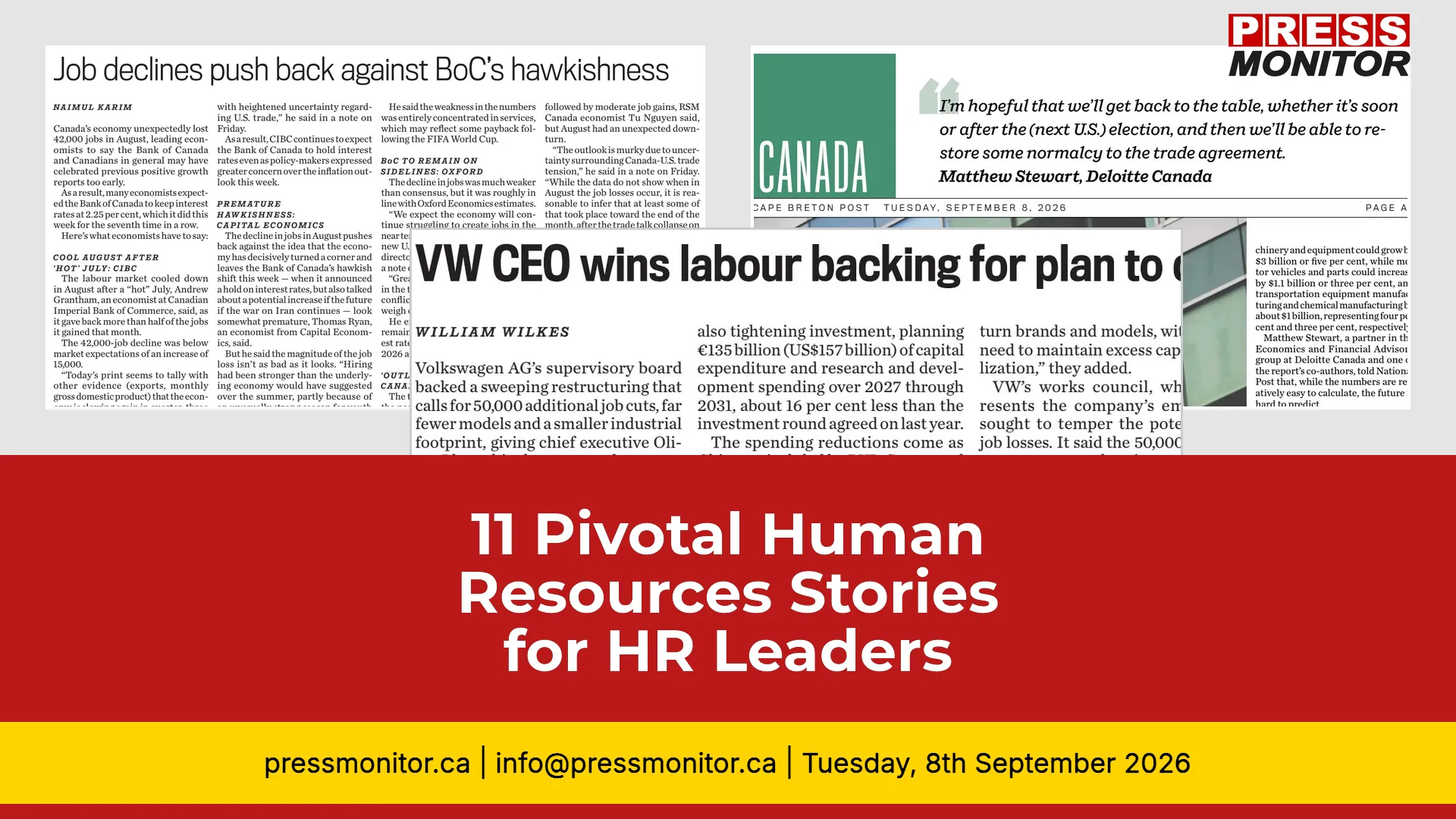
Regina Leader-post reports that Canada's economy unexpectedly lost 42,000 jobs in August, leading economists to say the Bank of Canada and Canadians in general may have celebrated previous positive growth reports too early. As a result, many economists expected the Bank of Canada to keep interest rates at 2.25 per cent, which it did this week for the seventh time in a row. The decline pushes back against the idea that the economy has decisively turned a corner amid heightened uncertainty regarding US trade and the Iran conflict.
Why it matters: Unexpected payroll contraction signals cooling momentum ahead of critical trade negotiations.
Key detail: Economists anticipate the Bank of Canada will hold interest rates at 2.25 percent amid tariff uncertainty and geopolitical tensions.
Source: Regina Leader-post
Next step: Audit Q4 hiring pipelines and stress-test contingency budgets against potential rate stability.
2. CUSMA Withdrawal Could Cost C$402 Billion
The Cape Breton Post reports that a new Deloitte Canada study warns a United States withdrawal from the Canada-United States-Mexico Agreement would cause a severe but survivable economic downturn, projecting a C$402 billion gross domestic product loss by 2036. The analysis outlines two potential futures, highlighting significant job cuts and manufacturing declines under a worst-case tariff scenario, while suggesting accelerated diversification and reduced interprovincial trade barriers could mitigate some damage.
Why it matters: A US exit from the trade pact threatens massive GDP contraction and annual job losses.
Key detail: Deloitte Canada projects 163,000 fewer jobs annually under a worst-case scenario, with manufacturing and electronics hit hardest.
Source: Cape Breton Post
Next step: Review supply chain dependencies and accelerate diversification strategies outlined in the report.
3. VW CEO Wins Labour Backing for 50,000 Job Cuts
Regina Leader-post reports that Volkswagen AG's supervisory board backed a sweeping restructuring calling for 50,000 additional job cuts, fewer models, and a smaller industrial footprint, giving CEO Oliver Blume a clear mandate to overhaul Europe's biggest carmaker. The measures approved on Thursday in Wolfsburg double workforce reductions across Volkswagen Group brands since late 2024 and pave the way to slim the vehicle lineup by as much as half by 2035, with new staff cuts representing roughly eight per cent of VW's global workforce. Management is pursuing the reductions in response to declining sales in China, high costs in Germany, and underused factories, while the works council secured assurances that no factory would be immediately abandoned and compulsory layoffs remain ruled out through the end of 2030.
Why it matters: Europe’s largest automaker doubles workforce reductions to offset declining Chinese sales and high German costs.
Key detail: CEO Oliver Blume secured works council assurances that compulsory layoffs remain ruled out through 2030.
Source: Regina Leader-post
Next step: Monitor European automotive labor trends for ripple effects on North American supplier contracts.
4. BC Hiring Stalls, Housing Declines
Business in Vancouver reports that hiring in British Columbia stalled as weak housing starts and trade uncertainty dampened labour market growth, while construction and construction‑sector payrolls fell and public‑sector employment marginally offset the decline.
Why it matters: Provincial payroll contraction ties directly to sluggish multi-family housing starts and trade caution.
Key detail: Construction payrolls fell while public-sector employment marginally offset the decline in June.
Source: Business in Vancouver
Next step: Align recruitment cycles with regional housing development milestones and infrastructure funding.
5. 6 Quebec Mothers Win EI Appeal
The Chronicle Herald reports that the Federal Court of Appeal ruled it is unconstitutional to deny regular Employment Insurance benefits to women who lose their jobs after receiving maternity or parental benefits. The unanimous decision handed a victory to six Quebec mothers and found parts of the EI system discriminate against women. Parliament now has one year to fix the law.
Why it matters: Federal Court of Appeal strikes down EI rules that disproportionately penalize women after maternity leave.
Key detail: Parliament has until September 2027 to amend legislation, potentially impacting hundreds of claimants nationwide.
Source: The Chronicle Herald
Next step: Update parental leave policies and employee communications to reflect Charter-compliant standards.
6. Service Canada Delays Trigger Local Job Losses
Le Journal de Quebec reports that Peinture Industrielle JD, a high-end architectural finishing firm in Lévis, faced unexpected layoffs after Service Canada delayed payroll for its shared-work program. Although the company submitted all required documentation before a planned operational pause, federal authorities caused administrative holdups that left workers without supplemental income. Management criticized the lack of transparency, noting the bureaucratic failure directly impacted employee retention.
Why it matters: Administrative bottlenecks in shared-work payroll programs directly threaten small-business retention.
Key detail: Lévis-based Peinture Industrielle JD faced unexpected layoffs after federal authorities delayed supplemental income disbursements.
Source: Le Journal de Quebec
Next step: Establish direct liaison channels with federal program administrators to prevent payroll cascades.
7. Ontario Adds 1,400 Jobs
Financial Post Magazine reports that Ontario’s manufacturing sector added one thousand four hundred jobs in August, taking total employment to 827,700 and erasing losses over the past year and a half despite trade tensions with the United States. The gains come amid new tariffs on U.S. products and Canada’s counter‑tariffs planned for comparable goods, while analysts warn that uncertainty may weigh on future investment.
Why it matters: Manufacturing sector defies national headwinds, erasing 18 months of losses despite cross-border tariffs.
Key detail: Total employment reached 827,700 in August, though analysts warn future investment remains tied to trade clarity.
Source: Financial Post Magazine
Next step: Capitalize on localized manufacturing resilience for targeted talent acquisition campaigns.
8. 255,000 Education Workers Return Without Contracts
The Daily Press (Timmins) reports that 255,000 education workers in Ontario returned to work without a contract, with about 2,000 in the northeast. Local union leaders and the province remain at an impasse over centralizing authority in education, with a decision expected from the Ontario Labour Relations Board around Thanksgiving.
Why it matters: Prolonged collective bargaining impasses disrupt school operations and strain teacher retention.
Key detail: Approximately 2,000 workers in northeastern Ontario await an Ontario Labour Relations Board decision around Thanksgiving.
Source: The Daily Press (timmins)
Next step: Prepare contingency staffing models and engage proactively with provincial education negotiators.
9. Volkswagen Repurposes German Plant For Defence Manufacturing
The Globe And Mail (ottawa/quebec Edition) reports that Volkswagen has struck a preliminary deal to sell its Osnabrueck plant in Germany to Aurelius Capital and the state of Lower Saxony, repurposing the site for defence manufacturing. The agreement aims to preserve approximately one thousand four hundred of the facility's eighteen hundred jobs through a collaboration with Israel's Rafael advanced defence systems, which will focus on producing air defence components and potentially converting pickup trucks for military use. This strategic shift positions the automotive giant to offset stagnant European car demand by leveraging rising continental defence spending.
Why it matters: Strategic industrial pivot preserves 1,400 jobs while aligning automotive capacity with continental defense spending.
Key detail: Rafael Advanced Defence Systems will produce air defense components and potentially convert pickup trucks for military use.
Source: The Globe And Mail (ottawa/quebec Edition)
Next step: Track defense-industrial conversion trends for adjacent procurement and workforce reskilling opportunities.
10. UNE Ousts Trusteeship, Elects New Leadership
Ottawa Citizen reports that the Union of National Employees (UNE) has elected new national and regional executives on August 27, ending a year‑long trusteeship overseen by the Public Service Alliance of Canada (PSAC). The new leadership, headed by Jean‑Michel Lavergne as president, aims to resume autonomous union operations from Ottawa while PSAC prepares a full handoff by early November. Former president Alisha Kang’s suspension and oaths of accountability have paved the way for this transition.
Why it matters: Public Service Alliance of Canada hands full operational control back to elected officials after governance overhaul.
Key detail: Jean‑Michel Lavergne assumes presidency, aiming to resume autonomous union operations by early November.
Source: Ottawa Citizen
Next step: Engage with newly empowered union leadership to align upcoming contract negotiations.
11. BC Labour Unions Ranked by Membership
Business in Vancouver reports that the British Columbia General Employees' Union leads the province's labour organizations with one hundred thousand members as of two thousand twenty-six. The Canadian Union of Public Employees follows with seventy-one thousand five hundred members, while the Hospital Employees' Union and BC Nurses' Union each maintain sixty thousand and fifty thousand members respectively.
Why it matters: Union density metrics reveal shifting leverage points across provincial sectors.
Key detail: BCGEU leads with 100,000 members, followed by CUPE at 71,500, highlighting concentrated bargaining power in public services.
Source: Business in Vancouver
Next step: Benchmark internal engagement strategies against peak union membership demographics.
Which of these workforce shifts requires immediate attention in your organization? Tag your HR director below to initiate a strategic review.