11 Pivotal Technology Stories for Tech Executives


Welcome to today's press review from Press Monitor. According to Press Monitor's tracking of Canadian publications, these are the 11 technology stories that matter most today. From Apple's leadership change to Nvidia's big bet on MediaTek, here's your media intelligence briefing.
1. Apple's New CEO: John Ternus Takes the Helm
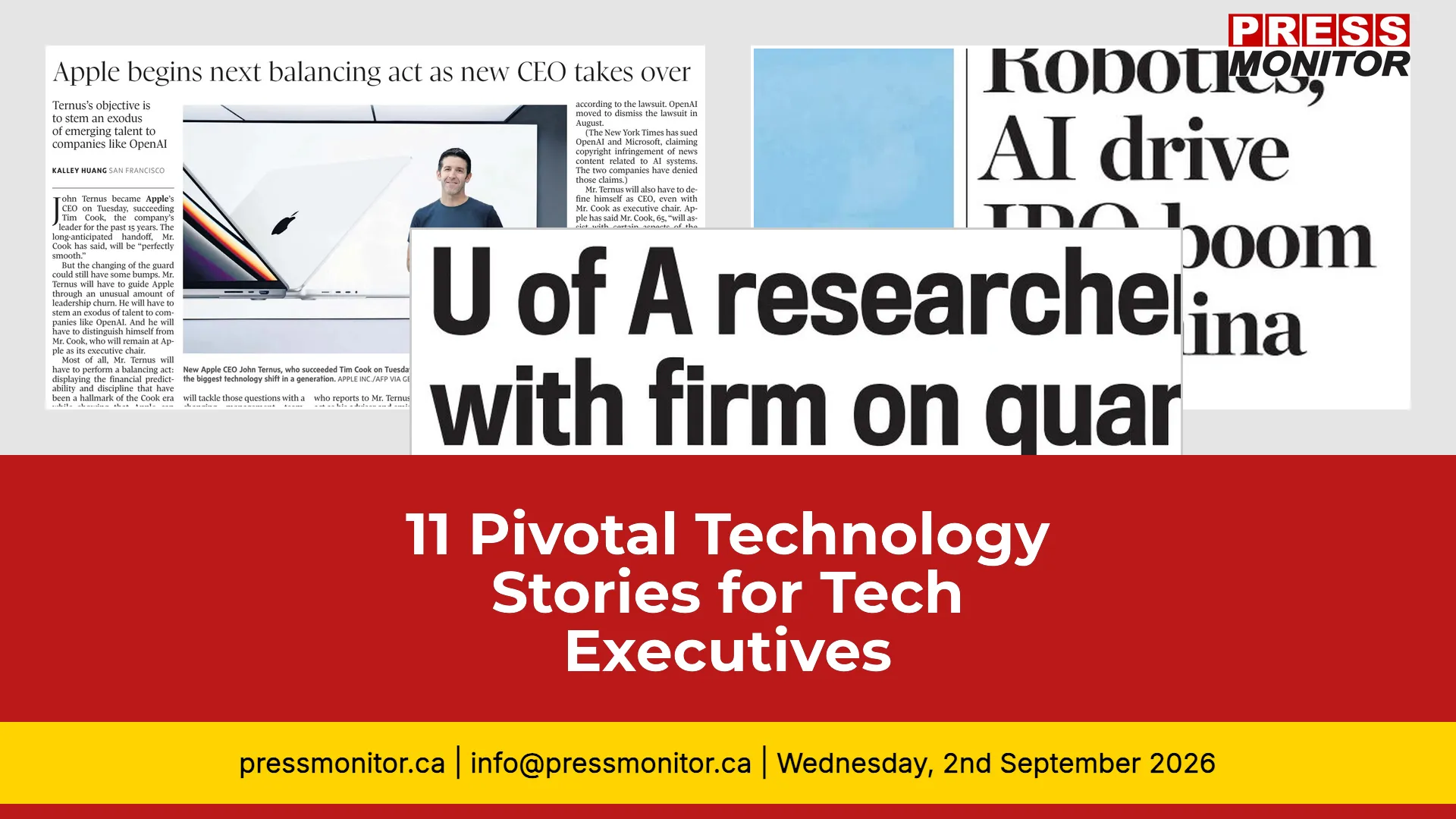
The Globe and Mail reports that John Ternus took over as Apple's chief executive on Tuesday, succeeding Tim Cook, who led the company for 15 years and will stay on as executive chair. Ternus, 51, faces an exodus of talent to OpenAI and a wave of executive retirements while preparing to introduce a foldable iPhone and weave artificial intelligence through Apple's products. John Ternus officially became Apple's CEO on Tuesday, succeeding Tim Cook after 15 years. Cook stays on as executive chair. Ternus faces a talent exodus to OpenAI and a wave of retirements while preparing a foldable iPhone and deeper AI integration. Why it matters: Leadership transitions at Apple ripple across the entire tech ecosystem. Key detail: Ternus, 51, is known for product engineering, having helped design the iPhone. Source: The Globe and Mail. Next step: Watch Apple's September 9 event for AI updates.
2. Shein's $17B IPO Powers China's Tech Boom
Toronto Star reports that Chinese markets are booming with new public stock offerings, driven by investor appetite for artificial intelligence and advanced technology. Shein debuted in Hong Kong with a blockbuster US$17 billion initial public offering, while memory chipmaker CXMT raised more than US$8.6 billion in Shanghai, where its shares jumped 466 per cent on the first day of trading. IPO proceeds in Hong Kong and Shanghai have surpassed US$54 billion so far in 2026, ranking second globally behind only the Nasdaq, according to LSEG. Shein debuted on the Hong Kong exchange in a blockbuster $17 billion IPO, while memory chipmaker CXMT raised $8.6 billion in Shanghai, with shares jumping 466% on day one. Hong Kong and Shanghai listings have raised over $54 billion in 2026, second only to the Nasdaq. Why it matters: This signals a shift in global capital markets toward AI and tech. Key detail: IPO proceeds in these markets now account for 21% of the global total. Source: Toronto Star. Next step: Monitor how these listings affect global tech valuations.
3. Quantum Computing Takes on Cancer
The Calgary Herald reports that Toronto-based Xanadu Quantum Computing has signed a memorandum of understanding with University of Alberta researchers to explore whether quantum computers can design new options for photodynamic therapy, a light-based treatment that kills cancerous tumours. Led by chemistry professor Alex Brown and Xanadu chief operating officer Rafal Janik, the teams will compare classical and quantum computing approaches and expect to begin working together in earnest this fall. Researchers hope to design molecules that absorb infrared light, which penetrates deep into tissue, to destroy cancer cells without invasive surgery. Toronto-based Xanadu Quantum Computing signed an MOU with University of Alberta researchers to explore quantum-designed molecules for photodynamic therapy, a light-based cancer treatment. Led by chemistry professor Alex Brown and Xanadu COO Rafal Janik, the project aims to design molecules that absorb infrared light to destroy tumors without surgery. Why it matters: Quantum computing could revolutionize healthcare. Key detail: The teams will compare classical and quantum approaches starting this fall. Source: Calgary Herald. Next step: Follow the research outcomes for potential clinical applications.
4. Paris Marx's US Tech Alternatives Gain Traction
The Hamilton Spectator reports that Canadian author Paris Marx has seen renewed interest in his catalogue of alternatives to US technology since US President Donald Trump signed an order renaming Lake Ontario to "Lake America." Marx, who hosts the Tech Won't Save Us podcast in St. John's, N.L., recommends services such as Switzerland's Proton, the Netherlands-made Fairphone and Estonia's Organic Maps. Policy researcher Emily Osborne of the Canadian Shield Institute says Canada's reliance on Amazon, Microsoft and Google, which hold 85 per cent of the Canadian public cloud market, poses a sovereign risk. Canadian author Paris Marx has seen renewed interest in his guide to non-US tech alternatives since President Trump's order renaming Lake Ontario to "Lake America." Marx recommends Proton, Fairphone, and Organic Maps. Policy researcher Emily Osborne warns that Canada's reliance on Amazon, Microsoft, and Google—which hold 85% of the public cloud market—poses a sovereign risk. Why it matters: Digital sovereignty is becoming a national priority. Key detail: The episode highlights the need for Canadian control over critical tech infrastructure. Source: The Hamilton Spectator. Next step: Evaluate your organization's dependence on US cloud providers.
5. Nvidia's $3.5B Bet on MediaTek
Financial Post Magazine reports that Nvidia Corp has invested US$3.5 billion in Taiwan's MediaTek Inc., its largest direct investment outside the United States, buying convertible bonds as part of MediaTek's US$3.9 billion bond sale. Taipei-listed MediaTek gained 10 per cent, or about US$20 billion in market value, on Tuesday, cementing its rise as a key designer of custom AI chips for data centres. Led by former TSMC chief Rick Tsai, the company is partnering with Nvidia and Alphabet's Google, and projects its AI chip business will grow to US$2 billion this year and US$12 billion in 2027. Nvidia invested $3.5 billion in Taiwan's MediaTek, its largest direct investment outside the US, buying convertible bonds as part of MediaTek's $3.9 billion bond sale. MediaTek's market value surged 10% (~$20 billion), and its AI chip business is projected to grow to $2 billion this year and $12 billion by 2027. Why it matters: This deepens Nvidia's reach into custom AI chip design for data centers. Key detail: MediaTek is partnering with Nvidia and Google. Source: Financial Post Magazine. Next step: Track MediaTek's AI chip revenue growth.
6. Cape Breton Soccer Clubs Hit by Phishing Scam
Cape Breton Post reports that three Cape Breton minor soccer associations — Glace Bay, Riverview and Whitney Pier — have been targeted by an email scam in which senders impersonate club representatives and request gift card purchases. The clubs warned members on social media on Aug. 20 and Aug. 22, and Soccer Cape Breton president Damien Barry said the organization never solicits gift card purchases through email. According to AAG IT Services, an estimated 3.4 billion phishing emails are sent globally every day, while Cape Breton Regional Police did not respond to a request for comment. Three minor soccer associations in Cape Breton were targeted by an email scam impersonating club reps and requesting gift card purchases. Soccer Cape Breton president Damien Barry confirmed the clubs never solicit gift cards via email. An estimated 3.4 billion phishing emails are sent daily globally. Why it matters: Even local community organizations are vulnerable to cyberattacks. Key detail: The clubs warned members via Facebook on Aug. 20 and 22. Source: Cape Breton Post. Next step: Review your organization's email security protocols.
7. US Urges Hands-Off AI Regulation at G20
The U.S. pressed G2O members to take a hands-off approach to AI regulation and avoid creating new rules for the technology at a gathering of industry titans and commerce ministers in North Carolina. The U.S. goals largely align with the thinking of the world’s biggest AI companies, nearly all of which are American. The US pressed G20 members to avoid creating new AI rules at a gathering in North Carolina, aligning with the world's biggest AI companies. Why it matters: This could shape global AI governance. Key detail: The US position largely matches the interests of American AI giants. Source: The Globe and Mail. Next step: Monitor G20 outcomes for regulatory impacts.
8. Bill C-34 Targets Kids' Social Media
The Montreal Gazette reports that cellphone bans in schools appear to provide a safer environment for young children, following similar moves in Australia and the United Kingdom. Canada's federal government cannot impose a nationwide school cellphone ban because education falls under provincial jurisdiction, but it can set minimum social media age requirements through Bill C-34, the Safe Social Media Act. Health Minister Marjorie Michel, Member of Parliament for Papineau, said the legislation will help young Canadians connect in person, build friendships and focus in school. Canada's federal government is advancing Bill C-34, the Safe Social Media Act, to set minimum social media age requirements. Health Minister Marjorie Michel says it will help young Canadians connect in person and focus in school. Why it matters: This is a federal response to school cellphone bans, which fall under provincial jurisdiction. Key detail: Similar moves have been made in Australia and the UK. Source: Montreal Gazette. Next step: Understand how this affects your organization's social media policies.
9. AI Robot Reacts in 20 Milliseconds
The Vancouver Sun reports that an artificial intelligence-powered robot can react in as little as 20 milliseconds while playing air hockey, outpacing a baseball batter's roughly 400-millisecond decision window. The project began in 2018 and has involved 25 students across seven teams, with the robot now showing human-level behaviours such as dribbling the puck and bank shots that emerged without explicit programming. Its creators are now weighing what a fair competition between a robot and a human should look like. An AI-powered robot can play air hockey with human-level behaviors, reacting in as little as 20 milliseconds—far faster than a baseball batter's 400ms decision window. The project, started in 2018, involved 25 students across seven teams. Why it matters: This showcases advances in real-time AI and robotics. Key detail: The robot developed dribbling and bank shots without explicit programming. Source: Vancouver Sun. Next step: Consider implications for automation and human-robot interaction.
10. Amazon, Microsoft, Google Hold 85% of Canada's Cloud Market
The Standard (St. Catharines) reports that Amazon, Microsoft and Google hold 85 per cent of the public cloud market share in Canada, according to a June report from the Canadian Anti-Monopoly Project. The report warned that Canada's dependence on the three hyperscalers creates a sovereign risk as well as a competition problem. Marx and Osborne say achieving digital sovereignty will require government investment, pointing to France's replacement of Windows, Microsoft Office and Zoom with French and open-source alternatives. A June report from the Canadian Anti-Monopoly Project warns that Canada's dependence on three hyperscalers creates sovereign risk and competition problems. Experts suggest government investment and open-source alternatives, citing France's replacement of Windows and Office. Why it matters: Digital sovereignty is a growing concern for Canadian businesses. Key detail: The report calls for government action to reduce reliance. Source: The Standard. Next step: Assess your cloud strategy for resilience.
11. Lake America: Ontario's Map Blunder
National Post reports that Ontario Crown agencies including Metrolinx, Hydro One and the LCBO were displaying Google Maps labelling Lake Ontario as "Lake America" after the name was drawn from an official American registry. Columnist Barry Appleton argues governments should use Canada's own free register of official place names, kept by Natural Resources Canada since 1897, and set contract terms governing how vendors label Canadian maps. He also notes Washington listed Canada's sovereign cloud procurement questions as a trade barrier in its 2026 National Trade Estimate Report. Ontario Crown agencies, including Metrolinx and Hydro One, displayed Google Maps labeling Lake Ontario as "Lake America" after the name was drawn from a US registry. Columnist Barry Appleton argues governments should use Canada's own place names register and set contract terms for map labeling. Why it matters: This highlights data sovereignty and procurement issues. Key detail: The US also listed Canada's sovereign cloud procurement questions as a trade barrier. Source: National Post. Next step: Review your organization's data sourcing and vendor contracts.
That's your daily media monitoring briefing. For deeper insights, remember that Press Monitor provides comprehensive print media monitoring across Canadian publications. What technology story will you track next?