11 Pivotal Transportation & Logistics Stories for Supply Chain Leaders


Tracking news on transportation & logistics requires precision. This press review distills today’s critical developments across Canadian and global supply chains, powered by rigorous media monitoring and print media monitoring. As geopolitical shifts and infrastructure investments reshape freight networks, here is your essential briefing.
1. Five Die In Amazon Jet Crash
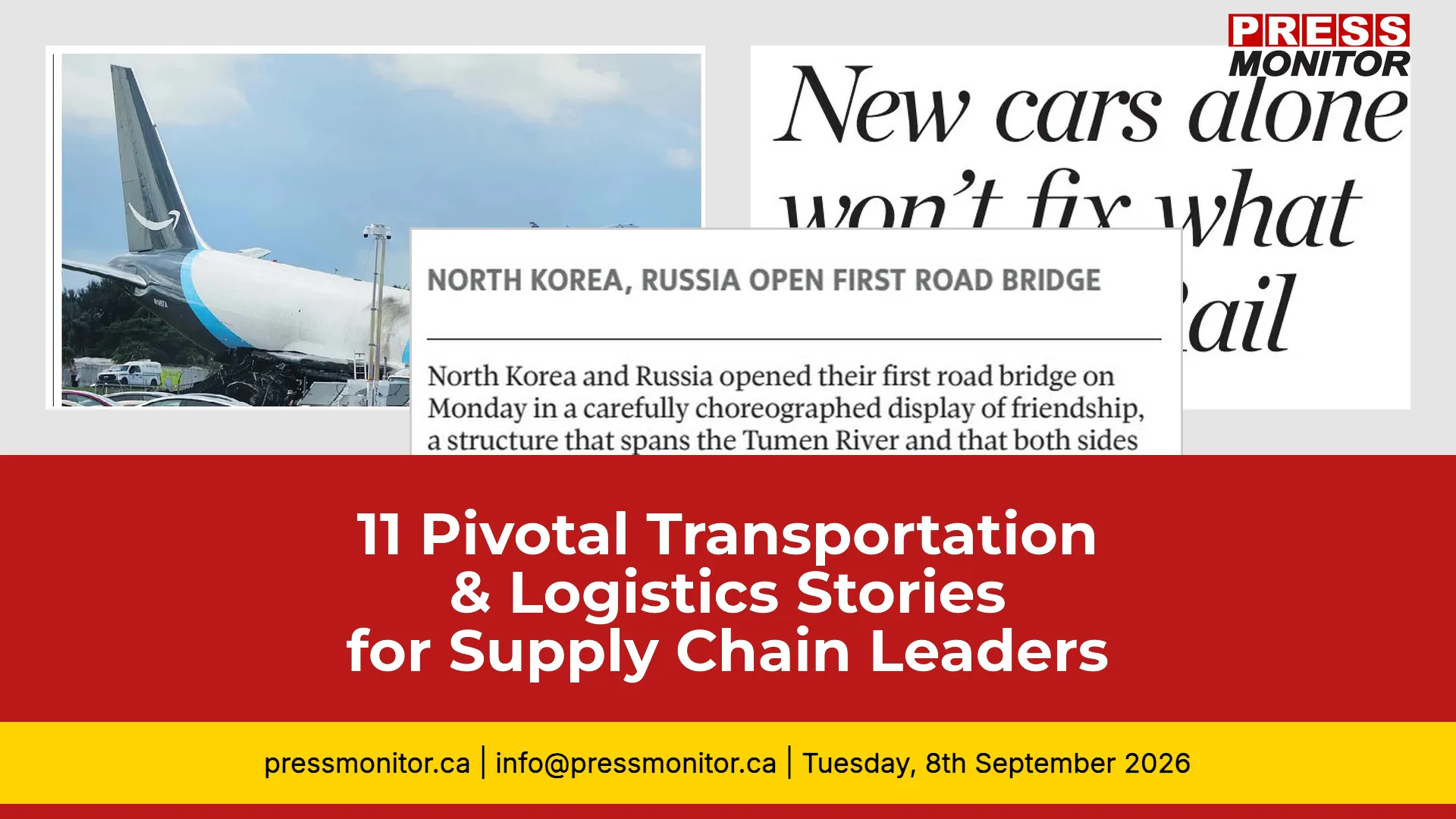
The Times Colonist reports that federal investigators are examining why an Amazon cargo jet veered off a runway at Miami International Airport and into vehicles, killing at least five people. The National Transportation Safety Board is focusing on whether the Boeing 767 touched down too late to stop safely, with video showing the plane remaining airborne well down the runway before landing. Miami-Dade Fire Rescue Chief Ray Jadallah confirmed that crews had to extricate a person trapped under a vehicle, and it was not immediately clear if the pilots were among those killed in the crash that sent thick black smoke billowing into the sky.
Why it matters: Aviation safety directly impacts air cargo reliability and insurance liabilities for logistics operators.
Key detail: Federal investigators are examining whether the Boeing 767 touched down too late to stop safely after overrunning a Miami runway and striking ground vehicles.
Source: Times Colonist
Next step: Review NTSB preliminary findings before adjusting air freight routing protocols.
2. $4.7 Billion Via Rail Fleet
The Standard reports that Prime Minister Mark Carney announced a new fleet of 300 Via passenger rail cars to be built by Alstom in Thunder Bay at a cost of $4.7 billion. The fleet will use Canadian steel and be maintained in Canada, with the goal of making Via Rail faster and more reliable. The announcement also references plans for high-speed rail between Toronto and Quebec City.
Why it matters: Domestic passenger rail modernization signals broader federal commitment to sustainable intercity transport.
Key detail: Prime Minister Mark Carney announced 300 new Alstom cars built in Thunder Bay using Canadian steel, targeting faster service between Toronto and Quebec City.
Source: The Standard (st. Catharines)
Next step: Monitor procurement timelines for potential ripple effects on regional freight corridors.
3. Russia North Korea Open First Road Bridge
The Globe And Mail (ottawa/quebec Edition) reports that North Korea and Russia opened their first road bridge on Monday, creating a permanent link across the Tumen River. Russian Prime Minister Mikhail Mishustin and North Korean Premier Pak Thae Song addressed officials via video, framing the project as a historic milestone in their deepening strategic partnership. The new structure will handle up to three hundred vehicles daily, replacing decades of makeshift plank crossings established since nineteen fifty-nine and significantly boosting bilateral trade and transportation networks.
Why it matters: New Eurasian land bridges could reroute Asian-European freight flows away from traditional maritime chokepoints.
Key detail: The Tumen River crossing allows up to 300 vehicles daily, replacing makeshift crossings and deepening bilateral trade ties amid Western sanctions.
Source: The Globe And Mail
Next step: Assess long-term implications for transcontinental shipping alternatives.
4. Cat reunited with owner after 16 days lost at YYZ
Toronto Sun reports that a seven-year-old feline named Caramel was returned to her Montreal owner after going missing at Toronto Pearson International Airport for just over two weeks. Caramel went missing from her pet carrier on Aug. 17 when owner Abir Batikhi arrived on a flight from Jordan to Toronto and was found inside a humane trap planted inside a cargo facility on Sept. 2. Batikhi, who was travelling with three other cats, called the reunion a miracle and praised Pearson staff and Falcon Environmental Inc.-Environnement Faucon for their efforts.
Why it matters: Highlights the complexities and emotional stakes of live animal logistics within airport cargo operations.
Key detail: A seven-year-old feline was recovered in a Pearson cargo facility humane trap after a coordinated search involving Falcon Environmental Inc.-Environnement Faucon.
Source: Toronto Sun
Next step: Update pet transport handling SOPs to prevent cargo hold incidents.
5. 218,000 Barrels Daily Ship Fuel Shortage Looms
The Globe And Mail (ottawa/quebec Edition) reports that a severe shortage of ship fuel oil is expected in the third quarter as refiners prioritize more profitable products like diesel amid ongoing conflicts in the Middle East and Ukraine. The global deficit could reach 218,000 barrels per day, with Asia facing the steepest impact due to disrupted shipping routes and refinery outages in key exporting regions like the Middle East and Russia. Fuel oil prices have surged 76 percent since the onset of the Iran war, threatening higher costs for shipowners and power generators worldwide.
Why it matters: Bunker fuel deficits directly threaten maritime scheduling and increase ocean freight costs globally.
Key detail: Asia faces the steepest impact as refiners prioritize diesel, pushing fuel oil prices up 76 percent since the Iran war onset.
Source: The Globe And Mail
Next step: Secure alternative bunker contracts and evaluate slow-steaming options.
6. Separated Letters: Venezuela, Central Bank, and Infrastructure
The Globe And Mail (ottawa/quebec Edition) reports that readers respond to recent articles on US energy policy, central bank independence, and Canadian infrastructure vulnerabilities. Letters highlight concerns about Venezuelan oil production, the importance of central bank autonomy, and critical railway links in British Columbia. Additional correspondence addresses gun violence litigation, obesity statistics, and a Hilroy notebook map error.
Why it matters: Public sentiment reflects growing scrutiny on energy policy autonomy and critical railway vulnerabilities in BC.
Key detail: Readers emphasize central bank independence and highlight fragile cross-border rail links essential for resource exports.
Source: The Globe And Mail
Next step: Track editorial discourse for emerging regulatory pressures on energy logistics.
7. Alto Rail Project Faces Call for Cancellation
Ottawa Citizen reports that readers are urging Prime Minister Mark Carney to freeze or cancel the Alto high-speed rail project, citing its estimated cost of 60 billion to 90 billion Canadian dollars and the failures of Ottawa's light rail system. Critics argue that winter weather makes electric trains impractical in Canada and that limited population density reduces potential ridership. Another letter raises concerns about Elections Quebec providing voting information only in French, and a separate submission notes that excessive summer rainfall has ruined wild blueberry crops in Ontario and Quebec.
Why it matters: High-speed rail debates underscore fiscal constraints and climate adaptation challenges for northern transit networks.
Key detail: Critics cite a $60–$90 billion price tag, Ottawa’s LRT struggles, and winter weather impracticality for electric trains.
Source: Ottawa Citizen
Next step: Evaluate public opposition metrics against projected ridership models.
8. U.S. Tariffs Drive Vancouver Freight Demand
The Globe And Mail (ottawa/quebec Edition) reports that Lisa McEwan of the family-owned Hemisphere Freight and Brokerage Services Inc has noted a sharp increase in demand for freight services following a second wave of United States tariffs introduced this summer. Her Vancouver-based operations are directly benefiting from shifting cross-border trade patterns caused by the new federal restrictions.
Why it matters: Shifting trade policies are actively rerouting Pacific coast cargo volumes through Canadian ports.
Key detail: Hemisphere Freight and Brokerage Services reports sharp demand increases following the second summer tariff wave.
Source: The Globe And Mail
Next step: Capitalize on port capacity expansions and adjust customs brokerage workflows.
9. Quebec transit funding crisis
Montreal Gazette reports that Quebec tailpipe pollution from cars is the fastest-growing source of greenhouse gases, with a social cost of C$2.4 billion in 2026. Yet public transit remains overlooked by political parties, while the CAQ government has starved mass transport of funding and no new projects have launched in Greater Montreal for eight years. Studies show losing existing transit would add 688,000 cars to roads, but new projects like the Blue Line extension and REM expansions could boost affordability, fight climate change, and create jobs.
Why it matters: Underinvestment in mass transit exacerbates tailpipe emissions and road congestion, straining urban freight efficiency.
Key detail: Losing existing transit would add 688,000 cars to roads, while REM expansions remain stalled despite a $2.4 billion social cost of pollution.
Source: Montreal Gazette
Next step: Advocate for integrated urban mobility funding to protect last-mile delivery windows.
10. Peru Shows Boundaries of Washington's Anti-China Push
The Globe And Mail reports that China's expanding economic footprint in Peru, marked by the US$1.3-billion Chancay megaport, has become a flashpoint in Western Hemisphere strategy as the Trump administration seeks to roll back Beijing's influence. Peruvian officials and analysts argue the port is economically vital and reject U.S. sovereignty warnings, while China remains Peru's largest trading partner and has filled investment gaps left by Western financiers. Secretary of State Marco Rubio is planning a visit this week as diplomatic friction escalates over the port's regulation and broader economic ties.
Why it matters: The Chancay megaport represents a strategic pivot in Latin American maritime logistics and Sino-American trade dynamics.
Key detail: China’s $1.3 billion investment fills Western financing gaps, prompting State Department diplomatic friction over port regulation.
Source: The Globe And Mail
Next step: Monitor Panama Canal diversion trends and South American port partnerships.
11. New Marine Atlantic Ferry Arrives
Cape Breton Post reports that the newest Marine Atlantic ferry, the Ile Rouge, has arrived and is docked at North Sydney. The vessel, named after a small island off Newfoundland's Port au Port Peninsula, has capacity for approximately 900 people and features 146 passenger cabins, 48 of which are pet-friendly. It will enter service later this fall after final preparations and employee training.
Why it matters: Expanded ferry capacity strengthens coastal supply chains and supports seasonal tourism logistics in the Maritimes.
Key detail: The Ile Rouge docks in North Sydney with space for 900 passengers and 48 pet-friendly cabins, entering service this fall.
Source: Cape Breton Post
Next step: Align vehicle transport bookings with peak travel schedules.
This media intelligence briefing captures the operational realities shaping today’s freight landscape. How will your network adapt to shifting port tariffs and aviation safety protocols? Stay ahead of the curve with consistent tracking.