13 Essential First Nations & Indigenous Stories for Policy Leaders


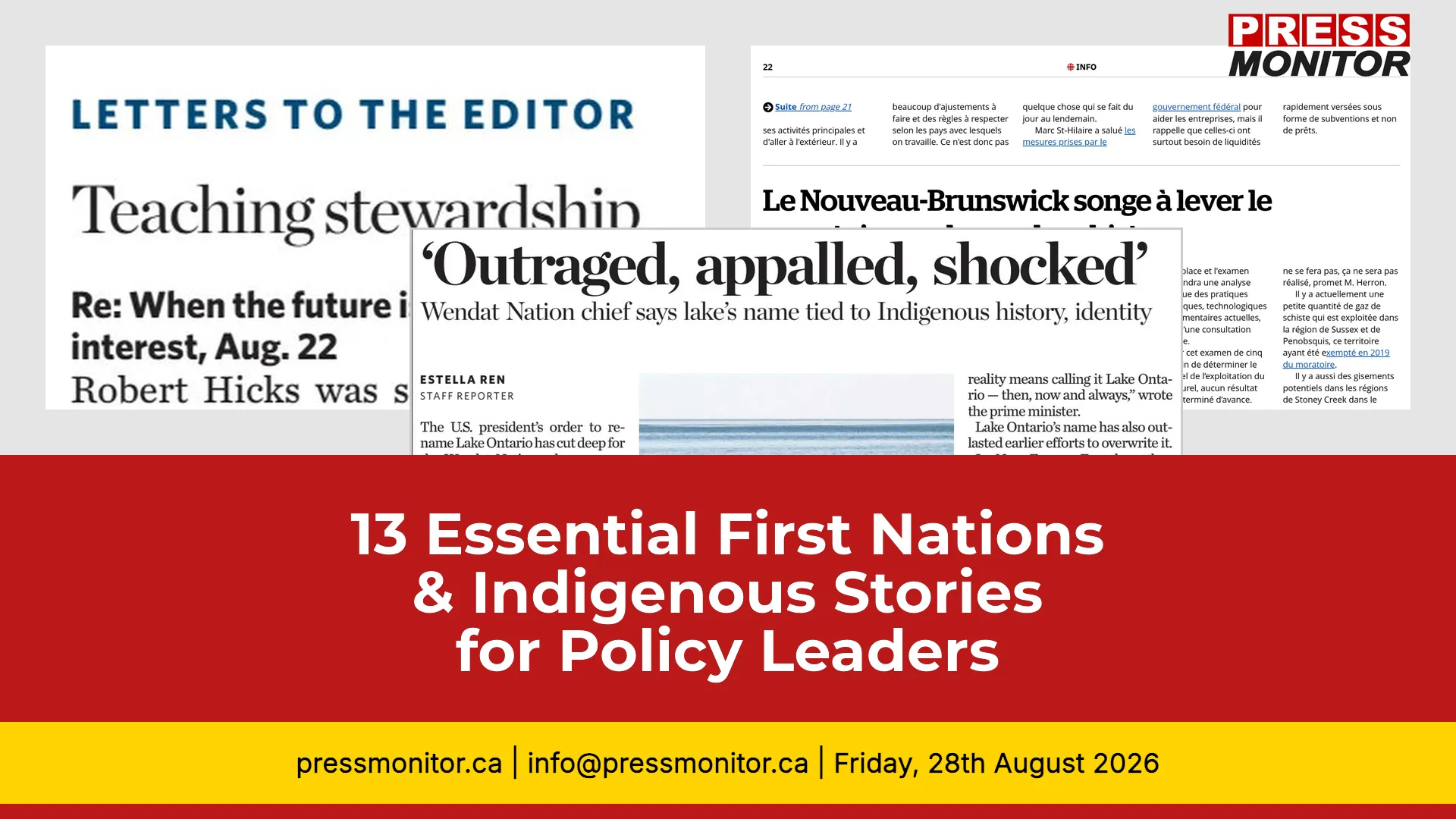
Media monitoring is the backbone of informed decision-making. This press review, curated by Press Monitor's tracking of Canadian publications, delivers the top First Nations and Indigenous stories making headlines. From the fight for cultural recognition to pivotal policy shifts, these 13 stories offer a comprehensive snapshot of today's landscape.
1. Teaching Stewardship
The Standard (St. Catharines) reports that Robert Hicks was spot on when he wrote “Indigenous Peoples have long asked us to think differently about our relationship with land, water and those who come after us.” The Haudenosaunee or Iroquois Confederacy espouse the philosophy of the Seventh Generation Principle.
Why it matters: The Seventh Generation Principle, rooted in Haudenosaunee philosophy, is gaining traction as a guiding framework for sustainable policy.
Key detail: Roger Demers' letter appears in both The Standard and The Welland Tribune, amplifying the call for long-term thinking.
Source: The Standard (St. Catharines) / The Welland Tribune
Next step: Incorporate this principle into your organization's sustainability reports.
2. New Brunswick to Review Gas Shale Moratorium
«Le Nouveau-Brunswick songe à lever le beaucoup d'ajustements à faire et des règles à respecter selon les pays avec lesquels on travaille. Ce n'est donc pas quelque chose qui se fait du jour au lendemain. Marc St-Hilaire a salué les mesures prises par le gouvernement fédéral pour aider les entreprises, mais il rappelle que celles-ci ont surtout besoin de liquidités. Nicolas Steinbach La province va entamer un examen public au cours des cinq prochains mois pour déterminer si elle va lever le moratoire sur l'exploration et l'exploitation du gaz de schiste. En décembre 2014, le gouvernement libéral du premier ministre libéral Brian Gallant a officiellement imposé un moratoire sur la fracturation hydraulique pour l'extraction du gaz de schiste au Nouveau- Brunswick. Ce n'est pas un feu vert pour commencer à forer dès maintenant. Susan Holt, première ministre du Nouveau- Brunswick Cette décision avait été prise après des mois de manifestations contre le gaz de schiste menées entre autres par les communautés autochtones. Le monde a changé, dit la première ministre Susan Holt, avec le coût de la vie qui a explosé, des déficits plus élevés et la relation avec les États-Unis. La population du Nouveau-Brunswick et notre province font face à d'importantes pressions économiques, et nous ne ménagerons aucun effort pour trouver des occasions de renforcer notre économie et de créer des emplois bien rémunérés pour les gens du Nouveau-Brunswick, dit la première ministre. L'exploitation du gaz de schiste est dans la ligne de mire des progressistes-conservateurs, qui forment l'opposition officielle au Nouveau-Brunswick. Les deux candidats à la chefferie, Daniel Allain et Don Monahan, s'entendent sur la nécessité de lever le moratoire. Cinq conditions pour exploiter le gaz naturel. Le gouvernement indique qu'il ne prend pas cette discussion à la légère et que cette consultation va se faire avec les communautés autochtones. Face aux tarifs douaniers imposés par le président américain, nous devons regarder les occasions dans notre province, dit la première ministre Susan Holt. Nous avons une responsabilité comme gouvernement, et le Nouveau-Brunswick a ce dont le monde a besoin, dit-elle. Aujourd'hui, le Nouveau-Brunswick a besoin d'un approvisionnement stable en énergie et la province est dépendante du gaz naturel américain, rappelle la première ministre. Cinq conditions seront évaluées au cours des cinq prochains mois : les droits, intérêts et priorités des Premières Nations; l'ampleur et la nature des ressources en gaz naturel; les plus récentes données scientifiques concernant les répercussions potentielles sur l'eau, la santé et l'environnement; les avantages économiques; le soutien du public. Un groupe d'experts sera mis en place et l'examen comprendra une analyse technique des pratiques scientifiques, technologiques et réglementaires actuelles, ainsi qu'une consultation publique. Pour cet examen de cinq mois afin de déterminer le potentiel de l'exploitation du gaz naturel, aucun résultat n'est déterminé d'avance. Susan Holt, première ministre du Nouveau- Brunswick Pour l'instant, il n'y a pas de promoteur ni d'entreprise privée qui se sont montrés intéressés à exploiter le gaz naturel dans la province advenant la levée du moratoire, a indiqué la première ministre. Douze ans depuis l'imposition du moratoire Il s'est passé 12 ans depuis l'application du moratoire du gaz naturel et la science a évolué durant ces années, dit le ministre des Ressources naturelles, John Herron. Si nous ne pouvons pas démontrer que ça peut se faire de façon sécuritaire, ça ne se fera pas, ça ne sera pas réalisé, promet M. Herron. Il y a actuellement une petite quantité de gaz de schiste qui est exploitée dans la région de Sussex et de Penobsquis, ce territoire ayant été exempté en 2019 du moratoire. Il y a aussi des gisements potentiels dans les régions de Stoney Creek dans le comté d'Albert et de Hillsborough. Nous examinerons les données de ces sites durant ce travail de révision, indique le ministre des Ressources naturelles. Il avance que, selon les estimations des experts, il y aurait des volumes potentiels de 60 trillions de pieds cubes de gaz de schiste dans le champ gazier McCully (Sussex) et 12 trillions de pieds cubes à Stoney Creek. Les relations avec les communautés autochtones Les chefs mikmaq ont indiqué que le gouvernement du Nouveau-Brunswick leur avait demandé de participer à un processus visant à déterminer la viabilité de l'exploitation du gaz naturel dans la province. Nous savons que c'est une question extrêmement importante pour de nombreux membres de notre communauté. L'histoire nous a montré ce qui arrive lorsque nous sommes exclus d'un processus, en particulier en ce qui concerne l'exploitation du gaz naturel, indique l'organisation Migmawe'l Tplu'taqnn dans un communiqué. Le gouvernement assure que, cette fois, les communautés vont être consultées et impliquées tout au long du processus. Le conseil de bande d'Elsipogtog, dont l'ancienne cheffe Susan Levi-Peters avait mené les manifestations en 2013 indique que la présence de leurs membres durant l'examen et les consultations ne doit pas être interprétée comme un appui à l'exploitation du gaz naturel ni à la levée du moratoire.
Why it matters: The review directly involves First Nations consultations and could reshape energy policy in the region.
Key detail: Premier Susan Holt emphasized five conditions, including Indigenous rights and environmental safety.
Source: Radio-Canada Info
Next step: Monitor the five-month public consultation for investment signals.
3. Wendat Nation's Protest Against Lake Ontario Name Change
The Toronto Star reports that Grand Chief Pierre Picard of Wendat Nation expressed outrage over President Trump’s decision to rename Lake Ontario 'Lake America', stating it attempts to eradicate their history. The name originates from the Wendat word Ontariio’, which means 'the lake is beautiful' or 'the lake is great'.
Why it matters: President Trump's renaming of Lake Ontario to 'Lake America' erases Indigenous history.
Key detail: Grand Chief Pierre Picard called it an attempt to eradicate the Wendat heritage.
Source: Toronto Star
Next step: Support Indigenous-led efforts to preserve place names.
4. Indigenous Law Repeal Petition Approved
Times Colonist reports that Elections B.C. has granted in-principle approval for a petition to proceed seeking the repeal of British Columbia’s Declaration on the Rights of Indigenous Peoples Act. The petition’s proponent is Harman Bhangu, transportation critic for the provincial Opposition B.C. Conservatives.
Why it matters: A petition to repeal B.C.'s Declaration on the Rights of Indigenous Peoples Act has been approved by Elections B.C.
Key detail: Harman Bhangu, transportation critic, is the proponent.
Source: Times Colonist
Next step: Prepare for a potential referendum campaign.
5. Media Needs to Ditch Indigenous Stereotypes
The Cape Breton Post reports that media needs to ditch Indigenous stereotypes and provide more culturally sensitive coverage. It highlights the critical role of media in perpetuating Indigenous inequities in Canada, fostering division and conflict through ignorance and misinformation. The article discusses the negative stereotyping of Indigenous Peoples in media and its profound implications, particularly in the cases of missing and murdered Indigenous women and girls.
Why it matters: Media coverage continues to perpetuate harm, especially around missing and murdered Indigenous women.
Key detail: Peter McKenna argues for culturally sensitive reporting.
Source: Cape Breton Post
Next step: Review your media guidelines for Indigenous representation.
6. New Family Doctor for Battlefords First Nations
Radio-canada Info reports that three First Nations in the Battlefords region now have access to a family doctor without leaving their communities. The Battle River Treaty 6 Health Centre, in partnership with the Saskatchewan Health Authority, has deployed a new service to Little Pine, Poundmaker, and Sweetgrass.
Why it matters: Access to healthcare is a critical issue for remote First Nations communities.
Key detail: The Battle River Treaty 6 Health Centre deployed a family doctor to Little Pine, Poundmaker, and Sweetgrass.
Source: Radio-Canada Info
Next step: Advocate for similar healthcare models in other regions.
7. Return of a Painted Tipi
Radio-canada Info reports that a painted tipi belonging to the First Nation of Kawacatoose in Saskatchewan is set to return to its community on August 28. The artifact, currently held at the Smithsonian National Museum of the American Indian, marks the end of nearly two years of efforts by the First Nation, the American museum, and researchers from the University of First Nations Canada.
Why it matters: Repatriation of cultural artifacts strengthens Indigenous sovereignty.
Key detail: The tipi, held at the Smithsonian, is returning to Kawacatoose First Nation after two years of effort.
Source: Radio-Canada Info
Next step: Support cultural repatriation initiatives.
8. Miss Indigenous Canada Pageant Promotes Sisterhood and Leadership
Edmonton Journal reports that University of Saskatchewan law student Kiauna Cote represented Ochapowace Nation at the Miss Indigenous Canada pag eant in Brantford, Ontario, winning the Charitable Giving and People's Choice awards in late July. The event features workshops, cultural activities, and a competition where delegates from across Canada share their heritage and raise money for selected causes.
Why it matters: The pageant showcases Indigenous leadership and philanthropy.
Key detail: Kiauna Cote, from Ochapowace Nation, won Charitable Giving and People's Choice awards.
Source: Edmonton Journal
Next step: Highlight these role models in your communications.
9. Canada Focuses on Sovereignty Costs in North
The Hamilton Spectator reports that Canada needs to develop infrastructure in northern regions, including transportation corridors, to demonstrate sovereignty. The article highlights security concerns, including potential threats from other nations, as global temperatures rise and the Northwest Passage opens up for shipping.
Why it matters: Infrastructure development in the Arctic is tied to Indigenous land rights and security.
Key detail: The Northwest Passage opening creates both opportunities and threats.
Source: Hamilton Spectator
Next step: Engage with Indigenous communities on northern development plans.
10. Lenteur Administrative dans les Reconnaissances Autochtones en Gaspésie
Radio-Canada Info rapporte que des citoyens de la Gaspésie dénoncent la lenteur administrative de Services aux Autochtones Canada dans le processus de reconnaissance de leur statut d'Indien comme membres de la Nation Gespeg.
Why it matters: Administrative delays hinder Indigenous status recognition, affecting access to services.
Key detail: Citizens of the Gespeg Nation denounce slow processing by Indigenous Services Canada.
Source: Radio-Canada Info
Next step: Push for streamlined recognition processes.
11. Mistaken Identity Issues
The Chronicle Herald reports that journalists need to avoid manipulating facts to further grievances and educate themselves on the history of Indigenous Peoples and colonial violence. It also discusses cases of mistaken identity, including a lawsuit by Cape Breton fiddler Ashley Maclsaac against Google for false search results.
Why it matters: Journalists must educate themselves on Indigenous history to avoid errors.
Key detail: The article also discusses a lawsuit by Cape Breton fiddler Ashley MacIsaac against Google.
Source: Chronicle Herald
Next step: Invest in media training on Indigenous cultural competency.
12. Indigenous Stewardship, Lake Renaming, Townhouse Project
The Standard reports that Robert Demers highlights Indigenous stewardship and the Seventh Generation Principle. Roscoe Reilly criticizes Trump's renaming of Lake Ontario. Douglas Todd expresses disappointment over a Welland townhouse project.
Why it matters: Letters to the editor reflect public discourse on Indigenous stewardship and controversial policies.
Key detail: Robert Demers highlights the Seventh Generation Principle; Roscoe Reilly criticizes the lake renaming.
Source: The Standard (St. Catharines)
Next step: Use these letters to gauge community sentiment.
13. Indigenous Stewardship and Trump's Controversial Moves
The Welland Tribune reports on letters to the editor that highlight the importance of Indigenous stewardship and the impact of President Trump's controversial actions, including renaming Lake Ontario and other aggressive foreign policy moves.
Why it matters: The intersection of Indigenous perspective and U.S. foreign policy is under-discussed.
Key detail: The letter ties Trump's actions to a disregard for Indigenous values.
Source: Welland Tribune
Next step: Consider the international implications of domestic Indigenous policies.
Closing: Which of these stories resonates most with your work? Share your thoughts below. This media intelligence is brought to you by Press Monitor — your trusted source for print media monitoring across Canada.