13 Essential Human Resources Stories for HR Leaders


Stay informed with the latest news on human resources, labour relations, and workplace policy across Canada. According to Press Monitor's tracking of Canadian publications, these 13 stories are making headlines. From federal aid packages to workplace tragedies, here's what HR professionals need to know.
1. Canada Launches $7.5B Counter-Tariff Support
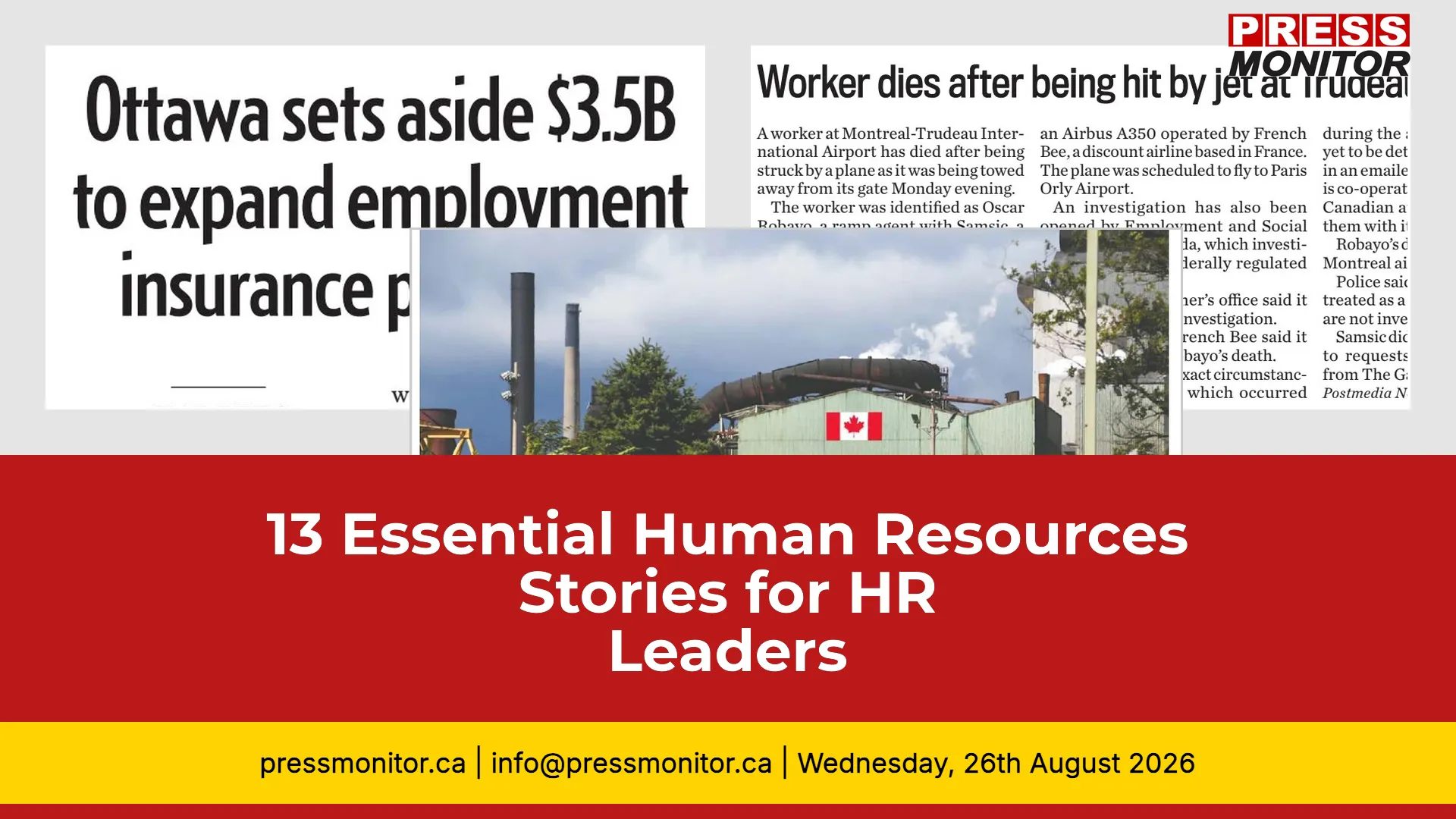
{source_name} reports that Canada is implementing a $7.5 billion aid package to offset U.S. tariffs, including $1.5 billion to a Regional Tariff Response Initiative, $500 million to the Business Development Bank, and $3.5 billion for employment insurance. Industry Minister Mélanie Joly emphasized urgent support access while acknowledging sustained uncertainty, and Bank of Montreal economist Michael Gregory projected potential GDP impacts.
Why it matters: This aid package directly impacts workforce stability and business continuity.
Key detail: The $7.5B package includes $1.5B for a Regional Tariff Response Initiative, $500M for BDC, and $3.5B for EI. Industry Minister Mélanie Joly stressed urgent access.
Source: Montreal Gazette
Next step: HR leaders should review eligibility for business support programs and communicate with employees about potential impacts.
2. Worker Dies After Being Hit by Jet at Trudeau Airport
The Montreal Gazette reports that a worker at Montreal-Trudeau International Airport died after being struck by a plane as it was being towed away Monday evening. The worker was identified as Oscar Robayo, a ramp agent with Samsic, a French company that provides various ground services to airlines using the airport. The Transportation Safety Board has dispatched a team of investigators. The aircraft involved, an Airbus A350 operated by French Bee, was scheduled to fly to Paris Orly Airport.
Why it matters: A tragic reminder of workplace safety risks in aviation.
Key detail: Oscar Robayo, a ramp agent with Samsic, was struck by an Airbus A350 during pushback. TSB investigating.
Source: Montreal Gazette, Le Journal de Montreal, Times Colonist
Next step: Review safety protocols for ground operations and ensure proper training.
3. U.S. Should Target Job Offshoring, Not Canada, Says UAW President
Edmonton Journal reports that Shawn Fain, president of the United Auto Workers union, suggests the U.S. should target countries job offshoring rather than Canada in response to trade disputes. He believes tariffs should be directed toward nations enabling corporate offshoring of jobs.
Why it matters: Trade policy direction affects Canadian jobs.
Key detail: Shawn Fain of UAW argues tariffs should target countries enabling offshoring.
Source: Edmonton Journal, Ottawa Citizen
Next step: Monitor trade policy developments for potential impacts on manufacturing jobs.
4. Dynacare Strike Deadline Set for Sept. 8
Winnipeg Sun reports that nearly 350 Dynacare laboratory professionals in Manitoba could walk off the job Sept. 8 after their union issued a strike deadline following a near-unanimous strike vote.
Why it matters: Potential strike of 350 lab professionals in Manitoba.
Key detail: Union issued strike deadline after near-unanimous vote.
Source: Winnipeg Sun
Next step: Prepare contingency plans for lab services.
5. Ottawa Accelerates Employment Insurance Payments
Le Journal de Montreal reports that Ottawa plans to accelerate the disbursement of employment insurance payments and simplify procedures to aid businesses and workers affected by Trump's tariffs, particularly in steel, aluminum, and furniture.
Why it matters: Faster EI disbursement supports workers affected by tariffs.
Key detail: Government simplifies procedures for EI to aid steel, aluminum, and furniture workers.
Source: Le Journal de Montreal
Next step: Inform employees about expedited EI access.
6. PSAC Bans Local President Ahead of Re-election
"Selon le Cape Breton Post, le Public Service Alliance of Canada (PSAC) a interdit à vie l’un de ses présidents locaux juste avant qu’il ne prévoie de se représenter, marquant la dernière bataille entre la plus grande organisation syndicale du pays et l’une de ses propres unités. Dans une lettre du 11 août obtenue par National Post, la présidente nationale du PSAC, Sharon DeSousa, a écrit à Theo Lagakos, président d’un local qui représente plus de 1200 travailleurs d’un casino populaire de Toronto, pour lui dire qu’il avait été interdit à vie en raison d’un « schéma de comportement répété et ciblé contre le plaignant ». Le bannissement signifie que Lagakos n’est plus éligible à se présenter aux élections syndicales la semaine dernière pour conserver son poste. Cela pourrait ouvrir la voie à quelqu’un plus en phase avec l’équipe dirigeante du PSAC pour obtenir le poste de premier du local."
Why it matters: Internal union governance impacts labour relations.
Key detail: PSAC permanently banned Theo Lagakos, president of a Toronto casino local, citing a pattern of behaviour.
Source: Cape Breton Post
Next step: Stay informed on union dynamics that may affect bargaining.
7. Nova Scotia Civil Service Cuts Hit Cybersecurity
The Chronicle Herald reports that the Nova Scotia government's four-year civil service reduction plan has resulted in layoffs at the Department of Cyber Security and Digital Solutions, affecting ten administrative roles since February. NSGEU president Sandra Mullen confirmed at least 100 union members have received layoffs and called on Premier Tim Houston to reconsider the cuts.
Why it matters: Government workforce reductions affect public sector HR.
Key detail: Ten positions eliminated in cybersecurity, with 100+ union members laid off across departments.
Source: The Chronicle Herald
Next step: Public sector HR leaders should reassess staffing strategies.
8. Auto Production Decline in Canada Post-NAFTA
Times Colonist reports that since the NAFTA agreement in 1994, Canada has seen a significant drop in auto production, falling by 38% in 2025 from 2.1 million to 1.3 million units. Despite a 40% population increase, the U.S. saw an 18% decline in auto production, while Mexico's production tripled.
Why it matters: Long-term manufacturing job trends.
Key detail: Canadian auto production fell 38% since 1994, while Mexico tripled.
Source: Times Colonist
Next step: Consider retraining programs for displaced auto workers.
9. Job Cuts Controversy: ERI Program Under Fire
Ottawa Citizen reports that a former federal executive is questioning the government’s handling of job cuts through the Early Retirement Incentive (ERI) program. Concerns are raised about the sequence of workforce adjustment measures and ERI approvals, suggesting missed opportunities for voluntary departures.
Why it matters: Federal workforce adjustment strategy questioned.
Key detail: Former executive criticizes sequencing of ERI and layoffs.
Source: Ottawa Citizen
Next step: Review voluntary departure options in your organization.
10. Stelco Output Falls to 55% Capacity Amid Trade War
The Hamilton Spectator reports that Stelco's Hamilton facility has operated at significantly lower capacity for months due to the Canada-US trade war. President of United Steelworkers Local 1005 Ron Wells estimates output levels for coated steel products have been around fifty-five to sixty per cent since April, compared to the usual ninety percent.
Why it matters: Steel industry job security.
Key detail: USW Local 1005 reports output down from 90% to 55% since April.
Source: The Hamilton Spectator
Next step: Monitor production levels for potential layoff implications.
11. Tariff Talks: Alberta's Diplomatic Edge
Calgary Herald reports that Ontario Premier Danielle Smith declined to impose counter-tariffs on U.S. imports due to risks to Ontario and Quebec, despite Alberta's opposition to potential 25% duties. Smith emphasized Alberta is unaffected by U.S. oil tariffs due to Enbridge's Line 5 infrastructure. Economists highlighted provincial job loss risks, with Alberta facing 9,000 possible losses versus British Columbia's 11,000 estimated jobs affected by national supply chain disruptions.
Why it matters: Provincial differences in tariff impact.
Key detail: Premier Smith avoids counter-tariffs on oil; Alberta faces 9,000 potential job losses vs BC's 11,000.
Source: Calgary Herald
Next step: HR in Alberta should prepare for supply chain disruptions.
12. Tens of Thousands of Jobs in Peril Under New Tariffs
The U.S. implemented a new 50 per cent tax on imports of hundreds of Canadian items including furniture, plastics, plywood and electrical equipment. It’s such a high rate that it may cut off the world’s biggest market for some Canadian enterprises.
Why it matters: New 50% US tariff on Canadian goods threatens jobs.
Key detail: Furniture, plastics, plywood, electrical equipment sectors hit hard.
Source: Saskatoon StarPhoenix
Next step: Identify at-risk roles and plan for potential layoffs.
13. U.S. Tariffs Impact on Canadian Economy
A University of Calgary economics professor estimates that 90,000 jobs — or about 0.4 per cent of Canada’s labour force — may be lost if the new U.S. tariffs persist. Escalation of the trade fight makes things more complicated for the Bank of Canada: US. tariffs hit sales and weaken growth, while retaliatory duties fuel inflation at home.
Why it matters: Macroeconomic impact on labour market.
Key detail: Professor estimates 90,000 jobs (0.4% of labour force) could be lost; Bank of Canada faces growth-inflation tradeoff.
Source: Regina Leader-Post
Next step: Factor economic forecasts into workforce planning.
This press review is powered by Press Monitor's media intelligence platform, providing comprehensive print media monitoring for HR professionals. What steps is your organization taking to address these workforce challenges?
