13 Essential Trade Stories for Business Leaders


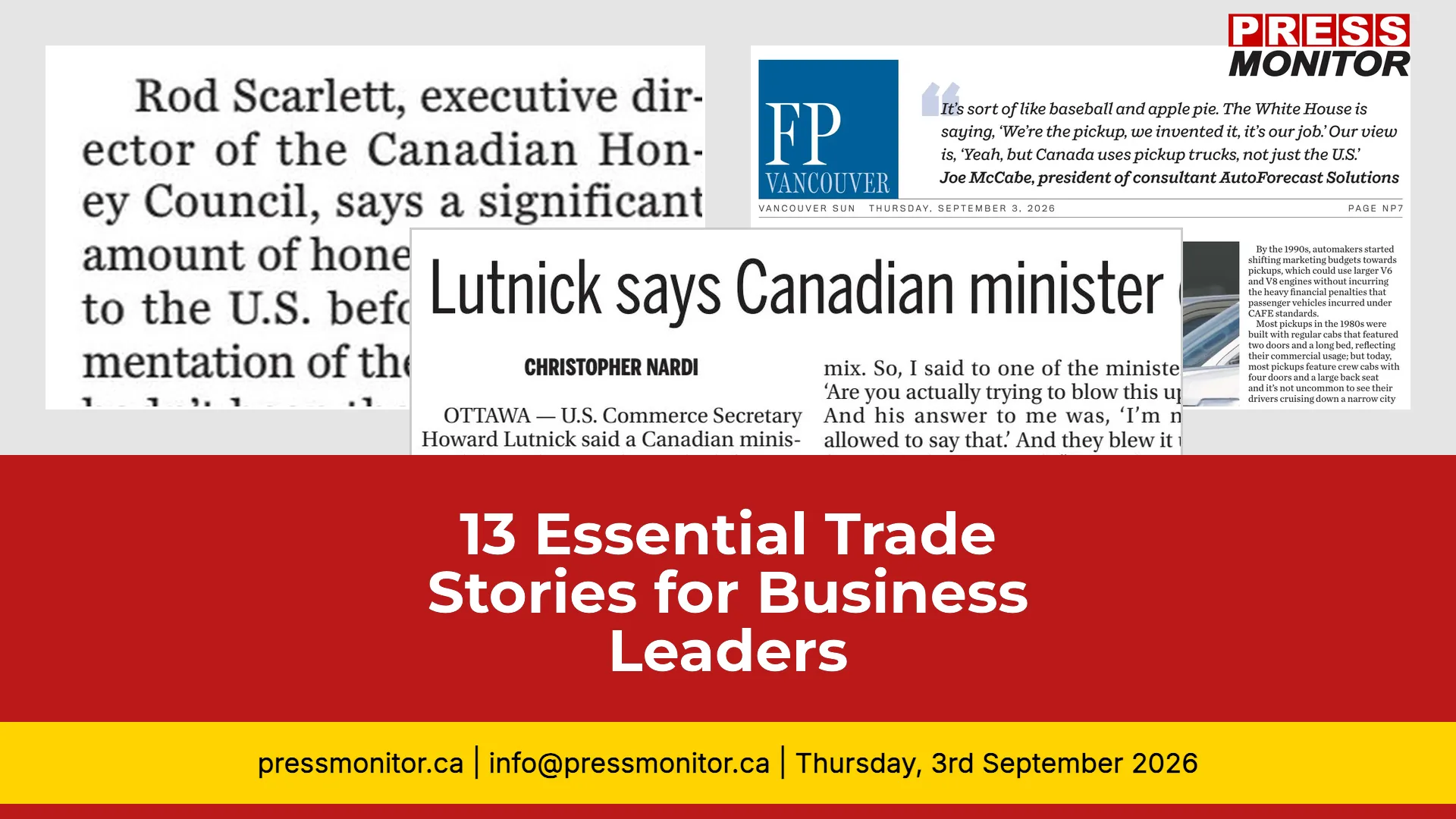
Media monitoring of Canadian print publications reveals 13 essential trade stories today — from tariffs on honey and autos to the collapse of negotiations and businesses bracing for counter-tariffs. This press review, grounded in media intelligence and print media monitoring, captures the full scope of the trade war's impact on Canadian businesses, workers, and policymakers. Tracked by Press Monitor, these stories represent the most-covered developments in Canadian print media on news on trade.
1. Canadian Honey Stuck in Tariff Limbo
Vancouver Sun reports that tariffs have left Canadian honey exports to the United States in limbo, with the Canadian Honey Council warning of broader damage if the disruption extends into the new year. Executive director Rod Scarlett and Alberta Beekeepers Commission executive director Barbara Engelbart McKenzie say the bigger risk is to pollination, which supports crops from canola to blueberries across Canada. The industry is pursuing new export partners and domestic marketing, urging companies like General Mills and Kellogg's to proclaim their use of Canadian honey. A 50% US tariff has left Canadian honey exports in limbo, with 80.2% of exports by quantity previously destined for the United States. The Canadian Honey Council warns of broader damage to pollination, which supports crops from canola to blueberries. Producers like Podolski Honey Farms have lost up to 90% of their US customers. Industry is pursuing new export partners and urging companies like General Mills and Kellogg's to proclaim their use of Canadian honey.
2. GM's C$144-Million Pickup Bet
Vancouver Sun reports that General Motors will spend C$144 million to expand pickup production at its Oshawa, Ontario assembly plant, even as medium- and heavy-duty pickups remain a key sticking point in Canada's trade war with the United States. Prime Minister Mark Carney cited a US tariff exception on Canadian-made pickups as a reason trade talks broke down, saying it would have threatened GM's Oshawa plant and Ford's C$5-billion investment in Oakville. Pickups account for less than 10 per cent of the 1.2 million vehicles produced in Canada but about 25 per cent of US output, and are the most profitable vehicles in an automaker's portfolio. General Motors will spend C$144 million to expand pickup production at its Oshawa, Ontario assembly plant, even as medium- and heavy-duty pickups remain a key sticking point in Canada's trade war. Prime Minister Mark Carney cited a US tariff exception on Canadian-made pickups as a reason trade talks broke down, saying it would have threatened GM's Oshawa plant and Ford's C$5-billion investment in Oakville. Pickups account for less than 10% of Canadian vehicle production but about 25% of US output.
3. Lutnick Claims Canadian Minister Did Not Deny Sabotage
The Province reports that U.S. Commerce Secretary Howard Lutnick claimed a Canadian minister did not deny trying to "blow up" trade negotiations last month. Lutnick, a close adviser to U.S. President Donald Trump, made the claim during an interview on CNBC, stating that the Canadian side added last-minute unacceptable conditions to the draft deal text. US Commerce Secretary Howard Lutnick claimed a Canadian minister did not deny trying to 'blow up' trade negotiations last month. Lutnick, a close adviser to President Donald Trump, made the remark during a CNBC interview, stating that the Canadian side added last-minute unacceptable conditions to the draft deal text. The claim adds a new dimension to the already collapsed talks.
4. 50% Tariff Hits Canadian Artists
Vancouver Sun reports that Ottawa visual artist Michael Harrington has cancelled an upcoming exhibition in Boston after the United States imposed a 50 per cent tariff on Canadian artwork, part of new duties on nearly C$30 billion worth of Canadian goods announced August 22. The Canadian Artists' Representation (CARFAC) is asking Ottawa to seek an exemption for original artworks and provide financial relief, while inflation fears tied to the U.S.-Iran conflict have already cut art sales. Ottawa visual artist Michael Harrington cancelled an upcoming exhibition in Boston after the US imposed a 50% tariff on Canadian artwork, part of new duties on nearly C$30 billion worth of Canadian goods. The Canadian Artists' Representation (CARFAC) is asking Ottawa to seek an exemption for original artworks and provide financial relief, while inflation fears tied to the US-Iran conflict have already cut art sales.
5. Trump Imposes 50% Tariffs on Canadian Imports
Regina Leader-post reports that President Donald Trump imposed 50 per cent tariffs on US$20 billion worth of Canadian imports. Canada retaliated with duties set to take effect on Sept 8 on a similar amount of U.S. goods. The talks collapsed due to issues including proposed tariff arrangements affecting key industries such as auto manufacturing. President Donald Trump imposed 50% tariffs on US$20 billion worth of Canadian imports. Canada retaliated with duties set to take effect on September 8 on a similar amount of US goods. The talks collapsed due to issues including proposed tariff arrangements affecting key industries such as auto manufacturing.
6. Businesses Brace for Counter-Tariffs
Calgary Herald reports that unless a Canada-United States trade deal is reached within the next few days, Canadian counter-tariffs are expected to kick in, beginning Tuesday. These tariffs will be placed on more than 600 items, including steel, agriculture, appliances, electronics, and pulp and paper products. Unless a Canada-United States trade deal is reached within the next few days, Canadian counter-tariffs are expected to kick in, beginning Tuesday. These tariffs will be placed on more than 600 items, including steel, agriculture, appliances, electronics, and pulp and paper products.
7. Canada-US Trade War: Poilievre's Shifting Stance
The Toronto Star reports that during Donald Trump’s first term as president, Pierre Poilievre was asked about criticism of the Trudeau government for its plan to retaliate against tariffs imposed by the US on Canadian steel and aluminum. Poilievre was the Conservative party’s finance critic at the time and questioned the cost of retaliation, but now his party is questioning the cost and effectiveness of retaliation as its MPs seek to define their role in opposition to a Liberal government. During Donald Trump's first term, Pierre Poilievre questioned the cost of retaliating against US tariffs on Canadian steel and aluminum. Now his party is questioning the cost and effectiveness of retaliation as MPs seek to define their role in opposition to a Liberal government.
8. Saint John Chamber Backs Carney on Tariffs
The Tribune (New Brunswick) reports that the Saint John Region Chamber of Commerce supports Prime Minister Mark Carney's position that Canada should not accept a trade agreement with the United States at any price. Chamber CEO Shannon Merrifield writes that with more than 90 per cent of New Brunswick's international exports destined for the United States, American tariffs on steel, aluminum, paper and softwood lumber will reach beyond large exporters to everyday small and medium-sized businesses. He calls for a disciplined, united response built on resilience, diversified markets, easier internal trade and buying Canadian. The Saint John Region Chamber of Commerce supports Prime Minister Mark Carney's position that Canada should not accept a trade agreement with the United States at any price. Chamber CEO Shannon Merrifield notes that with more than 90% of New Brunswick's international exports destined for the US, American tariffs on steel, aluminum, paper and softwood lumber will reach beyond large exporters to everyday small and medium-sized businesses.
9. Chuck Meier Apologizes for US Treatment of Canada
The Tribune (New Brunswick) reports that Charles (Chuck) Meier apologizes for the U.S. treatment of Canada in tariff negotiations, emphasizing the economic impact on both countries. Charles (Chuck) Meier apologized for the US treatment of Canada in tariff negotiations, emphasizing the economic impact on both countries. The remarks from Columbus, Ohio, signal growing concern about the diplomatic fallout from the escalating trade dispute.
10. Trump's Tariff Threat to Canadian Autos
The Tribune (New Brunswick) reports that US President Donald Trump’s threat to raise tariffs on Canadian autos and auto parts to 50 per cent starting in January would wreak havoc on Ontario’s already battered auto sector, but also inflict significant pain on U.S. automakers. US President Donald Trump's threat to raise tariffs on Canadian autos and auto parts to 50% starting in January would wreak havoc on Ontario's already battered auto sector, but also inflict significant pain on US automakers.
11. Welland Canal Blockade Would Backfire
The Standard (St. Catharines) reports that trade and supply chain experts are warning against blocking American ships from the Welland Canal in retaliation for tariffs imposed by United States President Donald Trump. Trade lawyer John Boscariol of McCarthy Tétrault says the move would be cutting off Canada's nose to spite its face, since the canal is overseen by both Canadian and American organizations and retaliation would likely follow. Supply chain expert Fraser Johnson of Western University's Ivey School of Business notes the canal handles roughly 3,000 ships a year carrying 40 million to 50 million tonnes of freight, and disruption would raise costs on both sides of the border. Trade and supply chain experts warn against blocking American ships from the Welland Canal in retaliation for tariffs. Trade lawyer John Boscariol of McCarthy Tétrault says the move would be cutting off Canada's nose to spite its face. The canal handles roughly 3,000 ships a year carrying 40 to 50 million tonnes of freight, and disruption would raise costs on both sides of the border.
12. Canada's Push for Independence
Toronto Star reports that Prime Minister Mark Carney’s decision to walk away from a trade deal with the US may have awakened a desire for a more independent Canada. Prime Minister Mark Carney's decision to walk away from a trade deal with the US may have awakened a desire for a more independent Canada, according to the Toronto Star.
13. Trade Talks Breakdown: US Tariffs on Canadian Goods
The Toronto Sun reports that the breakdown of trade talks between the US and Canada was due to American executives calling for lower tariffs. The new tariffs on Canadian goods cover just 5% of exports to the US. American officials argue that walking away from the deal was not an act of war. The goal should be finding a better deal rather than winning news cycles. The breakdown of trade talks was due to American executives calling for lower tariffs. The new tariffs on Canadian goods cover just 5% of exports to the US. American officials argue that walking away from the deal was not an act of war. The goal should be finding a better deal rather than winning news cycles.
What does this trade war mean for Canadian businesses and consumers? The answer lies in the resilience of a nation that refuses to accept a bad deal.