13 Essential Youth & Child Safety Stories for Parents & Educators


Tracking real-time shifts in youth wellness requires precise media monitoring. This press review distills today’s most critical developments for families and educators. Powered by media intelligence, we’ve curated these updates so you can act before headlines break.
1. Five Canadian Allergy-Free School Snacks
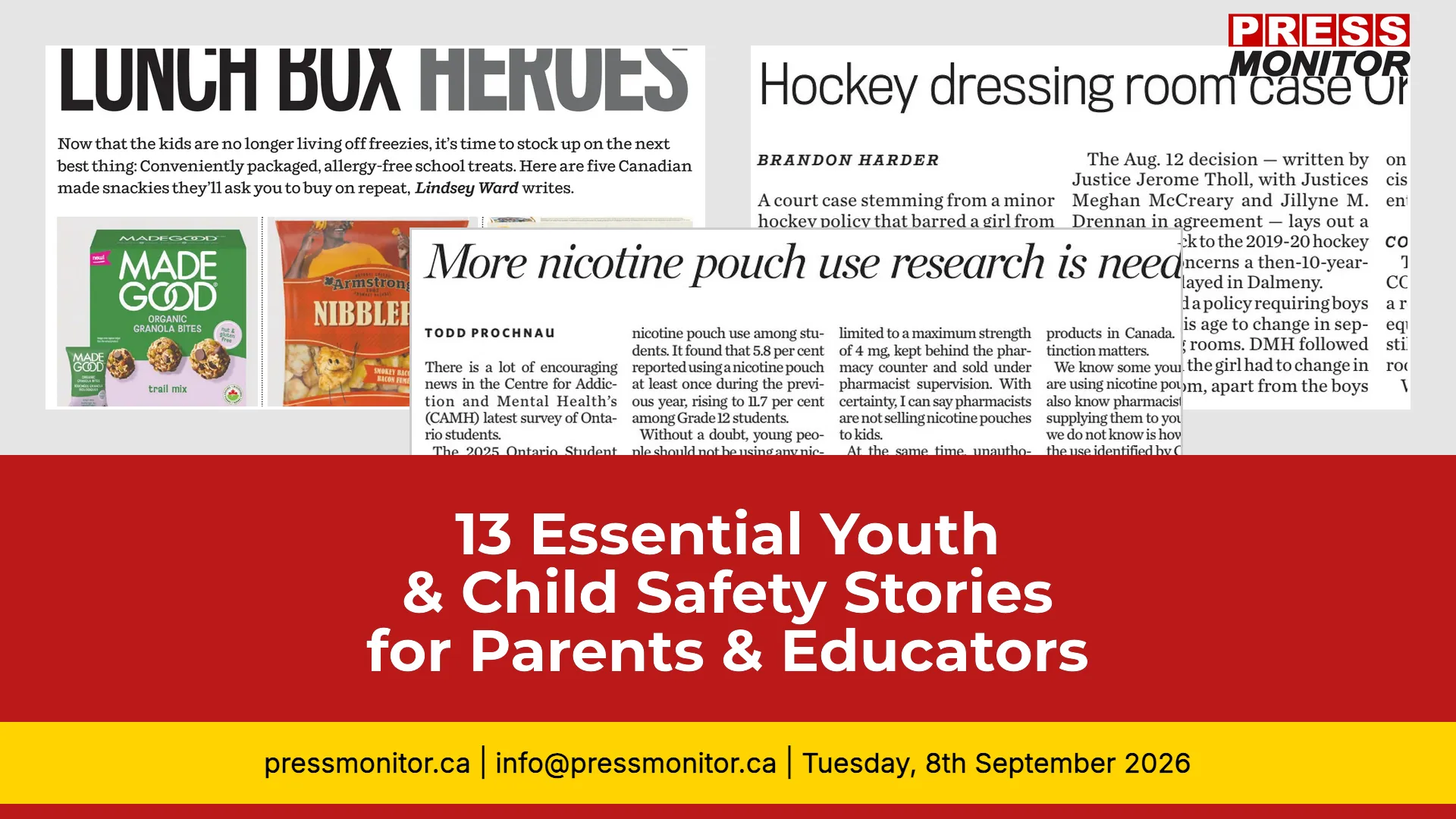
The Edmonton Journal reports that Canadian parents can stock up on convenient, allergy-free school treats as children return to class. Featured Canadian-made snacks include Treasure Mills' allergy-friendly Wholesome Bites, Armstrong's smoky bacon nibblers made with 100-per-cent Canadian milk, and Made Good's nut-free trail mix granola bites from Toronto. The selection highlights products from small businesses founded by Canadian families to provide safe, enjoyable options for school lunch kits.
Why it matters: Safe nutrition is foundational to student health and classroom inclusion.
Key detail: Brands like Made Good, Armstrong, and Treasure Mills offer nut-free, gluten-free options specifically designed for school lunch kits.
Source: Edmonton Journal
Next step: Review ingredient labels and support local Canadian manufacturers.
2. Saskatchewan Court Advances Hockey Dressing Room Case
Regina Leader-post reports that Saskatchewan Court of Appeal has ruled a nine-year-old girl's lawsuit regarding a mandatory gender-segregated hockey dressing room policy can move forward. A three-judge panel dismissed appeals from the Saskatchewan Hockey Association and Dalmeny Minor Hockey Inc., overturning their August decision. The dispute began during the 2019-20 season when the girl was forced to change in a separate facility from her male teammates, a practice her parents consistently opposed.
Why it matters: Sports governance policies directly impact youth participation and human rights.
Key detail: The Court of Appeal dismissed appeals from the Saskatchewan Hockey Association and Dalmeny Minor Hockey, allowing the Trayhorne family’s oppression application to proceed regarding gender-segregated changing facilities.
Source: Regina Leader-post
Next step: Monitor court filings and advocate for inclusive sports programming.
3. CAMH Survey Reveals Surge in Student Nicotine Pouch Use
The Hamilton Spectator reports that a recent CAMH survey reveals a surge in nicotine pouch use among Ontario students despite declining tobacco smoking rates. The survey indicates 58 per cent of students used a nicotine pouch at least once in the past year, prompting calls for more research into authorized versus unauthorized products.
Why it matters: Emerging substance trends require proactive public health intervention.
Key detail: 58 percent of Ontario students reported using a nicotine pouch at least once in the past year, despite declining traditional tobacco smoking rates.
Source: The Hamilton Spectator
Next step: Engage with pharmacists and educators on authorized cessation pathways.
4. 7,700-Kilometre Journey For Youth Mental Health
The Chronicle Herald reports that Rich and Pam Eyram completed a 7,700-kilometre cross-Canada journey from British Columbia to Nova Scotia to raise C$100,000 for youth mental health and the Kids Help Phone. The couple, who reside in Burlington, Ontario, began their trek on May 31 in Vancouver and finished by dipping their bikes into the Atlantic Ocean at Black Rock Beach in Point Pleasant Park.
Why it matters: Grassroots advocacy highlights critical gaps in rural youth support networks.
Key detail: Rich and Pam Eyram completed a cross-Canada bike trek, raising nearly $88,000 for Kids Help Phone and emphasizing suicide prevention resources.
Source: The Chronicle Herald
Next step: Donate or volunteer with crisis response organizations.
5. Regina Pediatric Diabetes Program Closing
Regina Leader-post reports that the closure of Regina’s pediatric diabetes program will mean longer travel times, higher costs, greater stress and less support for families in southern Saskatchewan. The Saskatchewan pediatric endocrinology and diabetes program said staffing losses made it impossible to continue local care, while the Saskatchewan Health Authority stated it had implemented a strategy to provide ongoing coverage through pediatric specialists in Regina. Provincial Health Minister Jeremy Cockrill said he was personally disappointed with the letter and pledged to work with the Saskatchewan Health Authority to ensure services remain available.
Why it matters: Healthcare access disparities disproportionately affect minors with chronic conditions.
Key detail: Staffing losses forced the closure of Regina’s pediatric diabetes program, increasing travel burdens and costs for southern Saskatchewan families.
Source: Regina Leader-post
Next step: Contact provincial health representatives to demand sustained pediatric specialist coverage.
6. Ontario High School Grades Include Attendance
Toronto Sun reports that Ontario students heading back to school this fall will face new measures to combat absenteeism and slipping academic standards, with high school grades now partially based on attendance. The Ministry of Education announced that only 65% of a secondary school student's final mark will be based on completed coursework, with the remainder allocated to mandatory testing, attendance, and participation. Additionally, students must complete financial literacy courses with a grade of 70% or higher to graduate, and Statistics Canada data shows back-to-school costs have risen nearly 25% since 2015 due to increased prices for supplies and food.
Why it matters: Academic accountability measures are reshaping secondary education standards.
Key detail: Final marks will now allocate 35 percent to mandatory testing, attendance, and participation, alongside new financial literacy graduation requirements.
Source: Toronto Sun
Next step: Schools should update attendance tracking systems and communicate policy changes to parents.
7. Sexual Choking Risks Gen Z Girls
The Globe And Mail reports that sexual choking has become ubiquitous among Gen Z but its safety issues and cognitive effects are underdiscussed. A sixteen-year-old Sydney girl died after her boyfriend consensually choked her during sex, exemplifying how deadly the choking trend is. More than half of female university students report being sexually choked, and neuroscientific studies show frequent choking is linked to differences in brain structure and function.
Why it matters: Unaddressed physical risks in adolescent relationships threaten long-term cognitive and neurological health.
Key detail: Neuroscientific studies link frequent sexual choking to brain structure differences, yet safety conversations remain underdiscussed among teens.
Source: The Globe And Mail
Next step: Integrate comprehensive consent and physical safety education into youth programs.
8. Mountie Gets Conditional Discharge
Edmonton Journal reports that an Alberta Mountie guilty of assaulting two teens while off-duty during an Airdrie hockey tournament has been given a conditional discharge. Court of King's Bench Justice Nick Devlin agreed to a joint submission that Const. Bridget Morla be granted a discharge along with 18 months probation and substance abuse counselling. Morla pleaded guilty to common assault in an incident involving 16- and 17-year-old males in December 2022 in a boozy encounter in an Airdrie hotel room.
Why it matters: Law enforcement accountability remains a priority in community safety discussions.
Key detail: Const. Bridget Morla received a conditional discharge and probation for off-duty assault involving two teenagers during an Airdrie hockey tournament.
Source: Edmonton Journal
Next step: Support transparent disciplinary frameworks within municipal police services.
9. Children's Charities Thank Legacy Gift Supporters
Toronto Star reports that the Toronto Star Children's Charities are thanking supporters who have left legacy gifts and inviting others to learn how such gifts can help inspire hope, joy, and curiosity in children. The September 8, 2026 appeal in Toronto highlights the Claus Fund, summer camp support for financially vulnerable children, holiday gift boxes, and contact information for Brian Cordingley.
Why it matters: Sustainable funding ensures continuity for vulnerable youth programs.
Key detail: The Toronto Star Children's Charities highlighted the Claus Fund and summer camp initiatives supporting financially vulnerable children across Ontario.
Source: Toronto Star
Next step: Explore legacy giving options to secure multi-year youth support.
10. Toronto Students Face Rising Back-to-School Anxiety
The Toronto Star reports that experts warn of rising back-to-school anxiety among youth, noting increased reach-outs to school social workers and a 69 percent rise in mental health support demand at lCalliClick over four years. Factors include social media use, economic uncertainty, and global crises, with professionals advising parents to establish routines, listen without dismissing concerns, and involve schools early if refusal occurs.
Why it matters: Mental health demand is outpacing traditional school counseling capacity.
Key detail: lCalliClick reported a 69 percent rise in mental health support demand over four years, driven by social media pressure and economic uncertainty.
Source: Toronto Star
Next step: Establish consistent home routines and involve school social workers early.
11. Snider Park: 2026 Reopen
Ottawa Sun reports that the BIA and Operation Come Home are addressing maintenance issues at Snider Park, which faced problems with electricity and a locked gate. The BIA has signed an agreement with Operation Come Home to provide staff to open and close the park daily, and they plan additional green upgrades and possibly fence removal. The park’s problems are seen as growing pains, but city partners are taking steps to improve accessibility and safety. Why it Matters: Revitalized public spaces provide safe recreational environments for minors.
Key detail: The BIA partnered with Operation Come Home to restore daily operations, upgrade green infrastructure, and improve accessibility.
Source: Ottawa Sun
Next step: Encourage community groups to utilize reopened parks for youth-led activities.
12. 12 Killed in Israeli Airstrikes
The Hamilton Spectator reports that Israel's air force carried out two airstrikes on the southern Lebanese village of Kfar Rumman, killing at least twelve people including children, in what the village mayor described as a massacre. The strikes came amid new escalation between Israel and Hezbollah despite a United States brokered truce reached over two months ago.
Why it matters: Global conflicts increasingly endanger civilian populations, including minors.
Key detail: Strikes on Kfar Rumman killed at least twelve people, including children, amid renewed escalation between Israel and Hezbollah.
Source: The Hamilton Spectator
Next step: Support international humanitarian aid organizations focused on child protection.
13. Seven Killed In Saudi Yemen Prison Airstrike
Toronto Star reports that Houthi rebels accused Saudi Arabian forces of striking the Central Corrective Facility in Hazm on Monday, killing seven people including a child and wounding at least seven others. Thirty-five prisoners and one visitor remain trapped in the rubble following the attack amid escalating tensions between Iran backed Houthis and Saudi backed Yemeni government troops.
Why it matters: Civilian casualties in regional conflicts underscore the urgent need for youth-safe zones.
Key detail: Houthi rebels accused Saudi forces of striking a correctional facility in Hazm, killing seven individuals including a child.
Source: Toronto Star
Next step: Advocate for diplomatic de-escalation and refugee support programs.
Which of these developments impacts your community most directly? Share your thoughts below.