13 Key Supply Chain Stories for Procurement Leaders


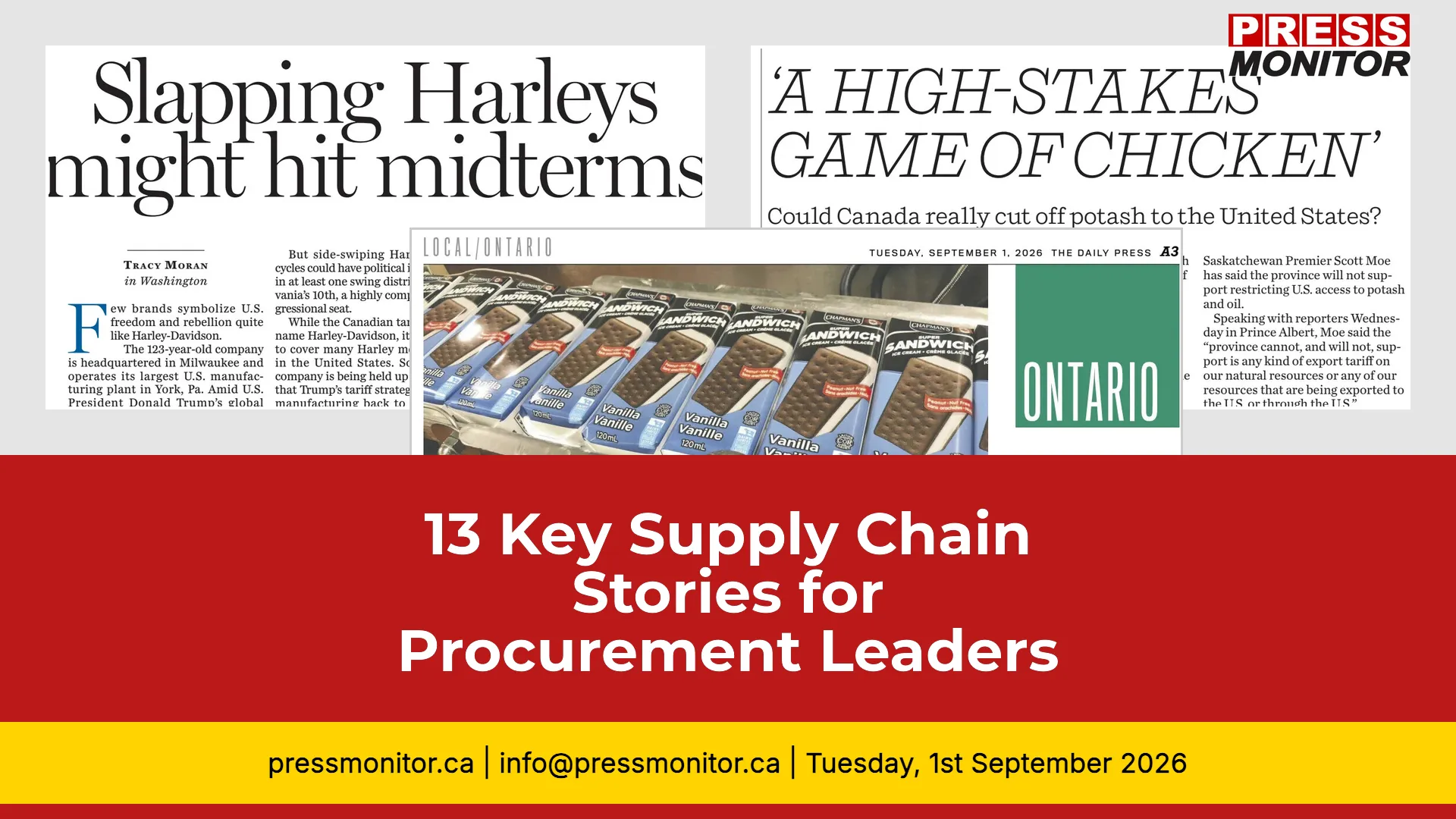
Welcome to today's press review, powered by Press Monitor's tracking of Canadian publications. These 13 stories cut through the noise to give you the actionable intelligence you need on supply chain disruptions, tariffs, and sourcing shifts. Our media monitoring captures the full picture from coast to coast.
1. Harley-Davidson Reshoring Under Canadian Tariff Pressure
A front-page report in the Calgary Herald reports that Harley-Davidson announced production of some products returning from Thailand to U.S.-based facilities before the Trump administration announced Section 232 tariffs. Canada announced its retaliation with Section 338 on Sept. 8 tariffs on sub-category D motorcycles eligible as passenger vehicles, with an additional duty on engines reaching 25%. If Canada implements the tariffs on Sept. 8, U.S. origin motorcycle imports to Canada larger than 800cc with internal-combustion engines will pay 50 per cent duty. Canada's list of tariffs was crafted to protect the domestic market share for Canadian companies, rather than targeting politically sensitive products in U.S. battleground states before November's midterms. The addition of tariffs on motorcycles could have political implications in at least one swing district: Pennsylvania's 10th, a highly competitive congressional seat. The Canadian tariff does not name Harley-Davidson but is expected to cover many Harley models made in the United States. Side-swiping Harley motorcycles could have political implications in at least one swing district: Pennsylvania's 10th, a highly competitive congressional seat. Canada accounted for roughly five per cent of Harley-Davidson’s global retail motorcycle sales last year, with 6,434 motorcycles sold north of the border. While the country does hold up the company as evidence that Trump's strategy to initiate the tariff strategy can bring manufacturing back to the United States, the country’s 50 per cent tariff could test whether those reshored factories can thrive when a major trading partner makes its products more expensive and what’s ‘Made in America’ is worth this effort. Manufacturing is shifting from Syria to Thailand to China due to uncertainty around Style and delivery dates. That production can be expected to continue this year, with more effective capabilities coming in 2026. Production is expected to begin as early as next year for the Revolution Max platform, but it was not saying whether production at all centres could begin by that date. The production move would return machining, powertrain assembly, painting, and final assembly for its north American market to U.S. facilities. Jason Miller, a supply chain management professor at Michigan State, said, ‘if you have production in a country where there’s very little U.S. value added, and then that production moves to the U.S., that will overall be a net gain for manufacturing in the U.S. for that specific production category.’ Obregon pointed out that a lot of the manufacturing jobs lost across America were not necessarily because of offshoring to other countries but because of technological changes resulting from the advent of advanced robotics. That means the prospect of reshoring it more extensively to create jobs should take into account factors such as reliance on Canadian parts, tariffed inputs, and end consumer purchasing power.
Why it matters: This story tests whether reshored manufacturing can thrive when a major trading partner slaps a 50% tariff on the product.
Key detail: Canada's tariff on motorcycles >800cc could hit Harley's sales in Pennsylvania's 10th district, a swing seat. Supply chain professor Jason Miller notes the net gain for U.S. manufacturing.
Source: Calgary Herald (front page)
Next step: Monitor how other reshored industries react to similar tariff exposure.
2. Canada's Potash Leverage in Trade War
According to a Saskatoon Starphoenix report, Canadian Premier Doug Ford has proposed using potash exports as a leverage point in trade negotiations with the U.S., warning of catastrophic impacts on American agriculture. While experts confirm potash’s critical role in U.S. farming, analysts note the reciprocal risks to Canada’s economy and potential retaliatory tariffs from President Trump. Saskatchewan Premier Scott Moe rejected export restrictions, emphasizing the resource’s value to both nations.
Why it matters: Potash is a critical agricultural input; any restriction would devastate U.S. farming.
Key detail: Saskatchewan Premier Scott Moe rejects export restrictions, balancing economic risk.
Source: Saskatoon Starphoenix
Next step: Evaluate your exposure to potash-dependent supply chains.
3. Chapman's Ice Cream Diversifies Sourcing
The Daily Press (timmins) reports that Chapman's Ice Cream is replacing more than 70 per cent of its American ingredients by mid-2027 to combat unjustified tariffs. The Markdale, Ontario, company is diversifying its supply chain by sourcing almonds from Australia and cherries from Chile while maintaining 100 per cent Canadian dairy.
Why it matters: A mid-sized company is reconfiguring its supply chain to avoid tariff risk.
Key detail: Chapman's will replace >70% of U.S. ingredients by mid-2027, sourcing almonds from Australia and cherries from Chile.
Source: The Daily Press (timmins)
Next step: Assess your own ingredient sourcing for tariff vulnerabilities.
4. Ontario EV Battery Gigafactory Breaks Ground
The Globe and Mail reports that Ontario will be home to the country’s largest electric vehicle (EV) battery plant, owned by PowerCo, a subsidiary of Volkswagen Group. The gigafactory will span 370 acres and is expected to start production in 2027. It will be part of the vision for St. Thomas’ 1,500-acre Yarmouth Yards industrial park.
Why it matters: The largest EV battery plant in Canada, owned by PowerCo, will reshape the automotive supply chain.
Key detail: The 370-acre facility in St. Thomas aims to start production in 2027.
Source: The Globe and Mail
Next step: Identify suppliers and logistics partners for the EV ecosystem.
5. Agriculture Prices Surge 13%
Financial Post Magazine reports that crop prices are set to cap their biggest monthly jump in more than a decade as wars and extreme weather disrupt supplies. The Bloomberg Agriculture Spot index is up more than thirteen per cent in August. Wheat and cocoa have been big drivers, reaching three-year highs as Black Sea port attacks and an El Nino phenomenon spur weather worries.
Why it matters: War and weather drive the biggest monthly jump in crop prices in a decade.
Key detail: Wheat and cocoa hit three-year highs; Black Sea port attacks and El Niño are factors.
Source: Financial Post Magazine
Next step: Hedge commodity price risks in your procurement strategy.
6. Doug Guzman Leaves Defence Investment Agency
The Globe And Mail reports that former banker Doug Guzman is expected to leave his position as head of the federal government’s newly created Defence Investment Agency due to frustration with the slow pace of government bureaucracy in defence procurement. Mr. Guzman was an important player in the July decision to purchase submarines from German company TKMS for the Royal Canadian Navy and has demanded quicker action on procurement files during his tenure.
Why it matters: The head of Canada's new defence procurement agency quits over bureaucracy, raising questions about procurement efficiency.
Key detail: Guzman was key in the July submarine purchase from TKMS.
Source: The Globe and Mail
Next step: Watch for procurement process reforms in defence.
7. Prince Rupert Port Adds $750M Container Facility
Montreal-headquartered logistics company Ray-Mont Logistics has opened a new $750-million container-handling facility at British Columbia’s Port of Prince Rupert aimed at expanding Canada’s international trade just as a trade war with the US heats up.
Why it matters: New capacity at a key west coast port strengthens Canada's trade infrastructure amid tariff tensions.
Key detail: Ray-Mont Logistics opens the facility to expand international trade.
Source: Montreal Gazette
Next step: Evaluate new logistics routes through Prince Rupert.
8. De Havilland Water Bomber Demand Outpaces Supply
The Globe and Mail reports that De Havilland Aircraft of Canada is facing unfulfilled orders for its famous water bombers as global wildfires surge. The company has a backlog due a decade of halted production and intends to lobby the government for expansion.
Why it matters: Supply chain constraints in aerospace: a decade of halted production creates a backlog as global wildfires surge.
Key detail: The company plans to lobby the government for expansion.
Source: The Globe and Mail
Next step: Monitor aerospace supply chain bottlenecks.
9. Enbridge Line 5 Pipeline Incident
The National Post reports that an Enbridge Line 5 pipeline incident in Wisconsin has exacerbated tensions surrounding the Canada-U.S. pipeline. The pipeline leaked natural gas, prompting calls for a thorough review of construction methods and safety protocols.
Why it matters: A natural gas leak on Line 5 escalates debate over Canada-U.S. energy infrastructure.
Key detail: Calls for review of construction methods and safety protocols.
Source: National Post
Next step: Review contingency plans for energy supply disruptions.
10. Public Competition Opportunities in Nova Scotia
Cape Breton Regional Municipality reports that public competition opportunities will be posted weekly on Tuesdays. The closing time for submissions is Thursdays at 3:00 PM unless otherwise noted. Specific requests for proposal and tender closing dates are mentioned for Needle 17 on September 2026 and for Sale on September 2026 respectively. To obtain competition documents, please visit the Nova Scotia Procurement Portal.
Why it matters: Weekly procurement notices for government contracts – a key intelligence source for suppliers.
Key detail: Tenders close Thursdays at 3 PM; visit Nova Scotia Procurement Portal.
Source: Cape Breton Post
Next step: Set up alerts for relevant opportunities.
11. Canada Faces Major Risk if It Weaponizes Energy Exports
The Chronicle Herald reports that if Canada restricts energy exports to the US., shutting down Enbridge’s Line 5 pipeline could cause an immediate oil crisis in Ontario and Quebec.
Why it matters: Restricting energy exports, including shutting Line 5, could cause an immediate oil crisis in Ontario and Quebec.
Key detail: The article warns of self-inflicted economic damage.
Source: The Chronicle Herald
Next step: Assess energy supply chain dependencies in your region.
12. Russian Strikes Disrupt Ukrainian Food Supply
The Globe And Mail (ottawa/quebec Edition) reports that air raids on food distribution centres have disrupted logistics, leaving some supermarket shelves bare.
Why it matters: Air raids on distribution centres leave shelves bare, worsening global food insecurity.
Key detail: Logistics disruptions in Kyiv.
Source: The Globe and Mail
Next step: Monitor alternative grain and oilseed sources.
13. Canada Shifts Crude Exports to Asia After Pipeline Expansion
The Globe And Mail reports that Canada shipped about 97 per cent of its crude to the U.S. before the expanded Trans Mountain system came online in May 2024. Since then, non-U.S. crude oil exports have climbed to 15 per cent. Calgary-based Trans Mountain announced its network moved an average of 840,000 barrels of oil each day in the second quarter of 2026.
Why it matters: The Trans Mountain pipeline allows Canada to diversify away from U.S. markets.
Key detail: Non-U.S. crude exports have climbed to 15% of total; 840,000 barrels/day moved in Q2 2026.
Source: The Globe and Mail
Next step: Consider how this shift affects North American crude supply balances.
Closing: This press review is powered by real-time media monitoring from Press Monitor. Stay ahead of supply chain disruptions with print media intelligence that cuts through the noise. What story will you act on today?