13 Pivotal Climate Stories for Canadian Leaders


Track vital climate shifts with our daily media monitoring briefing. According to Press Monitor's tracking of Canadian publications, the landscape is evolving rapidly. This press review covers 13 pivotal developments shaping policy, infrastructure, and markets. Stay ahead of news on climate adaptation and extreme weather with our print media monitoring insights.
1. Canada Climate Report Finds Irreversible Damage
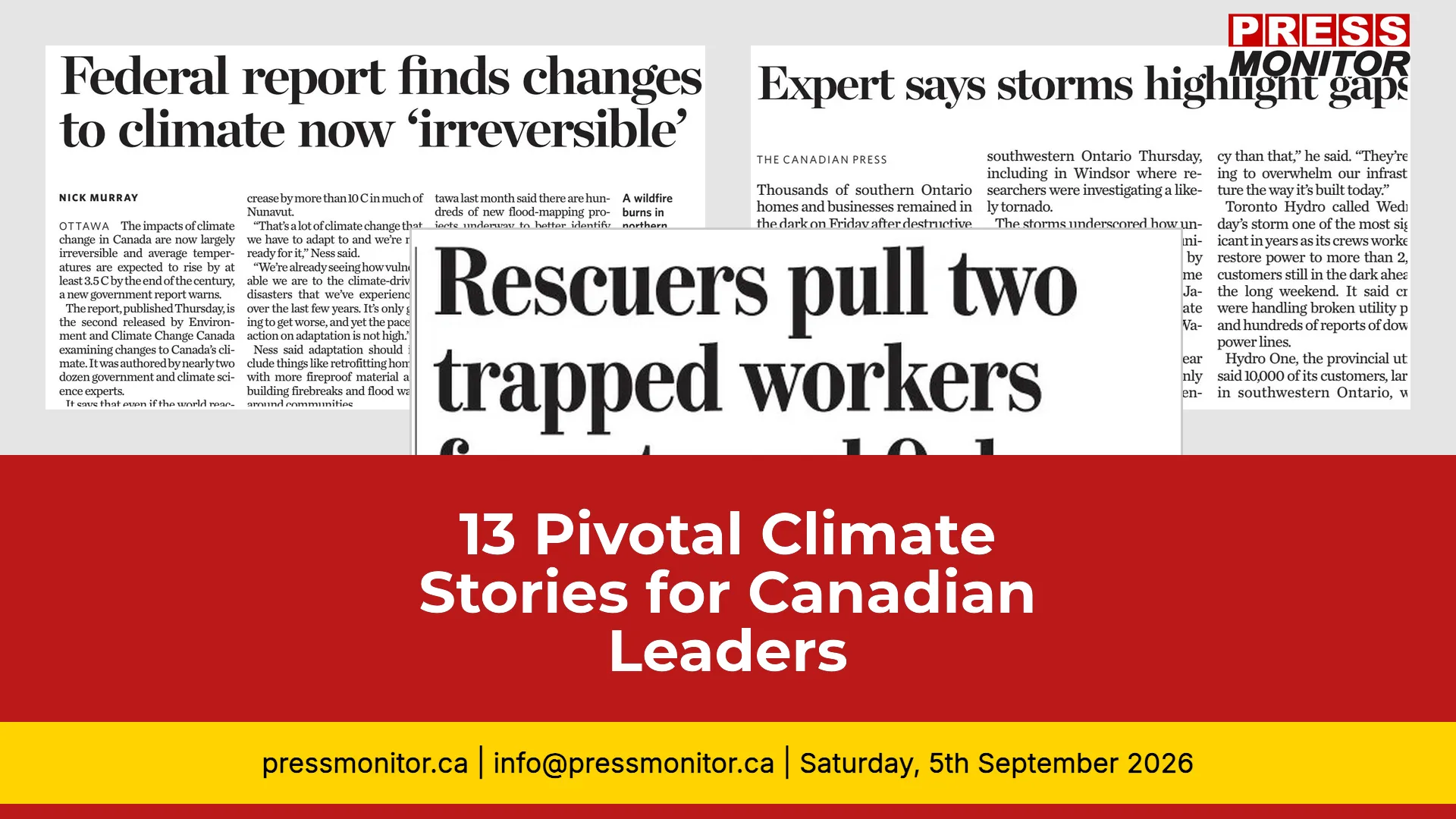
The Welland Tribune reports that a new federal report from Environment and Climate Change Canada warns climate change impacts in Canada are now largely irreversible, with average temperatures expected to rise by at least 3.5 C by the end of the century. The report, authored by nearly two dozen experts and released Thursday, projects a nearly 50 per cent increase in wildfire-burned area and Western Canada glaciers losing more than 75 per cent of their mass even if net-zero emissions are reached by 2075. Ryan Ness of the Canadian Climate Institute said the pace of adaptation action is not high despite growing vulnerability to climate-driven disasters, while Environmental Defence called the findings a stark warning and call to action.
Why it matters: Sets the baseline for national adaptation funding and infrastructure planning.
Key detail/stat: Average temperatures expected to rise by at least 3.5 C by century’s end; wildfire area could increase nearly 50%.
Source: The Welland Tribune
Next step: Review provincial emergency response frameworks against new federal baselines.
2. Storms Highlight Ontario Preparedness Gaps
{source_name} reports that thousands of southern Ontario homes and businesses remained without power on Friday after destructive thunderstorms that highlighted gaps in extreme weather preparedness. High winds and torrential rain caused flooding and downed power lines on Wednesday, with another storm hitting southwestern Ontario on Thursday, including a possible tornado in Windsor. Flood risk expert Jason Thistlethwaite from the University of Waterloo warned that infrastructure is being overwhelmed by increasingly frequent and intense storms.
Why it matters: Directly impacts utility reliability and municipal budget allocations.
Key detail/stat: Thousands lost power after destructive thunderstorms; infrastructure overwhelmed by frequent intense storms.
Source: The Welland Tribune
Next step: Audit grid resilience protocols and storm surge defenses.
3. Two Workers Rescued From Nepal Tunnel
Times Colonist reports that rescuers in Nepal pulled two workers alive from an underground tunnel at a hydropower plant on Friday, nine days after deadly floods swept away villages in the Himalayan region. The men, identified as a mechanical foreman and a mechanical supervisor, were rescued from the Trishuli 3A plant and flown to a hospital in Kathmandu. Officials say about 900 workers are missing from 12 hydropower projects, with roughly 500 believed trapped in tunnels, and at least 1,287 people were killed in the Aug. 26 floods.
Why it matters: Highlights global supply chain vulnerabilities and cross-border disaster response coordination.
Key detail/stat: Rescuers pulled two workers alive nine days after deadly Himalayan floods killed over 1,287 people.
Source: Times Colonist
Next step: Assess international partnership agreements for rapid humanitarian deployment.
4. Insurance Costs Rise After Floods
The Welland Tribune reports that a devastating storm on Wednesday brought more than one hundred millimetres of rain, flooding roads and submerging cars in Canada, prompting insurance experts to urge homeowners to document damage and review deductibles. The Insurance Bureau of Canada warned that insured losses from extreme weather have risen to an average of $3.7 billion annually, up from $14 billion a decade earlier, and that the costliest year on record in 2024 exceeded $9 billion. Claims can take weeks, so residents are advised to file early and keep receipts and photos to speed the process.
Why it matters: Drives premium adjustments and forces corporate risk reassessment.
Key detail/stat: Insured losses from extreme weather average $3.7 billion annually; costliest year exceeded $9 billion.
Source: The Welland Tribune
Next step: Update property risk models and negotiate deductible structures.
5. St. Catharines Lifts Flood Emergency
The Welland Tribune reports that St. Catharines has lifted its state of emergency after widespread flooding, which was declared on August 3 when three major rainfall events overwhelmed the city's infrastructure. Mayor Mat Siscoe said the city can now handle ongoing issues, though recovery continues. The city is seeking disaster assistance from provincial and federal governments while also planning a $20-million floodproofing program for residents.
Why it matters: Demonstrates municipal recovery timelines and federal disaster assistance pathways.
Key detail/stat: City declared state of emergency Aug 3; now seeking provincial/federal aid while planning $20M floodproofing.
Source: The Welland Tribune
Next step: Align local recovery grants with upcoming infrastructure tenders.
6. C$200 Billion Lost To Failed Climate Policies
{source_name} reports that Canada's lack of practical alternatives to sell oil to any country other than the United States is a legacy of the previous Liberal government of Justin Trudeau and its failed climate change policies, which cost federal taxpayers more than C$200 billion. Today, over 90 per cent of oil exports are sold at a discount to Americans because Canada is a captive market, with only one pipeline (TMX) able to ship oil to Asian markets from British Columbia.
Why it matters: Impacts energy sector valuation and trade negotiation leverage.
Key detail/stat: Over 90% of oil exports sold at discount to US due to captive market legacy; failed policies cost taxpayers >C$200B.
Source: The Chronicle Herald
Next step: Evaluate export diversification strategies and pipeline capacity utilization.
7. Himalayan Disaster Warns Canada
The Globe And Mail reports that the Elliot Creek landslide in British Columbia's Coast Mountains, triggered by glacier melt, caused a tsunami that destroyed salmon habitat and forest. Scientists warn that the root cause is similar to the Nepal floods that killed over 1,250 people, and that climate change is creating evolving risks in high mountain regions. Researchers emphasize that Canada lacks a systematic monitoring system for these hazards, despite glaciers in Western Canada losing 12 per cent of their volume between 2021 and 2024.
Why it matters: Signals emerging glacial hazard risks in BC and Yukon mountain regions.
Key detail/stat: Elliot Creek landslide triggered tsunami destroying salmon habitat; Western glaciers lost 12% volume 2021-2024.
Source: The Globe And Mail
Next step: Fund systematic glacier monitoring systems and early warning networks.
8. Food Prices Hit 3-Year High
{source_name} reports that global food prices reached their highest level since late 2022 in August, driven by extreme weather, drought, and disruptions in the Black Sea region. The United Nations Food and Agriculture Organization said its Food Price Index averaged 133.3 points, with rising costs across cereals, vegetable oils, sugar, meat, and dairy as supply risks grow. The agency also cut its 2026 global cereal production forecast by 3.4 million tonnes to 2.98 billion tonnes, marking the largest annual decline since 2018.
Why it matters: Influences consumer inflation forecasts and agricultural investment flows.
Key detail/stat: FAO Food Price Index averaged 133.3 points; global cereal production forecast cut by 3.4M tonnes.
Source: The Globe And Mail
Next step: Stress-test supply chain contracts against drought and Black Sea disruption scenarios.
9. Lavender Farms Face Climate Crisis
The Globe And Mail reports that lavender fields in Haute Provence, southeastern France, are blooming for only five days this year due to intensifying heat waves and drought, putting more than half of the region's lavender farms at risk of bankruptcy. Noah Brecy, a seasonal worker on a family-owned organic lavender estate, described the conditions as a disaster with only three days of rain since June. The crisis underscores the fragility of the natural world and the growing impact of climate change on traditional agriculture and regional tourism.
Why it matters: Illustrates global agricultural fragility and tourism revenue dependencies.
Key detail/stat: Haute Provence lavender blooms lasted only five days; >50% farms face bankruptcy risk.
Source: The Globe And Mail
Next step: Diversify crop portfolios and invest in drought-resistant irrigation tech.
10. Mazda rotary patent targets emissions
National Post reports that Mazda has filed a U.S. patent application suggesting renewed interest in a rotary engine for road-going vehicles. The filing, uncovered by Carscoops at the U.S. Patent and Trademark Office, proposes an exhaust-gas recirculation system integrated into the engine housing to reduce emissions and save space.
Why it matters: Signals potential shifts in automotive engineering and emission reduction roadmaps.
Key detail/stat: Filed U.S. patent proposes exhaust-gas recirculation integrated into engine housing to reduce emissions.
Source: National Post
Next step: Track regulatory approvals and assess impact on traditional ICE transition timelines.
11. Birla faces mayoral scrutiny over Hamilton soot
{source_name} reports that mayoral candidates Loomis, Horwath, and Cooper are proposing stricter measures against Birla and industrial emissions amid Hamilton's decade-long soot crisis. The MECP investigation into Birla continues, while past councils allocated funds for air monitors and the city's mobile monitors are being replaced. Candidates discussed a bylaw similar to Oakville's Health Protection Air Quality Bylaw and broader decarbonization efforts.
Why it matters: Tests municipal enforcement capabilities and industrial compliance standards.
Key detail/stat: Mayoral candidates propose stricter measures; MECP investigation continues amid decade-long soot crisis.
Source: The Hamilton Spectator
Next step: Monitor proposed health protection bylaws and air quality monitoring upgrades.
12. FireGuardian Wildfire Software Seeks Canadian Partners
The Chronicle Herald reports that 3D Wave Design, an Indigenous company co-founded by Barry Stevens and his son Noah, has developed FireGuardian wildfire simulation software to help Canadian municipalities model fire risks. The software, tested by the federal government, uses real-life data to simulate days or weeks of wildfire behaviour in seconds. Stevens said the company is actively seeking partners and joint ventures to scale FireGuardian across Canada.
Why it matters: Advances domestic tech solutions for municipal fire risk modeling.
Key detail/stat: Indigenous company 3D Wave Design developed app simulating wildfire behavior using real-life data; federal testing complete.
Source: The Chronicle Herald
Next step: Explore joint ventures for scaling simulation tools across western provinces.
13. Solvero winery survives wildfire
The Globe and Mail reports that the Bald Range wildfire forced evacuations of around 20,000 properties in the central Okanagan last month, destroying about 150 structures, but the Solvero winery in Summerland, B.C., survived with its buildings intact. Winemaker Alison Moyes and owner Matt Sartor returned to the site to find irrigated grape vines provided a buffer, though this year's crop at that location will not be harvested and replacement grapes are being sought from unaffected areas.
Why it matters: Showcases micro-climate adaptation and agricultural resilience strategies.
Key detail/stat: Bald Range wildfire destroyed ~150 structures; irrigated grape vines acted as firebreak saving buildings.
Source: The Globe And Mail
Next step: Study irrigation-based fire mitigation techniques for regional adoption.
Closing: Which of these climate developments will most impact your organization’s Q4 strategy? Share your perspective below. Tracked by Press Monitor.