13 Pivotal Climate Stories for Risk Leaders


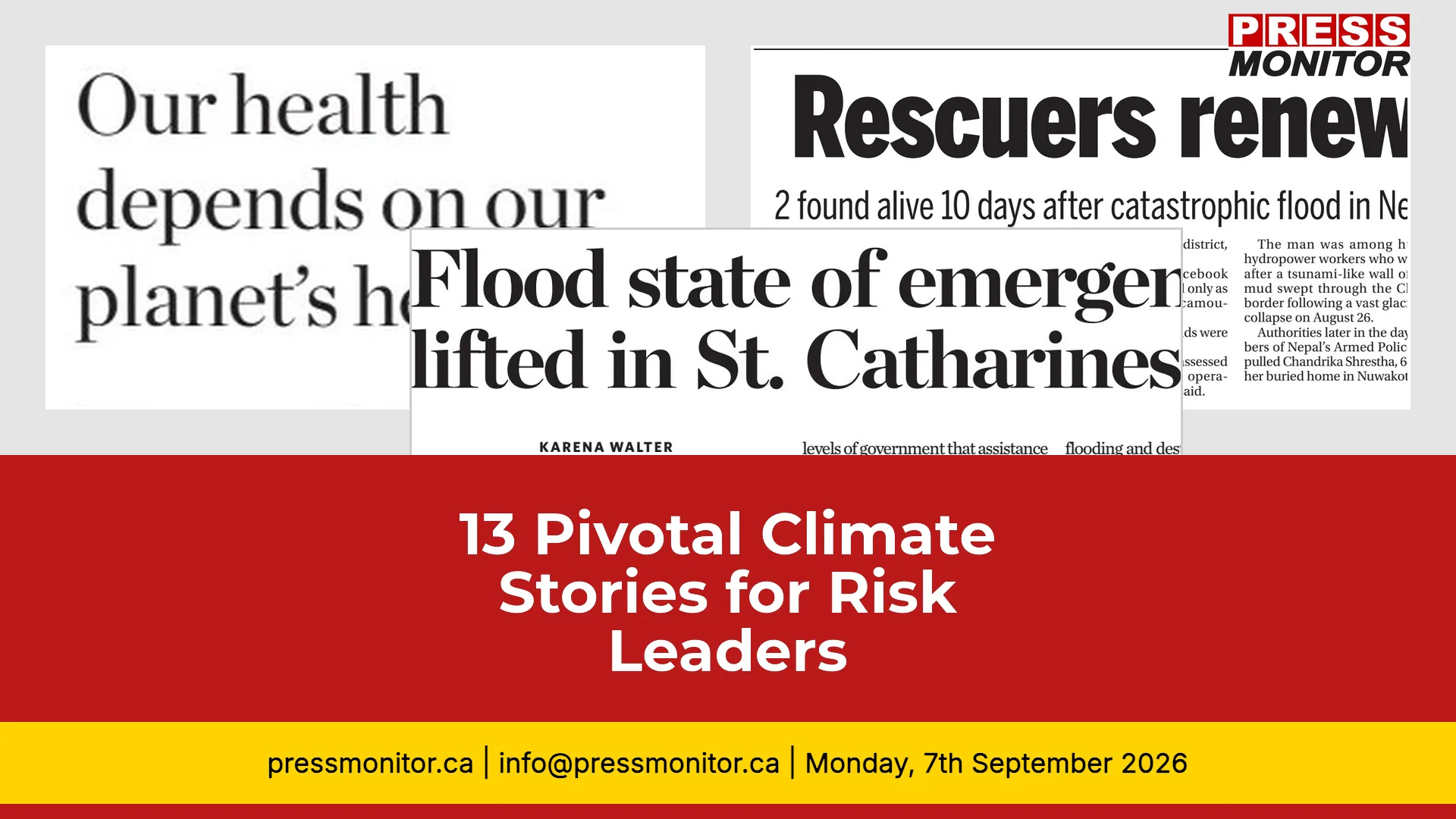
Sharp media monitoring separates signal from noise in today's climate landscape. This press review distills the most critical developments shaping Canada's climate landscape, offering actionable insights for executives and policymakers. According to Press Monitor's tracking of Canadian publications, here are the defining stories you need to know.
1. John Madden: Climate and Economy
Toronto Star reports that John Madden of Toronto argues Canadians do not have to choose between a healthy economy and a healthy planet. He says recent weather disasters, including the storm in Toronto, are made worse by climate change and create costly rebuilding needs, underscoring the link between environmental health and public wellbeing.
Why it matters: Economic resilience is now inextricably linked to environmental stewardship.
Key detail: Recent Toronto storms highlight how climate-driven disasters inflate rebuilding costs, proving that ecological health directly impacts public wellbeing and fiscal stability.
Source: Toronto Star
Next step: Align corporate sustainability goals with local infrastructure investment strategies. Question: How is your organization pricing climate risk into long-term capital planning?
2. 2 Found Alive After Flood
Toronto Sun reports that rescuers in Nepal pulled a Chinese national from a tunnel and a local woman from her partially submerged home on Saturday, as emergency teams searched with fresh urgency for thousands missing since catastrophic flooding ten days ago. A team comprising personnel from the Nepal Army and foreign experts rescued the Chinese man from 225 metres inside the tunnel of the Upper Trishuli Hydropower Project in Rasuwa district. Authorities later said members of Nepal's Armed Police Force had pulled Chandrika Shrestha, 64, alive from her buried home in Nuwakot district.
Why it matters: Global supply chains and humanitarian operations face escalating extreme weather threats.
Key detail: Rescuers pulled survivors from a hydropower tunnel and submerged homes ten days after catastrophic flooding in Nepal, underscoring the human toll of glacial collapses.
Source: Toronto Sun
Next step: Stress-test international vendor continuity plans against severe weather disruptions. Question: What contingency protocols exist for remote project sites during monsoon seasons?
3. Flood State of Emergency Lifted
The Standard reports that St. Catharines' state of emergency sparked by widespread flooding has been lifted. Mayor Mat Siscoe declared the emergency on August 3 and ended it on Thursday, saying the city now has the capacity to deal with ongoing issues. The Town of Lincoln also announced it ended its state of emergency on Friday.
Why it matters: Municipal recovery timelines dictate regional economic restart speeds.
Key detail: St. Catharines and Lincoln ended their emergencies after widespread flooding, signaling a transition from crisis response to structural adaptation.
Source: The Standard (st. Catharines)
Next step: Audit municipal drainage upgrades and zoning reforms in your operating footprint. Question: Are your facilities positioned to withstand rapid urban runoff events?
4. C$1.5 Billion In Storm Damage
Toronto Star reports that after last Wednesday's violent thunderstorms, many residents discovered their insurance policies do not cover flooded basements, damaged cars, and broken windows. Annie Gabrielian's Volvo XC40 rear window shattered from hail and debris on Highway 401, leaving her with a $1,350 window replacement bill. The storm, called a "100-year storm," has caused insurers to incur more than C$1.5 billion in catastrophic losses, with experts suspecting the flood damage could rival the $1 billion from the 2013 southern Ontario floods.
Why it matters: Insurance market shifts are fundamentally altering property risk exposure.
Key detail: A recent "100-year storm" triggered over C$1.5 billion in losses, with many homeowners discovering standard policies exclude basement flooding and vehicle hail damage.
Source: Toronto Star
Next step: Conduct immediate portfolio-wide policy audits to identify coverage gaps. Question: When was your last independent review of commercial property exclusions?
5. Storm Drenches Nova Scotia
The Globe And Mail reports that torrential rains and high-speed winds hammered Cape Breton Island and parts of the north-eastern mainland of Nova Scotia over the weekend, flooding and damaging roads, cutting off power to tens of thousands of residents, and leaving one person dead. Environment and Climate Change Canada issued a severe weather warning for all of Cape Breton on Saturday morning while 200 millimetres of rain poured over the region, prompting a state of emergency for the counties of Inverness, Richmond and Victoria. The RCMP confirmed the recovery of a missing 46-year-old woman's body in Richmond County, while roads across the region continued to be affected by flooding even after weather alerts ended on Sunday.
Why it matters: Coastal infrastructure vulnerability demands proactive federal-provincial coordination.
Key detail: Torrential rains killed one person, cut power to tens of thousands, and prompted state-of-emergency declarations across Cape Breton counties.
Source: The Globe And Mail
Next step: Evaluate grid hardening investments and emergency communication redundancies. Question: Does your disaster recovery plan account for simultaneous utility and transport failures?
6. UBC Seaweed School Inspires Future Stewards
Times Colonist reports that students on Hornby Island participated in a Seaweed School program co-created by UBC associate professor Bridgette Clarkston, photographing seaweed for identification and creating art. Their photographs are now on display at the Beaty Biodiversity Museum at UBC along with their names, and the students also produced a field guide sold at the Hornby Island Natural History Centre's gift shop. Clarkston emphasized the importance of getting children to appreciate seaweeds early to help protect key species, noting that warming waters are driving declines in kelp forests in the inner Salish Sea.
Why it matters: Early marine education drives long-term conservation outcomes and blue economy innovation.
Key detail: Students documented kelp declines driven by warming Salish Sea waters, creating educational materials now housed at UBC's Beaty Biodiversity Museum.
Source: Times Colonist
Next step: Partner with academic institutions on ocean literacy initiatives. Question: How can your CSR program leverage marine science partnerships?
7. Strongest El Nino Forecast for Canada
Times Colonist reports that meteorologists forecast an unprecedented El Nino event fueled by unusually warm tropical Pacific ocean temperatures. Scheduled to intensify through the coming months and peak around December, the climate pattern will likely trigger global weather extremes while bringing notably warmer winters and reduced snowpack to Western Canada. Researchers emphasize that compounding climate change trends are already straining regional vegetation, making these shifting conditions particularly hazardous for local ecosystems.
Why it matters: Macro-climate shifts will dictate agricultural yields and energy demand cycles.
Key detail: Meteorologists predict an unprecedented El Nino peaking in December, bringing warmer Western Canadian winters and reduced snowpack.
Source: Times Colonist
Next step: Adjust winter logistics routing and renewable energy forecasting models. Question: Have you stress-tested your Q1 operational budgets against milder winter scenarios?
8. Victoria Council Opposes West Coast Oil Pipeline
Times Colonist reports that Victoria city council voted to oppose the proposed West Coast Oil Pipeline from Alberta to B.C. and its national interest designation under the Building Canada Act. Mayor Marianne Alto will prepare a submission against the 1,250-kilometre pipeline expected to carry up to one million barrels of crude oil per day to Delta. Two councillors voted against the motion, citing political timing and hypocrisy concerns.
Why it matters: Local governance increasingly blocks fossil fuel infrastructure amid climate mandates.
Key detail: Victoria city council voted against the proposed 1,250-kilometre crude pipeline, citing national interest designation concerns under the Building Canada Act.
Source: Times Colonist
Next step: Engage municipal stakeholders early in energy transition projects. Question: What community alignment frameworks guide your infrastructure proposals?
9. Fast Wildfires Devastate BC Forests
Times Colonist reports that fast-moving wildfires in British Columbia are burning larger areas and leaving forests less able to regenerate, according to a study published in Science Advances that analyzed nearly three thousand five hundred fires across Canada and the western United States between 2012 and 2023. The research, led by Ellen Whitman of the Canadian Forest Service at Natural Resources Canada, found that the fastest fires killed more trees and hindered forest recovery, especially in the Western Cordillera region that includes the Bald Ridge blaze near Summerland.
Why it matters: Accelerated fire regimes threaten carbon sinks and timber supply reliability.
Key detail: Science Advances research shows fast-moving fires kill more trees and hinder regeneration, particularly in the Western Cordillera region.
Source: Times Colonist
Next step: Diversify raw material sourcing away from high-risk wildfire zones. Question: How does your procurement strategy factor in accelerated forest degradation?
10. Insurance Expert Advises Canadians Review Policies Before Storms Strike
Toronto Star reports that as severe storms occur more often, now is a good time to review your insurance policies to ensure you'll be covered when the next one hits. Standard home insurance does not include flooding coverage, which costs about twenty to twenty-five dollars a month to add, while the average repair cost for a flooded basement in Canada is fifty-six thousand dollars. Some areas are now uninsurable for basement flooding, and comprehensive auto insurance is needed for storm damage to vehicles.
Why it matters: Premium volatility is forcing consumers toward specialized risk transfer products.
Key detail: Experts warn that standard home policies exclude flooding, which averages $56,000 to repair, while some high-risk areas face uninsurability.
Source: Toronto Star
Next step: Negotiate bundled catastrophe coverage before peak storm season. Question: Is your enterprise risk register updated for emerging exclusion clauses?
11. Expert Tips For Storm Damage Claims
Toronto Star reports that insurance experts Mitchell and Thomas provide guidance for Canadians navigating storm and flood damage claims following recent severe weather. They advise documenting evidence thoroughly, contacting insurers promptly despite anticipated processing delays, and keeping receipts for immediate repair costs. Additionally, experts recommend investing in preventative measures like sump pumps and backwater valves to safeguard properties against future incidents.
Why it matters: Procedural diligence directly impacts claim approval velocity and financial recovery.
Key detail: Insurers recommend immediate documentation, prompt notification despite processing backlogs, and installation of sump pumps and backwater valves.
Source: Toronto Star
Next step: Implement standardized digital evidence capture protocols for facility managers. Question: What internal SLAs govern your incident reporting workflows?
12. 6 Billion Pounds Of Lettuce Waste
Toronto Sun reports that Americans eat only 14 grams of lettuce daily, making it mostly water with little nutrition. The article notes 3 billion pounds of lettuce are wasted annually, causing food poisoning cases and significant carbon emissions.
Why it matters: Food system inefficiencies generate disproportionate greenhouse gas emissions.
Key detail: Analysis reveals massive annual waste volumes from low-nutrient produce, highlighting urgent needs for supply chain optimization and circular agriculture.
Source: Toronto Sun
Next step: Audit cold-chain logistics and demand forecasting algorithms. Question: Where do your current ESG metrics fall short on Scope 3 food emissions?
13. Michel Vincent on Forest Reform
Radio-canada Info reports that Michel Vincent, president of the Conseil de l'industrie forestière du Québec, says the new forestry regime must adapt to regional specificities and that decisions should be taken regionally rather than uniformly across Quebec. Vincent emphasizes that wood is an ecological material that captures carbon and can contribute to the fight against climate change, hoping the environmental file will regain priority in the provincial election campaign. He also suggests betting on wood in new constructions to preserve the resource and avoid higher prices.
Why it matters: Regionalized forestry policy balances carbon capture with economic viability.
Key detail: Quebec industry leaders advocate for localized decision-making and expanded wood construction to preserve ecological resources and stabilize prices.
Source: Radio-canada Info
Next step: Monitor provincial regulatory shifts impacting sustainable building materials. Question: How will new regional forestry mandates affect your construction supply chain?
This print media monitoring roundup delivers essential media intelligence on the intersection of policy, markets, and physical climate risks. Track ongoing news on climate trends to maintain strategic agility. Which of these developments will reshape your sector first?