13 Pivotal Geopolitics Stories for Global Strategists


Tracking shifting alliances, trade fractures, and security escalations requires precise media monitoring. This press review distills today’s critical developments into actionable media intelligence for executives navigating volatile international waters. According to Press Monitor's tracking of Canadian publications, here are the defining stories shaping global strategy today.
1. Canada Targets Trillion Dollar Investments
Edmonton Journal reports that a summit is to be held in Toronto from September 14 to 15, attracting about 250 investment and financial service leaders from around the world. The event aims to help Ottawa attract at least one trillion Canadian dollars in investments over the next five years in areas including infrastructure, mines, energy, defence, housing and artificial intelligence. Trade talks with the United States broke down late last month, leaving access to the world's largest market uncertain in some sectors.
Why it matters: Capital flows dictate economic sovereignty amid fractured transatlantic trade.
Key detail/stat: Ottawa aims to attract C$1 trillion over five years across infrastructure, defence, energy, housing, and AI.
Source: Edmonton Journal
Next step: Align corporate investment pipelines with upcoming Toronto summit timelines. Closing + question: How will your sector position itself ahead of the September 14-15 capital mobilization?
2. Paparo Says He Would Follow Trump Orders
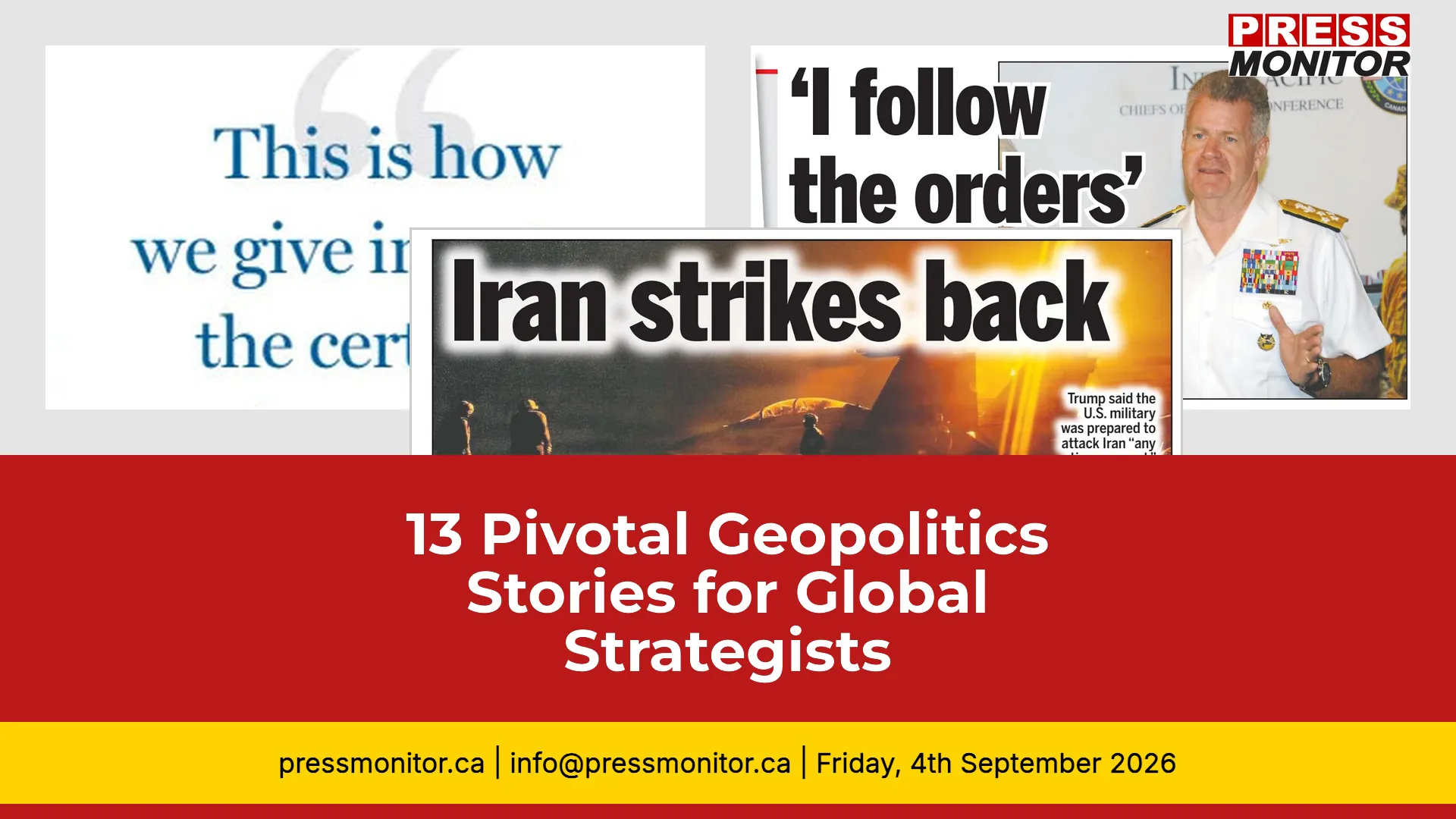
Ottawa Sun reports that U.S. Pacific Command Commander Adm. Samuel Paparo said at a Victoria, British Columbia, security conference on September 2 that he would follow President Donald Trump's orders, even if asked about military action against Canada. The comments came amid deteriorating Canada-U.S. relations, collapsed trade negotiations, White House attacks, and public mockery of Canadian forces by U.S. officials.
Why it matters: Command structures directly impact bilateral defence posture and alliance reliability.
Key detail/stat: U.S. Pacific Command Commander Adm. Paparo confirmed adherence to presidential directives even amid strained Canada-U.S. relations.
Source: Ottawa Sun
Next step: Review contingency protocols for joint Indo-Pacific operations. Closing + question: What internal safeguards should defence contractors implement when political signals shift?
3. Iran Attacks US Bases Across Gulf
Edmonton Sun reports that Iran launched missile and drone strikes targeting United States military bases across the Middle East, including facilities in Kuwait, Jordan, the United Arab Emirates, Bahrain, and Iraq. The offensive was triggered by recent American airstrikes ordered by President Donald Trump that killed at least nineteen Iranian civilians, prompting Tehran to declare a new strategic posture while continuing its blockade of the Strait of Hormuz. Meanwhile, Washington has tightened its counter-siege by blocking Iranian seaports and threatening maximum economic pressure through sweeping new sanctions.
Why it matters: Escalation in the Middle East immediately impacts global shipping lanes and energy pricing.
Key detail/stat: Tehran launched coordinated missile and drone strikes targeting U.S. facilities in Kuwait, Jordan, UAE, Bahrain, and Iraq.
Source: Edmonton Sun
Next step: Stress-test supply chain routing through alternative maritime corridors. Closing + question: Which logistics partners have demonstrated resilience during recent Strait of Hormuz disruptions?
4. Iceland Rejects EU Membership
Le Journal de Montreal reports that Iceland has rejected a bid to join the European Union, citing concerns over fishing rights, customs and monetary sovereignty. The decision follows a speech by Canadian central bank governor Mark Carney in Strasbourg and reflects Iceland's broader reluctance to cede control to Brussels.
Why it matters: Sovereignty decisions reshape European trade bloc dynamics and Nordic diplomatic alignments.
Key detail/stat: 53% voted against accession, prioritizing control over fishing rights, customs, and monetary policy.
Source: Le Journal de Montreal
Next step: Adjust European market entry strategies to account for expanded EEA alternatives. Closing + question: How will Brussels recalibrate its partnership framework with non-EU Atlantic states?
5. Putin Says Ukraine War Peace Deal Possible
The Globe And Mail (ottawa/quebec Edition) reports that Russian President Vladimir Putin said on Thursday there was a chance of reaching an agreement to end the war in Ukraine. Ukrainian President Volodymyr Zelensky said U.S. negotiators trying to broker a deal would soon visit both Moscow and Kyiv. U.S. President Donald Trump said he wanted to see an end to the war and losses sustained by both sides.
Why it matters: Diplomatic openings create windows for multinational risk reassessment and reconstruction planning.
Key detail/stat: Kremlin signals potential agreement as U.S. negotiators prepare dual visits to Moscow and Kyiv.
Source: The Globe And Mail
Next step: Update geopolitical risk models to factor in negotiated ceasefire scenarios. Closing + question: Which industries are best positioned to capitalize on post-conflict rebuilding contracts?
6. Carney Demands Putin End Ukraine Conflict
The Welland Tribune reports that Prime Minister Mark Carney plans to deliver a direct message to Vladimir Putin at the upcoming Group of Twenty leaders summit in Florida: get out of Ukraine. Carney emphasized that Russia must return all occupied territories and end the ongoing conflict, noting thirty thousand monthly casualties. While United States President Donald Trump has indicated Putin may attend despite an international arrest warrant, Carney affirmed that the host nation controls attendance invitations but highlighted valid reasons for excluding Moscow.
Why it matters: Canadian leadership stance reinforces multilateral pressure campaigns and sanctions enforcement.
Key detail/stat: Prime Minister Mark Carney will deliver direct messaging at the G20 summit, citing 30,000 monthly casualties.
Source: The Welland Tribune
Next step: Align corporate compliance frameworks with evolving Canadian diplomatic positions. Closing + question: How will your organization adapt procurement policies to align with G20 consensus outcomes?
7. Trump Repeats Annexation Threats, Echoing 19th-Century U.S. Pressure on Canada
The Globe And Mail reports that Donald Trump's latest tariffs and threats of annexation echo two historical episodes where the United States tried to pressure British North American colonies into joining the union. In 1865 and the early 1890s, U.S. tariff moves and annexation rhetoric instead strengthened Canadian nationalism, leading to the Dominion of Canada and protectionist policies. Today, Canadians are more united and can draw on this history, though the current threat is more serious because a U.S. president has publicly threatened annexation.
Why it matters: Historical parallels reveal how external coercion often accelerates domestic industrial consolidation.
Key detail/stat: Modern tariff tactics mirror 1865 and 1890s expansionist rhetoric, currently strengthening Canadian nationalist sentiment.
Source: The Globe And Mail
Next step: Evaluate domestic substitution opportunities in strategic sectors. Closing + question: Which legacy manufacturing clusters could benefit from accelerated federal support?
8. CPTPP Trade Deal Buffers Canada From Trump
The Globe And Mail reports that the Comprehensive and Progressive Agreement for Trans-Pacific Partnership is serving as an insurance policy against President Trump's global trade war. The twelve-country pact, which came into force in 2018, now includes Britain whose full membership took effect this past Tuesday. Canadian officials and British businesses are encouraging trade utilization to bolster economic growth across the Indo-Pacific region.
Why it matters: Multilateral agreements provide structural insulation against unilateral trade warfare.
Key detail/stat: Britain’s full membership activation expands the twelve-country pact, offering alternative export corridors.
Source: The Globe And Mail
Next step: Leverage CPTPP preferential tariffs to diversify revenue streams beyond North America. Closing + question: How quickly can your export teams pivot documentation to utilize new Indo-Pacific pathways?
9. Nepal Floods Claim 1,252 Lives
Toronto Sun reports that escalating military tensions between the United States and Iran have sparked targeted strikes on United States bases across Jordan and the United Arab Emirates, following Washington recent attacks on Iranian sites over sea mines in the Strait of Hormuz. Simultaneously, catastrophic flooding along the China-Nepal border has claimed at least 1,252 lives in Nepal, with thousands still missing as rescue operations intensify amid desperate family searches. Why it matter: Climate-driven humanitarian crises disrupt regional stability and trigger international aid reallocations.
Key detail/stat: Catastrophic flooding along the China-Nepal border leaves thousands missing as rescue operations intensify.
Source: Toronto Sun
Next step: Assess insurance exposure and employee safety protocols in South Asian operational hubs. Closing + question: Which crisis management frameworks require immediate stress-testing?
10. USMMA Collapse Threatens Canadian Economy
The Globe And Mail (ottawa/quebec Edition) reports that a new Deloitte Canada study warns dissolving the United States-Mexico-Canada Agreement would severely impact the domestic economy, potentially reducing real gross domestic product by 1.6 per cent and shedding an average of 163,000 jobs annually over the next decade. While expanding international trade partnerships offers some mitigation, researchers emphasize that eliminating interprovincial barriers and fostering new industries are essential to offsetting financial losses, particularly for manufacturing and energy sectors.
Why it matters: Agreement dissolution forecasts quantify systemic GDP contraction and employment displacement risks.
Key detail/stat: Deloitte Canada projects a 1.6% real GDP reduction and 163,000 annual job losses over the next decade.
Source: The Globe And Mail
Next step: Model interprovincial barrier removal scenarios to offset projected financial leakage. Closing + question: Which provincial jurisdictions are leading regulatory harmonization efforts?
11. Carney Urges Patience as Tariff Tensions Persist
Regina Leader-post reports that Geloso advises Prime Minister Carney to exercise patience rather than engage in a tit-for-tat tariff war with the United States. He suggests focusing on reducing red tape to strengthen Canada's economy and notes that Trump's low job approval ratings may render him a lame duck after November's midterm elections.
Why it matters: Strategic restraint prevents escalation cycles that damage cross-border commercial confidence.
Key detail/stat: Advisors recommend reducing administrative friction rather than initiating retaliatory duty hikes.
Source: Regina Leader-post
Next step: Optimize internal compliance workflows to absorb temporary tariff volatility. Closing + question: How will your treasury department hedge against prolonged trade uncertainty?
12. Mark Carney Rejects United States Trade Deal
The Welland Tribune reports that Prime Minister Mark Carney recently rejected a proposed trade agreement with the United States, a decision sparking nationwide debate over economic sovereignty in Canada. Drawing comparisons to historical benchmarks like the nineteen sixty five Auto Pact and the nineteen eighty seven Free Trade Agreement, the analysis highlights growing public demand for domestic control over national infrastructure and foreign investment. This political shift suggests Canadians may soon demand greater oversight of upcoming investment summits scheduled in Toronto.
Why it matters: Sovereignty-first negotiations signal a structural shift in Canadian economic diplomacy.
Key detail/stat: Rejection echoes historical benchmarks like the 1965 Auto Pact, fueling public demand for domestic infrastructure oversight.
Source: The Welland Tribune
Next step: Prepare stakeholder communications addressing independent valuation methodologies. Closing + question: Which advisory boards should be convened to validate new investment screening criteria?
13. Dutch Central Bank Moves Gold Reserves to London
{source_name} reports that the Dutch central bank moved 86 tonnes of gold reserves from the United States and Canada to London, citing increasing geopolitical unrest. The bank said London's market allows easier trading, and the total Dutch gold stock amounted to 612.4 tonnes valued at 72.2 billion euros at the end of 2025.
Why it matters: Reserve asset relocation reflects broader institutional hedging against transatlantic financial fragmentation.
Key detail/stat: 86 tonnes shifted from U.S. and Canadian vaults to London markets, citing geopolitical unrest and trading efficiency.
Source: Regina Leader-post
Next step: Review custodial banking arrangements and jurisdictional risk allocations. Closing + question: How will your institution adjust precious metals custody strategies in response to central bank movements?