13 Pivotal Government & Public Administration Stories for Decision Makers


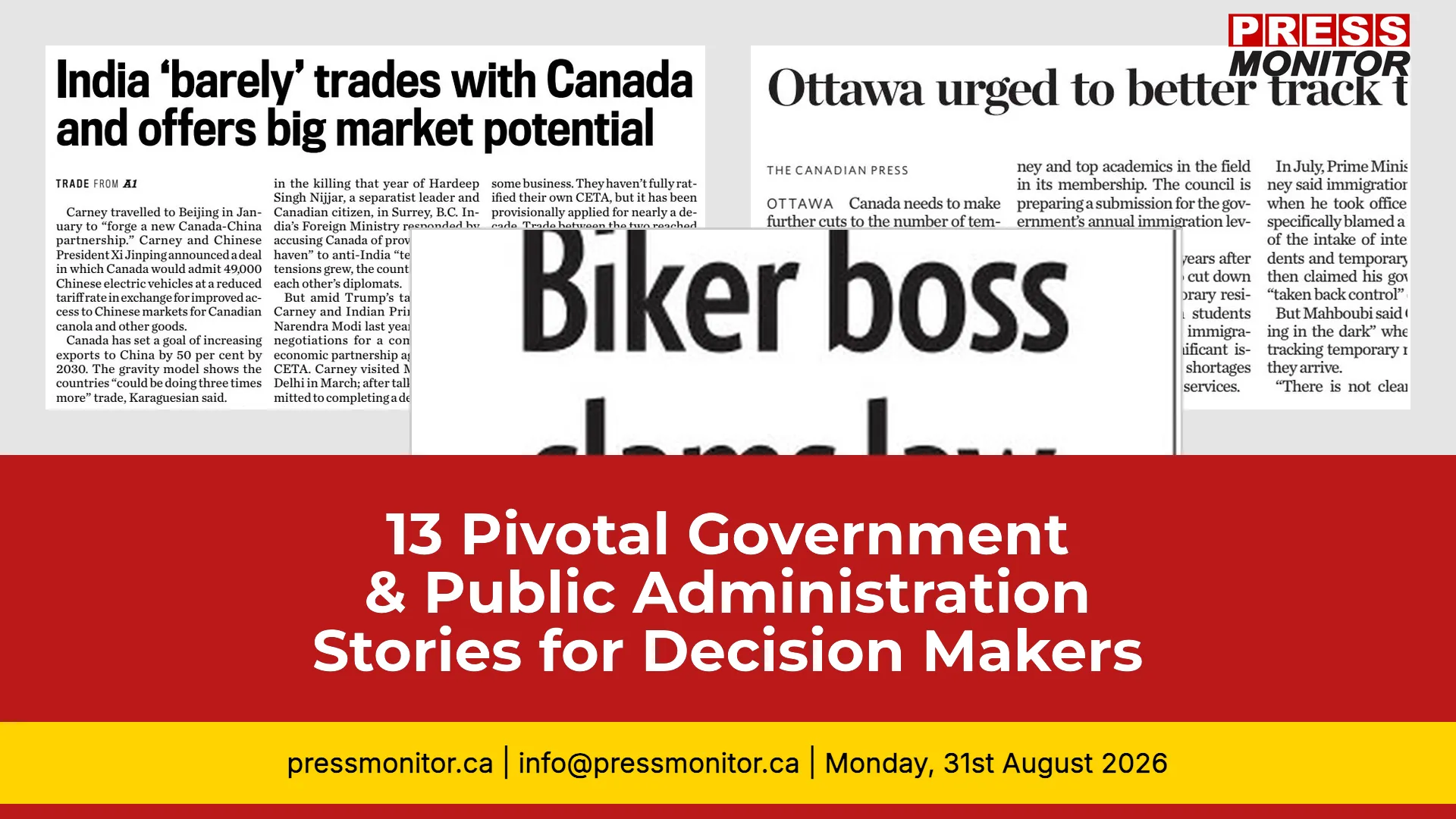
Keeping up with government and public administration news across Canada's expansive print landscape is essential for strategic decision-making. According to Press Monitor's tracking of Canadian publications, these 13 stories dominated the conversation on August 31, 2026, covering trade wars, infrastructure costs, immigration policy, and more. This press review highlights the developments that matter most for corporate, policy, and public sector leaders.
1. Carney's Global Trade Diversification Push
The Chronicle Herald reports that Prime Minister Mark Carney is working to diversify Canada's exports to reduce economic dependence on the United States. Following tariff threats from President Donald Trump, Canada is strengthening ties with China and India while investing in infrastructure to reach international markets.
Why it matters: Canada's heavy reliance on the U.S. market is a vulnerability as tariffs escalate. Prime Minister Mark Carney's diplomatic blitz seeks new partners to secure economic stability.
Key detail: Canada is strengthening ties with China and India while investing in port and pipeline infrastructure to reach non-U.S. markets.
Source: Chronicle Herald (syndicated across 7 newspapers)
Next step: Monitor Canada's trade negotiations and infrastructure announcements via print media monitoring to anticipate supply chain shifts.
Question: How will your organization adapt to Canada's pivot toward Asia?
2. Ottawa Urged to Better Track Temporary Residents
{source_name} reports that the head of an expert panel on immigration has urged better tracking of temporary residents, citing challenges in data collection and the need to reduce non-permanent populations. Parisa Mahboubi, chair of the Howe Institute's immigration targets council, emphasized Canada's lack of clarity on exit data for non-permanent visa holders, which complicates immigration policy adjustments.
Why it matters: Immigration policy directly affects labor markets, housing, and social services. Better data on temporary residents is critical for informed planning.
Key detail: Parisa Mahboubi, chair of the C.D. Howe Institute's immigration targets council, emphasizes Canada's lack of exit data for non-permanent visa holders.
Source: Hamilton Spectator (also covered by Welland Tribune, Standard St. Catharines)
Next step: Review your workforce planning assumptions against potential policy changes.
Question: Is your organization prepared for tighter temporary resident policies?
3. Quebec Bans Hells Angels Symbols
Ottawa Citizen reports that Quebec has implemented Bill 13, known as the anti-patch law, which bans the public display of symbols associated with criminal groups. The Hells Angels are the first organization targeted by the law, sparking criticism from other biker groups like Satan's Choice.
Why it matters: This anti-patch law sets a precedent for combating organized crime and raises freedom of expression questions.
Key detail: Bill 13 targets criminal groups, with Hells Angels being the first declared entity. Other clubs like Satan's Choice criticize the law.
Source: Ottawa Citizen (also covered by Montreal Gazette, National Post)
Next step: Businesses in Quebec should review compliance requirements regarding public displays and symbol use.
Question: Will other provinces follow Quebec's lead?
4. Government Promotes Boycott of U.S. Goods
Vancouver Sun reports that the Canadian government is encouraging citizens to boycott American products amid an escalating trade conflict with the United States. Finance Minister Francois-Philippe Champagne and Industry Minister Melanie Joly are urging economic patriotism to protect domestic jobs following new US tariffs.
Why it matters: Economic patriotism is reshaping consumer behavior and trade flows. Federal ministers are actively urging citizens to buy Canadian.
Key detail: Finance Minister Francois-Philippe Champagne and Industry Minister Melanie Joly lead the call for economic patriotism to protect domestic jobs.
Source: Vancouver Sun
Next step: Assess your supply chain for exposure to U.S. imports and reposition marketing around 'Made in Canada' messaging.
Question: How is your company leveraging the buy-Canadian movement?
5. Ottawa Rolls Out Countermeasures and Business Support
July 18, 2026, Calgary Herald reports that in response to U.S. tariffs, Ottawa is rolling out countermeasures and support for businesses. Federal Finance Minister Francois-Philippe Champagne announced the government's plans during a visit to Ideal’s Ottawa manufacturing plant last week.
Why it matters: The federal government is deploying targeted support to offset tariff damage, affecting business costs and competitiveness.
Key detail: Finance Minister Champagne announced the plans during a visit to Ideal's Ottawa manufacturing plant.
Source: Calgary Herald (also covered by Ottawa Citizen)
Next step: Explore available government support programs for export-oriented businesses.
Question: Have you applied for any tariff relief programs?
6. Trudeau Mobilizes Cabinet as Trade War Escalates
According to Toronto Star reports, Prime Minister Justin Trudeau mobilized cabinet ministers after U.S. President Donald Trump imposed tariffs impacting Canadian exports. The government's combative response followed Trump's false claims that tariffs target 'other nations' while increasing American consumer costs. Analysts noted parallels between the current dispute and previous negotiations involving U.S. Treasury Secretary James Baker under the Reagan administration. 67% of Canadians approve of Trudeau's firm stance, contrasting with plummeting support for Trump (33%), whose policies have caused domestic economic strain.
Why it matters: The trade war with the U.S. is at a flashpoint. Trudeau's firm stance has 67% approval, contrasting with Trump's declining support.
Key detail: Trump imposed tariffs impacting Canadian exports, with false claims about targeting other nations. Analysts draw parallels to Reagan-era negotiations.
Source: Toronto Star
Next step: Stay informed on diplomatic developments that could trigger sudden trade policy changes.
Question: Is your risk management team tracking the potential for rapid tariff escalations?
7. High-Speed Rail Cost Soars to $150 Billion
Selon The Globe and Mail, the estimated cost of a high-speed rail line from Toronto to Quebec City is around $150 billion when operating and maintenance expenses are included - a figure well above the range typically cited by federal officials. Alto, the Crown corporation overseeing the project, initially estimated costs between $60-90 billion, a range routinely used in public statements. The internal figures also show the Crown corporation expects fare revenue to cover operational expenses, although key financial figures were redacted in previous documents. The project has faced growing opposition from Conservative Leader Pierre Poilievre and local lawmakers concerned about its impact, while Alto continues to refine cost estimates and plans a specific route proposal later this year.
Why it matters: The Toronto-Quebec City high-speed rail project faces significant cost overruns, threatening its viability and public support.
Key detail: Internal Alto figures show costs reaching $150B when operating expenses included, far above the $60-90B range cited publicly.
Source: The Globe and Mail
Next step: Businesses along the corridor should monitor route decisions for real estate and workforce planning.
Question: How will this megaproject affect your investment timelines?
8. Trump Tariffs Could Cost U.S. Consumers $1,100 Annually
{source_name} reports that US President Donald Trump imposed new tariffs on Canadian imports, potentially raising shopping costs by up to US$1100 annually while reigniting global trade tensions reminiscent of his earlier trade war. Senior economist Sarah House warns inflation could rise, complicating Fed’s rate-hike strategy, as Canada retaliates with its own measures. The shift stalls long-term economic expectations and raises federal debt concerns, with GOP-led budget struggles raising debates over spending cuts far from advance on 2024 promises.
Why it matters: Tariffs are not just a trade issue—they have direct consumer consequences, potentially complicating Fed rate decisions.
Key detail: Senior economist Sarah House warns inflation could rise, pressuring the Federal Reserve's monetary policy.
Source: The Globe and Mail
Next step: Canadian exporters should prepare for sustained U.S. demand shifts as consumer costs rise.
Question: Are your pricing strategies resilient to cross-border cost increases?
9. Carney's Two-Dozen-Country Trade Mission
{source_name} reports that Canadian Prime Minister Mark Carney is actively seeking new buyers for Canadian exports as U.S. President Donald Trump imposes new tariffs and threatens more, creating a unique liability for Canada's heavily dependent economy. Since taking office, Carney has championed trade diversification and visited two dozen countries to cultivate new non-U.S. partnerships.
Why it matters: Prime Minister Carney is personally championing trade diversification, visiting 24 countries since taking office.
Key detail: The push includes de-risking Canada's economy from overwhelming dependence on the U.S. market.
Source: The Province
Next step: Identify which of Carney's target markets align with your export or investment plans.
Question: Which new trade corridor offers the most opportunity for your sector?
10. Ontario Aware of Psychiatric Hospital Isolation Practices for 8 Years
The Ontario government has been aware for at least eight years of serious concerns about a psychiatric hospital’s practice of keeping patients in isolation for prolonged periods of time, a practice that was recently found to be akin to torture. Documents filed in a proposed class-action lawsuit reveal that the Ministry of Health did not visit the facility and spoke to only one hospital executive over the phone before deciding no further action was necessary.
Why it matters: Government oversight failures in mental health care raise accountability and legal liability concerns.
Key detail: A proposed class-action lawsuit reveals the Ministry of Health did not visit the facility, only spoke to one executive by phone.
Source: Toronto Star
Next step: Public sector administrators should review their oversight protocols for facilities under their jurisdiction.
Question: What governance gaps exist in your organization's monitoring of contracted services?
11. Canada Boosts Trade Diplomacy in China and India
Canada's Minister Mark Carney has been working to enhance trade relations with China and India to boost trade and business opportunities. In January, Carney announced a deal to allow Chinese electric vehicles into Canada with reduced tariffs, in exchange for better market access for Canadian canola and other goods. Canada aims to increase exports to China by 50% by 2030. However, concerns about trade barriers, regulations, and intellectual property theft persist. Despite strained relations with India, Carney and Indian Prime Minister Narendra Modi have committed to finalizing a comprehensive economic partnership agreement by the end of the year.
Why it matters: Carney's outreach includes a deal allowing Chinese EVs with reduced tariffs in exchange for canola market access.
Key detail: Canada aims to increase exports to China by 50% by 2030. Meanwhile, a comprehensive economic partnership with India is targeted by year-end.
Source: Cape Breton Post
Next step: Evaluate how reduced tariffs on Chinese EVs might affect your domestic automotive or energy supply chain.
Question: Is your company positioned to benefit from the India-Canada trade pact?
12. Infrastructure Key to Trade Diversification
"Selon le Calgary Herald, le Canada est confronté à un défi majeur pour diversifier ses partenaires commerciaux en raison des nouvelles tarification et des menaces de représailles du gouvernement américain. Le Premier ministre Mark Carney a intensifié ses efforts en visitant des pays comme la Chine et l’Arabie saoudite, mais la dépendance historique envers les États-Unis représente un obstacle conséquent. L’article souligne l’importance des infrastructures, comme les ports et les pipelines, pour faciliter l’exportation de produits canadiens au-delà du marché américain."
Why it matters: Without adequate ports and pipelines, Canada cannot deliver goods to new markets even if deals are signed.
Key detail: The Calgary Herald reports that infrastructure gaps are a major bottleneck for diversifying away from the U.S.
Source: Calgary Herald
Next step: Track federal infrastructure spending announcements relevant to your logistics network.
Question: Are your supply chain investments aligned with Canada's new trade corridors?
13. Lincoln Seeks Provincial Flood Funding
The Standard (st. Catharines) reports that the Town of Lincoln is requesting assistance from the Disaster Recovery Assistance for Ontarians program to support flood victims. Residents in north Niagara suffered significant property losses following storms in late July and early August. The Ontario NDP is calling on the government to expand the program to include sewer backups.
Why it matters: Municipalities need provincial disaster assistance as climate events increase. The outcome may signal future funding models.
Key detail: The Ontario NDP is pushing to expand the Disaster Recovery Assistance for Ontarians program to cover sewer backups.
Source: The Standard (St. Catharines)
Next step: Municipal leaders should review their disaster recovery plans and engage with provincial programs.
Question: Is your community prepared for the next extreme weather event?
These stories represent just a snapshot of the critical government and public administration news covered by Press Monitor. Media intelligence tools that track print sources provide the signal needed to stay ahead of policy shifts. For a deeper dive into any of these stories, visit pressmonitor.ca and explore how our print media monitoring can keep your organization informed.