13 Pivotal Health Stories for Canadian Executives


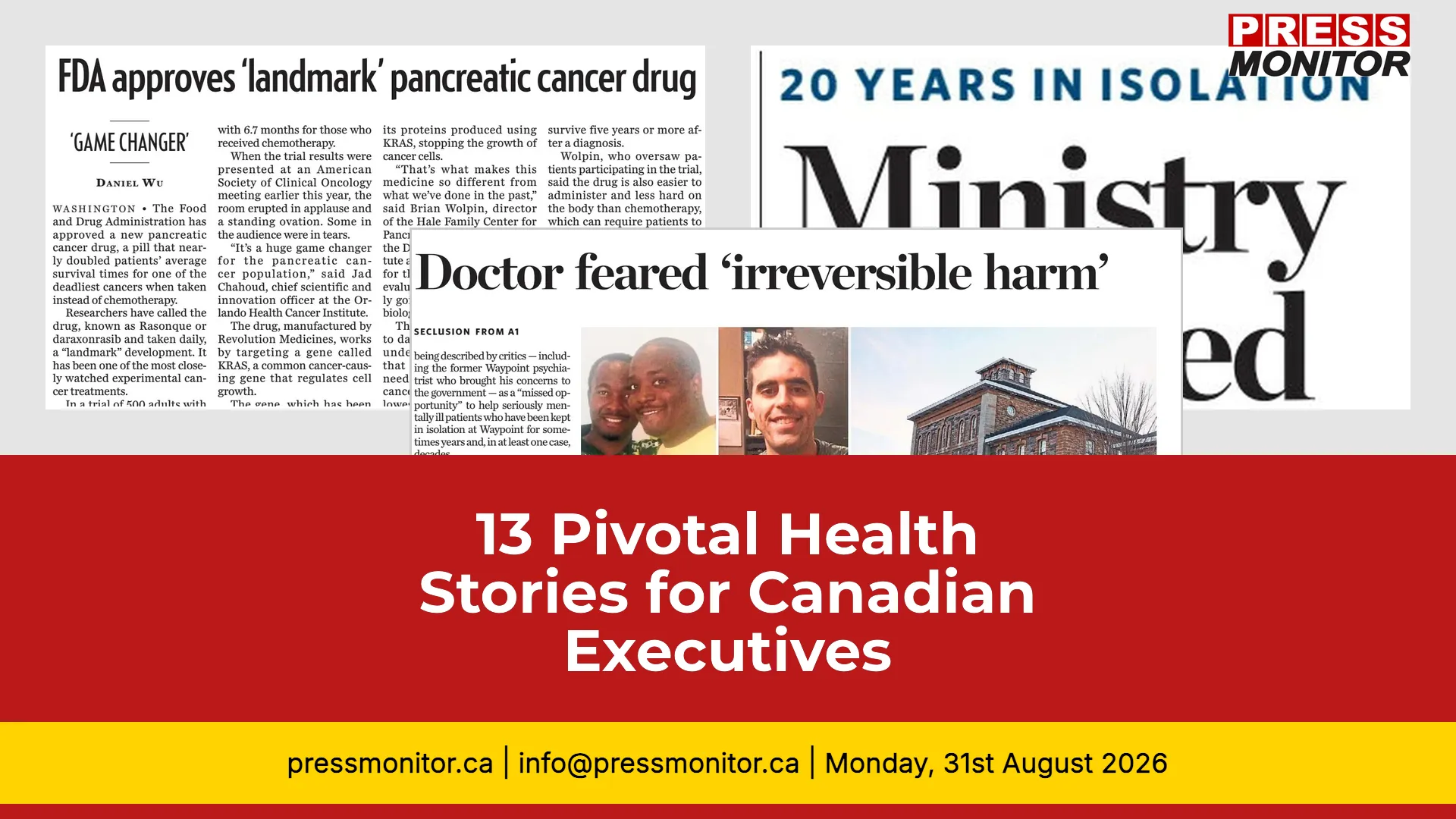
Healthcare executives, welcome to today’s press review. According to Press Monitor's tracking of Canadian publications, this week’s print media landscape reveals critical shifts in pharmaceutical innovation, mental health infrastructure, and systemic healthcare capacity. This media monitoring briefing distills 13 high-impact developments so you can act before the narrative solidifies. Leveraging advanced media intelligence, we’ve filtered the noise to deliver actionable print media monitoring insights. Here is your essential news on health.
1. FDA Approves 'Landmark' Pancreatic Cancer Drug
The Food and Drug Administration has approved a new pancreatic cancer drug, a pill that nearly doubled patients’ average survival times for one of the deadliest cancers when taken instead of chemotherapy. Researchers have called the drug, known as Rasonque or daraxonrasib and taken daily, a “landmark” development.
Why it matters: A paradigm shift in oncology treatment protocols and formulary planning.
Key detail: The oral drug Rasonque nearly doubled average survival times compared to traditional chemotherapy.
Source: Vancouver Sun, National Post, Ottawa Citizen, Edmonton Journal, Calgary Herald, The Province, Montreal Gazette.
Next step: Evaluate reimbursement pathways and patient access frameworks.
2. Ontario Aware of Psychiatric Hospital's Isolation Practices
The Ontario government has been aware for at least eight years of serious concerns about a psychiatric hospital’s practice of keeping patients in isolation for prolonged periods of time, a practice that was recently found to be akin to torture. Documents filed in a proposed class-action lawsuit reveal that the Ministry of Health did not visit the facility and spoke to only one hospital executive over the phone before deciding no further action was necessary.
Why it matters: Exposes systemic oversight failures in provincial mental health facilities.
Key detail: Ministry documents reveal eight years of unaddressed isolation practices deemed akin to torture.
Source: Toronto Star.
Next step: Audit compliance frameworks and prepare for class-action litigation risks.
3. Mental Health Concerns at Waypoint Centre
Toronto Star reports that the ministry had the opportunity to intervene and force Waypoint to correct course back then, but failed to do so, leading to long-term seclusion of patients like Camelott Hamblett and Andrew Azevedo.
Why it matters: Highlights regulatory gaps in private psychiatric care standards.
Key detail: Ministry failed to intervene despite known cases of long-term seclusion affecting patients like Camelott Hamblett.
Source: Toronto Star.
Next step: Review accreditation requirements and mandate independent safety audits.
4. ER Doctors Report Unprecedented Patient Load
The Globe and Mail reports that emergency physicians in major cities across Canada are facing an unprecedented patient load this summer, a symptom of hospital overcrowding, an aging population, more medically complex patients, limited access to other health care supports, and unique factors in certain provinces.
Why it matters: Signals acute strain on emergency infrastructure amid demographic shifts.
Key detail: Summer surge driven by overcrowding, aging populations, and fragmented primary care access.
Source: The Globe and Mail.
Next step: Stress-test surge capacity models and invest in community-based triage.
5. Health workers protest security gaps
Le Journal de Québec reports that health care professionals marched in Québec to denounce a lack of safety measures in facilities. The protest follows a violent assault on nurse Patsy Van Damme at the CHUL psychiatric emergency department and claims that budget cuts under Santé Québec have reduced security personnel.
Why it matters: Workplace violence is escalating due to chronic underinvestment.
Key detail: Nurses and staff marched over budget cuts reducing security personnel at CHUL.
Source: Le Journal de Quebec.
Next step: Allocate emergency funding for facility safety and staff protection protocols.
6. Santé Québec engloutit 500 M$ dans des systèmes désuets
Selon Le Journal de Montréal, Santé Québec a déboursé 500 millions de dollars dans des systèmes informatiques obsolètes. Cette dépense importante soulève des questions quant à l'efficacité des investissements en matière de santé et à la nécessité de moderniser les infrastructures technologiques. Les experts estiment que des systèmes plus récents et adaptés aux besoins actuels pourraient permettre d'améliorer les services offerts aux patients et de réduire les coûts à long terme.
Why it matters: Massive capital inefficiency threatens digital transformation goals.
Key detail: Half a billion dollars spent on obsolete IT infrastructure raises questions about ROI and patient data security.
Source: Le Journal de Montreal, Le Journal de Quebec.
Next step: Conduct vendor performance reviews and accelerate cloud migration strategies.
7. Heat Exposure Health Risks Underestimated
The Standard (st. Catharines) reports that a massive study of Chicago hospital and urgent care records found increased accidental gun-shot wounds, kidney complaints, skin problems, varicose veins and even mental health issues related to marijuana use when the temperature hits 33.7 C or higher.
Why it matters: Climate-driven morbidity is straining emergency departments beyond mortality metrics.
Key detail: Temperatures above 33.7 C correlate with spikes in gunshot wounds, kidney issues, and substance-related mental health crises.
Source: The Standard, The Welland Tribune, The Hamilton Spectator.
Next step: Update heat-response protocols and expand urgent care staffing during thermal peaks.
8. Mental Health Providers Brace for School Year Demand
The Hamilton Spectator reports that mental health services in Ontario are preparing for a typical September spike in demand as students return to classes. Increased time spent online, economic, and social pressures are exacerbating mental health concerns for young people. Dr. Katherine Matheson and Dr. Ripudaman Minhas highlight the growing trend and emphasize the need for better access to help from schools, communities, and primary care providers.
Why it matters: Youth mental health crisis is approaching peak seasonal intensity.
Key detail: Academic pressures, economic stress, and increased screen time are driving unprecedented September demand.
Source: The Hamilton Spectator, The Welland Tribune, The Standard.
Next step: Partner with school boards to embed on-site counseling and telehealth referrals.
9. Dr. Rébecca Robillard Leads Canadian Sleep Research
The Globe And Mail reports that Dr. Rébecca Robillard, PhD, is a clinical neuropsychologist and associate professor at the School of Psychology at the University of Ottawa. She also leads clinical sleep research at the Royal Mental Health Hospital. She co-chairs the Canadian Sleep Research Consortium, a national hub of sleep scientists and clinicians.
Why it matters: Positions Canada at the forefront of neuropsychological sleep science.
Key detail: Robillard co-chairs the national consortium linking clinical practice with academic research at the University of Ottawa.
Source: The Globe and Mail.
Next step: Leverage her leadership for institutional partnerships and grant alignment.
10. Hospital art program gives patients a voice
"HAMILTON SPECTATOR" reports that a hospital art program in Hamilton has provided valuable outlets for mental health patients, helping them gain confidence, build resumes through community mural projects, and prepare for an upcoming February twenty twenty seven exhibition at the Dundas Museum and Archives titled "The Art of Recovery."
Why it matters: Demonstrates low-cost, high-impact therapeutic interventions.
Key detail: Community mural projects are building confidence and professional skills for mental health recovery patients.
Source: The Hamilton Spectator.
Next step: Fund pilot creative therapy programs across regional hospitals.
11. Sisters' Struggle for Alzheimer's Care
Le Journal de Montréal reports that two sisters are battling the healthcare system for home care services for their mother suffering from Alzheimer's disease.
Why it matters: Reveals critical bottlenecks in home-care eligibility and caregiver support.
Key detail: Families face bureaucratic walls and excessive documentation requirements for essential dementia care.
Source: Le Journal de Montreal, Le Journal de Quebec.
Next step: Streamline assessment workflows and expand respite care funding.
12. Opinion: Toronto's Approach to Street Despair
The Toronto Star reports that Joey Scoleri has astute observations about the drug-poisoning crisis playing out on Toronto sidewalks and what's missing in our societal response but gets it wrong regarding what has failed and what would fix it.
Why it matters: Challenges prevailing narratives around harm reduction and urban health equity.
Key detail: Editorial analysis critiques current societal responses to the drug-poisoning crisis while calling for structural fixes.
Source: Toronto Star.
Next step: Engage policymakers in evidence-based harm reduction strategy reviews.
13. Health-Care System Needs Revisiting
According to a report in the Toronto Star, Hugh Murray’s tragic death highlights a critical gap in Ontario’s health-care system, supported by the Ontario Family Caregivers’ Advisory Network (OFCAN). The story emphasizes the struggles of families watching loved ones refuse necessary medical care and the feeling of powerlessness when observations are not heeded. Determining a person’s capacity to make decisions is complex and requires careful consideration, avoiding assumptions based solely on a psychiatric diagnosis.
Why it matters: Underscores the complexity of capacity assessments and family advocacy.
Key detail: Tragic outcomes highlight the need for clearer legal frameworks when patients refuse care.
Source: Toronto Star.
Next step: Develop standardized capacity evaluation tools and caregiver liaison services.
Closing: Which of these developments requires immediate board-level attention? Share your perspective below.
