15 Essential Arts, Culture & Heritage Stories for Cultural Leaders


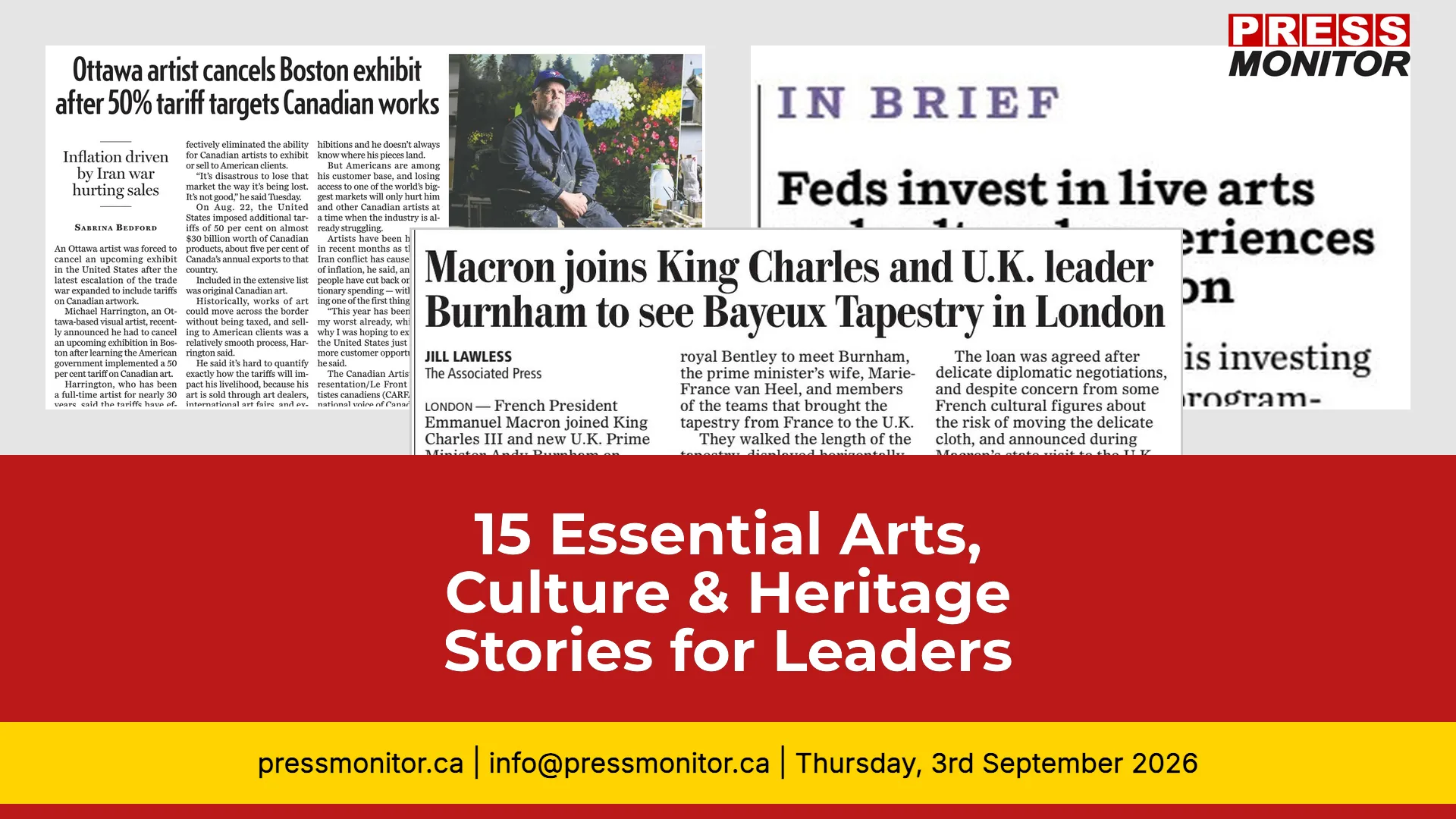
According to Press Monitor's tracking of Canadian publications, today's print media monitoring reveals 15 essential stories shaping Canada's arts, culture, and heritage landscape — from trade war impacts on artists to federal investments in live performance. This press review delivers the news on arts, culture and heritage that cultural leaders need to know.
1. 50% Tariff Hits Canadian Artists
Vancouver Sun reports that Ottawa visual artist Michael Harrington has cancelled an upcoming exhibition in Boston after the United States imposed a 50 per cent tariff on Canadian artwork, part of new duties on nearly C$30 billion worth of Canadian goods announced August 22. The Canadian Artists' Representation (CARFAC) is asking Ottawa to seek an exemption for original artworks and provide financial relief, while inflation fears tied to the U.S.-Iran conflict have already cut art sales.
Why it matters: A 50% U.S. tariff on Canadian artwork has forced Ottawa visual artist Michael Harrington to cancel a Boston exhibition, threatening livelihoods across the sector.
Key detail: The tariffs are part of new duties on nearly C$30 billion worth of Canadian goods, and the Canadian Artists' Representation (CARFAC) is seeking an exemption for original artworks.
Source: Vancouver Sun, Sabrina Bedford
Next step: Watch for Ottawa's response to CARFAC's request for financial relief.
2. Feds Invest in Live Arts
The Cape Breton Post reports that the federal government is investing in live arts and cultural programming in Cape Breton to strengthen the region’s cultural sector, increase public access to diverse performances, and support professional productions on local stages.
Why it matters: Federal funding for live arts and cultural programming in Cape Breton signals renewed government commitment to regional cultural infrastructure.
Key detail: The investment aims to strengthen the region's cultural sector, increase public access to diverse performances, and support professional productions on local stages.
Source: Cape Breton Post
Next step: Local arts organizations should prepare applications for expanded programming budgets.
3. Macron Views Bayeux Tapestry in London
Times Colonist reports that French President Emmanuel Macron joined King Charles III and new U.K. Prime Minister Andy Burnham for a private viewing of the Bayeux Tapestry at the British Museum in London on Wednesday. The nearly 1,000-year-old embroidery, insured for 960 million euros (US$1.1 billion), was loaned to Britain for a 10-month exhibition opening Sept. 10, its first time on British soil since the 11th century. Macron and his wife Brigitte also had tea with King Charles and Queen Camilla at Clarence House, with talks on Channel migration set for Thursday at 10 Downing Street.
Why it matters: French President Emmanuel Macron's private viewing of the 1,000-year-old Bayeux Tapestry at the British Museum underscores the diplomatic power of cultural exchange.
Key detail: The embroidery, insured for 960 million euros (US$1.1 billion), is on British soil for the first time since the 11th century, opening Sept. 10.
Source: Times Colonist, Jill Lawless
Next step: Cultural institutions should note the growing role of art loans in international diplomacy.
4. North Park Block Party Monday
Times Colonist reports that a free all-ages Empress Ave Block Party will be held Monday in Victoria's North Park neighbourhood, with performances by West My Friend, Cascadia Strings, Café Minuit, and Black Angus running from 4 p.m. to 8 p.m. alongside food trucks and lawn games. Victoria artist Lance Austin Olsen, 83, opens a solo exhibit of large-scale paintings and drawings at Xchanges Gallery, 2333 Government St., on Friday, running to September 20. The Esquimalt Farmers Market enters its final month of operation for 2026 with four September dates.
Why it matters: Free all-ages community arts events like the Empress Ave Block Party demonstrate the vitality of local cultural programming in Victoria.
Key detail: Performances by West My Friend, Cascadia Strings, Café Minuit, and Black Angus run 4-8 p.m., alongside food trucks and lawn games.
Source: Times Colonist, Mike Devlin
Next step: Community organizations can leverage such events for audience engagement and local artist exposure.
5. Indigenous Theatre Timmins Debuts at Tamarack Festival
The Daily Press (Timmins) reports that Indigenous Theatre Timmins will debut its short play 5O Shades of Brown at the Tamarack Festival on September 24 and 25 at the Timmins Museum: National Exhibition Centre. The 15-minute play, written by Faye Naveau, addresses racial profiling and aims to create a fun safe space for Indigenous performers and to educate the audience about the issues faced by Indigenous communities.
Why it matters: Indigenous Theatre Timmins' debut of 5O Shades of Brown addresses racial profiling through performance, creating space for Indigenous voices.
Key detail: The 15-minute play by Faye Naveau premieres Sept. 24-25 at the Timmins Museum: National Exhibition Centre.
Source: The Daily Press (Timmins)
Next step: Supporting Indigenous theatre strengthens cultural reconciliation and diversifies the performing arts landscape.
6. Canadian Theatre Production Lambs in Winter Expands Cast
The Hamilton Spectator reports that the Classical Theatre Company is expanding the cast of 'Lambs in Winter'. The play will be staged on the intimate Staircase Theatre stage, necessitating creative set design. The company plans to use four TV screens for a video wall, providing scene backdrops and additional information during transitions.
Why it matters: The Classical Theatre Company's expansion of Lambs in Winter reflects the resilience of intimate theatre production in Hamilton.
Key detail: The Staircase Theatre staging will use four TV screens as a video wall for scene backdrops and transitions.
Source: The Hamilton Spectator
Next step: Innovative set design like this could become a model for small-venue productions nationwide.
7. Inuit Carving in Hamilton
The Globe and Mail reports that an Inuit carving made during the 1950s and 1960s is now part of the Art Gallery of Hamilton's collection. The carving was made during a period when many Inuit were forcibly evacuated from the North and brought to Hamilton for tuberculosis treatment.
Why it matters: An Inuit carving from the 1950s-60s joining the Art Gallery of Hamilton's collection preserves a significant chapter of Canadian history.
Key detail: The carving was made during a period when many Inuit were forcibly evacuated from the North for tuberculosis treatment in Hamilton.
Source: The Globe and Mail
Next step: Museums should continue documenting the provenance and cultural context of Indigenous acquisitions.
8. Fall Theatre Season Kicks Off
The fall theatre season in Vancouver is underway with a variety of performances including new plays, the Fringe Festival, and musicals. Highlights include 'Running Wilde' at Jericho Arts Centre, the Vancouver Fringe Festival on Granville Island, and 'Avenue Q' at Metro Theatre.
Why it matters: Vancouver's fall theatre season launches with a robust lineup including Running Wilde, the Fringe Festival, and Avenue Q, signaling a strong recovery for live performance.
Key detail: Highlights span Jericho Arts Centre, Granville Island, and Metro Theatre.
Source: Vancouver Sun, Jerry Wasserman
Next step: Ticket buyers should secure seats early for popular shows like Avenue Q.
9. Royal Winnipeg Ballet, Victoria Symphony Sponsors Announced
The Times Colonist reports that Royal Winnipeg Ballet and Victoria Symphony have been announced as presentation sponsors. The event will take place at the Royal Theatre from Nov 27-29.
Why it matters: Major sponsorship announcements for Royal Winnipeg Ballet and Victoria Symphony ensure continued high-quality performances at the Royal Theatre.
Key detail: The event runs Nov. 27-29 at the Royal Theatre.
Source: Times Colonist
Next step: Sponsors and arts organizations should coordinate marketing efforts to maximize audience reach.
10. Canada Should Welcome Marginalized Artists
The Toronto Star reports that columnist Joshua Chong is urging Canada to welcome marginalized American artists, arguing that boycotting US cultural content would only hurt Canadians. He cites a 2024 PEN America survey of 95 American art museum directors in which 75 per cent said censorship is a problem, as President Donald Trump escalates attacks on institutions like the Kennedy Center. Chong contends that cross-cultural exchange defines Canadian identity and that art, unlike steel or potash, should not be blocked or tariffed.
Why it matters: Columnist Joshua Chong argues that boycotting U.S. cultural content would hurt Canadians, citing a PEN America survey where 75% of American museum directors called censorship a problem.
Key detail: President Trump's attacks on institutions like the Kennedy Center have escalated cultural tensions.
Source: Toronto Star, Joshua Chong
Next step: Canadian cultural institutions should champion cross-cultural exchange as a defining feature of national identity.
11. Canada Shouldn't Boycott American Artists
Toronto Star reports that Canadian nationalism is at a generational high and sweeping across the country's arts scene, with readers urging cultural institutions to reject American programming. Senior arts critic Joshua Chong argues that freezing out American artists in response to U.S. President Donald Trump's attacks on cultural institutions would be deeply short-sighted. He points to public arts funding that has fostered homegrown hits such as "Come From Away," "Heated Rivalry" and "North of North," saying the strength of Canada's arts scene has always been its variety and diversity.
Why it matters: Senior arts critic Joshua Chong warns that freezing out American artists in response to U.S. cultural attacks would be short-sighted and undermine Canada's diverse arts scene.
Key detail: Homegrown hits like Come From Away, Heated Rivalry, and North of North demonstrate the strength of Canadian arts through variety and diversity.
Source: Toronto Star, Joshua Chong
Next step: Policymakers should protect cross-border cultural exchange while defending Canadian institutions.
12. TaiwanFest 2026 Highlights
Vancouver Sun reports that TaiwanFest 2026 runs from Saturday to Monday in various locations in Vancouver showcasing Taiwanese arts and culture through performances and interactive events along with family-oriented activities in the downtown area.
Why it matters: TaiwanFest 2026 brings Taiwanese arts and culture to Vancouver, fostering international cultural exchange through performances and interactive events.
Key detail: The festival runs Saturday to Monday across various downtown Vancouver locations with family-oriented activities.
Source: Vancouver Sun
Next step: Cultural organizations should partner with international festivals to broaden audience reach.
13. Hamilton Philharmonic Youth Orchestra
The Hamilton Philharmonic Youth Orchestra (HPYO) at McMaster University enters the 2026-27 season with Armand Hall as sole conductor. Founded in 1965, the HPYO merged with the Hamilton Philharmonic Orchestra (HPO) in 2021 and focuses on mentoring young musicians.
Why it matters: The HPYO enters its 2026-27 season with Armand Hall as sole conductor, continuing a legacy of youth music mentorship since 1965.
Key detail: The orchestra merged with the Hamilton Philharmonic Orchestra in 2021 and focuses on developing young musicians at McMaster University.
Source: The Hamilton Spectator
Next step: Youth orchestra programs should be prioritized as essential infrastructure for classical music's future.
14. Artists Seek Permanent Relief from HST on Original Art Sales
Calgary Herald reports that the federal government has introduced several financial-relief packages and counter-tariff strategies for certain sectors facing the impact of tariffs, but not yet for artists. Harrington suggested one way the government could help would be to eliminate HST on sales of original art, not just during the trade dispute but permanently.
Why it matters: Artist Michael Harrington's proposal to eliminate HST on original art sales — not just during trade disputes — highlights a structural funding gap for visual artists.
Key detail: Federal financial-relief packages have not yet extended to artists, leaving individual creators vulnerable to economic shocks.
Source: Calgary Herald
Next step: Advocacy groups like CARFAC should push for permanent HST exemptions as part of arts policy reform.
15. Organization Urges Canadians to Buy Local, Crisis or No
Ottawa Citizen reports that The Canadian Artists’ Representation/Le Front des artistes canadiens (CARFAC), the national voice of Canada’s professional visual artists, said it was deeply concerned about the impact new tariffs will have on Canadian art and artists.
Why it matters: CARFAC's deep concern about tariff impacts on Canadian art and artists underscores the need for consumer support of domestic creative industries.
Key detail: As the national voice of Canada's professional visual artists, CARFAC's warnings carry significant weight in cultural policy discussions.
Source: Ottawa Citizen
Next step: Consumers and collectors should prioritize purchasing original Canadian artwork to sustain the domestic art market.
Closing question: With tariffs threatening artists, federal investments flowing to regional arts, and cultural diplomacy on the global stage, how will Canada's arts community navigate this pivotal moment?
This media intelligence review was compiled from Canadian print publications through Press Monitor's media monitoring platform.