15 Essential Geopolitics and International Relations Stories for Policy Leaders


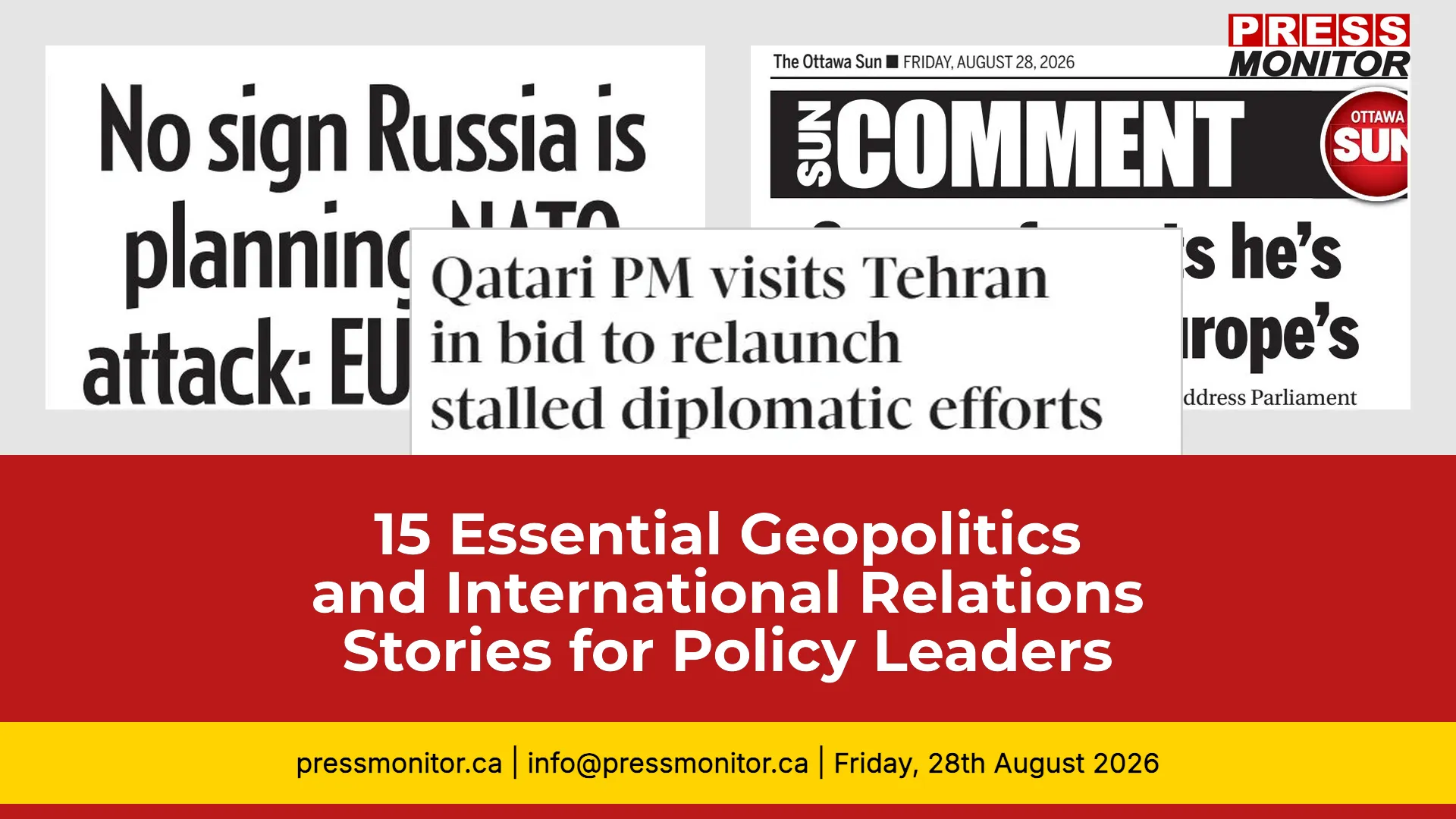
In today's fast-moving geopolitical landscape, staying ahead of developments requires rigorous media monitoring. According to Press Monitor's tracking of Canadian publications, the top stories on geopolitics and international relations this week reveal critical shifts in trade, security, and diplomacy. Here are the 15 most impactful narratives, powered by print media monitoring across Canada's leading newspapers.
1. EU Dismisses Claims of Imminent Russian NATO Attack
Vancouver Sun reports that European intelligence agencies see no sign of a planned military attack from Russia on European NATO countries. This comes after U.S. media reports that CIA Director John Ratcliffe warned Russia against such an attack during a visit to Moscow. The EU official emphasized that while there is no imminent threat, Russia is actively creating difficulties for European countries.
Why it matters: European intelligence agencies see no sign of a planned Russian military attack on NATO countries, easing immediate security fears.
Key detail: A senior EU official confirmed the assessment, following U.S. media reports that CIA Director John Ratcliffe warned Moscow during a visit.
Source: Vancouver Sun
Next step: Monitor EU-Russia relations and NATO readiness updates.
2. PM Carney's European Address Sparks Outrage at Home
The Ottawa Sun reports that Prime Minister Mark Carney is set to address the European Parliament in Strasbourg, France, while Canada's Parliament remains on summer recess. This move has drawn criticism from Conservative Leader Pierre Poilievre and Deputy Conservative Leader Melissa Lantsman for sidelining Canadian representation during a time of trade conflict with the United States.
Why it matters: Prime Minister Mark Carney's decision to address the European Parliament while Canada's Parliament is on recess draws sharp criticism from opposition leaders.
Key detail: Conservative Leader Pierre Poilievre and Deputy Leader Melissa Lantsman accuse Carney of sidelining Canadian representation during trade talks with the U.S.
Source: Ottawa Sun (cross-reported by Toronto Sun, Edmonton Sun, Calgary Sun)
Next step: Watch for Parliament reconvening and Carney's trade strategy.
3. Qatari PM Visits Tehran to Revive Diplomatic Efforts
According to a report in The Globe And Mail, the Prime Minister of Qatar visited Tehran on Thursday in an attempt to revive diplomatic efforts between the United States and Iran. Both sides are at odds over control of the Strait of Hormuz, and Qatar has played a key role in securing a recent ceasefire. The two leaders discussed a proposed phased framework including a joint shipping corridor. The White House stated that there were currently no negotiations happening between the United States and Iran.
Why it matters: Qatar's mediation aims to restart U.S.-Iran negotiations over the Strait of Hormuz.
Key detail: The visit included discussions on a proposed phased framework with a joint shipping corridor, but the White House says no negotiations are currently happening.
Source: The Globe and Mail
Next step: Follow Qatar's mediation role and any breakthroughs.
4. Canada Faces Agricultural Crisis Over Tariff Threat
National Post reports that Canada's potash exports, critical to U.S. agriculture, could become a flashpoint in U.S.-Canada trade tensions. Saskatchewan Premier Scott Moe confirmed the province will not support export restrictions on potash or oil, despite Ontario Premier Doug Ford's declaration that Canada has leverage. A Munk School expert warned that disrupting Canadian exports would cripple U.S. agriculture and trigger retaliatory tariffs exceeding 50%, while global fertilizer shortages persist amid Russia and Belarus trade bans.
Why it matters: Potash exports to the U.S. become a flashpoint in trade tensions, with global fertilizer shortages looming.
Key detail: Saskatchewan Premier Scott Moe rules out export restrictions, while experts warn U.S. agriculture would be crippled by retaliation.
Source: National Post
Next step: Track potash prices and U.S. agricultural lobbying.
5. Tariff Policy Becoming More Unpopular in U.S., Verheul Says
Saskatoon Starphoenix reports that the U.S. has applied 50 per cent tariffs under the Smoot-Hawley Tariff Act on nearly $28 billion worth of Canadian goods. Canada has retaliated with tariffs ranging from 15 per cent to 50 per cent on $27.6 billion worth of U.S. imports, effective Sept. 8. After weeks of negotiations, Prime Minister Mark Carney said his government had to walk away from an interim agreement due to several last-minute demands from the U.S. side.
Why it matters: Former chief negotiator Steve Verheul highlights growing U.S. opposition to 50% tariffs under the Smoot-Hawley Act.
Key detail: Canada retaliated with tariffs on $27.6 billion of U.S. imports, effective Sept. 8.
Source: Saskatoon StarPhoenix
Next step: Monitor public opinion polls and midterm election impacts.
6. US Intelligence Chief's Moscow Visit Amid Ukraine War
The Ottawa Citizen reports that President Donald Trump described Ratcliffe’s visit to Moscow as'semi-routine,' indicating the intelligence chief was in the Russian capital to discuss the Ukraine war. This visit comes during an escalation in Moscow’s offensive in Ukraine, with U.S.-brokered peace talks stalled.
Why it matters: CIA Director John Ratcliffe's visit to Moscow, described as 'semi-routine,' occurs during an escalation in Russia's offensive.
Key detail: U.S.-brokered peace talks remain stalled.
Source: Ottawa Citizen
Next step: Watch for any diplomatic progress or new sanctions.
7. Canada Becomes a Symbol of Resistance
The Hamilton Spectator reports that Canada’s ‘trade war’ with the United States, ignited on Aug. 21 when Prime Minister Mark Carney walked out of trade talks with the Trump administration, is not the foredoomed David-vs.-Goliath struggle that it seems. Its really about sovereignty, not trade, and Canada stands a fair chance of winning.
Why it matters: Canada's trade war with the U.S. is framed as a sovereignty struggle, not just economic.
Key detail: The article argues Canada has a fair chance of winning, as the dispute is fundamentally about democracy.
Source: The Hamilton Spectator
Next step: Engage in the sovereignty narrative for policy positioning.
8. C$28 Billion in Canadian Goods Hit Tariffs
Regina Leader-post reports that Canada and the United States are locked in a trade dispute after Canada imposed retaliatory tariffs on C$27.6 billion worth of U.S. imports. Prime Minister Mark Carney stated that negotiations for an interim agreement failed due to U.S. demands regarding automotive tariffs and Canadian sovereignty.
Why it matters: Retaliatory tariffs escalate the trade dispute, affecting industries on both sides.
Key detail: PM Carney says negotiations failed over U.S. demands on automotive tariffs and sovereignty.
Source: Regina Leader-Post
Next step: Assess sectoral impacts and supply chain adjustments.
9. Canada's Diplomatic Blunders
National Post reports that under Prime Minister Justin Trudeau, Canada's relationship with its most vital security and trading partner, the United States, has been disastrously mishandled. The article criticizes the government's focus on domestic politics over cross-border diplomacy and its failure to address foreign interference and elite capture, primarily orchestrated by Beijing.
Why it matters: Former policies under Justin Trudeau criticized for mishandling U.S. relations and enabling foreign interference.
Key detail: The article cites Beijing's influence as a key factor in elite capture.
Source: National Post
Next step: Review diplomatic strategies and foreign interference safeguards.
10. Negotiator Says CUSMA Review Talks Unlikely Soon
Saskatoon Starphoenix reports that Steve Verheul, one of Canada’s former chief trade negotiators, doesn’t expect formal conversations on the review of the Canada-U.S.-Mexico Agreement between Canada and the United States to happen in the near future, after the collapse of trade talks between the two countries last week.
Why it matters: Steve Verheul expects no formal conversations on the CUSMA review in the near future.
Key detail: The collapse of trade talks last week stalls the review process.
Source: Saskatoon StarPhoenix
Next step: Prepare for prolonged uncertainty in North American trade.
11. Negotiator Talks Inevitably Will Resume
Regina Leader-post reports that Steve Verheul, former chief trade negotiator for Canada, does not expect formal conversations on the review of the Canada-U.S.-Mexico Agreement between Canada and the United States to happen soon after the collapse of trade talks last week.
Why it matters: Despite the collapse, Verheul believes talks will eventually restart.
Key detail: No timeline given, but the economic interdependence makes resumption likely.
Source: Regina Leader-Post
Next step: Plan for eventual negotiation scenarios.
12. Potash Seen as Bargaining Chip in Canada-US Trade War
The Calgary Herald reports that Ontario Premier Doug Ford has suggested potash could be leveraged by Canada in ongoing trade negotiations with the United States, while experts highlight the resource's indispensability to the American agricultural sector.
Why it matters: Ontario Premier Doug Ford suggests potash leverage, but experts highlight its indispensability.
Key detail: The resource is critical to American agriculture, giving Canada strategic weight.
Source: Calgary Herald
Next step: Watch for provincial-federal coordination on resource exports.
13. Canada-US Diplomatic Collapse Benefits China
The Globe And Mail (ottawa/quebec Edition) reports that the diplomatic breakdown between Canada and the US will likely benefit China and other repressive regimes eager to undermine democracy and human rights.
Why it matters: The breakdown of Canada-U.S. relations is seen as a win for authoritarian regimes.
Key detail: The article warns that democracy and human rights suffer when allies fall out.
Source: The Globe and Mail
Next step: Factor in geopolitical implications for multilateral alliances.
14. PM Carney's Trade Talks Withdrawal
"{source_name} reports that..." Prime Minister Mark Carney withdrew from trade negotiations in Washington, sparking a rare coalition as relations with his brother became a sensitive topic, per a new rule allowing personal complaints.
Why it matters: Carney's withdrawal from Washington negotiations sparks a rare coalition, including personal tensions.
Key detail: A new rule allowing personal complaints adds a family dimension to the story.
Source: Ottawa Citizen
Next step: Monitor internal coalition dynamics and personal political fallout.
15. Americans Don't Get Trump's Trade War
The Globe And Mail (ottawa/quebec Edition) reports that the Trump administration wants to violate the free trade agreement by imposing tariffs on Canada. Canada wants to keep free trade, but the US does not.
Why it matters: The U.S. administration wants to violate free trade, while Canada defends it.
Key detail: The article highlights a fundamental disconnect in public understanding.
Source: The Globe and Mail
Next step: Use this narrative to build Canadian public support for free trade.
Closing: Which of these geopolitical shifts will define the next quarter? Share your insights and tag colleagues who need to see this press review. For deeper intelligence, Press Monitor's print media monitoring tracks these stories as they develop across Canadian newspapers.