15 Essential Government & Public Administration Stories for Policy Leaders


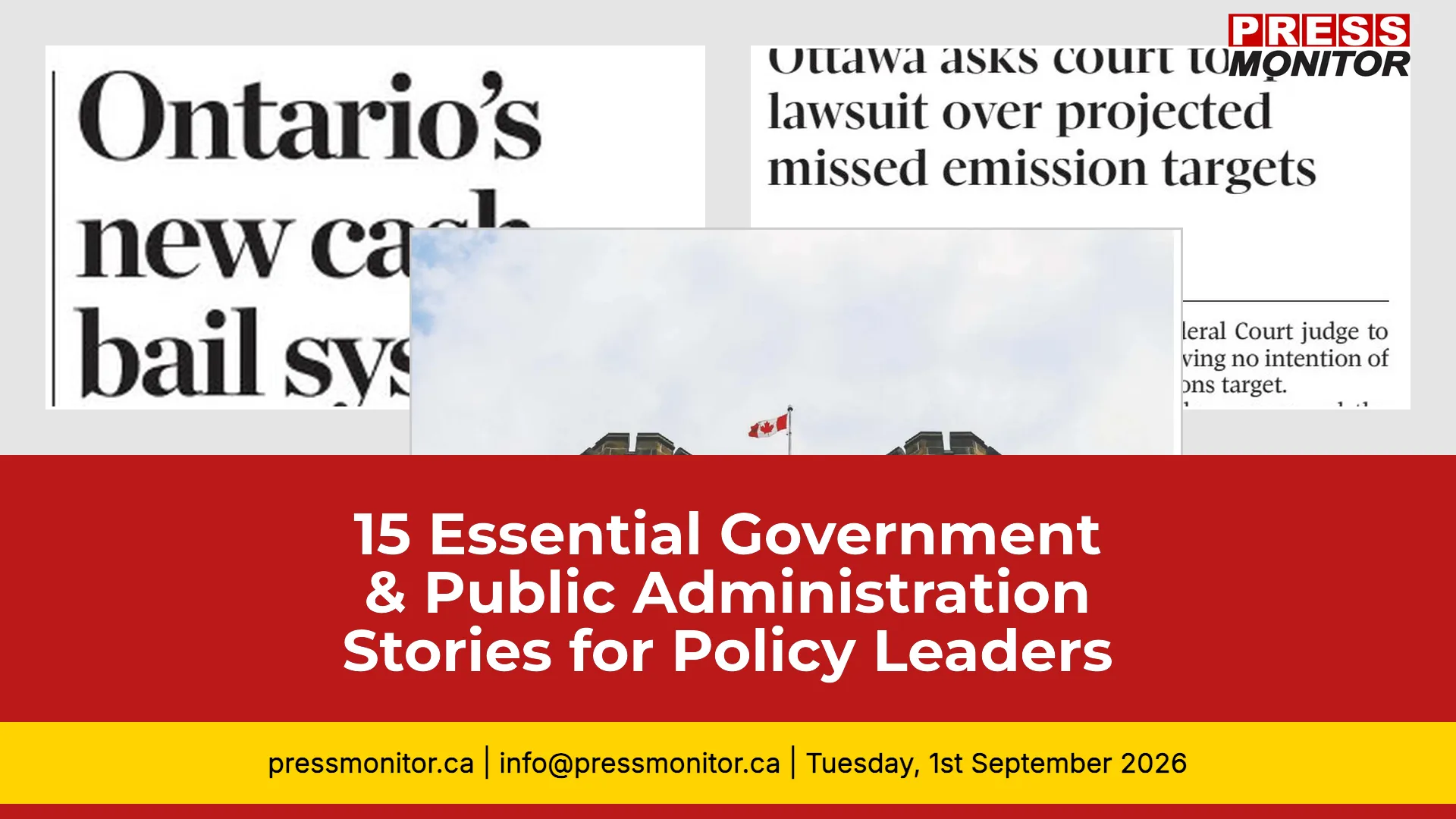
This press review, powered by Press Monitor's media monitoring of Canadian print publications, covers the 15 most important stories in government and public administration today. From tax reform to constitutional challenges, here is what you need to know.
1. Ontario Cash Bail System Put on Hold
«Selon The Hamilton Spectator, Ontario’s new cash bail system has been temporarily suspended while a judge reviews a constitutional challenge. The Canadian Civil Liberties Association and the Criminal Lawyers’ Association have sought an injunction, arguing the system infringes on federal jurisdiction and could disproportionately affect marginalized individuals. The province maintains the change is merely an administrative update that does not alter the conditions of release, and downplays concerns about its impact.»
Why it matters: A constitutional challenge has paused new cash bail rules, affecting the justice system and public safety.
Key detail: The Ontario Superior Court granted an injunction after the Canadian Civil Liberties Association argued the system unfairly targets low-income individuals.
Source: The Hamilton Spectator, The Globe and Mail, The Standard, The Welland Tribune.
Next step: Follow the final ruling expected in the coming weeks.
2. Ottawa Asks Court to Quash Emission Lawsuit
The federal government is asking a Federal Court judge to toss out a lawsuit accusing Ottawa of having no intention of meeting its 2O3O greenhouse gas emissions target. The government argued the Federal Court doesn’t have the power to order the government to take steps to meet its emissions targets.
Why it matters: The federal government is fighting a lawsuit that accuses it of failing to meet 2030 emissions targets.
Key detail: Government lawyers argue the Federal Court lacks authority to order specific climate actions.
Source: The Globe and Mail, The Welland Tribune, The Hamilton Spectator.
Next step: Watch for the court’s decision on jurisdiction.
3. Canadians Pay Way Too Much in Taxes, Economists Say
Despite some tepid cuts to personal income taxes in recent decades, economists say Canadians still pay way too much and the problem has been getting worse. Canada now relies more on personal income taxes for its revenue than any other G7 country. While governments’ slice from Canadians’ paycheques has been climbing for decades, Mintz pointed out that personal income taxes accounted for all per cent of gross domestic product in 2010, but grew to l3 per cent by 2023. Personal income taxes are now responsible for easily the biggest chunk of government revenue, and almost twice the amount of any other form of federal or provincial tax.
Why it matters: Canada leads the G7 in income tax reliance, stifling growth and investment.
Key detail: Personal income taxes now account for 13% of GDP, up from 10% in 2010.
Source: Regina Leader-Post.
Next step: Consider how tax reform could alter fiscal policy.
4. Calgary's Multibillion-Dollar Deficit
Calgary reports that the city is projected to have a multibillion-dollar deficit. The city's provincial budget submissions will be presented to council's intergovernmental affairs committee on Wednesday. If endorsed, the document will advance to council’s regular meeting in September for final ratification.
Why it matters: The city is facing a massive shortfall and will present budget submissions to council.
Key detail: The deficit requires provincial support to avoid service cuts.
Source: Calgary Sun.
Next step: Council’s September meeting will determine next steps.
5. Doug Guzman Departs Defence Investment Agency
The Globe And Mail reports that former banker Doug Guzman is expected to leave his position as head of the federal government’s newly created Defence Investment Agency due to frustration with the slow pace of government bureaucracy in defence procurement. Mr. Guzman was an important player in the July decision to purchase submarines from German company TKMS for the Royal Canadian Navy and has demanded quicker action on procurement files during his tenure.
Why it matters: The head of the new Defence Investment Agency leaves due to bureaucratic frustration.
Key detail: Guzman was key in the submarine purchase from Germany's TKMS.
Source: The Globe and Mail.
Next step: The government must find a replacement to maintain procurement momentum.
6. Canada-U.S. Trade War: Tax Reform Key to Economic Protection
According to a Regina Leader-post report, Canada is facing an economic attack from U.S. tariffs and shifting trade policies. Economists argue that a comprehensive overhaul of the tax system – specifically, cuts to both corporate and personal income taxes – would be the most effective long-term strategy to inoculate the Canadian economy against these challenges and stimulate growth. The Liberal government’s potential move to address the corporate tax system, coupled with political cover afforded by the trade dispute, presents an opportunity for transformative policy change, as acknowledged by bankers and economists.
Why it matters: Economists argue tax cuts are the best defence against U.S. tariffs.
Key detail: Reform could cover both corporate and personal income taxes.
Source: Regina Leader-Post.
Next step: Watch for federal budget proposals.
7. $90B Train Project Raises Cost Concerns
Ottawa Sun reports that the federal government has unveiled a high-speed rail plan, the Alto project, which involves a publicly owned federal mega-project. It aims to build a dual-track passenger network with trains traveling at three hundred kilometers per hour to cut travel times between Toronto and Quebec City in half.
Why it matters: The Alto high-speed rail project aims to connect Toronto and Quebec City.
Key detail: The publicly owned mega-project has a $90 billion price tag.
Source: Ottawa Sun.
Next step: Scrutiny over cost overruns and timeline.
8. City to Ask Province for More Than $1.2B
Calgary Herald reports that the City of Calgary will request more than $1.2 billion from the Alberta government’s 2027 budget, including hundreds of millions of dollars to support major transit capital projects and critical infrastructure upgrades.
Why it matters: Calgary seeks funding for transit and infrastructure upgrades.
Key detail: The request includes hundreds of millions for major capital projects.
Source: Calgary Herald.
Next step: Alberta’s 2027 budget will decide the allocation.
9. Corporate Tax Cuts and Economic Transformation
Saskatoon Starphoenix reports that there is an opportunity for the Canadian federal and provincial governments to drive transformational policy change. Economists argue that the government revenue lost by corporate income tax cuts is mitigated by the increased tax revenue derived from new investments spurred by the changes. Tax cuts also lead to behavioral changes, such as multinationals moving profit to jurisdictions with lower rates.
Why it matters: Lower corporate taxes could spur investment and offset revenue loss.
Key detail: Economists note that reduced rates can attract multinational profits.
Source: Saskatoon StarPhoenix.
Next step: Monitor federal and provincial tax policy changes.
10. Canada's High Income Taxes Hurt Growth
Saskatoon Starphoenix reports that economists are calling for a "big bang" overhaul of Canada's tax system to combat weak economic performance. Experts suggest shifting the tax burden from personal and corporate income taxes toward sales and payroll taxes to attract investment and prevent brain drain.
Why it matters: Experts call for a “big bang” tax shift to sales and payroll taxes.
Key detail: This could prevent brain drain and attract investment.
Source: Saskatoon StarPhoenix.
Next step: Policy makers weigh the political feasibility of such a shift.
11. Remote Voting in Canadian Parliament Continues
The Globe And Mail reports that hybrid proceedings introduced in the House of Commons during the onset of the COVID-19 pandemic are still in place, allowing MPs to vote and attend parliamentary sittings remotely. Critics argue that this diminishes accountability and weakens the fabric of Canadian democracy.
Why it matters: Hybrid proceedings persist post-COVID, raising accountability concerns.
Key detail: Critics argue remote voting weakens democratic oversight.
Source: The Globe and Mail.
Next step: Debate on ending the practice continues.
12. Draft Alberta Constitution Signals Separatist Intent
The Globe and Mail reports that the Alberta Prosperity Project has released a draft constitution featuring a president-led republic and a powerful fourth oversight branch. The document, derived in part from the far-right "Black Hat Gang", outlines a vision that challenges core Canadian values and includes plans for points-based immigration and balanced-budget mandates.
Why it matters: A proposed constitution challenges federal values.
Key detail: The document includes a president-led republic and points-based immigration.
Source: The Globe and Mail.
Next step: The Alberta Prosperity Project pushes for further discussion.
13. Could Canada Cut Off Potash to the U.S.?
The escalating trade war between Canada and the US has turned potash into a potential bargaining chip. Ontario Premier Doug Ford stated that the resource is one of the most powerful tools Canada has in negotiations, adding that the US agricultural sector would be dead overnight if Canada were to cut it off. Akaash Maharaj, a senior fellow at the Munk School of Global Affairs & Public Policy, confirmed that potash has become indispensable to the American agriculture sector, which is currently dependent on Canadian exports.
Why it matters: Potash is a powerful bargaining chip in the trade war.
Key detail: Ontario Premier Doug Ford highlighted its impact on U.S. agriculture.
Source: Cape Breton Post.
Next step: Trade negotiations may escalate.
14. Canada’s Government Investment Elevates Economic Growth
{Times Colonist} reports that the reader perspective challenges right-wing arguments about Canada’s public spending, emphasizing how government investment—spanning post-WWII through recent years—produces job opportunities, economic stability, and future benefits like federal pensions and infrastructure, highlighting Justin Trudeau’s role in funding growth and prosperity.
Why it matters: Public spending creates jobs and stability.
Key detail: The reader perspective argues against right-wing austerity views.
Source: Times Colonist.
Next step: Consider the role of government investment in future budgets.
15. Trump's Inner Circle Exodus
Ottawa Citizen reports that President Trump faces historically low approval ratings, a shaky economy, and an unpopular war in Iran that has roiled the global energy markets. The string of departures threatens to create a vacuum in Trump’s inner circle and finding replacements won’t be easy.
Why it matters: Senior staff resignations create a leadership vacuum.
Key detail: Trump faces low approval ratings and an unpopular Iran war.
Source: Ottawa Citizen.
Next step: The impact on Canada-U.S. relations remains uncertain.
Stay informed with Press Monitor’s daily media intelligence. These stories were tracked across Canadian print media to give you the edge in policy and communication.