15 Essential Human Resources Stories for HR Leaders


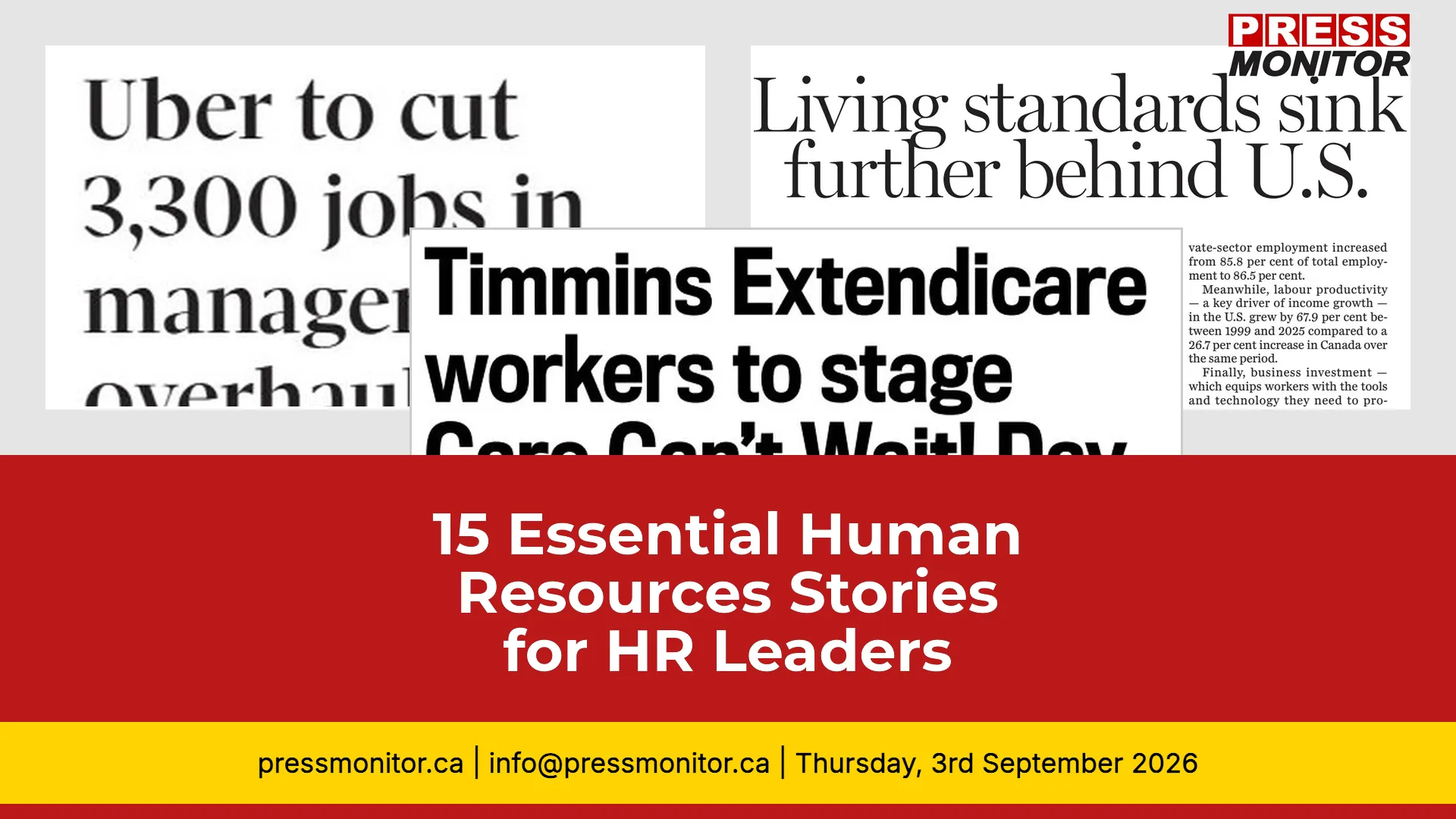
According to Press Monitor's media monitoring of Canadian publications, this press review delivers media intelligence on 15 essential human resources stories shaping the workforce today. From print media monitoring of Canadian newspapers, this coverage spans labour disputes, corporate restructuring, talent strategy, and workforce policy — news on human resources that matters for Canadian workplaces.
1. Uber Cuts 3,300 Jobs in Largest Restructuring Since COVID-19
The Globe And Mail (ottawa/quebec Edition) reports that Uber Technologies will lay off about 3,300 employees, or 10 per cent of its staff, in its largest cuts since the COVID-19 pandemic. CEO Dara Khosrowshahi said the restructuring will flatten management layers as Uber repositions for the rise of robotaxis, with plans to invest more than US$10 billion in autonomous driving amid competition from Waymo and Tesla.
Why it matters: Uber Technologies is eliminating 10% of its global workforce, the largest round of cuts since the pandemic, as CEO Dara Khosrowshahi flattens management layers and pivots toward robotaxis and autonomous driving.
Key detail: The company plans to invest more than US$10 billion in autonomous driving technology amid competition from Waymo and Tesla.
Source: The Globe and Mail (ottawa/quebec Edition)
Next step: Monitor how the restructuring impacts ride-hailing and delivery services in Canadian markets.
2. US Pulls Ahead of Canada Economically
Regina Leader-post reports that over the past quarter century, the gap in gross domestic product per person has more than doubled and the Americans have pulled ahead on income, employment, investment and productivity. According to a new study published by the Fraser Institute, in 1999, inflation-adjusted GDP per person in Canada was $48,076, while in the US it was $58,842. By 2024, GDP per person had grown to $83,286 in the US compared to just $59,529 in Canada.
Why it matters: A Fraser Institute study shows the GDP per person gap between the US and Canada has more than doubled over 25 years, with the US reaching $83,286 versus Canada's $59,529 in 2024.
Key detail: The gap affects income, employment, investment, and productivity — raising questions about Canadian competitiveness and workforce attraction.
Source: Regina Leader-post
Next step: HR leaders should factor economic competitiveness into talent retention and recruitment strategies.
3. CUPE Workers Strike Over Long-Term Care Contract
The Daily Press (timmins) reports that eight CUPE locals representing over 1,100 long-term care workers across Ontario, including those in Timmins, have been waiting for a fair contract from their employer on June 29.
Why it matters: Eight CUPE locals representing over 1,100 long-term care workers across Ontario have been waiting for a fair contract since June 29.
Key detail: Workers in Timmins and other Ontario communities are at the center of a growing labour dispute in the healthcare sector.
Source: The Daily Press (timmins)
Next step: Follow contract negotiation timelines and potential escalation actions.
4. CUPE Workers Stage Day of Action
The Daily Press (timmins) reports that members of CUPE 3l27, along with allies, are staging a Care Can't Wait Day of Action on Thursday from 11 a.m. to 1 p.m. at Extendicare Timmins, located at 62 St Jean Avenue. This action is in response to the prolonged delay in contract negotiations with their employer, which has been ongoing since June 29.
Why it matters: CUPE 3l27 members and allies are staging a Care Can't Wait Day of Action at Extendicare Timmins, highlighting the urgency of fair contract negotiations.
Key detail: The action runs from 11 a.m. to 1 p.m. at 62 St Jean Avenue, demonstrating worker solidarity in the long-term care sector.
Source: The Daily Press (timmins)
Next step: Track whether the Day of Action leads to renewed negotiations or further escalation.
5. Fredericton Chamber: Talent Fuels Growth
The Tribune (New Brunswick) reports that talent is the foundation upon which economic growth depends, according to Morgan Peters of the Fredericton Chamber of Commerce. The column warns that tariffs, labour shortages, and an aging population are straining New Brunswick businesses, making it urgent to both attract newcomers and develop the talent already in the region. Peters argues emerging industries from cybersecurity to artificial intelligence all hinge on people, tying population growth inseparably to economic growth.
Why it matters: Morgan Peters of the Fredericton Chamber of Commerce argues that talent is the foundation of economic growth, warning that tariffs, labour shortages, and an aging population are straining New Brunswick businesses.
Key detail: Emerging industries from cybersecurity to artificial intelligence all hinge on people, tying population growth inseparably to economic growth.
Source: The Tribune (New Brunswick)
Next step: Employers in the region should align talent acquisition strategies with emerging industry needs.
6. Canada Awards $504 Million to Attract Global Researchers
The Tribune reports that Canada has awarded $504 million in funding to 64 global scholars to relocate their work to Canadian universities. The initiative aims to advance projects in areas such as health and artificial intelligence.
Why it matters: Canada has awarded $504 million in funding to 64 global scholars to relocate their work to Canadian universities, advancing projects in health and artificial intelligence.
Key detail: This investment signals Canada's commitment to competing globally for research talent.
Source: The Tribune (New Brunswick)
Next step: Universities and research institutions should leverage this funding to attract top international talent.
7. RBC Report Urges Immigration Reset
Financial Post Magazine reports that a new Royal Bank of Canada study says Canada's immigration system has lost its edge and needs a reset to help Ottawa meet its economic goals and reduce reliance on the United States. The report, authored by Jackie Pichette, director of skills policy at RBC Thought Leadership, blames population shocks, frequent rule changes and a weakened points system for creating instability, including more than 20,000 job losses in the post-secondary sector. It urges rebuilding trust in the system to attract skilled workers for key sectors such as energy, mining and transportation.
Why it matters: A Royal Bank of Canada study says Canada's immigration system has lost its edge and needs a reset to help Ottawa meet its economic goals and reduce reliance on the United States.
Key detail: The report, authored by Jackie Pichette, blames population shocks, frequent rule changes, and a weakened points system for creating instability, including more than 20,000 job losses in the post-secondary sector.
Source: Financial Post Magazine
Next step: Policymakers and HR leaders should watch for immigration policy reforms that could reshape the labour market.
8. 80% of Apprenticeships Happen at Work
Times Colonist reports that more Canadians, including 49-year-old Simon Hardcastle of Ancaster, Ontario, are weighing a switch from desk jobs to skilled trades as governments invest heavily in the professions and the boom in artificial intelligence fuels fears about the future of office work. Career experts Rachel Buesink of Express Employment Professionals in Hamilton, Ontario and Shelley Gray, chief executive officer of SkilledTradesBC, advise researching trade options, trying pre-apprenticeship programs and securing an employer sponsor, noting training can take four months to become a truck driver and five years to become a qualified electrician.
Why it matters: More Canadians are weighing a switch from desk jobs to skilled trades as governments invest heavily in the professions and AI fuels fears about the future of office work.
Key detail: Training can take four months to become a truck driver and five years to become a qualified electrician.
Source: Times Colonist, Ritika Dubey, The Canadian Press
Next step: Career counselors and HR professionals should promote pre-apprenticeship programs and employer sponsorship pathways.
9. Skilled Trades Lure Mid-Career Workers
Times Colonist reports that skilled trades are becoming an increasingly attractive career option for Canadians, as government investment in the professions and fears about artificial intelligence reshaping desk jobs push mid-career workers to consider a switch. Ritika Dubey outlines the path from assessment tools and pre-apprenticeship sampler programs to securing an employer sponsor, noting certification can take four months for truck driving and up to five years for an electrician. Among those who made the leap is Simon Hardcastle, a 49-year-old from Ancaster, Ontario, who left a 25-year business administration career to operate heavy equipment and now reports high job satisfaction.
Why it matters: Skilled trades are becoming an increasingly attractive career option for Canadians, with government investment and AI fears pushing mid-career workers to make the switch.
Key detail: Simon Hardcastle, a 49-year-old from Ancaster, Ontario, left a 25-year business administration career to operate heavy equipment and now reports high job satisfaction.
Source: Times Colonist, Ritika Dubey, The Canadian Press
Next step: Employers in trades should develop mid-career transition programs to capture this growing talent pool.
10. Metro to Close Order Processing Center in Saint-Laurent
Le Journal de Montréal rapporte que Metro fermera un centre de traitement des commandes à Saint-Laurent, entraînant la perte d'environ 154 emplois. Metro travaille avec le syndicat pour accompagner les employés concernés et réduira ses coûts en utilisant davantage son réseau de magasins pour les livraisons.
Why it matters: Metro is closing its order processing center in Saint-Laurent, Montreal, resulting in the loss of approximately 154 jobs as the company shifts to store-based online grocery delivery.
Key detail: Metro is working with the union to support affected employees while reducing costs through its retail network.
Source: Le Journal de Montreal
Next step: Retail and grocery sector HR teams should prepare for workforce transition support obligations.
11. La Cordée Lays Off 31 Workers After Laval Store Closure
Le Journal de Quebec reports that outdoor equipment retailer La Cordée has closed its Laval store amid a restructuring, laying off 31 workers. The chain filed a notice of intention to make a proposal to its creditors on July 11, suspending legal proceedings while insolvency specialists at Raymond Chabot Grant Thornton guide the process. Four stores remain in Montreal, Saint-Hubert and Quebec City, with more than 175 employees still on the payroll.
Why it matters: Outdoor equipment retailer La Cordée has closed its Laval store, laying off 31 workers amid a restructuring and insolvency process.
Key detail: The chain filed a notice of intention to make a proposal to creditors on July 11, with insolvency specialists at Raymond Chabot Grant Thornton guiding the process. Four stores remain in Montreal, Saint-Hubert, and Quebec City.
Source: Le Journal de Quebec, Martin Jolicoeur
Next step: Monitor how the remaining stores will absorb operations and whether further closures are planned.
12. Federal Jobs Prioritized by Race, Sex, and Disability
The National Post reports that a new report by the Aristotle Foundation for Public Policy reveals that key federal departments are prioritizing candidates based on race, gender, and disability in new job postings. The report states that 42 percent of the 301 government job openings analyzed between February and July were subject to explicit or potential prioritization based on group identity.
Why it matters: A report by the Aristotle Foundation for Public Policy reveals that 42% of 301 government job openings analyzed between February and July were subject to explicit or potential prioritization based on group identity including race, gender, and disability.
Key detail: The findings have sparked debate about equity in federal hiring practices and transparency in public service recruitment.
Source: National Post, Andre Forget Postmedia News Files
Next step: HR professionals in the public sector should ensure hiring processes balance equity goals with merit-based standards.
13. Fréchette Early Retirement Plan for Public Servants
Le Journal de Montreal reports that Christine Fréchette, in an effort to downsize the state, would allow thousands of public servants to retire early at 55 without penalty.
Why it matters: Christine Fréchette announced a government CAQ policy allowing thousands of public servants to retire early at 55 without penalty, as part of an effort to downsize the state.
Key detail: The early retirement program aims to reduce the size of the public administration in Quebec.
Source: Le Journal de Montreal, Geneviève Lajoie
Next step: Public sector HR departments should prepare for potential workforce gaps and knowledge transfer challenges.
14. BCGEU Fights for Tomorrow's Rights on Labour Day
Vancouver Sun reports that this Labour Day, the BCGEU is proud to be 100,000 members strong and growing. They are fighting for the rights of tomorrow.
Why it matters: On Labour Day, the BCGEU proudly stands at 100,000 members strong and growing, fighting for the rights of tomorrow's workers.
Key detail: The union's growth reflects continued strength in British Columbia's public sector labour movement.
Source: Vancouver Sun
Next step: Follow BCGEU's advocacy priorities for the coming year and their impact on workplace policy.
15. CUPE BC's 110,000 Members Deliver Important Public Services
The Times Colonist reports that CUPE BC's 110,000 members deliver the important public services that make our communities a better place to live, learn, work, and play. They are committed to better services and better communities.
Why it matters: CUPE BC's 110,000 members deliver the important public services that make communities better places to live, learn, work, and play.
Key detail: The union emphasizes commitment to better services and better communities across British Columbia.
Source: Times Colonist
Next step: Recognize the role of public sector unions in maintaining essential services and community well-being.
Closing: Which of these human resources developments will have the greatest impact on Canadian workplaces in the coming months? Follow Press Monitor for ongoing news on human resources from Canadian print media.