15 Essential Infrastructure Stories for Decision Makers


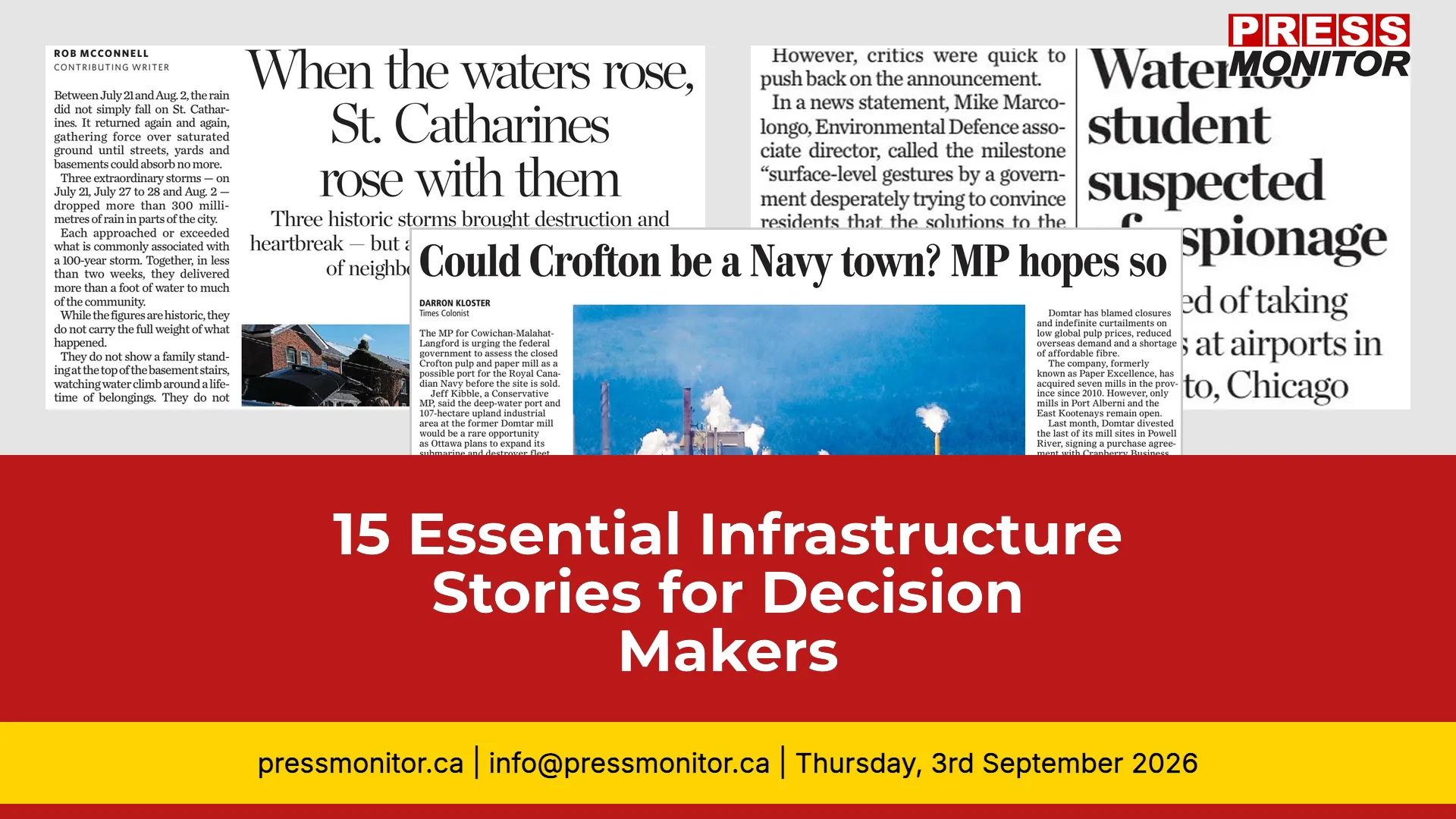
Media monitoring across Canadian print publications reveals 15 essential infrastructure stories for decision makers — from Ontario's largest-ever highway tender to a Navy port opportunity in British Columbia. This print media monitoring press review combines media monitoring and media intelligence to deliver news on infrastructure you need to know today. According to Press Monitor's tracking of Canadian publications, here are the stories shaping Canada's built environment.
1. Ontario Tenders Largest-Ever Highway 413 Contracts
The Standard reports that three extraordinary storms between July 21 and August 2 dropped more than 300 millimetres of rain on parts of St. Catharines, with each approaching or exceeding 100-year storm levels and damaging thousands of homes and businesses. Mayor Mat Siscoe declared a state of emergency on August 3 after the city activated its emergency operations centre on July 28. The floods strained roads, sewers and shoreline across the city, even as neighbours, firefighters and city staff rallied to help affected residents. The Ontario government is seeking proposals to design and build the eastern stretch of Highway 413 and extend Highway 427 in the Brampton, Caledon and Vaughan corridor. Transportation Minister Prabmeet Sarkaria called it the largest infrastructure procurement ever issued by the Ministry of Transportation. Why it matters: This procurement signals a major shift in Ontario's transportation infrastructure strategy and will reshape the GTA's development corridor for decades. Key detail: The contract covers about one third of the 52-kilometre corridor, with the Highway 410 extension also awarded to Infrastructure Partners of Ontario. Source: The Welland Tribune. Next step: Watch for proposal deadlines and contractor announcements in the coming weeks. How will this affect your region's supply chain?
2. Highway Plan Criticized by Environmental Groups
The Hamilton Spectator reports that critics are pushing back on a highway project announced by the government. Environmental Defence associate director, Mike Marcolongo, calls the milestone a 'surface-level gesture' by a government trying to convince residents that solutions to the GTA’s congestion are near, while the project is far in the future. The group argues that the project is environmentally destructive and not justified in terms of cost and benefits. Environmental Defence associate director Mike Marcolongo called the Ontario government's highway milestone a surface-level gesture, arguing the C$14 billion to C$18 billion project would pave over 400 acres of Greenbelt and 2,000 acres of prime farmland. Ontario Greens leader Mike Schreiner criticized Premier Ford for pushing ahead amid a trade war and affordability crisis. Why it matters: Environmental opposition could delay or derail major infrastructure approvals. Key detail: Critics argue the money could move twice as many people per hour if spent on transit, in a region where congestion already costs Ontarians C$45 billion a year. Source: The Hamilton Spectator. Next step: Monitor for legal challenges or provincial environmental assessment revisions. Will transit investment beat highway expansion in the court of public opinion?
3. Crofton Mill Eyed as Navy Port
Times Colonist reports that Cowichan-Malahat-Langford MP Jeff Kibble is urging Ottawa to assess the closed Crofton pulp and paper mill as a possible port for the Royal Canadian Navy before the 107-hectare Domtar site is sold. The mill's closure put more than 300 people out of work and cost the Municipality of North Cowichan about C$5 million a year in property taxes. Kibble says the deep-water port could ease congestion at CFB Esquimalt as the federal government builds 12 submarines and 15 River-class destroyers. Cowichan-Malahat-Langford MP Jeff Kibble is urging Ottawa to assess the closed Crofton pulp and paper mill as a possible port for the Royal Canadian Navy before the 107-hectare Domtar site is sold. Why it matters: The mill's closure put more than 300 people out of work and cost the Municipality of North Cowichan about C$5 million a year in property taxes. Key detail: The deep-water port could ease congestion at CFB Esquimalt as the federal government builds 12 submarines and 15 River-class destroyers. Source: Times Colonist. Next step: Track the Domtar sale timeline and Navy port feasibility study. Could this site become a strategic defence asset?
4. Metrolinx Names Two SmartTrack Stations
Toronto Star reports that Metrolinx has unveiled the names of two future SmartTrack stations in Toronto's west end: Stockyards Station at St. Clair Avenue West and Old Weston Road, and Junction Triangle Station at Bloor Street West and Lansdowne Avenue. Stockyards Station, which will be served by UP Express, is slated to open by the end of 2031, while Junction Triangle Station on the Barrie Line is expected to be in service by 2027. They are among only three remaining stations of former mayor John Tory's SmartTrack plan, whose cost has climbed past the approved C$17 billion budget cap. Metrolinx has unveiled the names of two future SmartTrack stations in Toronto's west end: Stockyards Station at St. Clair Avenue West and Old Weston Road, and Junction Triangle Station at Bloor Street West and Lansdowne Avenue. Why it matters: These stations are among only three remaining of former mayor John Tory's SmartTrack plan, whose cost has climbed past the approved C$17 billion budget cap. Key detail: Stockyards Station, served by UP Express, is slated to open by the end of 2031, while Junction Triangle Station on the Barrie Line is expected in service by 2027. Source: Toronto Star. Next step: Follow the budget review process for SmartTrack's remaining stations. Will the C$17 billion cap hold?
5. Ward Councillors Split on Tax Hikes for Infrastructure
Ottawa Citizen reports that councillor candidates in wards 7, 8 and 9 see the need for more infrastructure spending, they are divided over raising tax rates to pay for it. Ottawa Citizen reports that councillor candidates in wards 7, 8 and 9 see the need for more infrastructure spending, but they are divided over raising tax rates to pay for it. Why it matters: This split signals upcoming friction in Ottawa's municipal budget negotiations as infrastructure demands grow. Key detail: The divide reflects a broader tension between infrastructure investment and taxpayer affordability across Canadian municipalities. Source: Ottawa Citizen. Next step: Watch for ward-level campaign platforms on infrastructure funding. Which approach will Ottawa voters prefer?
6. Welland Canal Blockade Would Backfire
The Standard (St. Catharines) reports that trade and supply chain experts are warning against blocking American ships from the Welland Canal in retaliation for tariffs imposed by United States President Donald Trump. Trade lawyer John Boscariol of McCarthy Tétrault says the move would be cutting off Canada's nose to spite its face, since the canal is overseen by both Canadian and American organizations and retaliation would likely follow. Supply chain expert Fraser Johnson of Western University's Ivey School of Business notes the canal handles roughly 3,000 ships a year carrying 40 million to 50 million tonnes of freight, and disruption would raise costs on both sides of the border. Trade and supply chain experts are warning against blocking American ships from the Welland Canal in retaliation for tariffs imposed by U.S. President Donald Trump. Why it matters: The canal handles roughly 3,000 ships a year carrying 40 million to 50 million tonnes of freight, and disruption would raise costs on both sides of the border. Key detail: Trade lawyer John Boscariol of McCarthy Tetrault says the move would be cutting off Canada's nose to spite its face, since the canal is overseen by both Canadian and American organizations. Source: The Standard (St. Catharines). Next step: Monitor trade policy developments and canal usage data. What would a retaliatory blockade mean for Canadian exporters?
7. C$146 Billion Non-U.S. Trade Boost
The Vancouver Sun reports that a new PwC study says Canada could boost non-U.S. exports by C$146 billion by 2035 by focusing on energy, metals and minerals, and agriculture. Michael English, leader of PwC's transportation and logistics advisory practice, said strategic investments in ports, pipelines, rail and road infrastructure will be key, particularly through British Columbia ports such as Vancouver, Prince Rupert and Nanaimo. The report's release coincided with escalating trade tensions and new rounds of tariffs and counter-tariffs between Canada and the United States. A new PwC study says Canada could boost non-U.S. exports by C$146 billion by 2035 by focusing on energy, metals and minerals, and agriculture. Why it matters: Strategic investments in ports, pipelines, rail and road infrastructure will be key, particularly through British Columbia ports such as Vancouver, Prince Rupert and Nanaimo. Key detail: The report's release coincided with escalating trade tensions and new rounds of tariffs and counter-tariffs between Canada and the United States. Source: Vancouver Sun. Next step: Track which infrastructure projects are prioritized in the trade diversification strategy. Is Canada's trade pivot backed by real infrastructure spending?
8. Speeding Issue on Larry Uteck Boulevard
The Chronicle Herald reports that there has been an uptick in resident complaints about speeding on Larry Uteck Boulevard. Coun. Jean St-Amand is advocating for a lower speed limit and working with Halifax Regional Police to address the issue. The Chronicle Herald reports an uptick in resident complaints about speeding on Larry Uteck Boulevard. Coun. Jean St-Amand is advocating for a lower speed limit and working with Halifax Regional Police to address the issue. Why it matters: Local infrastructure safety concerns are rising as residential areas experience increased traffic volumes. Key detail: The issue highlights the gap between infrastructure design and community safety expectations in Canadian municipalities. Source: The Chronicle Herald (provincial). Next step: Follow the speed limit review process and police enforcement measures. Will Halifax act on resident safety concerns?
9. Doug Ford Targets Toronto Bike Lanes
Toronto Star reports that Doug Ford's Ontario government is officially taking bids to remove 19 kilometres of bike lanes from Toronto's streets as of September 1. A senior cyclist writing to the paper argues the removal is a culture war play aimed at punishing voters who do not support Ford, rather than a genuine traffic flow fix. The writer notes Toronto's worst congestion points, including Highway 401, the Gardiner and Don Mills Road, have no bike lanes to blame. Doug Ford's Ontario government is officially taking bids to remove 19 kilometres of bike lanes from Toronto's streets as of September 1. Why it matters: The move has sparked debate about whether removing bike lanes is a genuine traffic flow fix or a political culture war play. Key detail: A senior cyclist writing to the paper argues the removal targets voters who do not support Ford, noting that Toronto's worst congestion points including Highway 401, the Gardiner and Don Mills Road have no bike lanes to blame. Source: Toronto Star. Next step: Monitor the timeline for bike lane removal and public reaction from cycling advocacy groups. How will Toronto's cycling infrastructure evolve?
10. Watermain Break Leaves Businesses Closed in Mountjoy
The Daily Press (timmins) reports that a watermain break and emergency repair west of the Mattagami River Bridge impacted homes and businesses in the Mountjoy area. A watermain break and emergency repair west of the Mattagami River Bridge impacted homes and businesses in the Mountjoy area. Why it matters: Infrastructure failures at the local level can cause significant economic disruption for communities. Key detail: The emergency repair highlights the aging state of municipal water systems across Canadian towns and cities. Source: The Daily Press (Timmins). Next step: Watch for municipal water infrastructure investment announcements. How many other communities face similar risks?
11. B.C. Closing Cowichan Valley Road After Boy's Death
Times Colonist reports that the B.C. government will close public access to Poplar Road in the Cowichan Valley, one year after 12-year-old Xavier Rasul-Jankovics was struck and killed by a speeding driver while rollerblading with family on Aug. 25, 2025. Juan De Fuca-Malahat MLA Dana Lajeunesse announced the closure at a memorial event of about 300 people on Hillbank Road, and his private member's bill, Xavier's Law, which would give police the power to issue 30-day roadside driving bans to reckless drivers, is nearing the end of committee stage. The family is also funding an $81,000 scholarship to Simon Fraser University's newly established medical school and a full-ride scholarship to Shawnigan Lake School. The B.C. government will close public access to Poplar Road in the Cowichan Valley, one year after 12-year-old Xavier Rasul-Jankovics was struck and killed by a speeding driver while rollerblading with family. Why it matters: The closure represents a rare case of infrastructure being permanently altered in response to a tragedy, setting a precedent for road safety policy. Key detail: Juan De Fuca-Malahat MLA Dana Lajeunesse announced the closure at a memorial event of about 300 people, and his private member's bill, Xavier's Law, would give police the power to issue 30-day roadside driving bans to reckless drivers. Source: Times Colonist. Next step: Track the progress of Xavier's Law through committee stage. Could this become a national road safety model?
12. C$2M for Levis Riverfront Park
Le Journal de Québec reports that the Port de Québec is providing C$2 million in funding for a C$8.5 million riverfront park project at the Juvénat Notre-Dame in Lévis. The project includes a green classroom, trails, a one-kilometre promenade, a belvedere and a natural beach that will give the public access to the river. Main construction work began in early summer and should be completed before winter, with the park opening to the population in summer 2027. The Port de Quebec is providing C$2 million in funding for a C$8.5 million riverfront park project at the Juvenat Notre-Dame in Levis. Why it matters: Public infrastructure investment in green spaces and waterfront access is growing across Quebec municipalities. Key detail: The project includes a green classroom, trails, a one-kilometre promenade, a belvedere and a natural beach, with main construction beginning in early summer and the park opening in summer 2027. Source: Le Journal de Quebec. Next step: Follow the construction timeline and community engagement process. How will this park transform Levis's public spaces?
13. Hamilton's Toxic Waterfront Real Estate
The Hamilton Spectator reports that Hamilton’s AI data centre projects seem poised to take advantage of municipal grants and incentives that weren’t written with these novel facilities in mind. These projects create noise, raise hydro bills, lower property values, and put water systems at risk. Hamilton's AI data centre projects seem poised to take advantage of municipal grants and incentives that were not written with these novel facilities in mind. Why it matters: New infrastructure types are creating unforeseen environmental and economic impacts on surrounding communities. Key detail: These projects create noise, raise hydro bills, lower property values, and put water systems at risk. Source: The Hamilton Spectator. Next step: Monitor for municipal policy updates addressing data centre impacts. How will cities regulate emerging infrastructure?
14. First Prime Minister's Railway Initiative
The Times Colonist reports that our first prime minister's efforts to build the railway across Canada, connecting settlements on the west coast to Upper Canada. The Times Colonist reports on Canada's first prime minister's efforts to build the railway across Canada, connecting settlements on the west coast to Upper Canada. Why it matters: Understanding the historical roots of Canadian infrastructure helps contextualize today's investment decisions. Key detail: The railway was a foundational piece of Canadian nation-building, connecting a vast geography through strategic infrastructure. Source: Times Colonist. Next step: Reflect on how historical infrastructure vision compares to current priorities. What would a first prime minister think of today's infrastructure plans?
15. Human Remains Found During Road Work
Winnipeg Sun reports that human remains believed to be historical or archaeological in nature were discovered by a road maintenance crew in the RM of Wallace-Woodworth. Human remains believed to be historical or archaeological in nature were discovered by a road maintenance crew in the RM of Wallace-Woodworth. Why it matters: Infrastructure projects can uncover significant historical artifacts, requiring careful coordination between construction and heritage preservation. Key detail: The discovery highlights the intersection of public works and archaeological preservation in Canadian communities. Source: Winnipeg Sun. Next step: Follow the archaeological assessment process and any project timeline impacts. What else might be buried beneath Canada's roads?
Which infrastructure story will have the biggest impact on your sector? Share your thoughts in the comments.
