15 Essential Jobs, Employment & Training Stories for HR Leaders


In today's fast-moving labour market, staying ahead means knowing what's happening across Canada's workplaces before it hits the mainstream. According to Press Monitor's tracking of Canadian publications, these are the 15 stories shaping jobs, employment and training this week. From nuclear workforce expansion to court rulings on accommodation, here's your essential press review.
1. Canada-US GDP Gap Doubles to $23,757
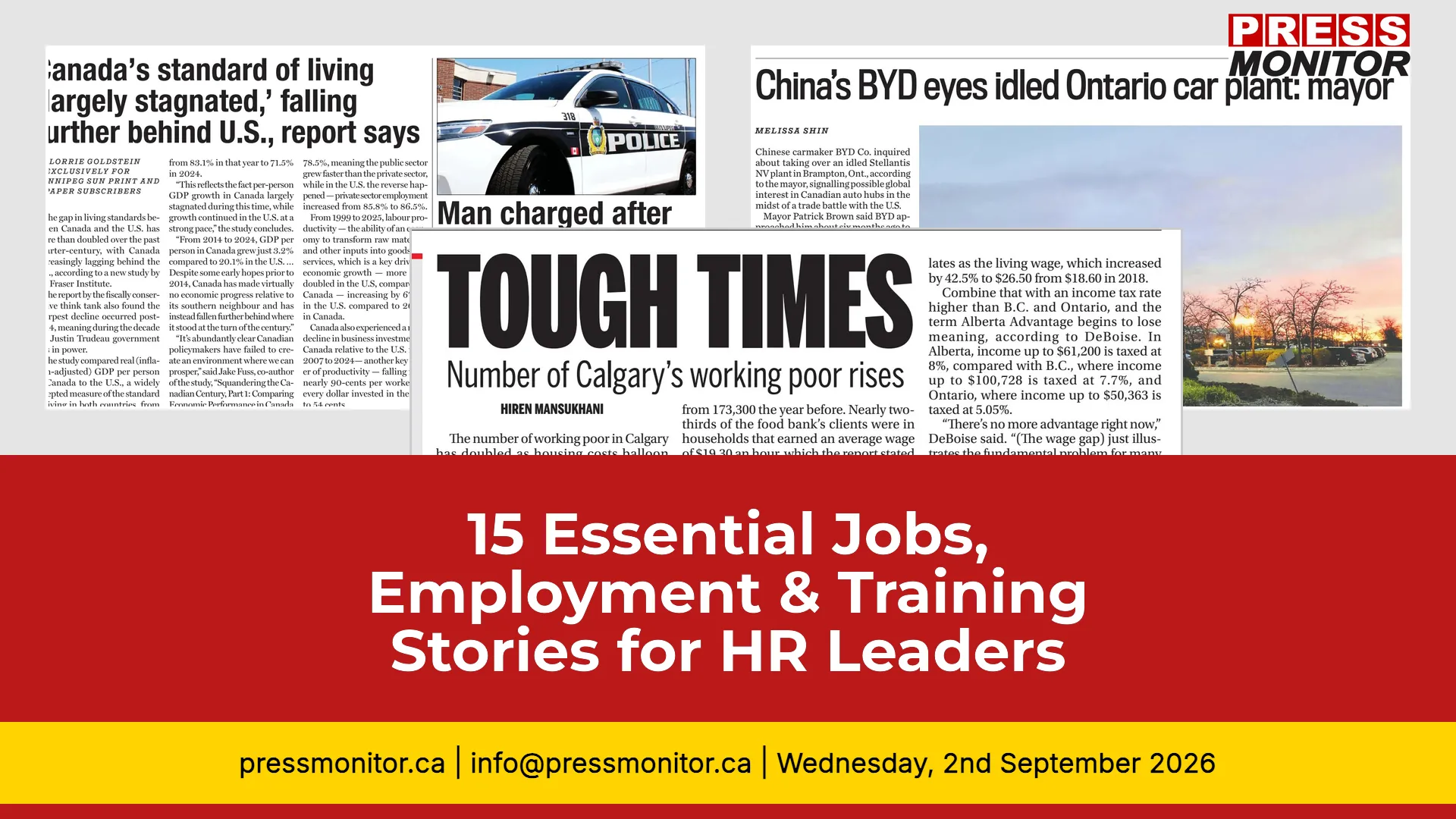
Winnipeg Sun reports that a new Fraser Institute study found the gap in living standards between Canada and the United States has more than doubled over the past quarter-century, with real GDP per person in Canada at $59,529 in 2024 compared to $83,286 in the U.S., a gap of $23,757. The report, titled Squandering the Canadian Century, found the steepest decline occurred after 2014, when Canadian GDP per person grew just 3.2% over the following decade while the U.S. grew 20.1% during the years the Justin Trudeau government was in power. Study co-author Jake Fuss said Canadian policymakers have failed to create an environment where Canadians can prosper.
Why it matters: The widening productivity gap signals structural challenges for Canadian workers and employers.
Key detail: Real GDP per person in Canada was $59,529 vs $83,286 in the US in 2024; the gap more than doubled since 1999.
Source: Winnipeg Sun (Fraser Institute study)
Next step: HR leaders should benchmark compensation against US counterparts to retain talent.
2. BYD Eyes Idled Ontario Car Plant
Calgary Herald reports that Chinese automaker BYD inquired about taking over Stellantis' idled Brampton, Ontario assembly plant, according to Mayor Patrick Brown, who said the carmaker approached him about six months ago about building buses at the factory. Stellantis halted plans to retool the plant for Jeep Compass production after the United States adopted tariffs on foreign autos, and the facility has not produced vehicles since late 2023, clouding the future for 3,000 workers. Brown also said Leapmotor International and Canadian defence firms Roshel Inc. and Dominion Dynamics expressed interest in the site.
Why it matters: Potential new investment could revive 3,000 jobs in Brampton.
Key detail: Chinese automaker BYD approached Mayor Patrick Brown about building buses at the former Stellantis plant.
Source: Calgary Herald / Ottawa Citizen
Next step: Monitor trade policy impacts on automotive employment.
3. Calgary's Working Poor Doubles to 5.6%
Calgary Sun reports that the number of working poor in Calgary has doubled, rising from 2.76% to 5.6%, as housing costs and transit fares climb while Alberta's minimum wage has stayed at $15 for more than a decade. A report by Vibrant Communities found median rents up 44% since 2021, Calgary Housing's affordable housing wait list at 7,739 households, and Calgary Food Bank demand reaching 200,000 emergency hampers between September 2024 and August 2025. Executive director Dani DeBoise said employment no longer guarantees protection from poverty, noting the province's minimum wage trails the calculated living wage of $26.50 an hour.
Why it matters: Employment no longer guarantees poverty protection; wages lag living costs.
Key detail: Minimum wage stuck at $15/hr for a decade; living wage calculated at $26.50.
Source: Calgary Sun / Calgary Herald
Next step: Review wage structures against living wage benchmarks.
4. Ontario Court Upholds Trucker Firing
National Post reports that an Ontario Superior Court has upheld the for-cause dismissal of a long-haul truck driver who failed random drug tests twice while working cross-border routes. The driver alleged discrimination based on a substance use disorder, but the court found he never disclosed a disability or requested accommodation, and the employer had clear policies, written acknowledgments, and a return-to-work program. The ruling confirms that accommodation is a two-way street and employees cannot invoke a disability retroactively to escape workplace consequences.
Why it matters: Clarifies that accommodation is a two-way street in workplace disputes.
Key detail: Driver failed random drug tests twice; never disclosed disability or sought accommodation.
Source: National Post / Financial Post Magazine
Next step: Ensure HR policies clearly document accommodation requests.
5. Ontario Inks C$1.9M Nuclear Supply Deal
Toronto Sun reports that the Ontario government announced a C$1.9 million investment in the province's nuclear supply chain, administered through the Organization of Canadian Nuclear Industries, to prepare manufacturers, engineers and skilled trades workers for Ontario's nuclear expansion. The move comes as more than a quarter of Canada's nuclear workforce is set to retire over the next four to nine years. Labour Minister David Piccini said the nuclear build-out, including reactor rebuilds at Bruce Power and the Darlington Nuclear Generating Station, could support up to 150,000 jobs and add more than C$800 billion to the provincial economy.
Why it matters: Prepares workforce for nuclear expansion; 150,000 potential jobs.
Key detail: Investment targets manufacturers, engineers, and skilled trades; 25% of nuclear workforce retiring soon.
Source: Toronto Sun
Next step: Explore upskilling programs for nuclear-related trades.
6. Unifor Ford Deal Sets Pattern Amid Tariff Threats
National Post reports that Unifor's settlement with Ford has set the pattern for talks with General Motors and Stellantis as Canada's auto sector braces for threatened US tariffs of up to 50 per cent on Canadian-made cars and parts starting January 1. Analysts say securing long-term investment is a win for the union, with Ford and GM commitments to build heavy-duty trucks in Canada boding well for the plants. But Stellantis, which assembles the Chrysler Pacifica in Windsor, is on weaker financial footing, has laid off more than 2,200 workers at its Brampton plant and is moving Jeep Compass production to the United States.
Why it matters: Auto sector negotiations with GM and Stellantis follow this template.
Key detail: Ford and GM commit to heavy-duty truck production in Canada; Stellantis faces layoffs.
Source: National Post
Next step: Track collective bargaining outcomes for manufacturing workforce planning.
7. Canada Factory Growth Defies Trade Tensions
Canada's manufacturing sector expanded for a fifth straight month in August, with output and employment rising even as trade tensions with the United States clouded the outlook. S&P Global's Canada Manufacturing PMI eased to 53.0 from 53.5 in July but stayed firmly in growth territory, with input cost pressures and softer exports emerging as fresh concerns for Canadian factories.
Why it matters: Manufacturing expansion continues despite US tariff threats.
Key detail: PMI eased to 53.0 but remains in growth territory; employment rising.
Source: The Globe and Mail
Next step: Consider manufacturing sector hiring opportunities.
8. B.C. Transit Workers Launch Overtime Ban
Times Colonist reports that B.C. Transit is warning riders of possible trip cancellations and delays as its unionized workforce began an overtime ban on Tuesday. About 750 bus drivers and mechanics represented by Unifor Local 333 in Greater Victoria have been without a contract since March 2025 and previously staged a uniform ban starting Aug. 17. Unifor national president Lana Payne said the overtime ban will end the moment B.C. Transit comes to the table with what it takes to settle.
Why it matters: Potential transit disruptions affect commuters and regional workforce mobility.
Key detail: 750 drivers and mechanics in Greater Victoria without contract since March 2025.
Source: Times Colonist
Next step: Prepare contingency plans for transit-dependent employees.
9. Canada Auto Jobs Fall 25%
The National Post reports that columnist Terence Corcoran argues free trade principles have been abandoned amid the fog of tariff-war theories from U.S. President Donald Trump and Prime Minister Mark Carney. Canada's auto sector has fallen from 170,000 jobs in 2000 to about 130,000 in 2025, contributing C$17 billion or less than one per cent of GDP, while national employment grew to 21.2 million. Corcoran says the market, not government tariffs, should determine the future of Canada's auto industry.
Why it matters: Columnist argues free trade principles abandoned; auto sector down to 130,000 jobs.
Key detail: Auto sector contributes less than 1% of GDP; national employment grew to 21.2M.
Source: National Post
Next step: Assess long-term viability of auto sector careers.
10. GM Pledges C$1.1 Billion to Canada
Financial Post Magazine reports that General Motors Co.'s commitment to invest about C$1.1 billion in Canada is being touted as a big win for Unifor, after more than 4,600 members ratified a new agreement over the weekend. The deal includes investments to build the heavy-duty GMC Sierra at the Oshawa plant, new engines and transmissions in St. Catharines, and a pledge not to close the CAMI assembly plant in Ingersoll. The union now faces a tougher task securing similar long-term commitments from Stellantis NV, with negotiations beginning Tuesday.
Why it matters: Investment secures Oshawa, St. Catharines, and Ingersoll plants.
Key detail: Includes heavy-duty GMC Sierra production; 4,600 members ratified deal.
Source: Financial Post Magazine
Next step: Leverage GM's commitment for regional workforce development.
11. Alberta Touts Record C$10.8B Education Funding
Calgary Herald reports that Premier Danielle Smith and Education Minister Demetrios Nicolaides are touting a record C$10.8 billion in education spending for the new school year in Alberta. The funding supports the hiring of 3,000 new teachers over three years and school construction, with 156 building projects underway. NDP education critic Amanda Chapman warned the investment is not enough, noting half of new teachers leave the profession within five years.
Why it matters: Hiring 3,000 new teachers over three years; addresses teacher shortage.
Key detail: 156 building projects underway; NDP critic warns half of new teachers leave within 5 years.
Source: Calgary Herald
Next step: Align training programs with education sector needs.
12. Hamilton Recycling Plan To Help Homeless
The Hamilton Spectator reports that reader Bridget Smith has proposed opening a recycling plant in Hamilton that would double as a work program for people experiencing homelessness. Workers would be welcomed on a rolling basis and paid at the end of each day without needing to provide a Social Insurance Number, address, or contact information. Smith says the plan would help people eventually afford a home while reducing the city's environmental impact.
Why it matters: Innovative work program offers daily pay without formal ID requirements.
Key detail: Recycling plant would double as employment for homeless individuals.
Source: The Hamilton Spectator
Next step: Explore social enterprise models for workforce inclusion.
13. Alberta Referendum Ballots Sent Out
The Times Colonist reports that special mail-in ballots for Alberta’s 10-question referendum next month started going out the door Tuesday, Elections Alberta said. The referendum is shaping up to be a massive undertaking for Elections Alberta, which has said it will need to hire at least 60,000 workers to hold the vote.
Why it matters: Elections Alberta needs 60,000 workers to run the vote.
Key detail: Special mail-in ballots for 10-question referendum now being distributed.
Source: Times Colonist
Next step: Consider temporary election worker opportunities.
14. Winnipeg 11th in Emerging Tech Markets
The Winnipeg Sun reports that Winnipeg has ranked 11th among the next 25 emerging tech markets in North America, with Halifax second and London, Ontario fifth. Homegrown companies such as Skip the Dishes, Bold Commerce and Payworks are leading Manitoba's growing tech sector, which employs about 35,500 people. Columnist Geoff Currier warns that the province's uncompetitive tax structure and Premier Wab Kinew's decision to block a massive AI centre, which will now be built in Alberta, could drive young tech talent to other provinces.
Why it matters: Tech sector employs 35,500; but tax structure and AI centre loss may drive talent away.
Key detail: Halifax 2nd, London 5th; Skip the Dishes, Bold Commerce, Payworks leading.
Source: Winnipeg Sun
Next step: Monitor talent mobility trends in tech hubs.
15. EDI Mandates Cut Research Productivity 15%
The National Post reports that a Macdonald-Laurier Institute study found the quality and quantity of Canada Research Chairs scholarship declined by 10 to 15 per cent after identity-based hiring mandates were imposed in 2017 under then-prime minister Justin Trudeau. The $311-million-per-year federal program funds 2,285 university research chairs under quotas requiring 22 per cent racialized, 4.9 per cent Indigenous and 50.9 per cent women and gender equity-seeking hires, with white males falling from 80 per cent of chairs at the program's 2000 launch to 25 per cent in 2025. The report concludes that ending EDI initiatives in Canadian research should be a top priority for any responsible government.
Why it matters: Identity-based hiring quotas linked to decline in research quality and quantity.
Key detail: Canada Research Chairs scholarship declined 10-15% since 2017 mandates.
Source: National Post (Macdonald-Laurier Institute)
Next step: Evaluate diversity hiring policies for unintended impacts.
Closing: These stories represent the pulse of Canada's labour market. For a deeper dive into any of these topics, rely on Press Monitor's media intelligence to stay ahead. What's your take on the GDP gap or the auto sector's future? Share your thoughts below.
This press review was compiled using print media monitoring from Canadian publications.