15 Essential Technology Stories for Decision Makers


According to Press Monitor's tracking of Canadian publications, this media monitoring review covers 15 essential technology stories spanning AI infrastructure, corporate strategy, and digital policy. This press report delivers the media intelligence and press review insights needed to act on news on technology before it breaks elsewhere.
1. Iran Conflict Redirects Capital from AI
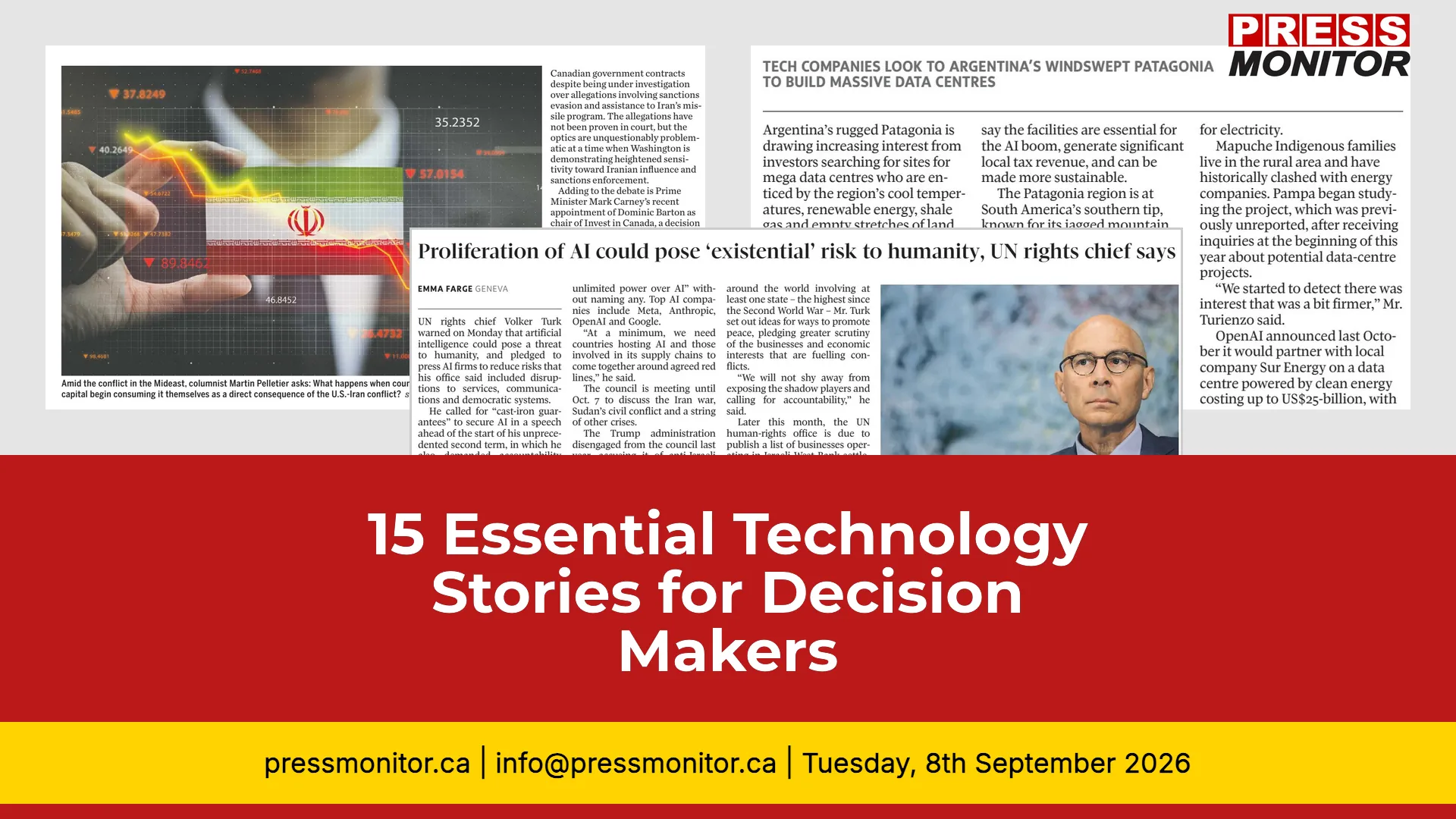
Edmonton Journal reports that the conflict between the United States and Iran is reshaping global capital flows as Gulf nations redirect energy revenues toward domestic spending, threatening the funding supply for artificial intelligence infrastructure and Western bond markets. Saudi Arabia faces a large fiscal deficit while United States technology companies and the government itself face unprecedented borrowing demands. The situation is further complicated by sanctions enforcement concerns and deteriorating Canada-United States trade relations.
Why it matters: The US-Iran conflict is reshaping global capital flows, with Gulf nations redirecting energy revenues toward domestic spending and threatening AI infrastructure funding.
Key detail: Saudi Arabia faces a large fiscal deficit while US technology companies and the government face unprecedented borrowing demands.
Source: Edmonton Journal
Next step: Monitor how sanctions enforcement affects cross-border AI investment. CTA: Which AI companies are most exposed to this capital shift? Comment below.
2. US$25 Billion OpenAI Data Centre
The Globe And Mail (ottawa/quebec Edition) reports that tech companies are turning to Argentina's Patagonia region to build massive data centres, drawn by cool temperatures, renewable energy, and shale gas. Pampa Energia is pushing for a data centre near its Loma de la Lata power plant in Neuquen province that would consume up to 500 megawatts from the Vaca Muerta shale formation. Open AI also announced a partnership with Sur Energy on a clean-energy data centre costing up to 25 billion US dollars.
Why it matters: Tech companies are turning to Argentina's Patagonia region for massive data centres, drawn by cool temperatures, renewable energy, and shale gas.
Key detail: OpenAI announced a partnership with Sur Energy on a clean-energy data centre costing up to 25 billion US dollars.
Source: The Globe And Mail
Next step: Track how Patagonia's energy capacity shapes global AI infrastructure. CTA: Tag a data centre analyst who should see this.
3. UN Rights Chief Warns AI Existential Risk
{source_name} reports that UN rights chief Volker Turk warned in Geneva that artificial intelligence could pose an existential risk to humanity, calling for cast-iron guarantees to secure AI safety. He pledged to press AI firms including Meta, Anthropic, OpenAl, and Google to reduce risks amid concerns that advanced AI capabilities are outpacing safeguards. Mr. Turk also condemned Russia's attacks on Ukraine and Iran's executions while addressing the 47-member council meeting until October 7.
Why it matters: The UN rights chief is calling for cast-iron guarantees to secure AI safety as advanced capabilities outpace safeguards.
Key detail: Volker Turk pledged to press AI firms including Meta, Anthropic, OpenAI, and Google to reduce risks.
Source: The Globe And Mail
Next step: Watch for regulatory responses from the 47-member council. CTA: Which AI firm should face the strongest safety mandates? Share your view.
4. Huawei, Xiaomi Launch Foldable Phones
The Globe And Mail (ottawa/quebec Edition) reports that Huawei and Xiaomi launched new flagship foldable smartphones in Beijing ahead of Apple’s upcoming iPhone launch, with Huawei’s Mate XT2 series featuring a new Kirin goso Pro chip and a redesigned hinge, and Xiaomi’s i8 Fold offering a medium‑fold solution and a lightweight design.
Why it matters: Chinese manufacturers are launching flagship foldables ahead of Apple's iPhone, signaling a shift in the smartphone competitive landscape.
Key detail: Huawei's Mate XT2 features a new Kirin goso Pro chip and redesigned hinge; Xiaomi's i8 Fold offers a lightweight medium-fold solution.
Source: The Globe And Mail
Next step: Monitor how Apple responds to the pre-launch competitive pressure. CTA: Would you switch from iPhone to a foldable? Tag a friend who might.
5. AI Lets Readers Talk To Books
Ottawa Citizen reports that artificial intelligence tools are letting readers ask books questions as they read, with companies like Sinai.ai, My Smart Book, Audible, and Amazon Kindle launching chatbot features. The technology allows users to explore character psychology, historical context, and plot details without separate research, though copyright concerns have sparked criticism from the Authors Guild.
Why it matters: AI chatbot features are transforming how readers interact with books, raising both excitement and copyright concerns.
Key detail: Companies like Sinai.ai, My Smart Book, Audible, and Amazon Kindle are launching conversational features for exploring character psychology and plot details.
Source: Ottawa Citizen
Next step: Follow the Authors Guild's response to these AI features. CTA: Would you use an AI chatbot to discuss your current read? Comment below.
6. ChatGPT Users Risk Cognitive Decline
Saskatoon Starphoenix reports that generative artificial intelligence tools significantly improve workplace efficiency, but new research warns they may erode human cognitive abilities and critical thinking skills. Studies involving organizations like the Boston Consulting Group and Carnegie Mellon University found that overreliance on automated assistants leads to cognitive surrender, where users accept incorrect outputs without scrutiny. Experts advise individuals to strategically use these models for data synthesis while retaining mental effort to preserve independent reasoning and lifelong learning.
Why it matters: New research warns that overreliance on generative AI may erode human cognitive abilities and critical thinking skills.
Key detail: Studies from Boston Consulting Group and Carnegie Mellon University found that users who lost AI access scored lower than those who never used it.
Source: Saskatoon Starphoenix
Next step: Consider how your organization balances AI efficiency with cognitive independence. CTA: How do you use AI without surrendering your own reasoning? Tell us.
7. Shein Loses $5 Billion After Hong Kong Listing
Toronto Star reports that Shein Global Holdings lost about $5 billion in market value since its initial public offering as shares finished among the worst opening weeks after a major Hong Kong listing. Investor concerns are focused on the fast-fashion retailer's growth outlook, citing regulatory headwinds, tariffs, and expanding competition that may prevent the company from regaining momentum.
Why it matters: Shein's IPO debut ranks among the worst opening weeks for a major listing, signaling investor skepticism about fast-fashion growth.
Key detail: Shares closed 19 percent down from the 48.56 Hong Kong dollar offering price, with concerns over regulatory headwinds and tariffs.
Source: Toronto Star
Next step: Watch whether Shein can regain investor confidence amid intensifying competition. CTA: Do you think Shein can recover from this rocky start? Tag a retail analyst.
8. Professors Fight AI Cheating at Western University
{source_name} reports that professors at Western University are redesigning assessments as AI cheating becomes easier. Many Canadian universities forbid AI detection software, forcing instructors to get creative with assignments. Four professors at Western are implementing AI-free labs, pen-and-paper essays, guided AI tools, and open AI policies to address the challenge.
Why it matters: Canadian universities are redesigning assessments as AI cheating becomes easier, with some banning detection software entirely.
Key detail: Four professors at Western University are implementing AI-free labs, pen-and-paper essays, guided AI tools, and open AI policies.
Source: The Globe And Mail
Next step: Consider how your institution is adapting evaluation methods for the AI era. CTA: Should universities allow or ban AI in student work? Share your perspective.
9. CCTV in Offices Confuses Managers
The Globe And Mail reports that workplace surveillance tools, like screen‑tracking and activity dashboards, may give managers misleading data, leading to mistrust and reduced productivity, according to professors Nick Turner and Justin M. Weinhardt.
Why it matters: Workplace surveillance tools may give managers misleading data, leading to mistrust and reduced productivity.
Key detail: Professors Nick Turner and Justin M. Weinhardt found that screen-tracking and activity dashboards can distort management decisions.
Source: The Globe And Mail
Next step: Evaluate whether your monitoring tools are building trust or eroding it. CTA: Has workplace surveillance helped or hurt your team? Comment below.
10. Telus CEO Faces Pressure To Turn B.C.
Business in Vancouver reports that the new chief executive of Telus is under significant pressure to turn around British Columbia's largest corporation. The telecommunications company recently opened its new Vancouver headquarters at Telus Garden in twenty fifteen.
Why it matters: The new CEO of Telus is under significant pressure to turnaround British Columbia's largest corporation.
Key detail: The telecommunications company recently opened its new Vancouver headquarters at Telus Garden.
Source: Business in Vancouver
Next step: Watch for strategic announcements from the new Telus leadership. CTA: What should Telus prioritize under its new CEO? Share your thoughts.
11. Telus Cuts Dividend 55 Percent
Business in Vancouver reports that new Telus Corp. CEO Victor Dodig cut the company's dividend by 55 percent on July 31, causing shares to briefly trade as low as $12.93. The B.C.-based telecommunications firm faces negative earnings growth and nearly $28.94 billion in net debt while planning to spend about $1 billion building data centres in British Columbia.
Why it matters: Telus Corp. slashed its dividend by 55 percent, reflecting negative earnings growth and nearly 28.94 billion in net debt.
Key detail: Shares briefly traded as low as 12.93 dollars after the July 31 cut, while the company plans to spend about 1 billion building data centres in British Columbia.
Source: Business in Vancouver
Next step: Monitor whether the dividend cut stabilizes Telus's financial position. CTA: Is a dividend cut a smart move for Telus's long-term growth? Comment below.
12. C$19B Fund Bets Asia
Financial Post Magazine reports that Pimco's flagship 60/40 Balanced Income and Growth Fund, with assets of about C$19 billion, is shifting its focus to Asian AI supply‑chain stocks, including equipment suppliers, financials and healthcare, as its manager Emmanuel Sharef sees better value outside crowded U.S. tech giants. Sharef, who oversees the fund, notes that high AI spending is driving debt and valuation concerns in U.S. hyperscalers, prompting the fund to overweight Asia and biotech while underweighting major U.S. tech firms.
Why it matters: Pimco's flagship fund is shifting focus to Asian AI supply-chain stocks, signaling a major reallocation away from crowded US tech giants.
Key detail: Manager Emmanuel Sharef sees better value outside US hyperscalers, noting that high AI spending is driving debt and valuation concerns.
Source: Financial Post Magazine
Next step: Track whether the Asia AI rotation continues among institutional investors. CTA: Are you overweight or underweight Asia in your tech portfolio? Share below.
13. Ontario Reviews School Cellphone Ban Enforcement
Ottawa Sun reports that Ontario's updated cellphone restrictions in schools face mixed enforcement, with 70% of elementary teachers reporting consistent rules compared to 44% of secondary teachers. Surveys indicate higher distraction and enforcement difficulty in high schools, prompting provincial and federal discussions on further regulating social media and AI chatbots following a tragic school shooting in British Columbia.
Why it matters: Ontario's updated cellphone restrictions in schools face mixed enforcement, with significant gaps between elementary and secondary levels.
Key detail: 70 percent of elementary teachers report consistent rules compared to 44 percent of secondary teachers, prompting discussions on regulating social media and AI chatbots.
Source: Ottawa Sun
Next step: Follow provincial and federal policy developments on school technology rules. CTA: Should schools ban cellphones entirely? Share your experience.
14. Queen's University Revives Traditional Essay Defenses
Toronto Star reports that generative artificial intelligence is fundamentally reshaping higher education assessment, prompting instructors at Queen’s University to revert to traditional pedagogical practices. Educators are reviving blue book examinations, banning classroom screens, and requiring oral defences to verify student comprehension amidst undetectable artificial intelligence generated assignments. This strategic pivot underscores a broader institutional struggle to maintain academic integrity and meaningful evaluation standards in the digital age.
Why it matters: Generative AI is fundamentally reshaping higher education assessment, prompting a return to traditional pedagogical practices.
Key detail: Queen's University is reviving blue book examinations, banning classroom screens, and requiring oral defences to verify student comprehension.
Source: Toronto Star
Next step: Consider how your institution is maintaining academic integrity in the AI era. CTA: Should all universities adopt AI-free assessment methods? Comment below.
15. Alphabet, Amazon Bonds Bargains
Financial Post Magazine reports that DoubleLine's Robert Cohen sees enticing value in Big Tech debt after a borrowing binge to bankroll the artificial intelligence buildout battered valuations. The director of corporate credit at DoubleLine is looking for bargains in top-rated bonds from companies like Alphabet and Amazon, noting they become a buy if spreads widen significantly beyond reasonable levels despite investor fatigue following a deluge of AI debt sales.
Why it matters: After a borrowing binge to bankroll AI buildouts, Big Tech debt is becoming a buy for value-seeking fixed-income investors.
Key detail: DoubleLine's Robert Cohen sees enticing value in top-rated bonds from Alphabet and Amazon, noting they become a buy if spreads widen significantly.
Source: Financial Post Magazine
Next step: Watch for opportunities in Big Tech debt as AI spending continues. CTA: Are you buying or selling Big Tech bonds right now? Tell us in the comments.
Closing question: Which of these 15 stories will have the biggest impact on your work this week? Follow Press Monitor for ongoing technology coverage.
