15 Key First Nations & Indigenous Stories for Decision-Makers


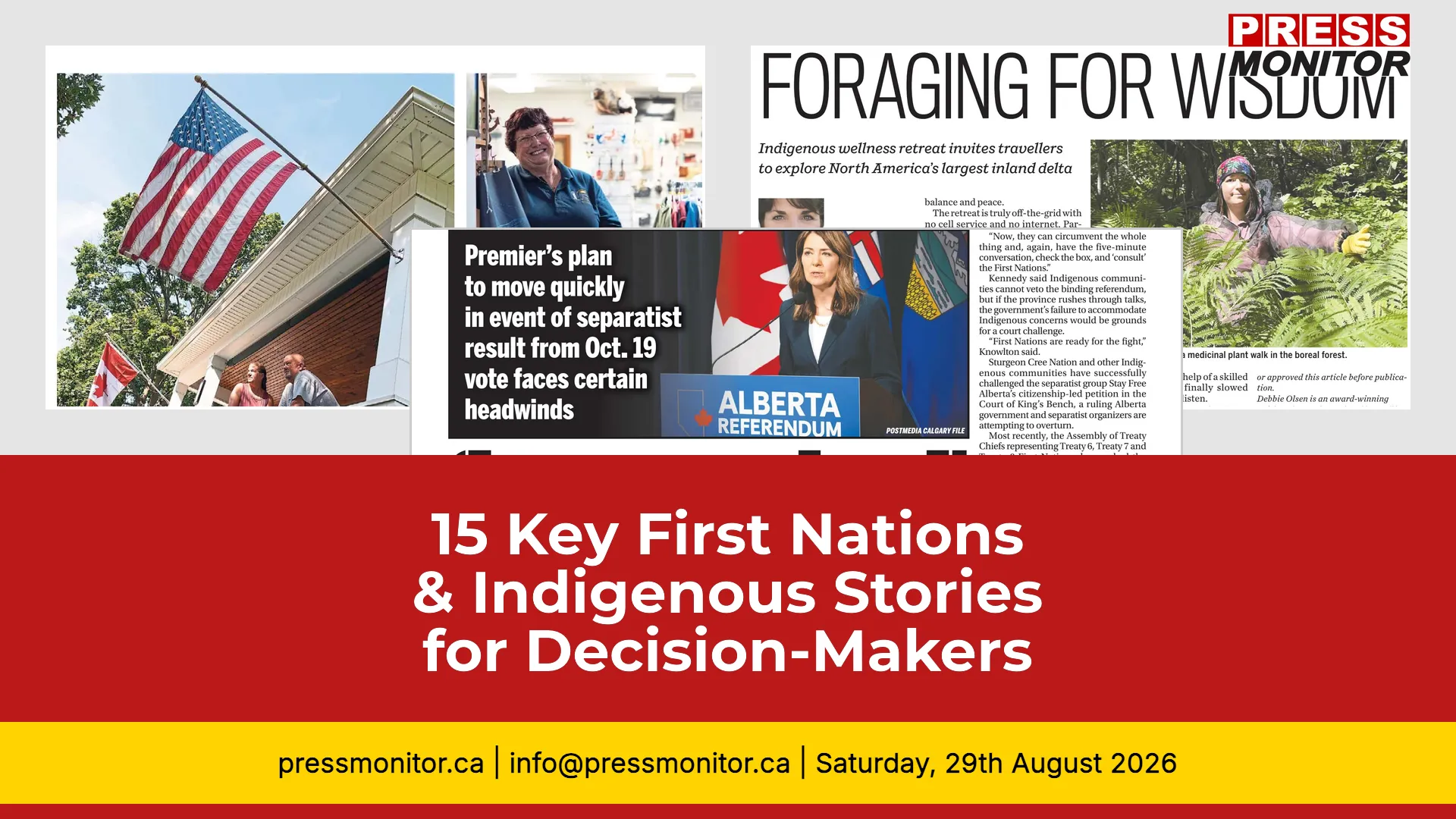
According to Press Monitor's tracking of Canadian publications, today's print media landscape delivers 15 essential stories on Indigenous affairs. From the forced contraception controversy in Greenland to Alberta's separation referendum, these articles demand the attention of leaders across sectors. This press review offers actionable insights for those using media monitoring to track Indigenous rights, governance, and cultural heritage.
1. Donald Trump Renames Lake Ontario
Toronto Star reports that US President Donald Trump signed an executive order renaming Lake Ontario to "Lake America" as part of an ongoing trade war with Canada. Local residents and Indigenous leaders on the New York shores expressed mixed reactions, ranging from apology to criticism of the move.
Why it matters: This move escalates trade tensions and disregards Indigenous history.
Key detail: Trump signed an executive order renaming Lake Ontario to 'Lake America' amid the tariff war.
Source: Toronto Star
Next step: Monitor the impact on Canada-US relations and Indigenous land acknowledgments.
2. Indigenous Wellness Retreat in Saskatchewan River Delta
Calgary Herald reports that Michela Carriére's Indigenous land-based ecotourism and wellness retreat in the Saskatchewan River Delta invites travelers to explore traditional teachings and reconnect with nature.
Why it matters: Showcases Indigenous-led ecotourism and traditional knowledge.
Key detail: Michela Carriére's retreat invites travelers to reconnect with nature.
Source: Calgary Herald (also covered by Vancouver Sun)
Next step: Consider partnerships for corporate wellness programs.
3. Smith Backtracks on Alberta Referendum Timeline
“Selon Edmonton Sun, le Premier Smith a reconsidéré ses plans concernant un référendum sur la séparation de l’Alberta, citant des lois qui empêchent d’organiser un référendum dans un an après une élection générale. Elle avait initialement annoncé un référendum au printemps 2026, mais maintenant elle estime cela impraticable. Le gouvernement de l’Alberta peut techniquement organiser un référendum à tout moment, sous réserve des exigences de la Loi sur la clarté. Independant, des experts soulignent les défis potentiels. Le chef de la Première Nation de Blackfoot a qualifié ce calendrier de "fantasy politique", mettant l’accent sur la difficulté d’organiser une consultation significative avec les communautés autochtones dans le temps imparti."
Why it matters: Indigenous consultation is a key obstacle.
Key detail: Blackfoot First Nation chief called the timeline 'political fantasy'.
Source: Edmonton Sun
Next step: Track constitutional developments and Indigenous engagement.
4. Canada is Our Land, Not 'Uninvited Guests'
National Post reports that Canada has centuries of history and constitutes the traditional land of the Canadian people, rejecting the narrative that all inhabitants are uninvited guests. The article argues that Indigenous legacy and political discourse regarding land ownership are conflating legal and historical terms, potentially undermining the national identity and belonging of those who have lived on the land for generations.
Why it matters: Rejects narrative that all inhabitants are guests.
Key detail: Article argues Indigenous legacy and legal terms are conflated.
Source: National Post
Next step: Evaluate implications for corporate land acknowledgments.
5. Lake Ontario's Cultural Ties to Canada
The Toronto Star reports that Michael Galban, director of the Seneca Art and Culture Center, discusses the long history of Indigenous peoples living on the shores of Lake Ontario. The article highlights the cultural connections between the lake's residents and Canada, including the impact of Trump's tariffs and the longing for the return of the ferry service that once connected the two countries.
Why it matters: Highlights Indigenous connections to the lake.
Key detail: Seneca Art and Culture Center director discusses long history.
Source: Toronto Star
Next step: Incorporate cultural context into regional communications.
6. Décès de la députée provinciale Joan Phillip
Radio-canada Info rapporte que la députée néo-démocrate de la circonscription de Vancouver-Strathcona, Joan Phillip, est décédée à l'âge de 74 ans. Selon un communiqué de l'Union des chefs indiens de la Colombie-Britannique, Mme Phillip s'est éteinte paisiblement, entourée de ses proches et des membres de sa famille.
Why it matters: Remembering a prominent Indigenous advocate.
Key detail: Joan Phillip, NDP MLA for Vancouver-Strathcona, passed at 74.
Source: Radio-canada Info
Next step: Acknowledge her legacy in policy circles.
7. Indigenous Tipi Returned to Kawacatoose
Radio-canada Info reports that nearly a century after it was taken from the Saskatchewan region, a Native American tipi canvas has been returned to the Kawacatoose First Nation. This return marks the culmination of nearly two years of efforts between the community, the Smithsonian Institute in Washington, and researchers from the University of First Nations of Canada.
Why it matters: Cultural repatriation after nearly a century.
Key detail: Tipi canvas returned from Smithsonian Institute.
Source: Radio-canada Info
Next step: Highlight similar repatriation efforts.
8. Thunderhead: National LGBTQ+ Monument Unveiled
The Hamilton Spectator reports that Ottawa has unveiled Thunderhead, Canada's national LGBTQ+ monument, just west of Parliament Hill. The monument transforms the turmoil and discrimination faced by queer and trans people in the Canadian Armed Forces and federal public service into a symbol of unstoppable energy and collective resilience.
Why it matters: Recognizes discrimination faced by Indigenous and other queer Canadians.
Key detail: Monument west of Parliament Hill.
Source: The Hamilton Spectator
Next step: Include in diversity and inclusion initiatives.
9. Lawrence Paul Yuxweluptun Featured at Audain
The Globe and Mail reports that artist Lawrence Paul Yuxweluptun is featured in the Audain Art Museum's collection in Whistler, British Columbia. His acrylic painting, "Clearcut to the Last Old Growth Tree," uses Surrealist-inspired imagery to critique the environmental impacts of logging and the loss of Indigenous rights.
Why it matters: Art critiques environmental impacts and Indigenous rights.
Key detail: Painting 'Clearcut to the Last Old Growth Tree' at Audain Art Museum.
Source: The Globe and Mail
Next step: Explore art as a tool for advocacy.
10. Danielle Smith Faces Alberta Separation Hurdles
Calgary Herald reports that Premier Danielle Smith's timeline for a spring referendum on Alberta separation is viewed as impractical by legal experts and Indigenous leaders. The process faces significant obstacles, including the requirements of the federal Clarity Act and necessary consultations with First Nations.
Why it matters: Legal and Indigenous consultation challenges.
Key detail: Clarity Act requirements and First Nations consultations.
Source: Calgary Herald
Next step: Monitor legislative developments.
11. Albertans Could Face Spring Referendum on Separation
Calgary Herald reports that Premier Danielle Smith plans to hold a binding referendum on Alberta separation next spring if the Oct. 19 vote supports it. However, Smith backtracked citing legislation that could prevent a referendum within a year of a general election.
Why it matters: Potential shift in provincial boundaries.
Key detail: Smith backtracked citing election law.
Source: Calgary Herald
Next step: Assess impact on Indigenous communities.
12. Greenland's Forced Contraception Controversy
Calgary Herald reports that from the 1960s to 1990, more than 4,000 Greenlandic women were forced to wear a contraceptive coil without their consent. Greenlandic Prime Minister Jens-Frederik Nielsen said the priority now was to begin the healing process.
Why it matters: Historical injustice against Inuit women.
Key detail: Over 4,000 women forced to use contraceptive coils.
Source: Calgary Herald
Next step: Support healing processes.
13. Eagle Feathers in Saskatchewan Courts
Regina Leader-post reports that a Saskatchewan First Nation leader is welcoming a decision by the province’s courts to allow people to use an eagle feather to either swear in a religious context or affirm in a secular manner to tell the truth in court.
Why it matters: Cultural recognition in legal system.
Key detail: Courts allow eagle feather for swearing in.
Source: Regina Leader-Post
Next step: Encourage similar accommodation across provinces.
14. Yellow Quill Water Plant Upgrade
Saskatoon Starphoenix reports that the Yellow Quill First Nation is inviting General Contractors to submit sealed tenders for a Water Treatment Plant Upgrade project. The tender closes on Friday, September 25, 2026.
Why it matters: Infrastructure investment in First Nation.
Key detail: Tender for water treatment plant upgrade.
Source: Saskatoon StarPhoenix
Next step: Track bidding process for business opportunities.
15. Treaty Six Anniversary: Indigenous Voices Call for Accountability
"Selon {source_name} reports that the treaty’s full scope was not discussed during more than a week of discussion. The talk was all of bright days and benevolence."
Why it matters: Treaty obligations not fully honoured.
Key detail: Full scope of treaty not discussed.
Source: The Globe and Mail
Next step: Engage in treaty education.
This press review, powered by Press Monitor's media intelligence, equips decision-makers with the critical context needed to navigate today's Indigenous affairs landscape.
What stories will you track next?