15 Key Geopolitics Stories for Policy Analysts


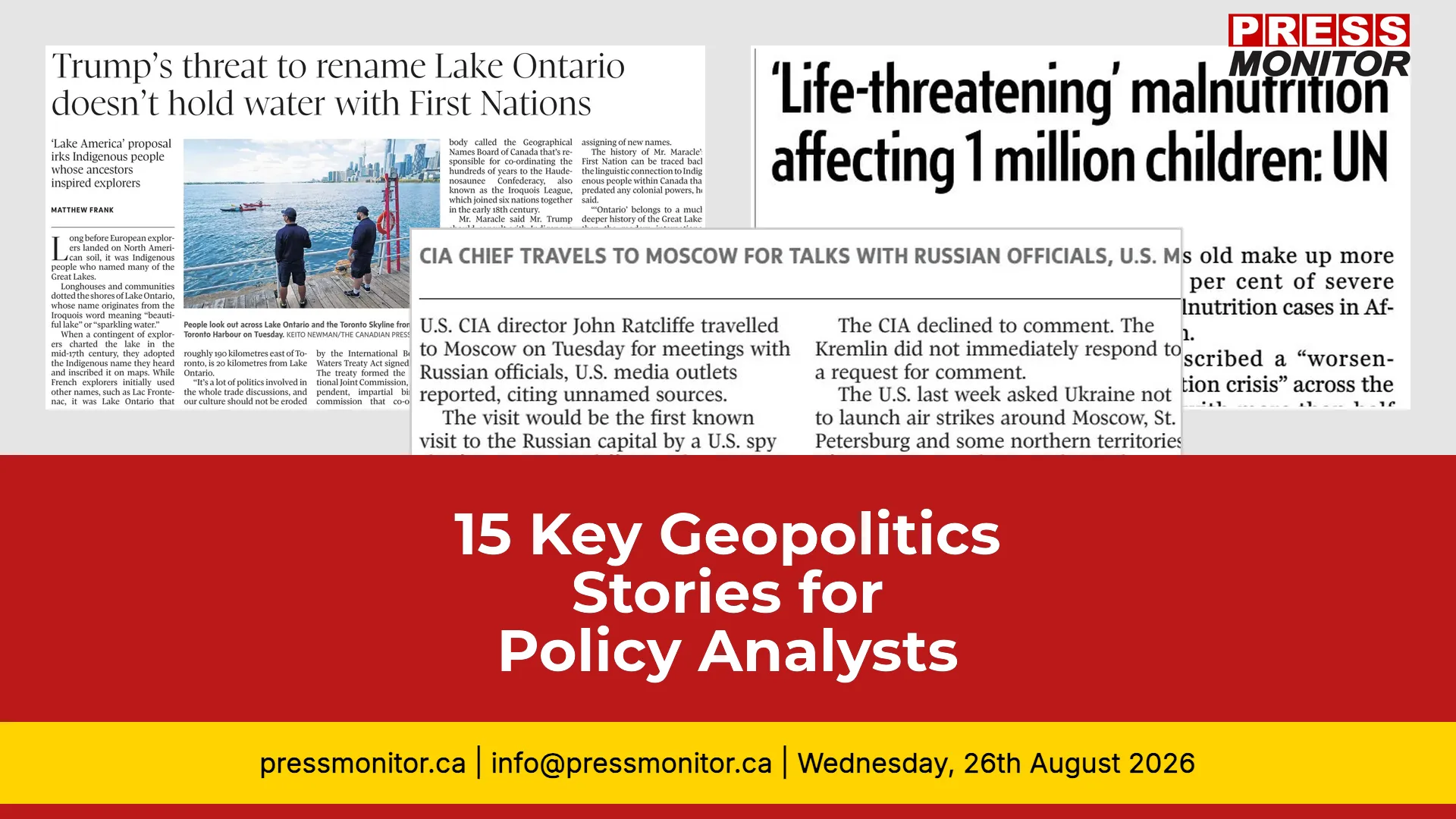
From CIA visits to Moscow to escalating trade tensions and humanitarian crises, Canadian print media provides in-depth coverage of global affairs. According to Press Monitor's tracking of Canadian publications, these are the must-read stories for anyone tracking geopolitics today. media monitoring is essential to stay ahead in this fast-moving landscape.
1. Lake America Renaming Move
{source_name} reports that U.S. President Donald Trump's proposed renaming of Lake Ontario to 'Lake America' as a political maneuver has drawn sharp criticism from Indigenous leaders and experts. Canada and the U.S. share the lake via the 1909 International Boundary Waters Treaty Act, governed by the International Joint Commission. Despite Trump's executive order last year renaming the Gulf of Mexico to 'Gulf of America,' Canada refuses to recognize the change, with Ontario Premier Doug Ford calling the proposal 'a lot of rhetoric.'
Why it matters: A symbolic territorial dispute with real diplomatic and legal repercussions.
Key detail: Four Canadian papers covered Trump's proposal to rename Lake Ontario to Lake America, sparking opposition from Indigenous leaders and legal experts.
Source: The Globe and Mail, Edmonton Journal, National Post, Calgary Herald.
Next step: Monitor the International Joint Commission's response.
Question: What other border disputes are brewing?
2. Afghan Children Face Malnutrition Crisis
“Selon National Post, one million children in Afghanistan are suffering from life-threatening severe acute malnutrition,” according to UNICEF’s Afghanistan country representative Tajudeen Oyewale. The UN agency has warned that 3.7 million children nationwide are experiencing wasting, and a further million are at risk of dying if treatment isn’t provided urgently. The crisis is exacerbated by repeated hunger emergencies, economic collapse following the Taliban’s return to power, and other challenges like drought and regional instability.
Why it matters: One million children at risk of starvation, a humanitarian emergency.
Key detail: UNICEF warns of 3.7 million children affected; economic collapse and drought worsen the crisis.
Source: National Post, The Province.
Next step: Track international aid pledges.
3. CIA Director in Moscow
"Selon The Globe And Mail, le directeur de la CIA, John Ratcliffe, s’est rendu à Moscou le mardi pour des réunions avec des responsables russes. La visite serait la première visite connue d’un chef d’agent américain à la capitale russe depuis que le prédécesseur de M. Ratcliffe, William Burns, a eu des discussions avec Vladimir Poutine en novembre 2021, peu de temps après le lancement de l’invasion russe de l’Ukraine. La visite survient alors que les États-Unis ont demandé à l’Ukraine de ne pas lancer d’attaques aériennes autour de Moscou, Saint-Pétersbourg et de certaines régions du nord de Russie cette semaine, car un avion transportant un haut fonctionnaire américain se rendrait à la capitale russe."
Why it matters: First known visit by a US intelligence chief to Russia since 2021.
Key detail: John Ratcliffe met Russian officials amid US request for Ukraine to avoid attacks near Moscow.
Source: The Globe and Mail.
Next step: Watch for any diplomatic breakthroughs.
4. Tehran Blocks Strait of Hormuz
Regina Leader-post reports that Tehran continues to block strategic Strait of Hormuz. Treasury Secretary Scott Bessent on Monday laid out plans for the ‘economic asphyxiation’ of Iran, expanding Washington’s secondary sanctions threats and warning of dire consequences for countries that do not join the campaign.
Why it matters: Strategic shipping lane disruption threatens global oil supplies.
Key detail: Iran continues blockade; US Treasury announces economic asphyxiation plan.
Source: Regina Leader-post.
Next step: Monitor naval responses and insurance rates.
5. US Vows Iran Economic Asphyxiation
Regina Leader-post reports that U.S. Treasury Secretary Scott Bessent laid out plans for the economic asphyxiation of Iran, expanding Washington’s secondary sanctions threats and warning of dire consequences for countries that do not join the campaign.
Why it matters: Expanded secondary sanctions target trading partners.
Key detail: Scott Bessent warns of consequences for countries not joining the campaign.
Source: Regina Leader-post.
Next step: Assess impact on Canadian businesses with Iranian ties.
6. Canada Rejects Trump's State Proposal
a statement released by the Times Colonist on July 18, 2026 in Canada, citing unnamed sources within Trump's administration, outlined a controversial proposal to merge parts of Canada into three US states. The article highlights significant political implications including potential shifts in US electoral power and widespread Canadian opposition to unification efforts.
Why it matters: Sovereignty threat to merge parts of Canada into US states.
Key detail: Unnamed sources reveal plan; 76% of Canadians support rejection.
Source: Times Colonist.
Next step: Track diplomatic fallout.
7. Iran and Oman Discuss Hormuz Management
Why it matters: Potential phased reopening of Strait of Hormuz.
Key detail: Joint navigational corridor and mine-clearing discussed.
Source: Times Colonist.
Next step: Watch for implementation agreements.
8. US Removes Syria from Terrorism List
Why it matters: Warming ties could reshape Middle East alliances.
Key detail: Lifts decades-old designation; signals thaw in relations.
Source: Cape Breton Post.
Next step: Monitor sanctions relief and investment flows.
9. CEOs Defuse Trade War
Why it matters: Economic interdependence at risk from tariffs.
Key detail: Canadian CEOs and American allies lobby to prevent tariffs that hurt US businesses.
Source: The Globe and Mail.
Next step: Follow lobbying outcomes.
10. Carney Warns of Trade War
Why it matters: Canada's PM describes situation as 'at war'.
Key detail: Carney declines bad deal; critics warn rhetoric may provoke Trump.
Source: Cape Breton Post.
Next step: Track retaliatory measures.
11. Trump's Frustrations Grafted
Why it matters: Parallel between Iran and Canada diplomacy.
Key detail: Trump's tough talk yields similar results with both nations.
Source: The Globe and Mail.
Next step: Analyze negotiating patterns.
12. US-Canada Trade Tensions
Why it matters: False claims and tariff threats endanger supply chains.
Key detail: US farmers rely on Canadian potash; Trump threatens to quit USMCA.
Source: Regina Leader-post.
Next step: Watch agricultural sector responses.
13. Canada Rejcts Trade Terms
Why it matters: Walking away from talks signals resolution.
Key detail: 76% of Canadians support the decision.
Source: Times Colonist.
Next step: Monitor new trade partners.
14.. Ford Urges Calm in Trade War
Why it matters: Ontario's Premier seeks de-escalation amid Lake America row.
Key detail: Ford supports retaliatory tariffs but rejects expelling US ambassador.
Source: Toronto Star.
Next step: Follow provincial-federal coordination.
15.. Jivani-Vance Alliance
Why it matters: Cross-border political ties influence trade negotiations.
Key detail: Leaked audio shows JD Vance praising MP Jivani's behind-the-scenes advocacy.
Source: The Globe and Mail.
Next step: Monitor impact on bilateral relations.
Stay informed with Press Monitor's print media monitoring for comprehensive tracking of these developments across Canadian newspapers. What geopolitical story do you think will dominate next? Share your thoughts in the comments.