15 Pivotal Accounting and Tax Stories for CFOs


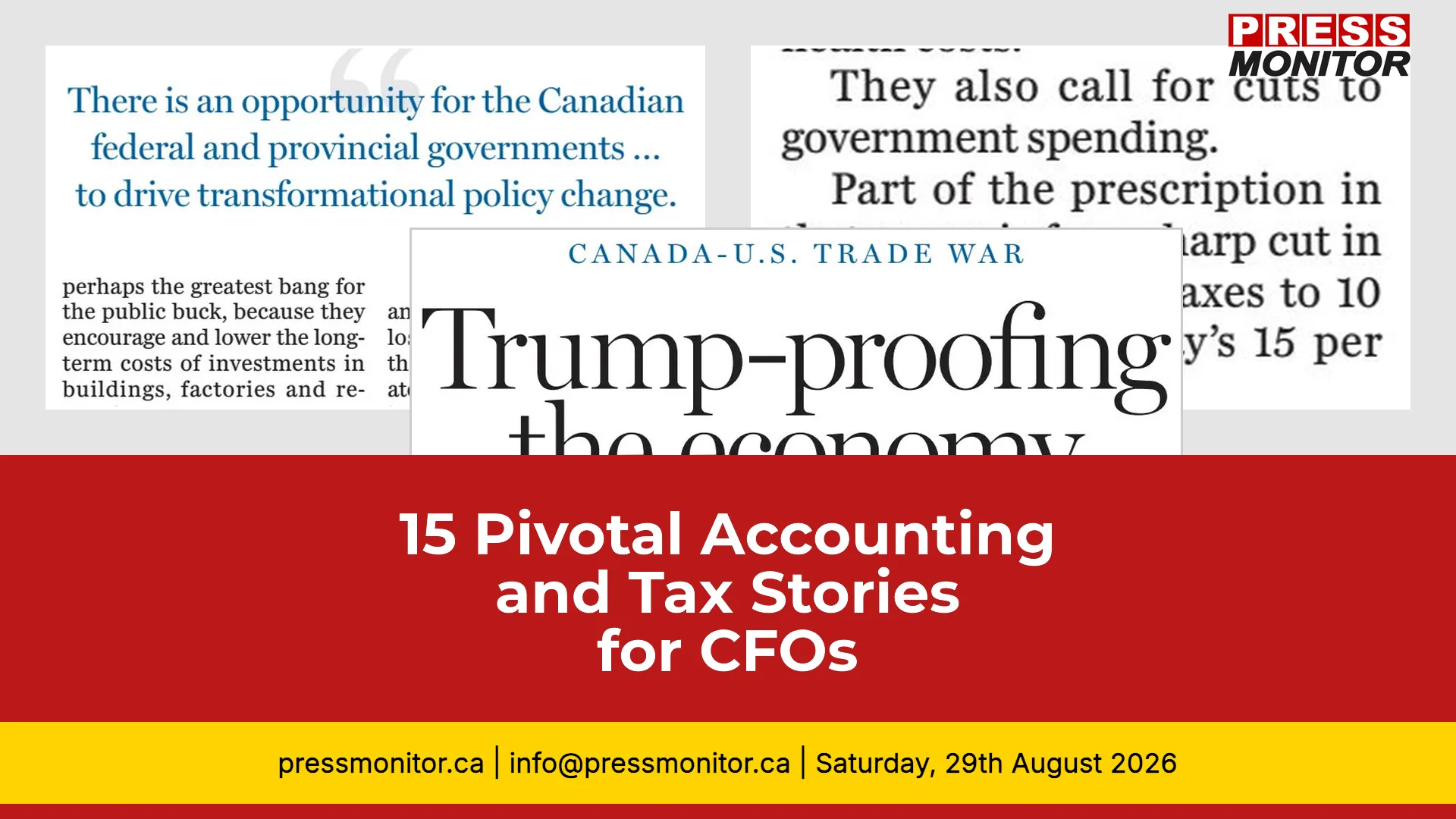
Your daily media monitoring briefing covers Canada's shifting tax landscape. This press review distills critical developments in accounting, corporate governance, and fiscal policy, powered by advanced media intelligence across national print outlets. Our dedicated print media monitoring framework ensures you receive editorial-vetted data before it hits the algorithmic feed. Here is your essential briefing.
1. Canada's Tax Policy Needs a 'Big Bang'
Vancouver Sun reports that economists call for a 'big bang' to Canada's tax policy because they argue the country's tax system is contributing to weak economic performance. The 'big bang' paper calls for the government to rely less on those taxes that hurt the economy the most, while shifting to those that encourage and lower the long-term costs of investments in buildings, factories and research.
Why it matters: A fundamental restructuring of the tax code is being championed to reverse weak economic performance.
Key detail: Economists advocate shifting away from growth-hindering levies toward incentives that lower long-term costs for buildings, factories, and R&D.
Source: Vancouver Sun
Next step: Review budget projections for capital investment allowances.
2. Canadian Economists Propose Tax Reforms to Boost Growth
Ottawa Citizen reports that economists recommend reducing corporate income taxes from 15% to 10% and implementing across-the-board cuts to personal income taxes. While BMO's Doug Porter advocates a cautious approach to corporate tax reductions, most experts agree interprovincial trade barriers cost Canada $50-130 billion annually and should be eliminated. Creating legitimate economic unions and lowering foreign investment barriers are key steps to increase national output estimates predict $80 billion to $130 billion yearly gains from removing provincial trade barriers.
Why it matters: Direct intervention in corporate and personal taxation could unlock billions in national output.
Key detail: Proposals include cutting the corporate rate to 10% and eliminating interprovincial trade barriers, which currently cost the economy up to $130 billion annually.
Source: Ottawa Citizen
Next step: Model scenario impacts on interprovincial supply chains.
3. Trade War Tariffs Push for Tax Reform
Montreal Gazette reports that Canadian Prime Minister Mark Carney warns of US tariffs bombarding the economy, prompting short-term support measures. Economists argue long-term tax reform, including cuts to personal and corporate taxes, is crucial to boost competitiveness and mitigate Trump’s tariff impact. The article highlights alignment of political conditions for potential tax overhaul, referencing past Liberal pledges and current economic vulnerabilities.
Why it matters: External trade pressures are accelerating calls for domestic fiscal agility.
Key detail: PM Mark Carney highlights short-term support measures, while experts stress long-term tax overhauls to mitigate tariff shocks and boost competitiveness.
Source: Montreal Gazette
Next step: Audit exposure to cross-border trade volatility.
4. Tax Reform Key to Shielding Canada from Tariffs
"Selon le Journal d’Edmonton, le Premier ministre Mark Carney affirme que le Canada est sous le coup d’une attaque, bombardé de tarifs américains et d’un partenaire commercial qui change de règles sur un coup de vent. Le gouvernement fédéral a initialement proposé un soutien à court terme aux entreprises et aux travailleurs touchés par les dernières taxes américaines. Cependant, les économistes estiment que les mesures politiques à long terme seront plus efficaces pour inoculer l’économie canadienne contre les tarifs américains, en plus de stimuler un niveau de vie plus élevé. La mesure la plus puissante serait une révision du système fiscal canadien, ce qui améliorerait la compétitivité du pays, une nécessité même sans la menace des tarifs de Trump."
Why it matters: Strategic tax adjustments are viewed as the primary defense against external economic aggression.
Key detail: Analysts argue that even without Trump-era tariffs, a revised system is necessary to elevate living standards and protect domestic industries.
Source: Edmonton Journal
Next step: Stress-test corporate tax positions against potential tariff pass-throughs.
5. Canada Under Attack: US Tariffs Fuel Economic Concerns
"Selon {source_name}, Canada is under attack, bombarded by US tariffs and a trading partner that moves goalposts on a whim." The federal government initially offered short-term support for businesses and workers, but economists argue that long-term policy shifts, particularly tax reform, are crucial for safeguarding the Canadian economy against Trump's tariffs and boosting its standard of living. Experts recommend a comprehensive overhaul of Canada’s tax system to improve competitiveness, encouraging investment and exports.
Why it matters: Shifting trade goalposts demand proactive corporate governance and fiscal planning.
Key detail: Comprehensive tax system overhaul is recommended to encourage exports and insulate the standard of living from volatile partner policies.
Source: Calgary Herald
Next step: Update risk registers for geopolitical trade disruptions.
6. Trump-Proofing Canada's Economy
National Post reports that economists suggest Canada needs to overhaul its tax system to improve national competitiveness and boost economic growth amidst the Trump tariffs. They argue that cuts to personal and corporate income taxes would encourage increased investment and exports.
Why it matters: National competitiveness hinges on aligning tax policy with global investment flows.
Key detail: Economists link personal and corporate income tax reductions directly to increased export capacity and domestic capital formation.
Source: National Post
Next step: Evaluate repatriation strategies and foreign direct investment incentives.
7. Canada’s Tariff Shock Demands Business-First Tax Strategy
{source_name} reports that Canada’s MARK Carney warns of Trump-led U.S. tariffs and urges a bold tax reform strategy to boost competitiveness and national economic strength in response to escalating trade tensions. Experts emphasize that immediate short-term relief is insufficient; long-term tax cuts for personal and corporate income are critical for fueling investment and exports. Finance Minister Champagne’s budget plans align politically for proactive change, though planned reforms remain unexplored.
Why it matters: Leadership alignment between federal and provincial tiers is critical for immediate market confidence.
Key detail: Finance Minister Champagne’s upcoming budget is expected to prioritize proactive tax cuts over reactive short-term relief.
Source: Vancouver Sun
Next step: Prepare contingency cash flow models for budget announcement day.
8. Late Tax Filing Penalties Case
National Post reports that a 71-year old Saskatchewan English-language instructor was unable to persuade a Federal Court judge that the Canada Revenue Agency's officer's decision to deny her request for relief from late-filing penalties and interest was unreasonable.
Why it matters: CRA enforcement remains strict despite documented hardship claims.
Key detail: Federal Court upheld penalties for a Saskatchewan instructor, rejecting arguments that medical and financial distress warranted relief from interest and filing fees.
Source: National Post
Next step: Implement automated filing reminders and document hardship protocols early.
9. BC Energy Ministry Miscalculation Could Cost $2.5 Billion
“This is huge. This is a stand-alone scandal, big enough to take down the government,” said Gavin Dew, the B.C. Conservative finance critic. ‘There’s really two scandals here. The first is how do you get a revenue forecast that is dramatically wrong by $1.5 billion, and the second is what happened after people inside government were warned that it was wrong?’ The error was revealed by Business in Vancouver in a story published this week. Its investigation found the shortfall could be closer to $500 million a year, or $2.5 billion over five years. Premier David Eby told reporters on Tuesday he had no knowledge of any miscalculations when it comes to the royalties B.C. receives from natural gas production.
Why it matters: Fiscal forecasting errors expose systemic risks in resource revenue management.
Key detail: Critics label the $1.5B to $2.5B shortfall in natural gas royalties a stand-alone scandal, questioning internal warning mechanisms.
Source: Vancouver Sun
Next step: Conduct independent audits of provincial royalty forecasting models.
10. B.C. Tories Seek Investigation into Royalty Miscalculation
“Selon {source_name} reports that the B.C. Conservatives are calling for an investigation by the province’s auditor general into how the Ministry of Energy and Climate Solutions miscalculates revenue from natural gas royalties by almost $1.5 billion over the next five years and why Premier David Eby claimed to know nothing about it. This is huge. This is a stand-alone scandal, big enough to take down the government,” said Gavin Dew, the B.C. Conservative finance critic. The error was revealed by Business in Vancouver in a story published this week. Its investigation found the shortfall could be closer to $500 million a year, or $2.5 billion over five years.
Why it matters: Political accountability is tightening around energy sector financial disclosures.
Key detail: Opposition demands an Auditor General probe into how the Ministry missed revenue targets and why leadership claimed ignorance.
Source: Vancouver Sun
Next step: Monitor legislative committee hearings for compliance precedents.
11. Economic Reforms: Tax Cuts and Trade Barriers
National Post reports that economists advocate for corporate and personal income tax cuts and the elimination of interprovincial trade barriers to stimulate economic growth.
Why it matters: Removing friction between provinces is as vital as lowering headline rates.
Key detail: Unified economic unions and reduced foreign investment caps are flagged as immediate levers for GDP expansion.
Source: National Post
Next step: Map interprovincial regulatory redundancies affecting operations.
12. Bank Leaders Urge Canadian Tax Reform
Edmonton Journal reports that leaders from the Bank of Montreal and Bank of Nova Scotia are calling for transformational tax policy changes to protect the economy from tariffs. Economists suggest reducing both corporate and personal income taxes to boost competitiveness and curb brain drain.
Why it matters: Institutional banking consensus is shifting toward aggressive fiscal stimulus.
Key detail: Executives from BMO and Scotiabank warn that brain drain and sluggish productivity require immediate corporate and personal tax relief.
Source: Edmonton Journal
Next step: Align treasury forecasts with anticipated credit market reactions to tax changes.
13. Canada's Bank Leaders Call for Tax Policy Change
Montreal Gazette reports that Darryl White and Scott Thomson of Canada's largest banks urge the government to initiate transformational policy changes in response to tariff disputes.
Why it matters: Financial sector stability is tied to broader macroeconomic policy direction.
Key detail: Darryl White and Scott Thomson emphasize that transformational policy shifts must precede any major monetary easing.
Source: Montreal Gazette
Next step: Engage with banking association policy white papers.
14. Corporate Tax Cuts Fail to Boost Canadian Economy
The Standard (st. Catharines) reports that for years, Canadians have been told that the solution to our sluggish economy is simple: cut corporate taxes. The trouble is the evidence doesn't support it. Canada's economy has struggled for much of the past decade with weak productivity and lagging investment.
Why it matters: Conventional wisdom on tax-driven growth faces mounting empirical pushback.
Key detail: Despite low borrowing costs and strong profits, investment and productivity remain stagnant, suggesting structural barriers outweigh rate advantages.
Source: The Standard
Next step: Focus capital allocation on efficiency and innovation rather than rate arbitrage.
15. Economists Urge Canada to Cut Taxes
Ottawa Citizen reports that economists and bank leaders are calling for significant corporate and personal income tax cuts to spur economic growth and protect against U.S. trade volatility. Proposed measures include reducing the corporate tax rate to 10 per cent and eliminating interprovincial trade barriers.
Why it matters: Cross-sector consensus points to fiscal reduction as the primary growth catalyst.
Key detail: Bank leaders and academic economists converge on a 10% corporate rate and full elimination of internal trade walls to counter U.S. volatility.
Source: Ottawa Citizen
Next step: Draft internal position papers for board advocacy.
Closing: According to Press Monitor's tracking of Canadian publications, this media monitoring snapshot captures the pulse of Canada's fiscal debate. Which reform would you prioritize first: corporate rate reduction or interprovincial barrier removal? Share your take below.