15 Pivotal Food & Beverage Stories for Restaurant Executives


Tracking real-time shifts in Canada’s food landscape requires precise print media monitoring. This press review distills today’s most critical developments into actionable insights for operators, suppliers, and investors. Leveraging media intelligence ensures you act before competitors. Here are the defining stories shaping the sector today.
1. Food Prices Hit 3-Year High
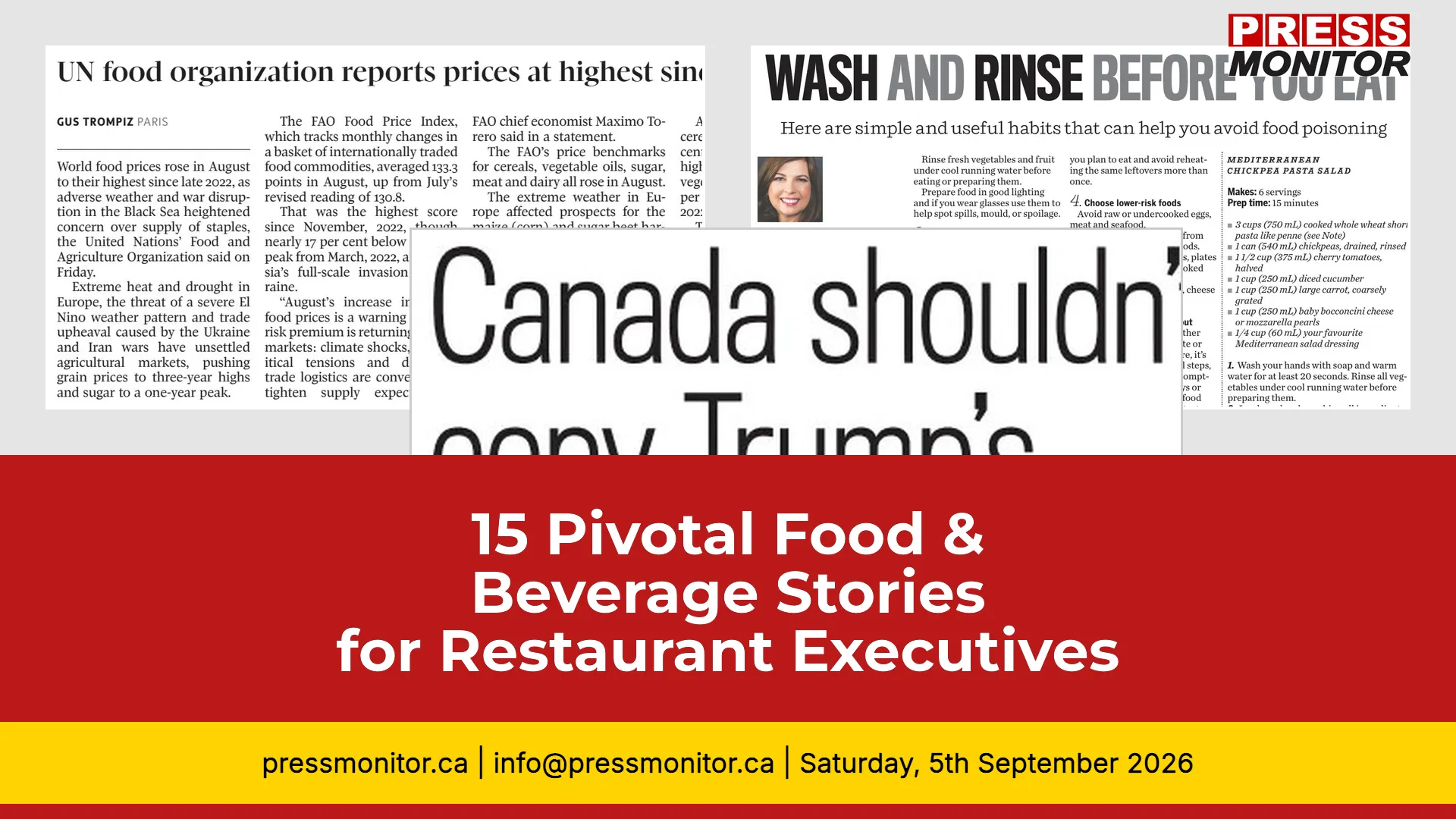
{source_name} reports that global food prices reached their highest level since late 2022 in August, driven by extreme weather, drought, and disruptions in the Black Sea region. The United Nations Food and Agriculture Organization said its Food Price Index averaged 133.3 points, with rising costs across cereals, vegetable oils, sugar, meat, and dairy as supply risks grow. The agency also cut its 2026 global cereal production forecast by 3.4 million tonnes to 2.98 billion tonnes, marking the largest annual decline since 2018.
Why it matters: Global supply shocks directly impact Canadian grocery margins and consumer spending power.
Key detail: FAO Food Price Index averaged 133.3 points in August, with cereal production forecast cut by 3.4 million tonnes.
Source: The Globe And Mail
Next step: Review procurement contracts and hedge against commodity volatility.
2. One in Eight Canadians Face Food Poisoning
Edmonton Journal reports that one in eight Canadians experiences food-borne illness annually, with older adults at significantly higher risk due to weakened immune systems. Implementing five simple food safety practices, such as thorough handwashing, strict temperature control, safe cooking temperatures, selecting lower-risk ingredients, and discarding questionable items, can greatly protect public health and reduce disease transmission.
Why it matters: Public health compliance remains a top operational risk for restaurants and retailers.
Key detail: Older adults face significantly higher risks; five core safety practices can drastically reduce transmission.
Source: Edmonton Journal
Next step: Audit kitchen protocols and staff training schedules immediately.
3. Trump Imports Beef Trimmings
Regina Leader-post reports that President Donald Trump authorized the import of 300,000 metric tonnes of lean beef trimmings into the United States at a lower tariff rate, hoping to lower beef prices, but analysts warn it may not solve the structural cattle shortage.
Why it matters: Cross-border trade policy shifts could alter North American cattle economics and pricing.
Key detail: US authorized 300,000 metric tonnes of lean beef trimmings at lower tariffs, though structural shortages persist.
Source: Regina Leader-post
Next step: Monitor USDA announcements and adjust livestock sourcing strategies.
4. Six New Winnipeg Restaurants Opening
The Winnipeg Sun reports that this fall brings a variety of new dining options to downtown Winnipeg, including Hermanos reopening in the Centennial Concert Hall and The Keg moving to a new high-rise. The article highlights upcoming openings like Greta arcade bar and the return of the revolving restaurant on the 30th floor.
Why it matters: Local hospitality expansion signals strong regional consumer confidence and labor absorption.
Key detail: Downtown sees major openings including Hermanos and The Keg relocations, plus new arcade bars.
Source: Winnipeg Sun
Next step: Track competitor foot traffic and staffing trends in emerging districts.
5. Farm-to-Table Dinners Connect Diners to the Land
Vancouver Sun reports that Graze by Lynn River Farm in Perth East, Ont., offers rustic six-course farm dinners outdoors in a heated tent from May through October. Owner Lindsay Higgins says the experience taps into an emotional connection to ancestral food practices, while chefs at Down Home and At Home Block benefit from picking ingredients at peak freshness. However, the proximity to the farm also means chefs must adapt to weather, pests, and seasonal timing, turning rough edges into part of the adventure for diners.
Why it matters: Direct-to-consumer agricultural models are reshaping restaurant value propositions.
Key detail: Ontario venues like Graze and Down Home leverage peak-fresh ingredients while adapting to seasonal weather variables.
Source: Vancouver Sun
Next step: Explore partnerships with local growers to enhance menu storytelling.
6. Down Home Farm Dining Experience
Calgary Herald reports that some Canadians are turning to gardens, vineyards and working farms for a dining experience that is special. At Down Home in Markdale, Ont., chef-owners Joel Gray and Hannah Harradine host meals in their cosy home and outdoors on the property using many ingredients gathered on their own land. The article also profiles Home Block at CedarCreek Estate Winery in Kelowna, B.C., and Graze by Lynn River Farm in Perth East, Ont., highlighting how the farm-to-table movement is transforming food from a commodity into a story.
Why it matters: Experiential dining transforms food service from transactional to narrative-driven.
Key detail: Markdale venue hosts meals using property-gathered ingredients, turning rough edges into curated adventures.
Source: Calgary Herald
Next step: Benchmark immersive service models for premium positioning.
7. Victoria Urban Food Garden Tour Returns
Times Colonist reports that the Victoria Urban Food Garden Tour returns on September 12 from 10 a.m. to 4 p.m. with an 11-garden self-guided route around Victoria and Saanich, benefiting Shelbourne Community Kitchen. Tickets cost C$30, and the tour features edible urban gardens such as Jane's private kitchen garden, organized by Kaleigh Valois and Rebecca Lang of Any Thyme Gardening with support from Rivers Landscaping and a plant and seed sale sponsored by Satinflower Nurseries.
Why it matters: Community-led food security initiatives drive grassroots engagement and sustainable landscaping.
Key detail: September 12 self-guided route benefits Shelbourne Community Kitchen, featuring edible urban gardens and seed sales.
Source: Times Colonist
Next step: Align corporate CSR programs with local food sovereignty projects.
8. Outdoor Food & Drink Market Returns
The Hamilton Spectator reports that an outdoor food and drink market is running every Thursday this summer from 3 PM to 9 PM at the corner of Prospect and Regency in Fallsview, with free play available. Thursday and Saturday pickups are offered every week, and the event is serviced by Fallsview Transit with specific departure times from locations including Hamilton Mountain, Stoney Creek, and Walmart Centennial. For more information, callers can contact the tour operator at 1-855-943-4242 or visit frontlinetours.com.
Why it matters: Pop-up retail formats offer low-overhead testing grounds for emerging culinary brands.
Key detail: Fallsview hosts weekly Thursday markets with integrated transit pickup and free entertainment.
Source: The Hamilton Spectator
Next step: Evaluate pop-up leasing opportunities for seasonal brand launches.
9. Rouge Forage To Table Experience
Calgary Herald reports that Rouge's Forage to Table event runs until October 21 on selected dates only. The experience costs 430 dollars per person and includes transportation, the foraging session, and dinner. Other culinary exploration options in Calgary include Calgary Blue Sky Experiences, Eau Claire Distillery, Alberta Ale Trail, and Alberta Food Tours.
Why it matters: Culinary tourism monetizes wild food sourcing and educational gastronomy.
Key detail: Runs until October 21 at $430/person, combining transport, foraging, and dinner in Calgary.
Source: Calgary Herald
Next step: Develop guided experience packages targeting high-net-worth travelers.
10. Indigenous Influencers Revive Sea Gardens
{source_name} reports that Dr. Jennifer Grenz says Indigenous influencers are sharing traditional knowledge online, including sustainable sea gardens built in intertidal zones. Grenz also describes an incident where a school apologized after stopping her twins from teaching classmates to eat wild salmon berries.
Why it matters: Traditional ecological knowledge is gaining digital traction and influencing modern sustainability frameworks.
Key detail: Dr. Jennifer Grenz highlights intertidal zone cultivation and school-based cultural education pushback.
Source: The Globe And Mail
Next step: Integrate Indigenous food sovereignty principles into ESG reporting.
11. 70 BC Species Become Social Media Sensation
The Globe And Mail (ottawa/quebec Edition) reports that thirty-year-old food influencer Justin Park foraged across British Columbia, consuming over seventy distinct flora and fauna species in just under a year. The amateur chef documents his culinary discoveries online while highlighting a growing trend of North Americans turning to wild food sourcing as an alternative to industrial agriculture and rising grocery costs.
Why it matters: Wild food foraging is trending as an affordable alternative to industrial grocery inflation.
Key detail: Influencer Justin Park consumed over 70 BC flora/fauna species, documenting findings online.
Source: The Globe And Mail
Next step: Monitor social sentiment around foraging legality and safety guidelines.
12. Most Active Canadian Companies
Vancouver Sun reports that the most active BC companies listed on the stock exchange include Telus, Finning International, and Boston Pizza Royalties. Stock prices for companies such as Capstone Mining and Ivanhoe Mines showed changes, while mortgage rates ranged from lowest to highest across one, two, and three-year terms.
Why it matters: Capital market activity reflects broader economic health affecting food tech and agri-business valuations.
Key detail: Telus, Finning International, and Boston Pizza Royalties lead BC exchange volume alongside shifting mortgage rates.
Source: Vancouver Sun
Next step: Correlate equity movements with consumer discretionary spending forecasts.
13. 3 Indian Dinners for Leftovers
The Globe And Mail (ottawa/quebec Edition) reports that, in a recent week, Globe food culture reporter Dakshana Bascaramurty tested three Indian-flavoured dinners from Vijaya Selvaraju's Indian Food Is Easy in The Globe's Wieesee Lab. Selvaraju, a Toronto-based recipe developer, says the goal was to make Indian home cooking feel accessible, and Bascaramurty evaluated whether the meals stayed tasty and reheated well for lunches the next day.
Why it matters: Meal prep innovation addresses rising labor costs and home cooking convenience demands.
Key detail: Tested recipes maintain flavor quality after reheating, streamlining grocery shopping with shared aromatics.
Source: The Globe And Mail
Next step: Adapt batch-cooking workflows for institutional catering operations.
14. Indian Food Is Easy
The Globe And Mail reports that Appetite by Random House has published Indian Food Is Easy by Vijaya Selvaraju, with photographs by Tanya Pilgrim. The book offers accessible Indian recipes for home cooks. It is part of a new wave of food titles aimed at broadening culinary skills.
Why it matters: Accessible cookbook publishing broadens culinary skill adoption among mainstream consumers.
Key detail: Appetite by Random House releases Vijaya Selvaraju’s guide aimed at demystifying home Indian cooking.
Source: The Globe And Mail
Next step: Partner with publishers for branded recipe integration campaigns.
15. Indian Food Is Easy Presents Reshmi Kebabs
The Globe And Mail (ottawa/quebec Edition) reports that the newly released cookbook Indian Food Is Easy by Vijaya Selvaraju provides a simple method for preparing Reshmi kebabs. The recipe details a quick marinade blending cream, cashews, yogurt, and aromatic spices before grilling the chicken skewers until charred. Cooks are encouraged to serve the dish with butter naan and mint chutney, noting that leftovers easily transition into wraps or salads the following day.
Why it matters: Signature dish features drive repeat engagement and social sharing for food brands.
Key detail: Quick marinade of cream, cashews, yogurt, and spices yields charred skewers ideal for wraps or salads.
Source: The Globe And Mail
Next step: Feature quick-prep proteins in promotional menus to boost weekday traffic.
According to Press Monitor's tracking of Canadian publications, these developments highlight a sector balancing inflation pressures with experiential innovation. Which shift will redefine your Q4 strategy?