17 Essential Children & Youth Stories for Canadian Leaders


According to Press Monitor's tracking of Canadian publications, these are the 17 most important stories on children and youth today. From school nutrition to vaccine rates, from youth mental health to online safety, this press review gives you the intelligence you need to stay ahead.
1. Hegseth Mocked for Targeting Canadian Cadets
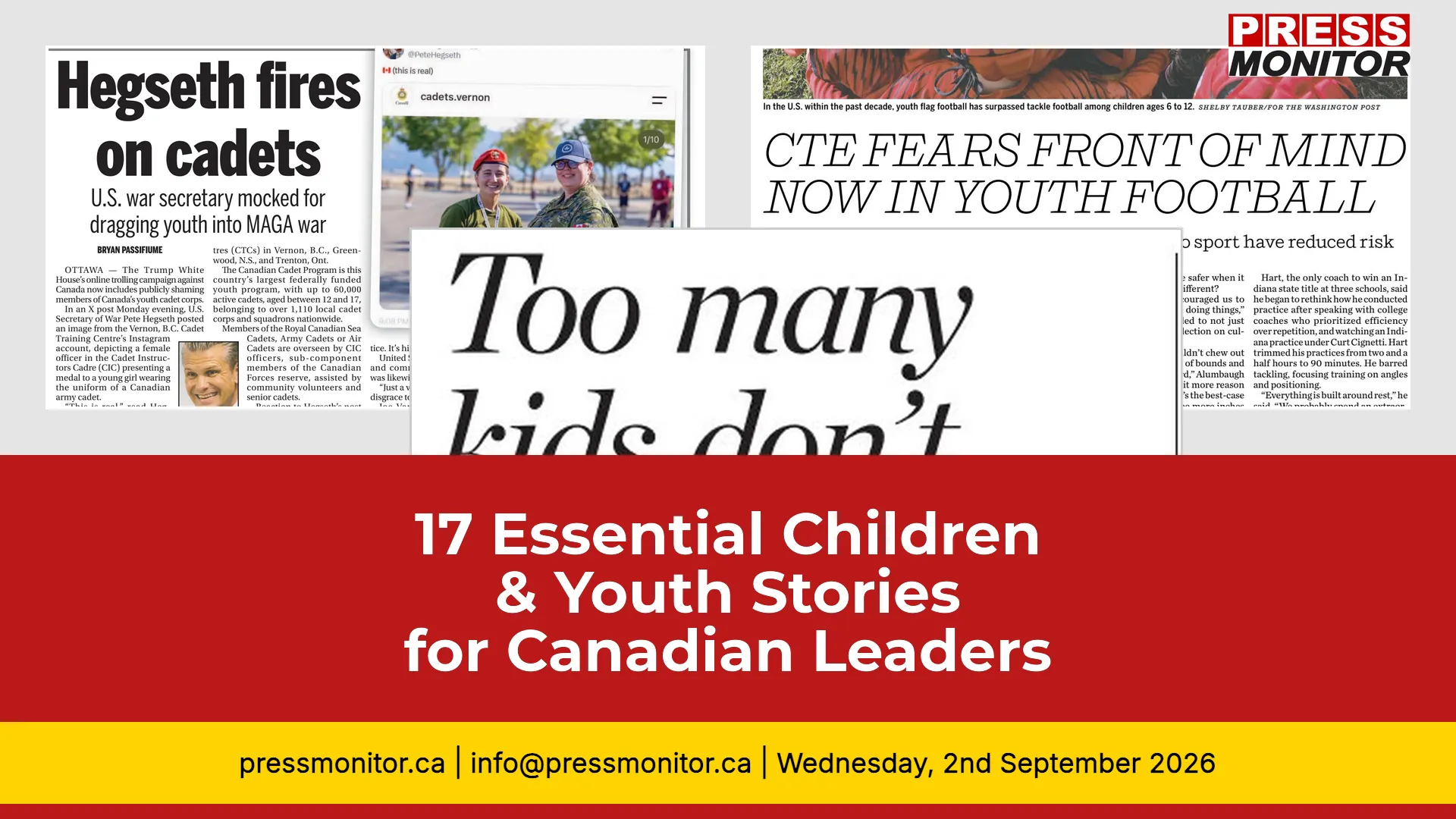
Toronto Sun reports that U.S. Secretary of War Pete Hegseth faced widespread criticism after posting an image of a Canadian army cadet awards ceremony on X, mocking a female Cadet Instructors Cadre officer and a young cadet from the Vernon, B.C. Cadet Training Centre. The Canadian Cadet Program is the country's largest federally funded youth program, with up to 60,000 cadets aged 12 to 17. Critics including Conservative MP Garnett Genuis and Macdonald-Laurier Institute senior fellow Joe Varner called the post a new low, stressing that cadets are not members of the military.
Why it matters: A U.S. official publicly shamed Canadian youth cadets, sparking cross-border controversy.
Key detail: Pete Hegseth posted a photo from a Vernon cadet ceremony, drawing criticism from MPs and veterans. The cadet program serves up to 60,000 youth.
Source: Toronto Sun, The Province, Vancouver Sun, Globe and Mail
Next step: Monitor how this affects Canada-U.S. youth program relations.
2. CTE Fears Shadow Youth Football Comeback
The Chronicle Herald reports that a landmark study published in the British Medical Journal found CTE, a degenerative brain disease linked to repeated blows to the head, in more than 90 per cent of the 338 former NFL players whose brains were examined posthumously. Despite the findings, tackle football participation among American children has rebounded after a decade of decline, and flag football has now surpassed tackle among kids ages 6 to 12. Coaches at schools such as Brownsburg High in Indiana and De La Salle in California say safer tackling techniques, shorter practices and equipment changes have reduced the sport's risks.
Why it matters: New research on brain injury is reshaping youth sports participation.
Key detail: A BMJ study found CTE in 90% of examined NFL brains, yet youth tackle football is rebounding with safety reforms.
Source: Chronicle Herald, Cape Breton Post
Next step: Review safety protocols for youth contact sports.
3. 25,259 Hamilton Students Fed Daily
The Hamilton Spectator reports that Hamilton's child poverty rate stood at 21.1 per cent in 2023, leaving more than 24,000 children living in poverty and many arriving at school hungry. Tastebuds, Hamilton's Student Nutrition Collaborative, provided daily meals to 25,259 students through 132 school programs in 2025-26, serving more than 3.5 million meals and snacks with the support of 95,875 volunteer hours. Program manager Bhairavi Kumar urges voters ahead of the Oct. 26 municipal election to ask candidates how they will ensure students have access to nutritious food at school.
Why it matters: Child poverty drives hunger, impacting learning and health.
Key detail: Tastebuds served 3.5M meals to 25,259 students via 132 school programs.
Source: Hamilton Spectator
Next step: Advocate for sustainable school food programs.
4. 85% Measles Vaccination Rate Falls Short
Times Colonist reports that Canada's chief public health officer, Dr. Joss Reimer, is urging parents to check that routine childhood vaccinations are up to date as kids head back to school. The national measles immunization rate for two-year-olds sits at about 85 per cent, short of the 95 per cent needed for herd immunity, and Canada lost its measles elimination status after an outbreak that began in 2024. Reimer also warned that vaccine misinformation continues to circulate online and that other vaccine-preventable diseases such as mumps, rubella and diphtheria remain a risk.
Why it matters: Herd immunity requires 95% coverage; Canada lost elimination status.
Key detail: Chief public health officer urges parents to update vaccinations before school.
Source: Times Colonist
Next step: Promote immunization campaigns in your community.
5. 28.5% of Kindergarteners Developmentally Vulnerable
The Hamilton Spectator reports that kindergarteners starting school in Hamilton on September 8 are noticeably less independent than in the past, with toileting and personal care needs greater than ever in the first weeks. Recent McMaster University research found the overall rate of children with at least one developmental vulnerability rose to 28.5 per cent in 2023 from 27.3 per cent in 2017, with emotional maturity seeing the largest decline. In response, the Hamilton-Wentworth District School Board launched a universal life skills program in 2024 to teach kindergarten students basic skills like responding to their name and asking for help.
Why it matters: Early childhood development is declining, affecting school readiness.
Key detail: McMaster research shows emotional maturity dropped; HWDSB launched life skills program.
Source: Hamilton Spectator
Next step: Support early intervention and life skills education.
6. Fresh Air Fund Sends Vulnerable Kids to Camp
The Toronto Star Fresh Air Fund has been providing opportunities for financially vulnerable children to attend camp since 1901. Your support helps them build life-changing friendships and civic bonds while learning invaluable life skills.
Why it matters: Camp builds life skills and friendships for financially vulnerable children.
Key detail: Since 1901, the Toronto Star Fresh Air Fund has provided camp opportunities.
Source: Toronto Star
Next step: Donate or volunteer to expand access.
7. 6% Brain Injury Risk After Overdose
The Winnipeg Sun reports that opioid overdoses can cause immediate brain damage, with data from British Columbia showing adults face a 6% risk of diagnosed brain injury within one year of a first overdose, rising to 10% for those under 19. A letter in the journal Addiction co-authored by Dr. Nathaniel Day, Canadian Centre of Recovery Excellence CEO Kym Kaufmann, and BC Chief Scientific Advisor Dr. Daniel Vigo argues that current North American opioid treatment guidelines are silent on acquired brain injury. Columnist Marty Gold contrasts Alberta's prevention-focused approach with Manitoba's harm reduction policies, urging action from minister Asagwara.
Why it matters: Opioid overdoses can cause immediate brain damage, especially in teens.
Key detail: Under-19 risk is 10%; study challenges harm reduction policies.
Source: Winnipeg Sun
Next step: Integrate brain injury awareness into youth addiction services.
8. Children's Vision Day
The Manitoba Association of Optometrists will mark Children’s Vision Day on Wednesday, Sept. 2, with events across the province aimed at raising awareness about the importance of children’s eye health.
Why it matters: Early eye health is critical for learning and development.
Key detail: Manitoba optometrists host awareness events on Sept. 2.
Source: Winnipeg Sun
Next step: Encourage regular eye exams for children.
9. Youth Mental Health Support
Montreal Gazette reports that pressure to succeed, coupled with fallout from the pandemic, is behind many of the issues that youth are currently dealing with. What helped youth most was talk therapy, though it took trying a few different therapists over several years to find someone they clicked with and helped them get to the core of their issues.
Why it matters: Pandemic fallout and pressure to succeed are affecting youth.
Key detail: Talk therapy proved most helpful, though finding the right therapist takes time.
Source: Montreal Gazette
Next step: Expand access to youth mental health services.
10. Arc-en-ciel: Summer Camp for Everyone
Montreal Gazette reports that the Notre-Dame-de-Fatima Centre in Notre-Dame-de-l'Île-Perrot, Quebec, operates Arc-en-ciel, a specialized day camp for children ages five to 14 with autism spectrum disorder, intellectual disabilities or multiple disabilities. Operations director Guillaume Roberge says the camp on the shores of Lake Saint-Louis offers campers an authentic camp experience while giving parents of special-needs children a moment of respite, supported by staff-to-child ratios of one-to-one or one-to-two and monitors who receive 50 to 80 hours of training. The centre funds the summer camp by running year-round camp services for neurotypical campers.
Why it matters: Inclusive camps provide respite and authentic experiences for special-needs children.
Key detail: Staff-to-child ratios of 1:1 or 1:2 with 50-80 hours of training.
Source: Montreal Gazette
Next step: Support inclusive recreation programs.
11. Carney Fights Youth-Led Climate Challenge
Times Colonist reports that Prime Minister Mark Carney has asked the courts to disallow a youth-led challenge to the Canadian government's abandonment of measures aimed at reducing emissions so Canada can reach its net-zero targets. Carney argues that the direction of policy is at stake in the case.
Why it matters: Youth climate activism faces legal opposition from the PM.
Key detail: Carney asks courts to disallow a youth-led challenge to net-zero policy.
Source: Times Colonist
Next step: Track the legal outcome and its implications for youth advocacy.
12. Bill C-34 Targets Kids' Social Media
The Montreal Gazette reports that cellphone bans in schools appear to provide a safer environment for young children, following similar moves in Australia and the United Kingdom. Canada's federal government cannot impose a nationwide school cellphone ban because education falls under provincial jurisdiction, but it can set minimum social media age requirements through Bill C-34, the Safe Social Media Act. Health Minister Marjorie Michel, Member of Parliament for Papineau, said the legislation will help young Canadians connect in person, build friendships and focus in school.
Why it matters: Federal legislation aims to set minimum age for social media.
Key detail: Safe Social Media Act would help kids connect in person and focus in school.
Source: Montreal Gazette
Next step: Understand how this affects digital safety policies.
13. Cellphone Ban From BL
Montreal Gazette reports that cellphone bans in schools appear to provide a safer environment for young kids to grow. Australia and the United Kingdom have adopted similar measures, followed by plans to introduce an age requirement for social media accounts. Bill C-34, the Safe Social Media Act, aims to enforce minimum age requirements for social media accounts in Canada.
Why it matters: School cellphone bans create safer environments for kids.
Key detail: Australia and UK have adopted similar measures; Canada considers age requirements.
Source: Montreal Gazette
Next step: Evaluate school phone policies.
14. Calgary Charities Ease Back-to-School Costs
Calgary Herald reports that the Markin Kossowski Foundation For Hope partnered with Tsuut'ina Nation on a back-to-school event Friday at the Seven Chiefs Sportsplex, where 677 children received school supplies and roughly C$120,000 worth of new clothing. Charities including the Calgary Food Bank, Brown Bagging for Calgary's Kids and EducationMatters say demand for support is climbing as families face mounting back-to-school costs.
Why it matters: Families face rising costs; charities step in.
Key detail: 677 children received supplies and $120K in clothing at Tsuut'ina Nation event.
Source: Calgary Herald
Next step: Support local back-to-school drives.
15. 20% of Halifax E-Scooter Injuries Severe
The Chronicle Herald reports that Dr. Kirstin Weerdenburg, a pediatric emergency physician and trauma team leader at IWK Health in Halifax, has found that 20 per cent of e-bike and e-scooter injury patients in Halifax Regional Municipality emergency departments required a trauma team activation. Her data, collected since May, shows a median patient age of roughly 13, despite Nova Scotia banning children under 14 from riding e-scooters, and helmet use dropping to 40 per cent among adults. She is calling for better regulations and enforcement as Halifax considers the future of its two-year rental pilot program with Bird Canada.
Why it matters: E-scooter injuries are common among youth, with low helmet use.
Key detail: Median patient age 13; 20% required trauma team activation.
Source: Chronicle Herald
Next step: Advocate for stricter e-scooter regulations.
16. Ellie Krieger on Picky Eaters
The Province reports that, in a Washington Post column, Ellie Krieger advises parents of picky young eaters to let children explore food on their own terms by helping to choose ingredients and join in the cooking. She highlights the Instagram feed cookingforlevi, where five-year-old Levi Zhang cooks colourful meals with his parents Jack and Emmy Zhang, authors of the new cookbook Weeknight Winners, Family Dinners. The column features a curried stir-fried noodle dish with ham and shrimp, adapted from the book, that pops with brilliant colour.
Why it matters: Involving kids in cooking improves eating habits.
Key detail: Five-year-old Levi Zhang cooks with parents; new cookbook features family dinners.
Source: The Province
Next step: Try kid-friendly cooking activities at home.
17. Vanguard Survey: Talk Money With Kids
The Globe and Mail reports that a Vanguard Canada survey, conducted by Angus Reid in March with 1,014 Canadian parents, found that parents who regularly talk to their children about money pass along a deeper understanding of financial concepts such as credit. Children whose parents stay quiet about finances are five times more likely to feel anxious about money, with financial curiosity peaking between the ages of 10 and 14. Vanguard has also introduced its free My Classroom Economy digital program in Canada as a teaching resource for schools.
Why it matters: Financial literacy reduces anxiety and builds understanding.
Key detail: Kids whose parents avoid money talks are 5x more likely to feel anxious.
Source: Globe and Mail
Next step: Start money conversations early.
Which of these stories will you act on today? Stay informed with Press Monitor's daily media monitoring.