17 Key Education Stories for School Leaders


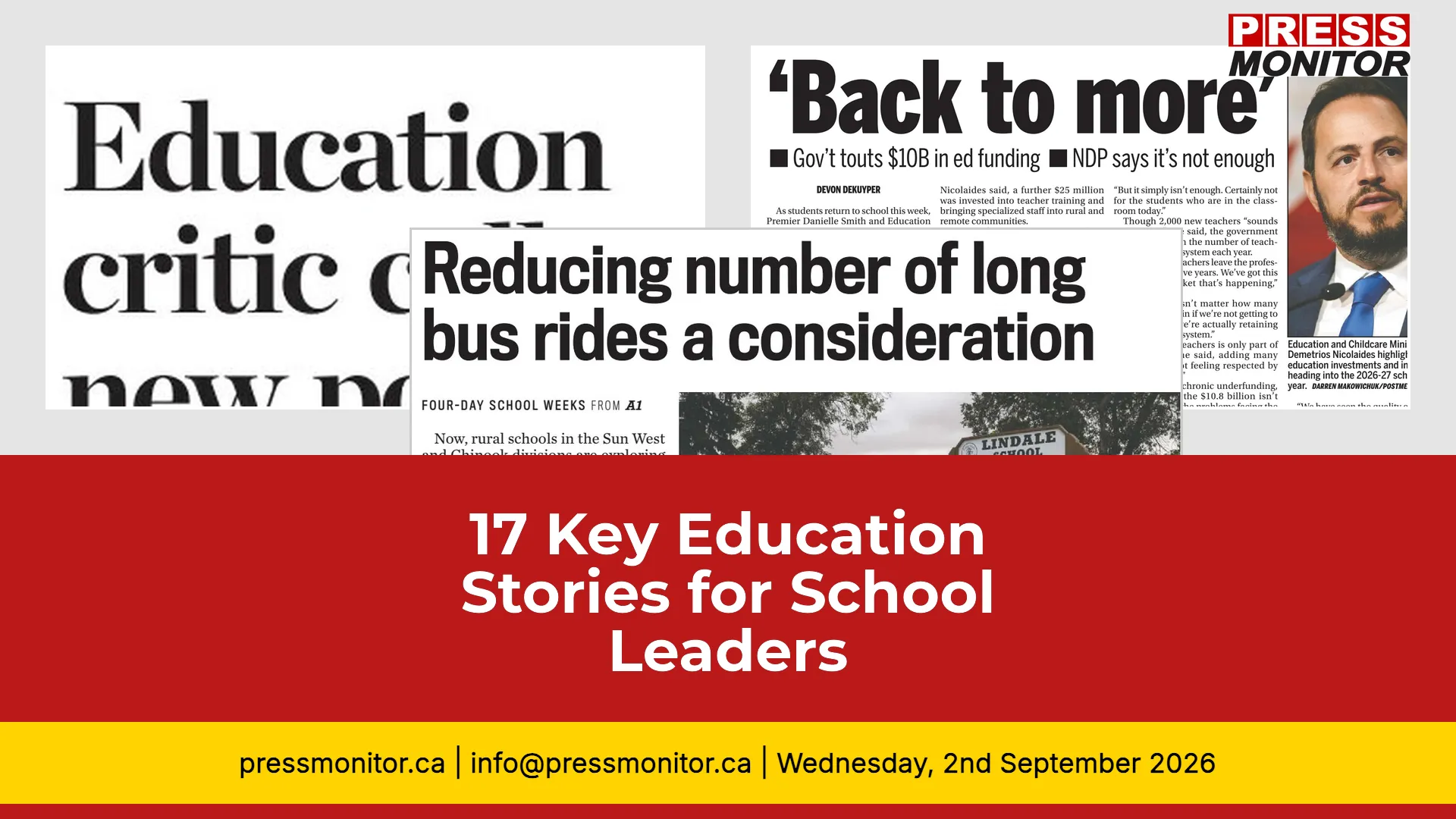
Welcome to Press Monitor's daily education briefing. According to Press Monitor's media monitoring of Canadian publications, these are the stories shaping classrooms, boardrooms, and policy debates today. From record funding in Alberta to attendance policies in Ontario, here are 17 developments you need to know. Let's dive in.
1. Ontario Attendance Policy Docks Marks
Toronto Star reports that Ontario's new attendance policy will dock marks for missed high school classes, with principals making the final call on whether extended vacations or non-school sports tournaments count as authorized absences. Attendance and participation will comprise 15 per cent of final marks in Grades 9 and 10, and 10 per cent in Grades 11 and 12. Principals say they were not consulted on the rules, and opposition critics have questioned the policy's consistency, with NDP education critic Chandra Pasma calling it a stunt.
Why it matters: Ontario's new policy ties grades to attendance, affecting every high school student.
Key detail: Attendance and participation will be 15% of marks in Grades 9-10, 10% in Grades 11-12.
Source: Toronto Star
Next step: Principals need clarity on authorized absences.
2. Alberta Touts Record C$10.8B Education Funding
The Calgary Sun reports that Premier Danielle Smith and Education Minister Demetrios Nicolaides announced a record C$10.8 billion in education funding for Alberta schools this year, as nearly 90,000 new students have entered the system over the past four years. The investment includes 566 complexity teams, 2,127 new teachers hired this school year and 17 new school buildings, with 156 construction projects underway. New Democratic Party education critic Amanda Chapman called the announcement a re-announcement that does not make up for years of underfunding.
Why it matters: Record investment aims to address growth and teacher shortages.
Key detail: 2,127 new teachers hired, 156 construction projects underway.
Source: Calgary Sun
Next step: Watch for NDP criticism on teacher retention.
3. Saskatchewan Rural Schools Try Four-Day Weeks
The Regina Leader-Post reports that all rural schools in the Prairie South School Division, including Lindale Elementary and Caronport Elementary near Moose Jaw, are moving to an alternative school calendar with 14 four-day weeks out of 38 school weeks this fall under a two-year pilot project. School days will start roughly 25 minutes earlier to make up the time, and parents such as Alana Noble welcome the change because it means fewer long bus rides for rural students. The Sun West and Chinook school divisions are now exploring the option, with Dinsmore Composite School among six Sun West schools trying the calendar this fall.
Why it matters: Alternative calendars could reshape rural education.
Key detail: 14 four-day weeks in 38-week year, days start 25 min earlier.
Source: Regina Leader-Post
Next step: Monitor pilot results for other divisions.
4. EDI Mandates Cut Research Productivity 15%
The National Post reports that a Macdonald-Laurier Institute study found the quality and quantity of Canada Research Chairs scholarship declined by 10 to 15 per cent after identity-based hiring mandates were imposed in 2017 under then-prime minister Justin Trudeau. The $311-million-per-year federal program funds 2,285 university research chairs under quotas requiring 22 per cent racialized, 4.9 per cent Indigenous and 50.9 per cent women and gender equity-seeking hires, with white males falling from 80 per cent of chairs at the program's 2000 launch to 25 per cent in 2025. The report concludes that ending EDI initiatives in Canadian research should be a top priority for any responsible government.
Why it matters: Federal research funding tied to identity-based quotas may be hurting output.
Key detail: Canada Research Chairs productivity down 10-15% since 2017.
Source: National Post
Next step: Policy debate on EDI in academia.
5. Bill C-34 Targets Kids' Social Media
The Montreal Gazette reports that cellphone bans in schools appear to provide a safer environment for young children, following similar moves in Australia and the United Kingdom. Canada's federal government cannot impose a nationwide school cellphone ban because education falls under provincial jurisdiction, but it can set minimum social media age requirements through Bill C-34, the Safe Social Media Act. Health Minister Marjorie Michel, Member of Parliament for Papineau, said the legislation will help young Canadians connect in person, build friendships and focus in school.
Why it matters: Federal legislation could set minimum age for social media.
Key detail: Safe Social Media Act aims to enforce age requirements.
Source: Montreal Gazette
Next step: Schools may see reduced distractions.
6. Ontario Teachers Reject Centralized Bargaining
The Toronto Star reports that Ontario's five major education unions are resisting the Doug Ford government's push to move local bargaining issues, such as staffing timelines and professional development funding, into provincial contract talks after their contracts expired. The unions, representing 275,000 teachers and school staffers, have appealed to Ontario's labour relations board to decide which issues belong at which bargaining table. Education Minister Paul Calandra says he is optimistic a deal can be reached without labour strife, and no strike vote has been taken as students return to school on September 8.
Why it matters: Labour dispute could disrupt school year.
Key detail: Five unions representing 275,000 staff resist Ford government.
Source: Toronto Star
Next step: Labour board to decide bargaining tables.
7. Conestoga Lays Off 32 More Faculty
The Hamilton Spectator reports that Conestoga College has issued layoff notices to 32 more full-time faculty as it grapples with a $33-million operating deficit driven by collapsing foreign enrolment. Interim president Norma McDonald Ewing says the cuts are necessary for the college's long-term sustainability, while Ontario Public Service Employees Union Local 237 president Leopold Koff says courses exist for the dismissed professors but the work is going to part-time instructors. The Kitchener-based college, which laid off 81 professors in March, has seen an estimated 2,780 jobs disappear since 2025 after Canada pulled back on student visas.
Why it matters: College deficit from falling foreign enrolment.
Key detail: $33M deficit, 2,780 jobs lost since 2025.
Source: Hamilton Spectator
Next step: Impact on students and programs.
8. Alberta Book Bans Won't Help Kids
The Calgary Herald reports that columnist Catherine Ford has criticized new Alberta government regulations requiring public libraries to restrict access to material depicting sex for patrons aged 15 and younger by January, with school libraries facing even stricter rules. Ford argues the restrictions are repressive and will not stop children from reading, comparing them to the Roman Catholic Church's former Index of banned books, which once included classics by Victor Hugo and Gustave Flaubert.
Why it matters: New library restrictions spark censorship debate.
Key detail: Columnist Catherine Ford criticizes regulations.
Source: Calgary Herald
Next step: Libraries to implement rules by January.
9. Staples Portal Prices Under Fire
Toronto Star reports that Ontario elementary teachers found numerous items priced higher on the new C$750 school supply spending portal, run by Staples, than on the retailer's own website. Education Minister Paul Calandra defended the program, saying the 200 core products identified by 25,000 teachers in a survey are the cheapest available, while Staples Canada promised to price match any discrepancies through a dedicated hotline. Union leaders and opposition critics, including New Democratic Party education critic Chandra Pasma and Elementary Teachers' Federation of Ontario president David Mastin, slammed the rollout as stressful and questioned why a U.S.-headquartered firm won the government contract.
Why it matters: School supply portal pricing questioned.
Key detail: Items priced higher than Staples' own website.
Source: Toronto Star
Next step: Staples promises price match.
10. Hamilton Councillors Approve Islamic School
The Hamilton Spectator reports that Hamilton councillors voted 10-0 to approve a zoning bylaw amendment with holding provisions allowing the Muslim Association of Canada to open a 28-classroom Islamic private school at the former Lloyd George public school on Beach Road. City staff had recommended denial over air quality, noise, soil and transportation concerns tied to the site's proximity to ArcelorMittal Dofasco's industrial operations. The decision is to be ratified by council on October 7.
Why it matters: Zoning approval for 28-classroom school.
Key detail: 10-0 vote despite staff concerns.
Source: Hamilton Spectator
Next step: Ratification on Oct 7.
11. 28.5% of Kindergarteners Developmentally Vulnerable
The Hamilton Spectator reports that kindergarteners starting school in Hamilton on September 8 are noticeably less independent than in the past, with toileting and personal care needs greater than ever in the first weeks. Recent McMaster University research found the overall rate of children with at least one developmental vulnerability rose to 28.5 per cent in 2023 from 27.3 per cent in 2017, with emotional maturity seeing the largest decline. In response, the Hamilton-Wentworth District School Board launched a universal life skills program in 2024 to teach kindergarten students basic skills like responding to their name and asking for help.
Why it matters: Early childhood development trends.
Key detail: Rate rose from 27.3% in 2017.
Source: Hamilton Spectator
Next step: Schools implement life skills programs.
12. 25,259 Hamilton Students Fed Daily
The Hamilton Spectator reports that Hamilton's child poverty rate stood at 21.1 per cent in 2023, leaving more than 24,000 children living in poverty and many arriving at school hungry. Tastebuds, Hamilton's Student Nutrition Collaborative, provided daily meals to 25,259 students through 132 school programs in 2025-26, serving more than 3.5 million meals and snacks with the support of 95,875 volunteer hours. Program manager Bhairavi Kumar urges voters ahead of the Oct. 26 municipal election to ask candidates how they will ensure students have access to nutritious food at school.
Why it matters: Child poverty and food security.
Key detail: Tastebuds served 3.5M meals in 2025-26.
Source: Hamilton Spectator
Next step: Voters to ask candidates about school food.
13. Duncan School Sold for C$3.15M
Times Colonist reports that the former Koksilah Elementary School in Duncan has been sold to the Duncan Pentecostal Church and Living Stones Landscaping Inc. for C$3.15 million. The Cowichan Valley School District finalized the sale on Aug. 28 and will use the proceeds to help fund an estimated C$100 million in deferred maintenance across its school sites. The sale drew criticism from the Cowichan Valley Regional District, which had sought the property for an emergency shelter or supportive housing.
Why it matters: Proceeds fund deferred maintenance.
Key detail: Sold to Pentecostal Church and landscaping firm.
Source: Times Colonist
Next step: Regional district sought property for shelter.
14. First Mi'kmaq Woman in PSAC Leadership
Cape Breton Post reports that Terri Leigh Gould, a teacher's assistant at Eskasoni Elementary and Middle School, was elected in June as the Atlantic region's women's representative for the National Indigenous Peoples' Circle with the Public Service Alliance of Canada. She is the first Mi'kmaq woman from Unama'ki (Cape Breton) and Mi'kma'ki to hold the position, and she aims to bring the voices and lived experience of Indigenous women into spaces where decisions are made. Gould also plans to push for leadership training, stronger support for Indigenous members and continued work on reconciliation within the union.
Why it matters: Indigenous representation in union leadership.
Key detail: Terri Leigh Gould elected as women's rep.
Source: Cape Breton Post
Next step: Push for leadership training.
15. 12 Years for Ex-Teacher Who Abused Student
Toronto Sun reports that Allison Havemann-Niedrach, a 45-year-old former special education teacher at Freehold Intermediate School in New Jersey, has been sentenced to 12 years in jail for sexually abusing a 15-year-old student over six months beginning in January 2024. She pleaded guilty to first-degree aggravated sexual assault after investigators uncovered more than 25,000 text messages between her and the teen. The victim described the abuse as 'like a nightmare' but told the court he forgave her.
Why it matters: Accountability in education.
Key detail: Sentenced for sexual assault of 15-year-old.
Source: Toronto Sun
Next step: Schools to review safeguarding.
16. Vanguard Survey: Talk Money With Kids
The Globe and Mail reports that a Vanguard Canada survey, conducted by Angus Reid in March with 1,014 Canadian parents, found that parents who regularly talk to their children about money pass along a deeper understanding of financial concepts such as credit. Children whose parents stay quiet about finances are five times more likely to feel anxious about money, with financial curiosity peaking between the ages of 10 and 14. Vanguard has also introduced its free My Classroom Economy digital program in Canada as a teaching resource for schools.
Why it matters: Financial literacy starts at home.
Key detail: Kids whose parents avoid money talk are 5x more anxious.
Source: Globe and Mail
Next step: Use free classroom resources.
17. Paul Bennett: Screens Harming Students
Edmonton Journal reports that Canadian researcher Paul Bennett has released a report for the Calgary-based Aristotle Foundation warning that screens and overdependence on education technology are harming the current generation of students. The report, Children and Screens: It is time to bring back the textbook, argues there is little convincing evidence that digital tools have improved student achievement, noting instead a negative relationship. Bennett urges schools to act as a counterweight to social trends and put paper textbooks back at the centre of teaching and learning.
Why it matters: EdTech may not improve achievement.
Key detail: Report urges return to textbooks.
Source: Edmonton Journal
Next step: Schools to reconsider tech use.
These stories are just the tip of the iceberg. What's happening in your district? Let us know in the comments. For a deeper dive, follow Press Monitor for daily media intelligence.