17 Pivotal Climate Stories for Risk Managers


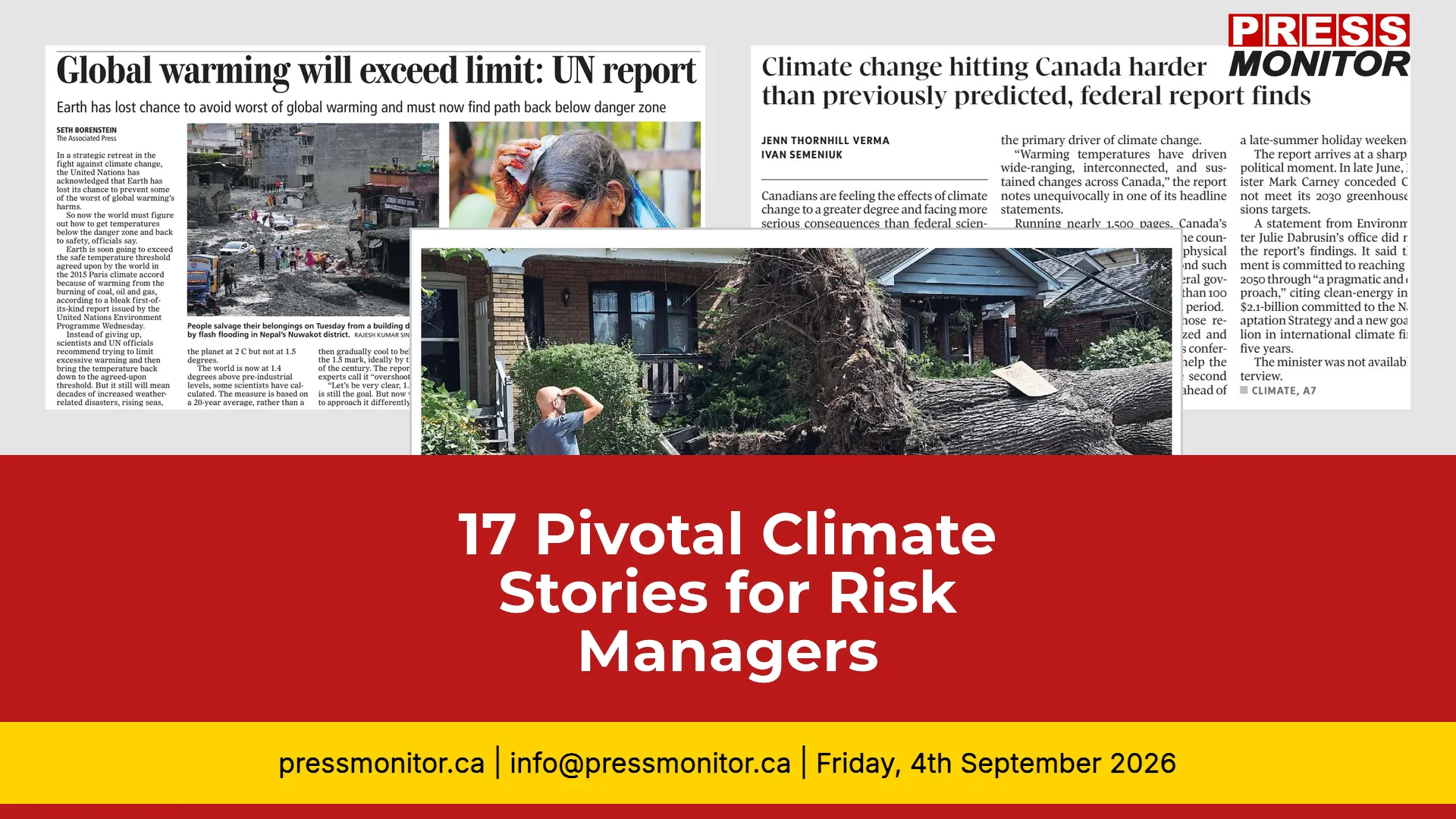
Today's print media landscape delivers critical signals on shifting weather patterns, infrastructure strain, and policy realignments across Canada and globally. According to Press Monitor's tracking of Canadian publications, these developments demand immediate attention from corporate leaders and public sector strategists. Here is your essential press review of today's climate and environmental news.
1. UN: 1.5C global warming threshold to be exceeded
Times Colonist reports that the United Nations Environment Programme issued a bleak first-of-its-kind report Wednesday acknowledging Earth will exceed the 1.5 degree Celsius safe temperature threshold from the 2015 Paris climate accord within the next few years. UN officials now recommend a strategy of limiting excessive warming and then bringing temperatures back down through ending fossil fuel use and developing carbon dioxide removal technologies, while preparing for decades of increased weather-related disasters, rising seas, extinctions, and melting ice.
Why it matters: Global climate targets are officially being breached, signaling accelerated regulatory and physical risks worldwide.
Key detail/stat: UNEP acknowledges Earth will surpass the 1.5°C Paris Accord threshold within years, recommending fossil fuel phase-outs and carbon dioxide removal technologies.
Source: Times Colonist
Next step: Audit supply chain exposure to temperature-sensitive regions and update climate scenario modeling. Closing + question: How is your organization adjusting its net-zero roadmap as international thresholds shift?
2. Climate Change Hitting Canada Harder Than Predicted
The Globe And Mail reports that Canada is experiencing climate change impacts more severely than federal scientists projected less than a decade ago. A comprehensive report released Thursday details physical transformations including floods, wildfires, and vanishing glaciers, with high certainty linking these effects to fossil-fuel emissions. The government acknowledged it will not meet 2030 greenhouse-gas targets but reaffirmed its commitment to net zero by 2050.
Why it matters: Domestic climate impacts are outpacing federal projections, increasing liability and adaptation costs.
Key detail/stat: Comprehensive report links floods, wildfires, and vanishing glaciers directly to fossil-fuel emissions; government admits missing 2030 GHG targets but keeps 2050 net-zero goal.
Source: The Globe And Mail
Next step: Review provincial adaptation funding eligibility and stress-test asset resilience. Closing + question: What infrastructure upgrades are prioritized in your Q4 capital planning?
3. Toronto Storm Causes Widespread Damage and Near Misses
The Toronto Star reports that a severe storm battered Toronto, causing significant damage including upended trees, downed traffic lights, and destroyed stadium seating, while a near-miss incident involving workers on a balcony prompted a Ministry of Labour investigation. Environment Canada confirmed no fatalities, crediting targeted cellphone alerts for helping residents avoid serious injuries. In the aftermath, Toronto Hydro restored power to 90 percent of the 65,000 affected customers, though 5,300 remained without electricity, leaving businesses like the Cheese Boutique facing substantial losses.
Why it matters: Extreme weather is testing urban emergency response and workplace safety protocols simultaneously.
Key detail/stat: Violent winds uprooted century-old trees, downed traffic lights, and triggered 60 fire department rescues; Ministry of Labour investigates a balcony near-miss.
Source: Toronto Star
Next step: Verify contractor safety certifications and review business continuity plans for severe weather. Closing + question: Are your field teams equipped with real-time hazard communication tools?
4. 29 Canadians Missing After Nepal Floods
The Globe And Mail (ottawa/quebec Edition) reports that at least 29 Canadian citizens and permanent residents remain missing after devastating floods and mudslides in Nepal killed more than 1,250 people. Ottawa has allocated C$5 million for emergency relief as consular teams work to locate missing nationals in the Himalayan region.
Why it matters: International travel and humanitarian operations face escalating climate-driven disaster risks.
Key detail/stat: Flash floods killed over 1,250 people; Ottawa allocated C$5 million for emergency relief while consular teams collect DNA samples for missing nationals.
Source: The Globe And Mail
Next step: Update employee travel advisories and verify overseas insurance coverage limits. Closing + question: How does your crisis management team handle cross-border evacuation logistics?
5. Ottawa Projects $11.16M Surplus Despite Mid-Year Deficit
Why it matters: Municipal fiscal health is directly tied to climate mitigation spending and tariff impacts.
Key detail/stat: Year-end surplus forecast driven by rate-supported programs and hiring freezes, though tax-supported services show a $40.17M deficit partly due to snow-clearing and July flooding costs.
Source: Ottawa Citizen
Next step: Monitor municipal bond yields and local infrastructure grant announcements. Closing + question: Is your procurement strategy aligned with upcoming municipal budget shifts?
6. Ontario Storm Exposes Alert Failures
The Toronto Star reports that many in southern Ontario were caught on roads during a dangerous storm on Wednesday despite seeing forecasts and dark clouds. Toronto Mayor Olivia Chow stated the city activated emergency plans, but residents received mobile alerts too late to change plans. The author argues that governments must fully systematize responses and emphasize preparation over reactive heroism.
Why it matters: Public safety communication gaps create reputational and operational vulnerabilities for municipalities.
Key detail/stat: Residents received mobile alerts too late to alter travel plans; Mayor Olivia Chow activated emergency plans but experts call for systematized preparation over reactive measures.
Source: Toronto Star
Next step: Conduct tabletop exercises for early-warning system integration. Closing + question: Does your internal comms framework mirror municipal alert protocols?
7. Toronto Storm Leaves Thousands Without Power
The Hamilton Spectator reports that cleanup and power restoration efforts continued in Toronto after a severe storm battered the city and surrounding areas, drenching some neighbourhoods in more than 100 millimetres of rain and knocking down trees as well as utility lines. Toronto Hydro restored power to about 90 per cent of those who lost it, with roughly 5,300 still in the dark Thursday afternoon, while localized flooding forced the closure of major roadways including parts of Yonge Street and the Don Valley Parkway. Toronto Mayor Olivia Chow praised public servants and emergency responders who fielded an overwhelming number of calls, reassuring residents that the city had planned and co-ordinated its response ahead of the storm.
Why it matters: Utility resilience remains a critical operational bottleneck during compound weather events.
Key detail/stat: Toronto Hydro restored 90% of outages overnight, leaving 5,300 customers dark; localized flooding closed major roadways including Yonge Street and Don Valley Parkway.
Source: The Hamilton Spectator
Next step: Validate backup generator capacity and remote work readiness. Closing + question: How quickly can your operations pivot if grid access drops below 50%?
8. Toronto Storm Hits Ontario
Toronto Star reports that a sudden storm struck southern Ontario on Wednesday, forcing a couple to seek shelter after a tree fell. Residents received emergency alerts only minutes before impact, prompting calls for improved warning systems and volunteer street clearing.
Why it matters: Sudden micro-climate events require decentralized decision-making authority.
Key detail/stat: A couple sought shelter after a tree fell; residents received emergency alerts minutes before impact, sparking calls for volunteer street clearing networks.
Source: Toronto Star
Next step: Empower regional managers with pre-approved contingency budgets. Closing + question: Are your site leads authorized to trigger shutdowns without central approval?
9. Storm Cuts Power to 7,300 in Hamilton Area
The Hamilton Spectator reports that crews in Hamilton cleared a tree that fell on a vehicle on Fairmount Avenue near Glenfern Avenue during Wednesday's storm. The system swept across much of the province, cutting power to more than 7,300 homes and businesses around Ancaster and prompting more than 200 calls to city forestry crews about downed trees.
Why it matters: Regional utility fragmentation complicates coordinated recovery efforts.
Key detail/stat: Crews cleared a vehicle-straddling tree on Fairmount Avenue; over 200 forestry calls logged around Ancaster as the system swept through southern Ontario.
Source: The Hamilton Spectator
Next step: Map third-party vendor response times across service territories. Closing + question: Do your SLAs include guaranteed restoration windows for critical sites?
10. Toronto Braces For Increasingly Destructive Storms
Toronto Star reports that a severe multi-hazard storm struck Toronto on Wednesday, delivering heavy rain, damaging winds, and large hail that triggered widespread flooding and fallen trees. Climatologist David Sills warns that climate change is making such extreme weather events more frequent, emphasizing the urgent need for city-wide infrastructure upgrades. Municipal officials confirmed that multiple neighbourhoods recorded over one hundred millimetres of precipitation, classifying the event as a localized one hundred year storm.
Why it matters: Climatological trends are shifting from cyclical to chronic, demanding permanent infrastructure investment.
Key detail/stat: Climatologist David Sills warns of increased frequency; multiple neighborhoods recorded over 100mm of precipitation, classifying the event as a localized 100-year storm.
Source: Toronto Star
Next step: Commission independent floodplain and wind-load assessments. Closing + question: When was your last physical risk audit conducted?
11. Toronto Storm Causes Widespread Damage
Toronto Star reports that the strongest storm in years left a wide trail of destruction across the region, with Environment Canada saying it will likely end up being one of the strongest to hit the region in at least twenty years. Violent winds ripped out century-old trees across Toronto and much of southern Ontario, while floodwaters rushed onto the Don Valley Parkway, leaving thousands without power and prompting Toronto's fire department to conduct sixty rescue operations.
Why it matters: Historical weather baselines are obsolete, invalidating legacy engineering assumptions.
Key detail/stat: Environment Canada labels it one of the strongest storms in two decades; violent winds and flash flooding disrupted transit and airport operations.
Source: Toronto Star
Next step: Update insurance policies to reflect current meteorological data. Closing + question: Are your coverage terms indexed to updated climate models?
12. Toronto Severe Hailstorm
The Welland Tribune reports that intense weather brought torrential rain, large hail and tornado risk to southern Ontario on Wednesday, with hail falling and downpours flooding vehicles and causing flight delays at Toronto Pearson airport.
Why it matters: Aviation and logistics networks remain highly vulnerable to convective weather.
Key detail/stat: Torrential rain and large hail caused flight delays at Pearson Airport and flooded vehicles across southern Ontario.
Source: The Welland Tribune
Next step: Review freight routing alternatives and cargo protection standards. Closing + question: How does your logistics dashboard integrate real-time convective forecasts?
13. Short Hills Park Reopens Trails After Floods
The Welland Tribune reports that Short Hills Provincial Park in St. Catharines is gradually reopening its trails one month after severe flooding from an August second storm caused extensive damage to bridges, culverts, and paths. While most areas are accessible again, the northern section of the Swayze Falls Trail remains closed following the destruction of a pedestrian bridge built by local volunteers. Ontario Parks officials continue conducting detailed damage assessments and restoration work across the site.
Why it matters: Public land recovery timelines reveal broader ecological stress and funding gaps.
Key detail/stat: Most trails reopened a month post-August second storm, but the northern Swayze Falls Trail remains closed due to destroyed pedestrian bridges built by volunteers.
Source: The Welland Tribune
Next step: Align CSR initiatives with municipal restoration partnerships. Closing + question: Could your sustainability program fund targeted ecosystem repairs?
14. 2.6 Degree Arctic Warmth Alters Canadian Climate
The Globe And Mail (ottawa/quebec Edition) reports that average annual temperatures and precipitation across Canada have measurably increased from the late 1940s through 2023, with the Arctic experiencing the most rapid shifts at 2.6 degrees Celsius warmer on average. Experts like Ewa Jackson of the Ontario Resource Centre for Climate Adaptation and Sherilee Harper from the University of Alberta emphasize that communities must prepare for extreme weather and pursue net zero emissions to mitigate severe impacts and save lives.
Why it matters: Polar amplification is accelerating permafrost thaw and northern supply chain disruptions.
Key detail/stat: Average annual temperatures rose measurably from the late 1940s through 2023; Arctic warmed 2.6°C on average, prompting calls for community-level adaptation.
Source: The Globe And Mail
Next step: Evaluate northern route viability and cold-chain integrity. Closing + question: Is your cold storage infrastructure rated for non-historical temperature extremes?
15. Thousands Lose Power as Storm Hits Toronto
Times Colonist reports that a severe storm with heavy rain, hail, and strong winds hit Toronto and parts of southern Ontario on Wednesday night and Thursday, leaving thousands without power and forcing flooding, road closures, transit disruptions, and airport delays. Toronto Hydro, Hydro One, Pearson Airport, Toronto city officials, emergency responders, and Vaughan authorities dealt with outages, downed trees and utility lines, and damage at Rogers Stadium.
Why it matters: Cascading failures across utilities, transit, and aviation highlight systemic interdependence.
Key detail/stat: Heavy rain, hail, and strong winds triggered road closures, transit disruptions, and Pearson Airport delays alongside widespread outages.
Source: Times Colonist
Next step: Stress-test cross-sector dependency maps. Closing + question: Which single point of failure poses the greatest threat to your operations?
16. Rogers Stadium Storm Damage
Edmonton Sun reports that Rogers Stadium, a seasonal temporary open-air venue at the former Downsview Airport Lands, sustained significant damage after Wednesday's extreme weather and powerful storm. Video and photos spread on social media showed collapsed sections, upended bleachers, stripped tents, and debris, while CP24 and CTV News helicopters documented the aftermath. Live Nation Canada said it was assessing the damage, safety was its top priority, and no one was injured.
Why it matters: Temporary and modular structures face disproportionate wind and debris risks.
Key detail/stat: Video and photos showed collapsed sections, upended bleachers, and stripped tents at Downsview Airport Lands; Live Nation confirmed safety as priority with zero injuries.
Source: Edmonton Sun
Next step: Inspect temporary venue contracts for force majeure and structural warranties. Closing + question: Do your event liability clauses account for rapid-onset wind events?
17. Toronto Storm Leaves 65000 Without Power
The Toronto Star reports that a severe storm swept through Toronto on Wednesday, knocking down a traffic light, tearing apart seating at Rogers Stadium, and leaving 65,000 customers without power. The Ministry of Labour is investigating a near-miss incident involving workers on a platform, while experts suggest improvements to storm readiness and sensor networks could help the city better handle localized weather events.
Why it matters: Mass-scale outages expose gaps in municipal sensor networks and proactive grid hardening.
Key detail/stat: A traffic light was knocked down and stadium seating torn apart; experts recommend upgraded sensor networks to better handle localized weather events.
Source: Toronto Star
Next step: Invest in predictive maintenance IoT deployments. Closing + question: How many of your facilities utilize automated weather-triggered safeguards?
According to Press Monitor's tracking of Canadian publications, these stories underscore the urgent need for proactive climate intelligence. Print media monitoring remains the most reliable method to capture editorial-vetted developments before they trend online. Stay ahead of the curve—what climate adaptation measure will you implement this quarter?