17 Pivotal Government & Public Administration Stories for Policy Leaders


Stay ahead of federal and provincial shifts with today’s essential media monitoring briefing. According to Press Monitor's tracking of Canadian publications, these 17 developments are reshaping policy, trade, and public service operations right now.
1. Carney Tariff Deadline Aug 8
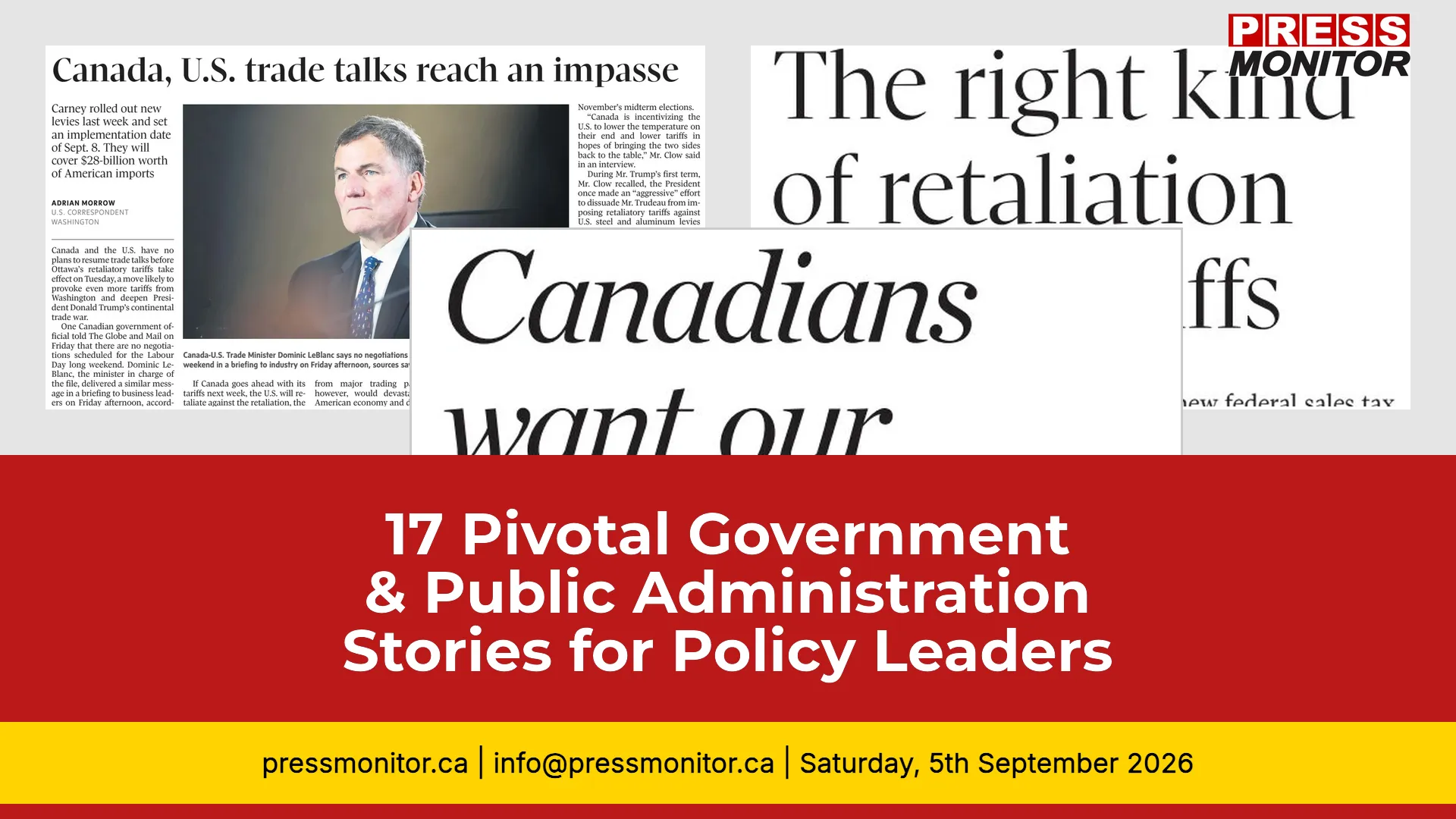
The Globe and Mail reports that Canada and the U.S. have no plans to resume trade talks before Ottawa’s retaliatory tariffs take effect on Tuesday, a move likely to provoke even more tariffs from Washington and deepen President Donald Trump’s continental trade war. Prime Minister Mark Carney rolled out the new levies last week and set an implementation date of Sept. 8, covering $28-billion worth of U.S. imports, while the Trump administration has warned it will retaliate against the retaliation no later than Wednesday.
Why it matters: Sets the timeline for escalating continental trade tensions.
Key detail/stat: Ottawa’s retaliatory tariffs on $28-billion worth of U.S. imports take effect Tuesday, with Washington warning immediate counter-retaliation.
Source: The Globe and Mail
Next step: Track implementation dates and sector-specific exemptions.
2. Canada Faces $4 Billion Tariff Cost
The Globe And Mail (ottawa/quebec Edition) reports that Canada will impose retaliatory tariffs on U.S. goods starting September 8, costing consumers almost four billion Canadian dollars annually and hitting low‑income households hardest. Economist Trevor Tombe estimates the tariffs will reduce disposable income for households earning under thirty‑000 dollars by more than half a percent, triple the impact on higher‑income groups.
Why it matters: Quantifies the direct household impact of trade retaliation.
Key detail/stat: Economist Trevor Tombe estimates nearly $4 billion annually in consumer costs, disproportionately reducing disposable income for households earning under $30,000.
Source: The Globe and Mail
Next step: Review regional economic exposure reports.
3. Carney rejects US trade deal, Canadians rally for independence
The Standard reports that Prime Minister Mark Carney’s decision to walk away from a trade deal with the US has electrified Canadians and awakened a desire for a more independent Canada. The article contrasts this moment with the 1987 Canada-US Free Trade Agreement signed by Brian Mulroney, which former negotiator Simon Reisman opposed, and highlights his support for the earlier Canada-US Auto Pact that increased Canadian economic control. It suggests that Carney’s rejection of the Trump trade deal may make Canadians less receptive to his Toronto investment summit aimed at foreign ownership of national infrastructure and more insistent that Canadians are in charge of their economy.
Why it matters: Signals shifting public sentiment toward economic sovereignty.
Key detail/stat: Prime Minister Carney’s rejection of the proposed U.S. deal echoes historical auto pact negotiations, fueling calls for domestic control over infrastructure and trade.
Source: The Standard
Next step: Monitor polling data and parliamentary debate transcripts.
4. Fraser Leads Canada's Trade War Push
{source_name} reports that Sean Fraser, Canada's minister of justice and attorney general, rallied support in Dartmouth for the Liberal government's defiant response to Donald Trump's latest tariffs. He declared that Canada will not let Washington dictate its trade policy and emphasized building an economy that stands on its own two feet, citing major projects legislation and new export development opportunities.
Why it matters: Highlights federal strategy to diversify export markets.
Key detail/stat: Justice Minister Sean Fraser rallied support in Dartmouth, emphasizing major projects legislation and new export development opportunities to reduce U.S. dependency.
Source: The Chronicle Herald
Next step: Follow Atlantic Canada trade delegation announcements.
5. C$1.5 Billion Alberta Imports Face Counter-Tariffs
Saskatoon Starphoenix reports that Canadian counter-tariffs are expected to kick in on Tuesday unless a Canada-United States trade deal is reached soon. The Mark Carney government announced retaliatory tariffs on more than 600 items, including steel, agriculture, and electronics, in response to US tariffs on over $27 billion of Canadian products. Alberta businesses, including Saturn Oil & Gas and RAM Elevators and Lifts, are bracing for increased costs, with ATB Financial estimating C$1.5 billion in Alberta imports subject to the new tariffs.
Why it matters: Directly impacts western supply chains and manufacturing costs.
Key detail/stat: Over 600 items face retaliatory duties, with ATB Financial estimating $1.5 billion in Alberta imports subject to the new levies.
Source: Saskatoon Starphoenix
Next step: Audit procurement pipelines for affected steel, agriculture, and electronics categories.
6. Alberta Immigration Referendum Questions Criticized
Calgary Herald reports that Albertans face a referendum on October 19 that asks whether Alberta should secede from Canada, along with nine controversial immigration questions. Authors Ron Ghitter and Cori Ghitter argue these questions are unconstitutional and designed to satisfy extremist elements of the United Conservative Party, urging voters to reject all nine questions. The referendum proposes increased provincial control over immigration and limits on services for non-permanent residents, affecting approximately 65,000 people including temporary foreign workers and international students.
Why it matters: Tests constitutional boundaries and federal-provincial immigration authority.
Key detail/stat: Voters face secession and nine controversial immigration questions on Oct 19, affecting ~65,000 temporary workers and students.
Source: Calgary Herald
Next step: Prepare compliance frameworks for potential provincial policy shifts.
7. Trump return-to-office mandate damaged morale
Ottawa Citizen reports that U.S. President Donald Trump's abrupt return-to-office mandate for federal employees damaged morale and eroded trust across the U.S. public service, according to a recent study whose author believes Canada has failed to learn from those mistakes. The peer-reviewed article published in the Review of Public Personnel Management examined the aftermath of a dramatic policy reversal that sent U.S. public servants back into the office full-time in 2025. Etienne Charbonneau, a professor at the National School of Public Administration, said the Canadian government missed an opportunity to learn from the intense blowback to Trump's actions.
Why it matters: Provides critical benchmarks for Canadian public sector workplace policy.
Key detail/stat: Peer-reviewed research shows Trump’s directive eroded trust; Etienne Charbonneau notes Canada missed an opportunity to adopt hybrid safeguards.
Source: Ottawa Citizen
Next step: Benchmark internal retention metrics against public service trends.
8. Supreme Court to hear two landmark cases on notwithstanding clause
The Globe And Mail reports that the Supreme Court of Canada is likely to hear two landmark cases involving the notwithstanding clause within a one-year period. Arguments in March focused on Quebec's use of the clause to shield a law prohibiting civil servants from wearing religious symbols, while another case early in the new year will challenge Saskatchewan's law requiring parental consent for students' preferred names and pronouns. Candice Telfer, a partner at Aird & Berlis LLP, argues that the notwithstanding clause must be understood alongside Section 1 of the Charter, which allows governments to justify infringements on rights in a free and democratic society. Why it rights: Clarifies the legal threshold for overriding Charter protections.
Key detail/stat: Cases challenge Quebec’s civil servant religious symbol ban and Saskatchewan’s student pronoun consent law.
Source: The Globe and Mail
Next step: Update corporate governance and HR handbooks for provincial compliance risks.
9. Canadian Court Rules EI Denials Unconstitutional
Winnipeg Sun reports that the Federal Court of Appeal ruled it is unconstitutional to deny employment insurance job loss benefits to women recently receiving maternity and parental benefits. The three-judge panel sided with six Quebec women who were denied EI after being laid off near their maternity leaves, finding the Employment Insurance Act violates the Canadian Charter of Rights and Freedoms equal rights guarantee. The court declared the contested provisions invalid but suspended the decision for one year to allow the federal government to adjust the program.
Why it matters: Expands employment insurance access and reduces litigation risk.
Key detail/stat: Federal Court of Appeal struck down provisions denying job loss benefits to women near maternity leave, suspending the ruling for one year.
Source: Winnipeg Sun
Next step: Align payroll systems and benefits administration with updated eligibility criteria.
10. $78.3-billion deficit sparks criticism
Winnipeg Sun reports that Prime Minister Mark Carney’s Liberal government has faced significant criticism over its economic management, citing a projected C$78.3 billion deficit and tax burdens exceeding forty-two percent of family income. The publication highlights concerns regarding stalled energy infrastructure, inadequate housing support, and proposed legislation aimed at regulating social media and limiting online speech. Critics argue these policies deviate from free-market principles and threaten national prosperity and civil liberties.
Why it matters: Shapes fiscal policy expectations and tax burden projections.
Key detail/stat: Critics cite a projected $78.3 billion deficit, tax burdens exceeding 42% of family income, and stalled energy infrastructure.
Source: Winnipeg Sun
Next step: Model cash flow scenarios under proposed regulatory changes.
11. C$12 Billion Infrastructure Plan Announced
Vancouver Sun reports that the Canadian government has unveiled a C$12 billion infrastructure plan to modernize transportation and energy systems across British Columbia. The initiative aims to create thousands of jobs and improve connectivity in both urban and rural areas. Construction is expected to begin in the coming fiscal year.
Why it matters: Drives construction, logistics, and regional development cycles.
Key detail/stat: New funding targets transportation and energy modernization across British Columbia, with construction slated for the upcoming fiscal year.
Source: Vancouver Sun
Next step: Identify tender windows and partnership opportunities.
12. Budget Miscalculations Cost $6.46 Billion
Times Colonist reports that a former energy consultant claims budget miscalculations overstated anticipated revenues by about $1.46 billion Canadian dollars. The article questions whether the errors were intentional to mask the deficit during a record deficit period in British Columbia. Mandatory steps like converting cubic feet to gigajoules were allegedly missed or botched.
Why it matters: Raises accountability standards for provincial revenue forecasting.
Key detail/stat: Former consultants allege $1.46 billion in overstated revenues due to unconverted natural gas valuations.
Source: Times Colonist
Next step: Strengthen audit trails and third-party verification protocols.
13. AFN Calls For 19 Billion
The Edmonton Journal reports that the Assembly of First Nations needs at least 19 billion Canadian dollars over 20 years to ease chronic underfunding of Indigenous schools. The shortfall in federal funding has left schools overcrowded and unsafe despite two billion dollars in funding since 2016, according to a report released Thursday.
Why it matters: Impacts Indigenous education funding and federal grant allocations.
Key detail/stat: Assembly of First Nations demands $19 billion over 20 years to address chronic school overcrowding and safety deficits.
Source: Edmonton Journal
Next step: Review grant eligibility and community partnership frameworks.
14. Quebec Firms Reap Defence Dividends
The Montreal Gazette reports that Quebec aerospace and defence firms are benefiting from increased military spending, with Montreal hosting the world's third-largest aerospace hub. Major contractors like Bombardier, Bell Textron Canada, and General Dynamics have secured billions in defence contracts, including a $688 million satellite deal and $1 billion for munitions production. The sector employs thousands across the province, spanning space, aviation, and land defence systems.
Why it matters: Highlights aerospace and defense contract growth trajectories.
Key detail/stat: Montreal hosts the world’s third-largest aerospace hub, securing billions in satellite and munitions contracts from Bombardier, Bell Textron, and General Dynamics.
Source: Montreal Gazette
Next step: Explore B2B supply chain integration opportunities.
15. MacLeod resigns as energy minister
Cape Breton Post reports that Marco MacLeod has resigned from cabinet as Nova Scotia's energy minister following scrutiny over misogynistic rap lyrics he recorded under the name Meadowville. MacLeod, the MLA for Pictou West, apologized in mid-August for lyrics written over a decade ago and met with women's advocacy groups before stepping down. Premier Tim Houston will resume the energy minister role while MacLeod continues to serve as MLA.
Why it matters: Triggers cabinet realignment and leadership succession planning.
Key detail/stat: Marco MacLeod stepped down following scrutiny of past rap lyrics; Premier Tim Houston assumes interim energy portfolio.
Source: Cape Breton Post
Next step: Monitor legislative committee appointments and policy continuity statements.
16. Victoria council expenditures questioned
Times Colonist reports that the letters criticize Victoria mayor Marianne Alto and five councillors for spending on a jazz club, vanity project, e-bike stalls, and public washrooms. A second writer questions B.C. budget miscalculations regarding natural gas valuations totaling about 1.46 billion dollars. Conservative leader Kerry-Lynne Findlay defended her qualifications in a statement.
Why it matters: Highlights municipal fiscal scrutiny and taxpayer accountability trends.
Key detail/stat: Letters criticize mayor and councillors for spending on cultural venues and vanity projects amid broader BC budget concerns.
Source: Times Colonist
Next step: Benchmark local governance transparency against emerging standards.
17. Canada PM Government Announces New Protection Measures
Financial Post Magazine reports that new protection policies are being implemented across Canada. The initiative involves government agencies working to strengthen regulatory frameworks. Details of the specific measures are expected to be released in the coming weeks.
Why it matters: Signals upcoming regulatory shifts across protected sectors.
Key detail/stat: Agencies are strengthening frameworks, with detailed implementation guidelines expected shortly.
Source: Financial Post Magazine
Next step: Prepare compliance documentation and stakeholder communication plans.
Closing: This press review captures the pulse of Canadian governance, trade dynamics, and public administration shifts. How will your organization adapt to these regulatory and economic pivots? Share your strategic response in the comments.