19 Pivotal Health Stories for Canadian Leaders


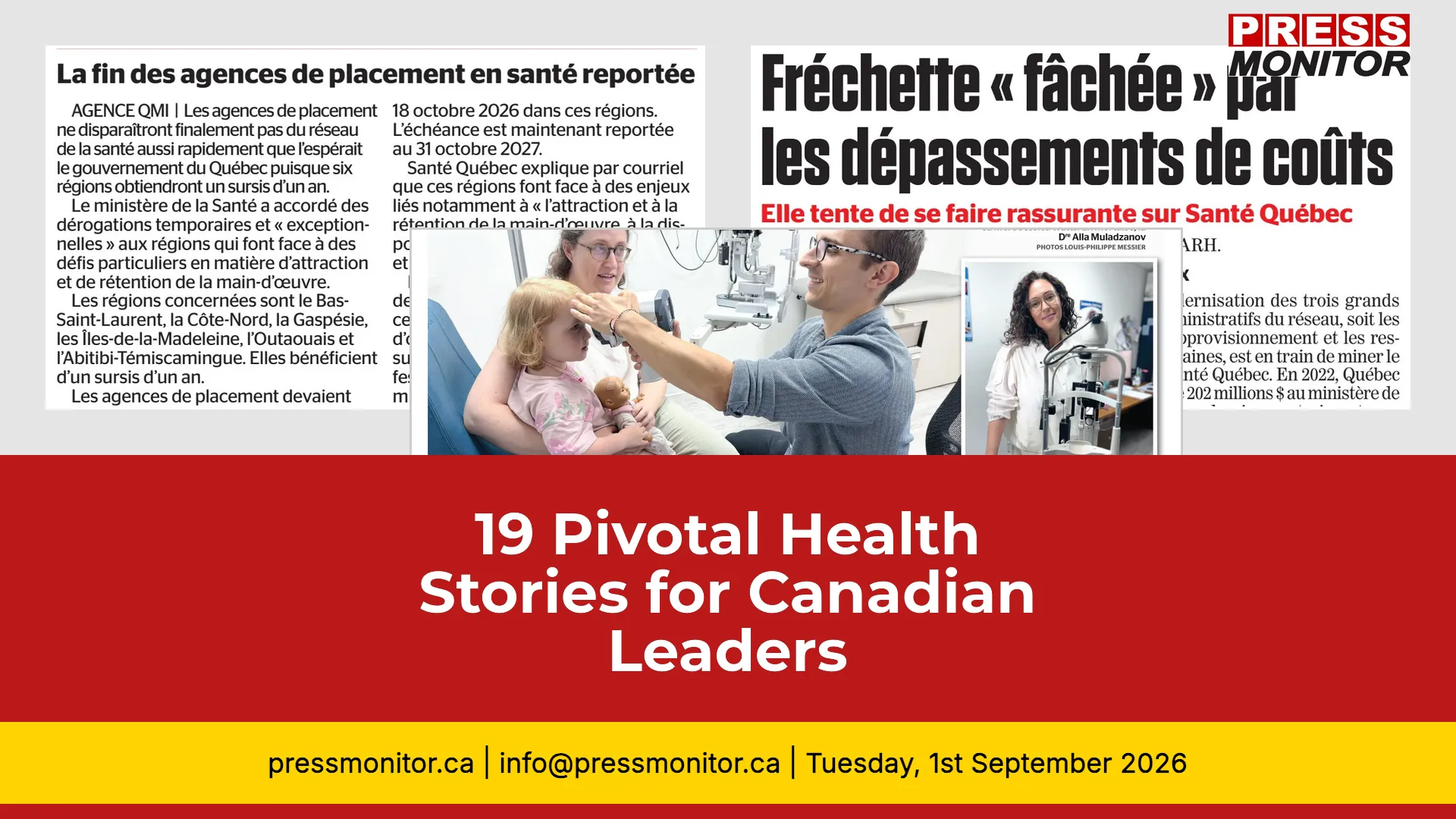
Tracking real-time shifts in Canadian healthcare requires rigorous print media monitoring. According to Press Monitor's tracking of Canadian publications, today's landscape reveals critical policy debates, operational challenges, and clinical innovations shaping patient outcomes nationwide. This press review synthesizes verified reporting into actionable media intelligence for decision-makers.
1. Placement Agencies Reprieve Extended
Le Journal de Montreal reports that the Quebec government has granted a one-year reprieve to six specific regions for health placement agencies. The cutoff initially scheduled for October 2026 is postponed to October 2027 due to challenges in attracting and retaining skilled workers.
Why it matters: Workforce retention remains the backbone of accessible care across rural and remote regions.
Key detail: Six Quebec regions receive a one-year extension until October 2027 for health placement agencies due to recruitment bottlenecks.
Source: Le Journal de Montreal
Next step: Evaluate regional staffing strategies and align procurement timelines with the new deadline.
2. Digital Transformation Cost Overruns
Le Journal de Montreal rapporte que le gouvernement du Québec a dépensé près de 500 millions en trois ans pour maintenir les vieux systèmes de gestion des ressources humaines du réseau de la santé, alors que leur remplacement a été mis sur la glace.
Why it matters: IT infrastructure failures directly delay patient data accessibility and administrative efficiency.
Key detail: Nearly $500 million spent over three years maintaining legacy HR systems while replacements remain stalled.
Source: Le Journal de Montreal
Next step: Audit current vendor contracts and prioritize phased migration to modernized health information platforms.
3. Pediatric Eye Clinic Expands Access
Le Journal de Montreal reports that a Montreal ophthalmology clinic has decided to welcome young patients since March as it covers consultations by the public regime. Many children are waiting for years in pediatric ophthalmology queues while their cases could be effectively treated by optometrists.
Why it matters: Reducing specialist waitlists improves early intervention rates for childhood vision development.
Key detail: Montreal clinic accepts young patients under the public regime since March, bypassing multi-year queues.
Source: Le Journal de Montreal
Next step: Monitor referral patterns and assess scalability for other underserved pediatric specialties.
4. Dual Practice Proposal Sparks Debate
Le Journal de Quebec reports that Quebec’s outgoing first minister is considering a proposal to allow some doctors to practice in both the public and private systems simultaneously if the Coalition Avenir Québec (CAQ) wins re-election. The author argues that this policy would accelerate the departure of medical and nursing staff from the public network, leading to a severe collapse of the public health system.
Why it matters: Balancing public and private sector roles impacts workforce distribution and system sustainability.
Key detail: Outgoing premier considers allowing physicians to practice in both sectors simultaneously if re-elected.
Source: Le Journal de Quebec
Next step: Track legislative proposals and prepare stakeholder briefings on potential regulatory adjustments.
5. CAQ vs PQ Clash Over Privatization
Montreal Gazette reports that Parti Québécois leader Paul St-Pierre Plamondon accused the Coalition Avenir Québec of losing control of the bureaucracy, while CAQ health minister Sonia Bélanger defended Santé Québec amid reports of budget overruns. The discussions focused on healthcare policy and infrastructure.
Why it matters: Political alignment dictates funding priorities and healthcare delivery models for the next term.
Key detail: Parti Québécois leader accuses government of losing bureaucratic control amid reported budget overruns.
Source: Montreal Gazette
Next step: Align internal communications with emerging policy directions and prepare scenario planning.
6. Poverty Stress Impacts Brain Health
Le stress lié à la pauvreté peut causer des dommages durables au cerveau, selon une nouvelle étude. Des scientifiques britanniques ont examiné un groupe de plus de 27OO personnes nées en mars 1946, elles ont donc aujourd’hui 80 ans, qui ont accepté que leur état de santé et leurs conditions sociales soient suivis pendant des années.
Why it matters: Socioeconomic determinants require integrated public health interventions beyond clinical settings.
Key detail: British longitudinal study confirms lasting cognitive damage from chronic financial stress in aging cohorts.
Source: Le Journal de Quebec
Next step: Integrate social risk screening into primary care workflows and community outreach programs.
7. Peer Support Transforms Addiction Care
The Globe and Mail reports that a new pilot project at St. Joseph’s Healthcare in Hamilton is utilizing peer support teams to improve care for patients battling substance use. Funded by a $4.3 million grant from Health Canada, the initiative has logged over 14,000 patient interactions since its launch in March 2025.
Why it matters: Lived-experience integration reduces relapse rates and improves patient engagement in recovery.
Key detail: St. Joseph’s Healthcare pilot logs over 14,000 interactions since March 2025, backed by $4.3 million in federal funding.
Source: The Globe and Mail
Next step: Scale peer support frameworks across acute care units and track outcome metrics.
8. Tick-Borne Disease Awareness Campaign
Le Journal de Montreal reports that the presence of Lyme disease-carrying ticks in Quebec is increasing, leading to higher cases reported in recent years. There are several ways to reduce the risk of infection, even in case of a tick bite. Lyme disease is transmitted only through the bite of a tick carrying the disease. In Quebec, only one species, the black-legged tick (Ixodes scapularis), can carry it. The risk of infection increases with the number of hours the tick is attached to the skin, especially beyond 24 hours. Therefore, it is suggested to examine the skin after outdoor activities, as prompt removal of the tick reduces the risk of infection.
Why it matters: Climate-driven vector expansion increases Lyme disease incidence across southern provinces.
Key detail: Black-legged tick presence rises; infection risk spikes significantly after 24-hour attachment.
Source: Le Journal de Montreal
Next step: Distribute prevention guidelines to outdoor recreation groups and update clinic triage protocols.
9. Dementia Community Connect Event
Cape Breton Post reports that ConnectionMatters will take place on September twentieth at the New Waterford Community Wellness Centre. The free event, hosted by the Alzheimer Society of Nova Scotia, connects people living with dementia, caregivers, and service providers to share information and access resources.
Why it matters: Caregiver isolation drives systemic burnout and delayed diagnosis referrals.
Key detail: Free September 20 gathering in New Waterford links patients, caregivers, and service providers.
Source: Cape Breton Post
Next step: Partner with Alzheimer Society chapters to host localized resource mapping sessions.
10. Health Commissioner Dismissal Recommended
Le Journal de Montreal rapporte qu'une enquête interne recommande de limoger la commissaire à la santé et au bien-être en raison de contrats octroyés à un proche.
Why it matters: Ethical oversight ensures public trust in institutional leadership and contract management.
Key detail: Internal probe recommends removal following conflicts tied to awarded vendor agreements.
Source: Le Journal de Montreal
Next step: Strengthen conflict-of-interest disclosures and implement third-party audit cycles.
11. Financial Planning for Caregivers
The Globe and Mail reports that caregiving for family members has a significant emotional and financial impact. As costs of care rise and more Canadians become caregivers, financial advisers are crucial in helping clients navigate the responsibilities and challenges of caregiving.
Why it matters: Uncompensated family caregiving strains household liquidity and retirement security.
Key detail: Rising care costs necessitate structured financial advising for middle-income families.
Source: The Globe and Mail
Next step: Develop client workshops on tax credits, leave policies, and long-term care funding options.
12. Alberta Care Workers Threaten Strike
Calgary Sun reports that the Alberta Union of Provincial Employees said Monday that 157 of its member groups are still in talks with care providers, after years of bargaining in some cases.
Why it matters: Labor disputes in provincial health services disrupt continuity of care and emergency readiness.
Key detail: 157 member groups remain in negotiations after prolonged bargaining cycles.
Source: Calgary Sun
Next step: Review collective agreement benchmarks and prepare contingency staffing rosters.
13. Firefighter Fitness & Mental Resilience
The Chronicle Herald reports that firefighters from across Nova Scotia competed in a rigorous physical challenge involving gear carries, weight lifting, and obstacle courses. Organizer Nathan Smith emphasized that the event promotes both physical and mental health to help first responders manage stress and PTSD.
Why it matters: Physical conditioning correlates with reduced PTSD prevalence and faster incident response.
Key detail: Nova Scotia competitors tackle gear carries and obstacle courses to build stress tolerance.
Source: The Chronicle Herald
Next step: Adopt standardized wellness metrics for first responder departments and track participation rates.
14. Jamieson Wellness Tender Rating Upgrade
The Globe And Mail reports that National Bank Financial analyst Nathan Po believes it is unlikely another bid will emerge to rival Kirin Holdings Co.’s $2.5-billion all-cash offer for Jamieson Wellness Inc. Accordingly, he moved his rating for the Toronto-based natural health products company to “tender” from “outperform” previously.
Why it matters: M&A activity signals consolidation trends in natural health products and retail pharmacy.
Key detail: National Bank moves rating to tender following Kirin Holdings’ $2.5 billion all-cash offer.
Source: The Globe and Mail
Next step: Monitor shareholder approvals and assess supply chain integration implications.
15. E-Scooter Injury Surge Demands Policy
The Hamilton Spectator reports that a co-ordinated strategy is needed to address the danger of e-scooters after a dramatic increase in emergency room visits related to injuries at McMaster Children's Hospital.
Why it matters: Micromobility safety gaps overwhelm pediatric emergency departments.
Key detail: McMaster Children’s Hospital reports dramatic ER visit increases, prompting calls for coordinated municipal strategy.
Source: The Hamilton Spectator
Next step: Advocate for designated lanes, speed limits, and helmet enforcement ordinances.
16. Timmins Kidney Walk Fundraiser
The Daily Press reports that the annual Timmins-Porcupine Kidney Walk will take place on September 27 at the Gillies Lake Conservation Area. The event supports The Kidney Foundation, which aims to reach a one million Canadian dollar fundraising milestone to support kidney research and patient services.
Why it matters: Community-driven campaigns sustain vital research and patient navigation services.
Key detail: September 27 event aims to reach $1 million milestone for kidney foundation initiatives.
Source: The Daily Press
Next step: Secure corporate sponsorships and organize workplace donation drives ahead of race day.
17. Dauphin Emergency Department Reopens
The Winnipeg Sun reports that emergency services are set to return to Dauphin Regional Health Centre on Sept. 7 as restoration work continues following extensive flood damage.
Why it matters: Infrastructure restoration restores critical access for northern Manitoba communities.
Key detail: Services return September 7 following extensive flood damage repairs.
Source: Winnipeg Sun
Next step: Verify equipment calibration and conduct staff readiness drills before public launch.
18. Ontario Leadership Scrutinized
The Hamilton Spectator reports that Doug Ford's admiration for Donald Trump and his controversial policies are under scrutiny. Ford's support for Trump, attempts to privatize health care and education, underfunding these sectors, and his business dealings are highlighted as key issues.
Why it matters: Executive policy direction influences provincial health funding allocations and privatization efforts.
Key detail: Premier faces criticism over education and healthcare underfunding alongside foreign political alignments.
Source: The Hamilton Spectator
Next step: Prepare transparent messaging on service delivery commitments and budget reallocations.
19. Domestic Violence as Public Health Crisis
Winnipeg Sun reports that domestic abuse is a public health crisis in Canada. The author shares a personal story of her mother's struggle and murder, highlighting the inadequacies of the justice system and the need for more support for survivors.
Why it matters: Systemic gaps in survivor support perpetuate cycles of trauma and justice delays.
Key detail: Advocates emphasize need for expanded counseling, legal aid, and interagency coordination.
Source: Winnipeg Sun
Next step: Fund trauma-informed training for frontline workers and expand shelter capacity partnerships.
These developments underscore why proactive print media monitoring remains essential for navigating complex healthcare landscapes. Which of these operational shifts will your organization address first?
