19 Pivotal Health Stories for Healthcare Executives


Navigating today’s healthcare landscape requires sharp media monitoring to catch policy shifts, clinical breakthroughs, and public health alerts before they trend. This press review distills 19 pivotal developments from Canadian print outlets into actionable insights for hospital leaders, policymakers, and industry analysts. According to Press Monitor's tracking of Canadian publications, leveraging robust media intelligence ensures you act on news on health before competitors do. Here is what demands your attention today.
1. Niagara Hospital construction hits three-year mark
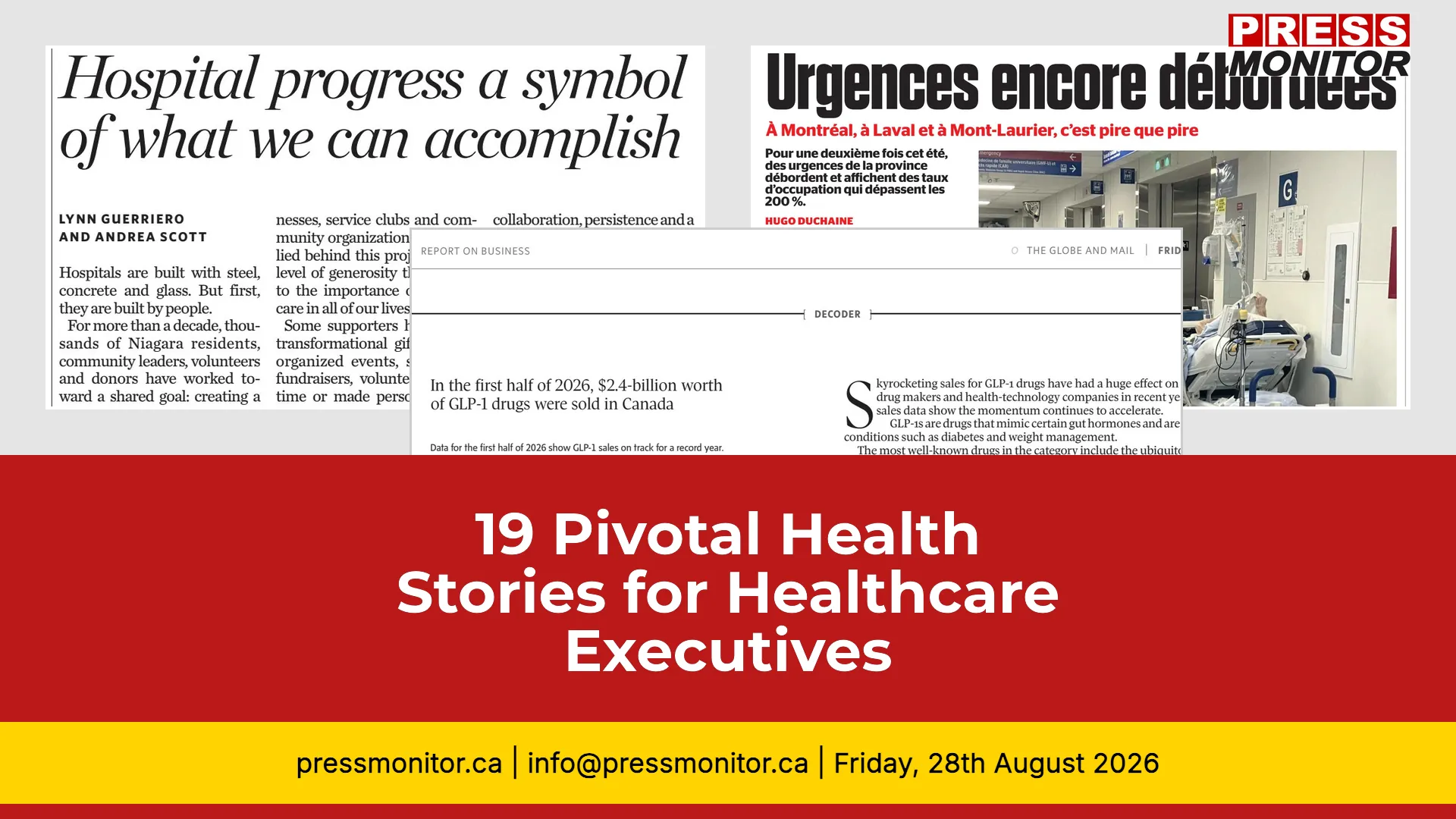
The Standard (st. Catharines) reports that the south Niagara hospital project has reached its three-year construction milestone, with the building now standing 12 storeys high. More than 1,100 donors have contributed over C$75 million through the Niagara Health Foundation's campaign to support the new regional centre of excellence.
Why it matters: Community-funded infrastructure projects signal strong regional health capacity expansion.
Key detail: Building stands 12 storeys high; over 1,100 donors contributed C$75 million through the Niagara Health Foundation.
Source: The Standard (st. Catharines)
Next step: Track local philanthropy trends for future capital campaigns.
2. Quebec ERs exceed 200% occupancy
Le Journal de Montréal reports that emergency rooms across Quebec are overflowing for the second time this summer, with occupancy rates exceeding 200 percent. Dr. Gilbert Boucher and Dr. Marie-Maud Couture attribute the crisis to deficient access to primary care and clinic closures during vacations.
Why it matters: System-wide capacity strain highlights primary care access gaps.
Key detail: Occupancy rates surpass 200% for the second summer; attributed to clinic closures and delayed primary referrals.
Source: Le Journal de Montreal
Next step: Review patient flow protocols and community clinic partnerships.
3. GLP-1 Drug Sales Surge in Canada
The Globe and Mail reports that in the first half of 2O26, $2.4-billion worth of GLP-l drugs were sold in Canada. Ozempic, Wegovy, Mounjaro, and Zepbound are on track for a record year with sales nearly reaching $5B in 2O26.
Why it matters: Record pharmaceutical spending impacts insurance formularies and public health budgets.
Key detail: $2.4 billion sold in H1 2026; Ozempic, Wegovy, Mounjaro, and Zepbound on track for nearly $5B annual sales.
Source: The Globe And Mail
Next step: Assess formulary impact and patient access strategies.
4. U.S. Vaccine Rhetoric Sparks B.C. Health Alarm on Measles Clusters
The Times Colonist reports that British Columbia authorities say U.S. President Donald Trump's recent executive order recommending splitting the measles, mumps, and rubella (MMR) vaccine is exacerbating fears around proven vaccines protecting public health. Provincial Health Minister Ravi Kahlon and Health Officer Dr. Bonnie Henry warned that concerning measles resurgences—including a June cluster of cases in northeastern B.C.—stem from declining vaccination rates fueled by America’s vaccine skepticism.
Why it matters: Cross-border political discourse directly influences domestic vaccination confidence.
Key detail: Provincial officials warn that U.S. executive orders splitting MMR vaccines fuel skepticism, correlating with recent measles clusters in northeastern B.C.
Source: Times Colonist
Next step: Strengthen public communication around vaccine safety and herd immunity.
5. Kardium Gets Federal Funding Boost
The Globe And Mail reports that Kardium Inc., one of Canada’s most promising medical-device developers, is getting a $31.25-million funding boost from the federal government to expand its manufacturing capabilities in the greater Vancouver area.
Why it matters: Domestic medtech manufacturing gains critical scale amid global supply chain shifts.
Key detail: $31.25 million federal investment expands Vancouver-area production capabilities.
Source: The Globe And Mail
Next step: Explore procurement opportunities and innovation partnerships.
6. 64 researchers to receive $504M
The Globe And Mail reports that the federal government has awarded $504-million in federal funding over eight years to sixty-four researchers from thirteen countries, including the United States, through the Canada Global Impact Research Talent Initiative. The program, known as the Goldenberg Research Chairs of Canada, aims to attract global talent amid political uncertainty in the United States.
Why it matters: Global talent attraction program positions Canada as a research hub amid U.S. uncertainty.
Key detail: Goldberg Research Chairs fund 64 scientists across 13 countries over eight years.
Source: The Globe And Mail
Next step: Align institutional recruitment with federal grant cycles.
7. Légionellose à Toronto
Radio-canada Info rapporte que les autorités de santé publique de Toronto ont identifié une tour de refroidissement de la Commission de transport de Toronto (CTT) comme étant à l'origine d'une récente épidémie de légionellose.
Why it matters: Environmental health hazards require rapid municipal coordination.
Key detail: TTC cooling tower identified as source of recent legionellosis outbreak.
Source: Radio-canada Info
Next step: Audit facility water systems and emergency response timelines.
8. Deaths in provincial custody raise alarm
The Chronicle Herald reports that deaths in provincial custody in Nova Scotia have been on the rise with four this year, leading to concerns over the quality of care given to those in custody. A study by Laura Beach from Carleton University found the health-care system behind bars to be grossly inadequate and a major contributing factor to deaths in custody.
Why it matters: Correctional health service delivery faces systemic scrutiny.
Key detail: Four custodial deaths this year in Nova Scotia; Carleton University study cites inconsistent assessments and long wait times.
Source: The Chronicle Herald
Next step: Review inmate health screening protocols and mental health support.
9. Two New Researchers Join University of Victoria
The Times Colonist reports that two new researchers are coming to the University of Victoria thanks to $16 million in federal funding announced Thursday as part of a national research initiative.
Why it matters: Targeted federal funding accelerates climate and ocean science leadership.
Key detail: $16 million national initiative brings two new faculty members to UVic.
Source: Times Colonist
Next step: Foster interdisciplinary grants between environmental and health sciences.
10. Women’s Mental and Brain Health
The Globe and Mail reports that women’s mental and brain health is under pressure across Canada, due in part to cognitive load and caregiving pressures, hormonal transitions, job-related stress and burnout. The challenge is even sharper for women who are part of marginalized groups and those with lower socioeconomic standing. What solutions and approaches will close the gaps in prevention, awareness and care?
Why it matters: Gender-specific cognitive load and burnout require tailored clinical pathways.
Key detail: Marginalized women face compounded stressors; experts call for gap-closing prevention models.
Source: The Globe And Mail
Next step: Implement gender-responsive care frameworks in primary settings.
11. Second free foot-care clinic
Saskatoon nurse Maddie Brown runs a free foot-care clinic for unhoused people, aiming to prevent emergencies through better foot care and Narcan administration.
Why it matters: Community-led preventative care reduces emergency department burden.
Key detail: Saskatoon nurse Maddie Brown provides podiatry and Narcan administration to unhoused residents.
Source: Saskatoon Starphoenix
Next step: Support mobile outreach programs and harm reduction integration.
12. Family Sees Improvement for Psychiatric Patient Through Routine Care
"Selon Toronto Star, changes to Andrew Azevedo’s care plan at the psychiatric hospital have aided his improvement, including routine showering, exercise and spending time outdoors," reports the Toronto Star. The family believes these adjustments have significantly improved his well-being. Azevedo, who had previously experienced difficulties with his care, is now showing positive results thanks to a structured daily routine that focuses on physical and social engagement. The hospital staff have focused on providing basic, supportive care which appears to have made a notable difference in his overall health.
Why it matters: Structured daily engagement outperforms pharmacological-only approaches.
Key detail: Andrew Azevedo’s recovery improved significantly with routine showering, exercise, and outdoor time.
Source: Toronto Star
Next step: Standardize behavioral activation in psychiatric ward schedules.
13. Illicit Nicotine Pouch Market Booms in Canada
"Selon le Regina Leader-post, un circuit routier à travers le pays a révélé un marché illégal florissant de paquets de nicotine, dont la plupart étaient contrefaits et contenaient des concentrations allant jusqu'à 50 mg. Papaioannoy, 53 ans, a eu une expérience particulièrement instructive lorsqu'un détaillant du Saskatchewan a refusé de vendre ses paquets de nicotine cachés. Malgré ce refus, un jeune homme a pu en acheter sur place. En outre, les pharmacies se sont avérées plus difficiles à trouver que les magasins de convenance et les boutiques de vapotage dans les zones rurales et éloignées, réduisant les options de nicotine sûres pour certains Canadiens."
Why it matters: Unregulated consumer products challenge public health regulations.
Key detail: Counterfeit pouches contain up to 50 mg nicotine; rural pharmacies struggle to compete with convenience stores.
Source: Regina Leader-post
Next step: Monitor regulatory enforcement and consumer education campaigns.
14. Pickleball Tournament to Fund Shoreline Medical Society
The Times Colonist reports that the Shoreline Medical Society will host a pickleball tournament in September to raise funds. The event, called the Pickles for Patients Charity Classic, will take place at Centennial Park Multi-Sport Box in Saanichton from September 18 to 20. The tournament aims to support doctor recruitment and retention, the Doctor of the Day program at Saanich Peninsula Hospital, and the medical society’s youth clinic.
Why it matters: Grassroots fundraising sustains rural doctor recruitment and youth clinics.
Key detail: Pickles for Patients Charity Classic raises funds for Saanich Peninsula Hospital staff retention.
Source: Times Colonist
Next step: Partner with local sports leagues for health sector sponsorships.
15. MP Jamil Jivani uses Zyn canisters
National Post reports that Omomal MP Jamil Jivani, an advocate for loosening restrictions, has been particularly visible with his support for nicotine pouches. He signed Zyn canisters during a tour of college campuses, prompting discussion about the culture around these products and the stance government should take.
Why it matters: Political visibility shapes public perception of novel nicotine alternatives.
Key detail: Omomal MP signs Zyn cans on college campuses, sparking debate on restriction policies.
Source: Regina Leader-post
Next step: Track legislative shifts around tobacco control and harm reduction.
16. Mobile Medical Supply Expands Delivery Services
The Vancouéréria medical supply company, Vancouéréria 3534 Quadra St, near Cloverdale, announces its mobile service expansion within the Greater Victoria area for home medical equipment and supplies.
Why it matters: Last-mile logistics improve home-based chronic disease management.
Key detail: Vancouéréria extends mobile equipment delivery across Greater Victoria.
Source: Times Colonist
Next step: Evaluate telehealth integration with physical supply networks.
17. Canada declines pandemic management inquiry
Radio-canada Info reports that there will be no public inquiry into the management of the pandemic in Canada. Experts express concern that the country may repeat previous mistakes without a formal investigation.
Why it matters: Absence of formal review may limit systemic preparedness improvements.
Key detail: Experts warn against repeating past failures without transparent investigation.
Source: Radio-canada Info
Next step: Advocate for internal audit mechanisms and continuous quality improvement.
18. Crisis des surdoses oubliée
Radio-canada Info reports that a long-time activist, Garth Mullins, deplores what he sees as a weakening of public policies to prevent drug users from dying unnecessarily in British Columbia. According to the British Columbia Coroners Service, 138 people died from overdoses in the province in June, slightly higher than May but a decrease compared to June 2025.
Why it matters: Stagnant overdose prevention policies risk reversing recent mortality declines.
Key detail: BC activist Garth Mullins warns of weakened safeguards despite June death counts remaining stable.
Source: Radio-canada Info
Next step: Reinvest in supervised consumption sites and naloxone distribution.
19. CTE Study Finds At Least One In Four Deceased NFL Players Examined
The study reports that at least one in four now-deceased NFL players examined had CTE, a degenerative brain disease linked to repeated head impacts. While the research focuses on retired players, experts caution against direct extrapolation to active or currently retired players.
Why it matters: Neurodegenerative research informs athlete safety standards and liability frameworks.
Key detail: Autopsy findings confirm CTE in 25% of examined former players; experts caution against overgeneralization.
Source: Winnipeg Sun
Next step: Update concussion protocols and fund longitudinal brain health studies.
Closing: How will your organization adapt to these shifting health priorities? Share your strategy below. This print media monitoring roundup proves that grounded editorial data drives better decisions. Tracked by Press Monitor.
