21 Essential Health Stories for Healthcare Leaders


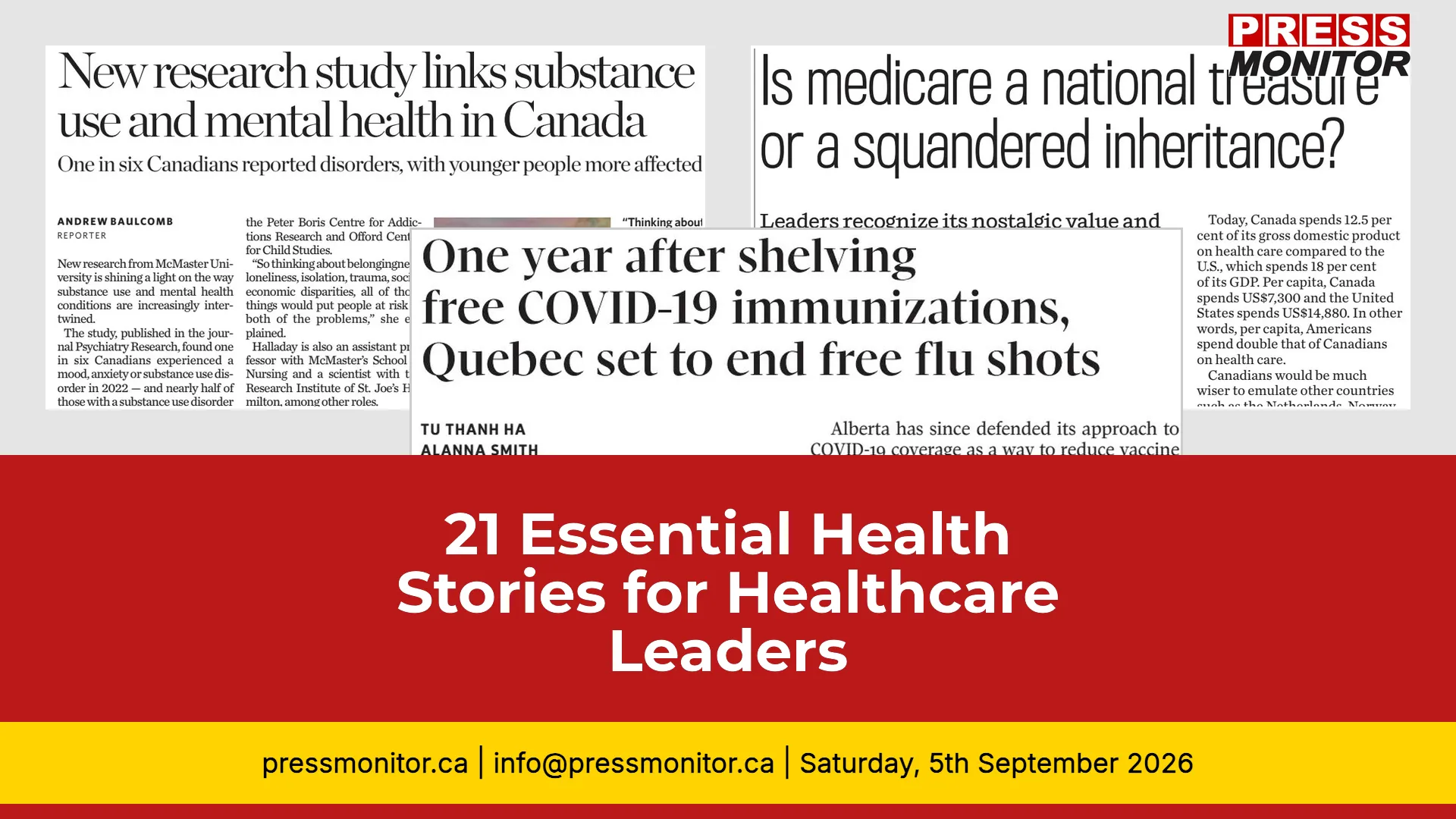
According to Press Monitor's tracking of Canadian publications, today's health landscape spans Medicare reform, mental health research, long-term care labor disputes, and medical breakthroughs from coast to coast. This print media monitoring review delivers the news on healthcare that matters most for leaders, policymakers, and practitioners. Here are the 21 stories shaping the health conversation in Canada and beyond.
1. McMaster Study Reveals One in Six Canadians Face Mental Health and Substance Use Disorders
{source_name} reports that new research from McMaster University found one in six Canadians experienced a mood, anxiety or substance use disorder in 2022. The study, published in Psychiatry Research, revealed that nearly half of those with a substance use disorder also had a mood or anxiety condition. Lead author Jillian Halladay emphasized the need to integrate mental health and substance use services, especially for youth and females disproportionately affected.
Why it matters: This research from McMaster University, published in Psychiatry Research, is the most comprehensive look at co-occurring disorders in Canada and demands integrated service delivery. Media intelligence from this study reveals that nearly half of those with a substance use disorder also have a mood or anxiety condition, disproportionately affecting youth and females.
Key detail/stat: One in six Canadians experienced a mood, anxiety, or substance use disorder in 2022.
Source: The Hamilton Spectator, The Standard (St. Catharines)
Next step: Health systems should use this data to advocate for unified mental health and substance use funding models.
2. Medicare at Risk of Becoming a Squandered Inheritance
Regina Leader-post reports that medicare, a single-payer system fundamental to Canadians, is at risk of being a squandered inheritance due to outdated systems and government inaction. Ken Fyke, a former deputy minister of health, argues that reform is needed to provide timely service without surrendering medicare to the private market. He points to countries like the Netherlands and Norway as models for modernizing health care with public funding and regulated private markets.
Why it matters: Former Saskatchewan deputy minister Ken Fyke warns that outdated systems and government inaction threaten the single-payer model Canadians rely on. This press review highlights the urgent need for reform before private market pressures erode universal coverage.
Key detail/stat: Fyke points to the Netherlands and Norway as models for modernizing health care with public funding and regulated private markets.
Source: Regina Leader-post
Next step: Policymakers should use media monitoring of Canadian publications to track reform proposals before they reach the ballot box.
3. Quebec to End Free Flu Shots for Entire Population
The Globe And Mail (ottawa/quebec Edition) reports that Quebec will end free flu shots for its entire population this fall, one year after it stopped offering free COVID-19 vaccinations to everyone. The Quebec Health Department said the change follows guidance from the province’s Immunization Committee to align flu and COVID-19 vaccination eligibility while keeping COVID-19 shots for higher-risk groups.
Why it matters: Quebec's decision to align flu vaccination eligibility with COVID-19 guidance signals a shift in public health resource allocation that other provinces may follow.
Key detail/stat: The change follows guidance from the province's Immunization Committee, keeping COVID-19 shots for higher-risk groups only.
Source: The Globe and Mail (Ottawa/Quebec Edition)
Next step: Watch for similar policy shifts in other provinces as health departments reassess universal vaccination programs.
4. Father Follows Son Through Nova Scotia's Mental Health and Justice System
The Chronicle Herald reports that September is Polish Heritage Month in Nova Scotia. Everyone is warmly welcome to the many activities planned. More information is available at PolishMonthNovaScotia.ca.
Why it matters: This heartbreaking account exposes systemic failures in involuntary psychiatric treatment and the gaps between charter rights protections and the need for care.
Key detail/stat: The son cycles between involuntary treatment, homelessness, and the criminal justice system due to administrative errors under the Involuntary Psychiatric Treatment Act.
Source: The Chronicle Herald (Halifax)
Next step: Nova Scotia health authorities should review the Involuntary Psychiatric Treatment Act for administrative reform.
5. 86 Percent of Saskatchewan Residents Support Social Media Limits for Children
Saskatoon Starphoenix reports that a Saskatchewan government survey found 86 percent of respondents support social media limits for children under 16, with a majority favouring restrictions for youth aged 16 and under. The results were sent to the federal government during a Regina news conference on Thursday, where Mental Health and Addictions Minister Lori Carr said the province does not plan to impose its own restrictions.
Why it matters: This overwhelming public consensus puts pressure on the federal government to act, even as the province itself declines to impose its own restrictions.
Key detail/stat: Mental Health and Addictions Minister Lori Carr sent results to the federal government during a Regina news conference.
Source: Saskatoon StarPhoenix
Next step: Federal legislators should treat this survey data as a mandate for the Safe Social Media Act.
6. Soul Journeys Restorative Healing Opens in Hamilton
The Hamilton Spectator reports that Sarah, co-founder of Soul Journeys Restorative Healing, has opened a new wellness centre in Hamilton, Ontario. Founded with the support of her mother Cindi and daughter Emma, the centre welcomes beginners and focuses on restorative healing rooted in family and spiritual growth. Sarah emphasizes that people do not need to be experts to begin their wellness journey.
Why it matters: A new wellness centre rooted in family and spiritual growth fills a gap in Hamilton's holistic health offerings, welcoming beginners without requiring expertise.
Key detail/stat: Founded by Sarah with support from her mother Cindi and daughter Emma.
Source: The Hamilton Spectator
Next step: Community health planners should consider integrating restorative healing models into public health programming.
7. British Columbia School Districts Ban Electric Bikes and Scooters
The Globe And Mail (ottawa/quebec Edition) reports that more British Columbia school districts are banning electric bikes and scooters from their properties, including the Langley School District and Nanaimo-Ladysmith school district, ahead of the new school year. The districts cite a spike in injuries among underage riders, with BC Children's Hospital trauma medical director Dr. Genevieve Ernst noting a steep rise in emergency room visits and brain injuries for child patients. Data shows 81 visits to BC Children's emergency department between April 2025 and 2026, more than double the previous year, with most resulting from falling off scooters, and more than half of seriously injured patients not wearing helmets.
Why it matters: A spike in child injuries — with BC Children's Hospital seeing more than double the ER visits year-over-year — has prompted school districts to act before the new school year.
Key detail/stat: 81 visits to BC Children's emergency department between April 2025 and 2026, more than half of seriously injured patients not wearing helmets.
Source: The Globe and Mail (Ottawa/Quebec Edition)
Next step: Other provinces should consider similar safety regulations for micro-mobility devices on school grounds.
8. Invasive Mosquito Species Threatens African Megacities
The Hamilton Spectator reports that an invasive, malaria-carrying, insecticide-resistant mosquito called Anopheles stephensi is spreading rapidly across Africa and may be impossible to contain. A new genomic analysis led by Tristan Dennis at the University of Queensland shows the mosquito has genetic resistance to all current chemicals and thrives in urban areas, threatening megacities like Lagos and Kinshasa. Djibouti saw malaria cases surge from 27 in 2012 to over 70,000 in 2020 after the mosquito arrived in 2013, while United States funding cuts have reduced malaria-control budgets by a third or more in high-prevalence countries.
Why it matters: Anopheles stephensi, carrying malaria and resistant to all current insecticides, may be impossible to contain and threatens urban populations across Africa.
Key detail/stat: Djibouti saw malaria cases surge from 27 in 2012 to over 70,000 in 2020 after the mosquito arrived in 2013.
Source: The Hamilton Spectator
Next step: Global health organizations should reassess malaria-control budgets in light of US funding cuts.
9. Kyrgyzstan Faces Growing Crisis of Botched Cosmetic Surgery
Saskatoon Starphoenix reports that Diana Tergenbayeva suffered severe swelling and an open wound after a botched breast lift surgery in Kyrgyzstan. Around forty patients had lodged complaints against her surgeon, who was detained for smuggling medications but later released. The case highlights a growing trend of failed cosmetic procedures in Central Asia driven by social media and a lack of state regulation.
Why it matters: The case of Diana Tergenbayeva highlights a dangerous trend of unregulated cosmetic procedures in Central Asia driven by social media demand.
Key detail/stat: Around forty patients had lodged complaints against the surgeon, who was detained for smuggling medications.
Source: Saskatoon StarPhoenix
Next step: International health regulators should consider cross-border oversight of medical tourism.
10. Canadian Courage Project Expands Support for Homeless Youth in Toronto
The Globe And Mail (ottawa/quebec Edition) reports that sisters Shania and Anya Bhopa launched the Canadian Courage Project in two thousand and twenty, providing healthcare and support services to homeless youth. The project recently partnered with Friends of Ruby, a Toronto shelter for two-spirit, lesbian, gay, bisexual, transgender, queer, intersex, and asexual young people, opening the Jade Health and Wellness Room funded by approximately twenty thousand Canadian dollars from Telus Health.
Why it matters: The partnership with Friends of Ruby and funding from Telus Health demonstrates how targeted health interventions can reach vulnerable populations.
Key detail/stat: The Jade Health and Wellness Room was funded by approximately $20,000 from Telus Health.
Source: The Globe and Mail (Ottawa/Quebec Edition)
Next step: Other cities should replicate this model of nonprofit-healthcare partnerships for homeless youth.
11. Elizabeth Manley Champions Mental Health at St. Joseph's Healthcare Foundation
The Hamilton Spectator reports that Olympic figure skater Elizabeth Manley will headline A Mental Health Morning at St. Joseph's Healthcare Foundation in Hamilton on October 6, sharing her personal experience with anxiety and depression that was censored during the 1988 Olympics. The annual event has raised over $610,000 in the past 13 years to support the hospital's mental health and addictions program, which serves more than 30,000 new patients annually. Tickets are $50 per person and the 2026 Spirit of Hope Awards will also be presented at the event.
Why it matters: The Olympic figure skater's personal story of anxiety and depression, censored during the 1988 Olympics, draws attention to the stigma that still surrounds mental health.
Key detail/stat: The annual event has raised over $610,000 in 13 years, supporting a program serving more than 30,000 new patients annually.
Source: The Hamilton Spectator
Next step: Corporate sponsors should increase investment in hospital mental health fundraising events.
12. HealthView Medical Imaging Offers Ultrasound Appointments in Halifax
The Chronicle Herald reports that HealthView Medical Imaging in Halifax is advertising ultrasound appointments available now. The clinic at 255 Lacewood Drive, Suite 100A, says its highly trained staff use advanced ultrasound imaging technology and enhanced health and safety standards, with reports available within five days. Free on-site parking is also advertised.
Why it matters: A new clinic offering advanced ultrasound imaging with five-day report turnaround and free parking addresses diagnostic access gaps in Nova Scotia.
Key detail/stat: Located at 255 Lacewood Drive, Suite 100A, Halifax.
Source: The Chronicle Herald (Halifax)
Next step: Patients in Halifax should consider HealthView for faster diagnostic imaging access.
13. SPRIND Funds 376 Innovation Teams Across Europe
The Hamilton Spectator reports that C3 Biotech in Stockport, England, received a grant from Germany's Federal Agency for Breakthrough Innovation (SPRIND) to develop a cheap method to convert agricultural waste into acrylic glass. SPRIND, which started in early 2020, has received 4,740 submissions and funded 376 teams across Europe. The agency aims to prove that governments can fund ambitious, cutting-edge ventures quickly and across national borders.
Why it matters: Germany's Federal Agency for Breakthrough Innovation demonstrates that governments can fund ambitious, cross-border ventures quickly — a model Canadian agencies could emulate.
Key detail/stat: C3 Biotech in Stockport received a grant to convert agricultural waste into acrylic glass; 4,740 submissions funded 376 teams since early 2020.
Source: The Hamilton Spectator
Next step: Canadian innovation agencies should study SPRIND's cross-border funding model for domestic health tech.
14. 200 Long-Term Care Workers at Extendicare Timmins Demand Fair Collective Agreement
The Daily Press reports that 200 long-term care workers at Extendicare Timmins have been without a collective agreement since December 2025 and demonstrated outside the facility on Thursday to protest delays in contract negotiations. CUPE Local 3127 president Casey Fortin said the employer walked away from the bargaining table in June 2025 and workers are demanding wages that match private long-term care sector standards, while Extendicare stated it remains committed to meaningful engagement.
Why it matters: After eight months without a contract, CUPE Local 3127 members are escalating pressure as the facility operates with 298 people on a waiting list for 180 licensed beds.
Key detail/stat: Workers held a province-wide day of action; CUPE says the employer walked away from bargaining in June 2025.
Source: The Daily Press (Timmins)
Next step: Ontario's government should intervene in long-term care labour disputes to protect vulnerable residents.
15. Dr Walter Peters, Distinguished Plastic Surgeon and Researcher, Dies at 82
The Globe And Mail (ottawa/quebec Edition) reports that Dr Walter Wally Joseph Peters, a distinguished plastic surgeon and researcher, has passed away. He was born in British Columbia and spent his career at the University of Toronto and Toronto General Hospital, where he developed the Burn Unit. His legacy includes over 160 peer-reviewed publications, five million dollars in research grants, and decades of mentorship in the medical field.
Why it matters: The legacy of Dr Peters — who developed the Burn Unit at Toronto General Hospital and authored over 160 peer-reviewed publications — underscores the importance of sustained medical research funding.
Key detail/stat: His career included $5 million in research grants and decades of mentorship.
Source: The Globe and Mail (Ottawa/Quebec Edition)
Next step: The University of Toronto should establish a memorial research fund in Dr Peters' name.
16. CIHR Funds $370,000 Sepsis Study in Niagara
The Standard (st. Catharines) reports that sociologist Leigha Comer has been recruited to lead the Insights-Niagara Study examining sepsis diagnosis and management in community hospitals. The study is backed by a $370,000 grant from the Canadian Institute of Health Research over three years. Comer will use institutional ethnography to observe medical staff in patient wards, intensive care units, and emergency departments.
Why it matters: Sociologist Leigha Comer's institutional ethnography of sepsis diagnosis in community hospitals could reshape how Canadian hospitals approach early detection.
Key detail/stat: The three-year study will observe medical staff in patient wards, ICUs, and emergency departments.
Source: The Standard (St. Catharines)
Next step: Hospital administrators in the Niagara region should prepare for potential workflow changes based on study findings.
17. Health Care at the Forefront of the Quebec Election
Le Journal de Quebec reports that an Ottawa bureau chief says blood pressure rises whenever politicians discuss anything other than health during this election campaign. The article questions whether Quebec can return to basics, such as treating patients in a province where income tax rates are about twice those of Ontario. It also notes that while Donald Trump may pose an existential threat to parts of the economy, hundreds of thousands of Quebecers face a non-cancre threat daily in health care.
Why it matters: As politicians debate tax policy, hundreds of thousands of Quebecers face daily health care access challenges that demand urgent attention.
Key detail/stat: Quebec income tax rates are about twice those of Ontario, raising questions about health care sustainability.
Source: Le Journal de Quebec
Next step: Voters should prioritize health care platforms when casting ballots in the Quebec election.
18. 3D Facial Imaging Achieves 96 Percent Accuracy for Rare Genetic Diagnoses
Calgary Herald reports that researchers at the Alberta Children's Hospital Research Institute have developed a machine-learning prototype using three-dimensional facial imaging to diagnose rare genetic syndromes with 96 percent accuracy. The technology, led by Dr. Benedikt Hallgrimsson, analyzes subtle facial patterns that may also indicate disease severity. It aims to shorten the diagnostic odyssey for families and could eventually be available in rural and remote communities.
Why it matters: This breakthrough from the Alberta Children's Hospital Research Institute could shorten the diagnostic odyssey for families with rare genetic syndromes, including in rural and remote communities.
Key detail/stat: Led by Dr Benedikt Hallgrimsson, the machine-learning prototype analyzes subtle facial patterns indicating disease severity.
Source: Calgary Herald
Next step: Provincial health ministries should fund pilot deployments of this technology in underserved communities.
19. CHSLD Waitlist Forces Seniors Into Emergency Rooms in Montreal
Le Journal de Montreal reports that elderly people are being held in emergency rooms while waiting for a placement in long-term care facilities. These seniors do not require urgent medical attention but have nowhere else to live. The situation highlights overcrowding in hospitals as CHSLD beds remain unavailable.
Why it matters: Elderly patients without urgent medical needs are occupying ER beds because long-term care facilities have no available placements — a systemic capacity crisis.
Key detail/stat: These seniors do not require urgent medical attention but have nowhere else to live.
Source: Le Journal de Montreal
Next step: Quebec's health ministry should accelerate CHSLD bed construction and streamline placement processes.
20. Rare Disease Drug Myalepta Costs C$93,612 Per Month as Insurer Denies Coverage
Le Journal de Quebec reports that Sonia Chabot, a 51-year-old woman with familial partial lipodystrophy, fears losing access to Myalepta, a drug costing C$93,612 per month, after her insurer Medic Construction refused coverage. The treatment has stabilized her condition, but her participation in a clinical trial at Université Laval is temporary. Her insurer cites a lack of medical necessity under Quebec's drug insurance law.
Why it matters: Sonia Chabot's fight to maintain access to a life-stabilizing drug highlights the gap between pharmaceutical innovation and insurance coverage in Quebec.
Key detail/stat: Her insurer Medic Construction cites a lack of medical necessity under Quebec's drug insurance law.
Source: Le Journal de Quebec
Next step: Quebec should review its drug insurance law to ensure rare disease treatments are covered during clinical trials.
21. 93 Percent of Deceased NFL Players Found to Have CTE
Vancouver Sun reports that a new study from Boston University’s long-running "brain bank" found chronic traumatic encephalopathy (CTE) in 93% of 338 deceased NFL players' brains examined. The findings have prompted public health experts to question whether high-collision sports like football and rugby warrant intervention similar to workplace safety regulations. Surrey teacher and coach Gord Randall expressed growing pessimism about the future of the game he loves after previously believing safety measures could eliminate CTE risk.
Why it matters: Boston University's brain bank study raises fundamental questions about whether high-collision sports warrant workplace safety-style intervention.
Key detail/stat: 93% of 338 deceased NFL players' brains examined showed chronic traumatic encephalopathy.
Source: Vancouver Sun
Next step: Canadian sports organizations should review contact sport safety protocols in light of these findings.
Closing question: Which of these 21 stories will have the biggest impact on Canadian health policy in the coming months? Follow Press Monitor for ongoing print media monitoring and health intelligence.
