3 Critical Workplace and Remote Work Stories for HR Leaders


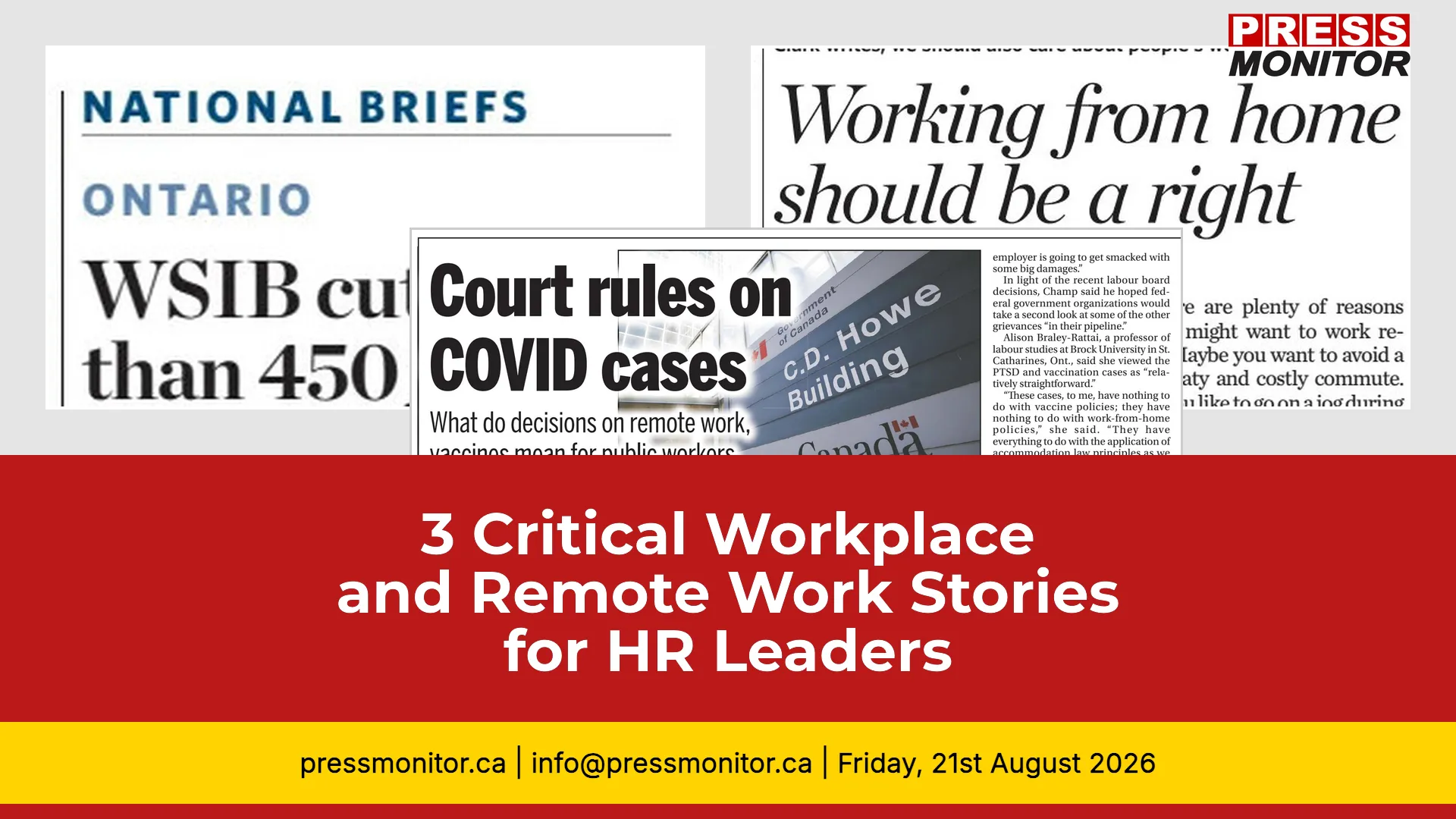
As the return-to-office debate intensifies and policy changes ripple across Canada and beyond, staying ahead of workplace trends is essential. According to Press Monitor's tracking of Canadian publications, today's print coverage reveals three key developments that HR leaders and corporate strategists cannot afford to ignore. This press review uses media monitoring to surface the most impactful stories from national and regional sources.
1. WSIB Cuts 466 Remote Back-Office Jobs Across Ontario
The Workplace Safety and Insurance Board is cutting 466 jobs across the province, in a move the union calls a "gut punch." WSIB says it has made a "difficult business decision to consolidate" the roles of some back-office staff who work remotely. Affected employees are in Sudbury, Windsor, Thunder Bay, St. Catharines, Guelph, Sault Ste. Marie, Kingston, North Bay and Timmins.
Why it matters: The Workplace Safety and Insurance Board's decision to eliminate 466 positions signals a major shift in how public sector organizations view remote work efficiency and operational consolidation.
Key detail: Affected employees are in Sudbury, Windsor, Thunder Bay, St. Catharines, Guelph, Sault Ste. Marie, Kingston, North Bay, and Timmins. The union called the move a "gut punch" and warned of service delays.
Source: The Hamilton Spectator
Next step: Organizations relying on remote back-office staff should evaluate their own consolidation risks and union relations.
2. Victoria's Legal Right to Work From Home Delayed by One Year
The Hamilton Spectator reports that Victoria's legal right to work from home, due to start on September 20, 2026, has been delayed for one year by new Premier Ben Carroll due to fierce business opposition. The policy would have been a global benchmark for employee flexibility.
Why it matters: The Australian state's policy was poised to become a global benchmark for employee flexibility. The delay underscores the tension between progressive workplace policies and business opposition.
Key detail: New Premier Ben Carroll postponed the September 2026 start date to 2027 after fierce pushback from business groups.
Source: The Hamilton Spectator, reporting by Rebecca L. Clark
Next step: Canadian employers and policymakers should watch this as a case study in balancing flexibility and economic interests.
3. Federal Government Faces Labour Board Rulings on Return-to-Office Accommodation
Ottawa Sun reports that recent labour board decisions have found the federal government discriminated against employees by refusing accommodation requests for PTSD and religious exemptions. These rulings highlight the legal risks of using blanket policies for return-to-office and vaccination mandates.
Why it matters: Recent decisions found the government discriminated against employees by denying accommodation requests for PTSD and religious exemptions, highlighting legal risks of blanket RTO policies.
Key detail: The rulings emphasize that blanket mandates without individual assessment can lead to legal liability.
Source: Ottawa Sun, reporting by Ben Andrews
Next step: HR teams should review their return-to-office policies to ensure accommodation processes are robust and legally compliant.
These stories, curated through comprehensive media monitoring, demonstrate the complex landscape of workplace policy today. Which trend will have the biggest impact on your organization?