3 Essential Civil Aviation Stories for Aviation Professionals


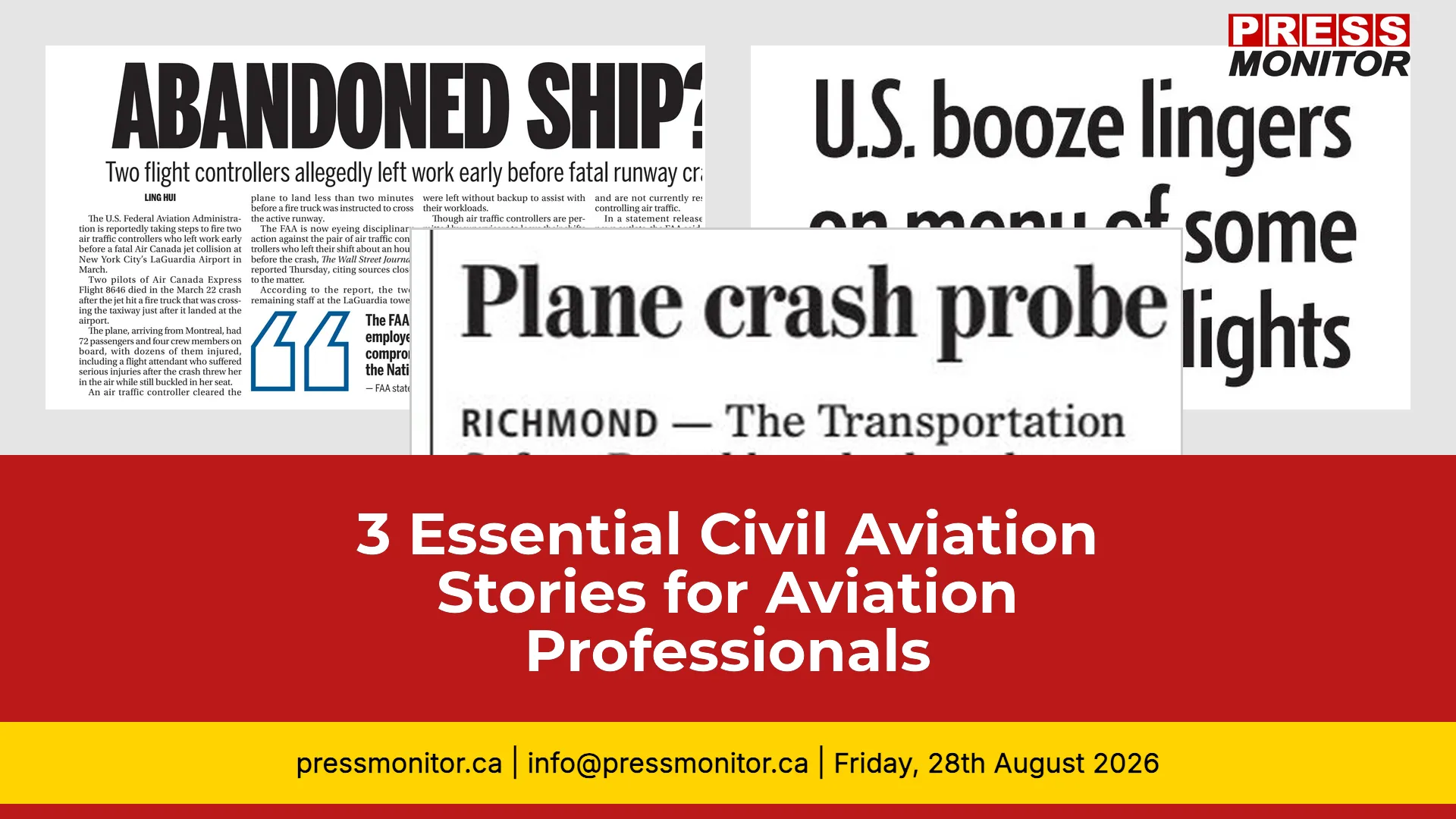
Stay ahead of the curve with Press Monitor's curated press review. Our media monitoring across Canadian print publications reveals the three most critical civil aviation stories this week. From safety lapses at LaGuardia to trade policy impacts on airline service, here's what you need to know.
1. FAA Targets Controllers After Fatal LaGuardia Crash
"Selon Edmonton Sun, l'administration fédérale américaine est en train de prendre des mesures pour licencier deux contrôleurs aériens qui ont quitté le travail tôt avant une collision mortelle entre un avion Air Canada à New York City en mars. Deux pilotes d'Air Canada Express Flight 8646 sont morts dans l'accident de mars 22 après qu'un jet ait heurté un camion de pompiers qui traversait la voie de circulation juste après son atterrissage à l'aéroport. ‘L'avion, arrivant de Montréal, transportait 72 passagers et quatre membres d'équipage, des dizaines d'entre eux étant blessés, dont un agent de bord qui a subi des blessures graves après que l'accident l'ait projetée en l'air alors qu'il était toujours attaché à son siège. Un contrôleur aérien a donné l'autorisation de décollage à l'avion à moins de deux minutes avant qu'un camion de pompiers ne soit autorisé à franchir la voie de circulation active. L'FAA examine maintenant des mesures disciplinaires à l'encontre des deux contrôleurs aériens qui ont quitté leur poste une heure avant l'accident, selon The Wall Street Journal, cité par des sources proches de l'affaire. Selon le rapport, le reste du personnel de la tour de LaGuardia était sans sauvegarde pour faire face à leur charge de travail. Bien que les contrôleurs aériens soient autorisés par leurs supérieurs à quitter leur poste pendant les périodes de faible affluence avec salaire – une pratique informelle connue sous le nom de « poussées précoces », l'FAA considère cela comme une fraude de tournée et mène une analyse plus large de cette pratique. Les deux contrôleurs aériens impliqués dans l'accident de LaGuardia sont en congé, l'FAA s'engage à tenir les employés responsables et ne compromettra pas la sécurité ou l'efficacité du système national de l'espace aérien. La National Air Traffic Controllers Association – la société américaine représentant les contrôleurs aériens – a déclaré dans un communiqué qu'elle « débat activement de ces allégations avec la direction de l'FAA. » La National Transportation Safety Board poursuit son enquête sur l'accident, bien qu'un rapport préliminaire publié en avril ait révélé un certain nombre de problèmes, notamment des problèmes de communication, qui ont contribué à la catastrophe."
Why it matters: The FAA's move to fire two air traffic controllers for leaving early before the March 22 Air Canada Express crash signals a zero-tolerance shift in aviation safety enforcement.
Key detail: The accident killed both pilots and injured over 40 people. A controller cleared the plane for takeoff less than two minutes before a fire truck was authorized to cross the active runway. The remaining tower staff were left without backup.
Source: Edmonton Sun, citing The Wall Street Journal and anonymous sources.
Next step: Aviation safety officers should monitor the NTSB's final report and the FAA's broader crackdown on early departures, a practice known as 'early pushes.'
2. Air Canada Continues Serving U.S. Bourbon Amid Trade Tensions
Saskatoon Starphoenix reports that in the context of Canada-U.S. trade talks, Air Canada continues to serve U.S. bourbon in business class. Despite a boycott of U.S. alcohol by some provinces, the airline justifies its choice by citing the importance of catering to its global customer base under federal jurisdiction.
Why it matters: Even as some provinces boycott U.S. alcohol, Air Canada's decision to keep U.S. bourbon in business class highlights the tension between trade policy and global customer expectations.
Key detail: The airline cites federal jurisdiction and customer preferences, noting it offers at least one Canadian wine on every international flight.
Source: Saskatoon StarPhoenix.
Next step: PR and government relations teams should watch for consumer backlash and potential policy shifts affecting airline procurement.
3. Small Plane Crash in Prince George, B.C. Claims One Life
{source_name} reports that the Transportation Safety Board's third accident investigation of the month has intensified after a small plane crashed near Mission in Prince George, B.C., striking multiple vehicles and fatally injuring a single individual due to mid-air collisions this month with two other planes over Chilliwack cabin class causing repeated aviation incidents.
Why it matters: The third accident investigation of the month by the Transportation Safety Board underscores ongoing safety concerns in general aviation.
Key detail: The crash near Mission struck multiple vehicles, killing one person. The TSB is investigating.
Source: Times Colonist.
Next step: Operators in the region should review safety protocols and communicate with the TSB.
Powering this review is Press Monitor's print media monitoring, tracking every major Canadian daily for actionable intelligence. What's your take on the FAA's disciplinary action? Share your thoughts below.