3 Essential First Nations & Indigenous Stories for Canadian Readers


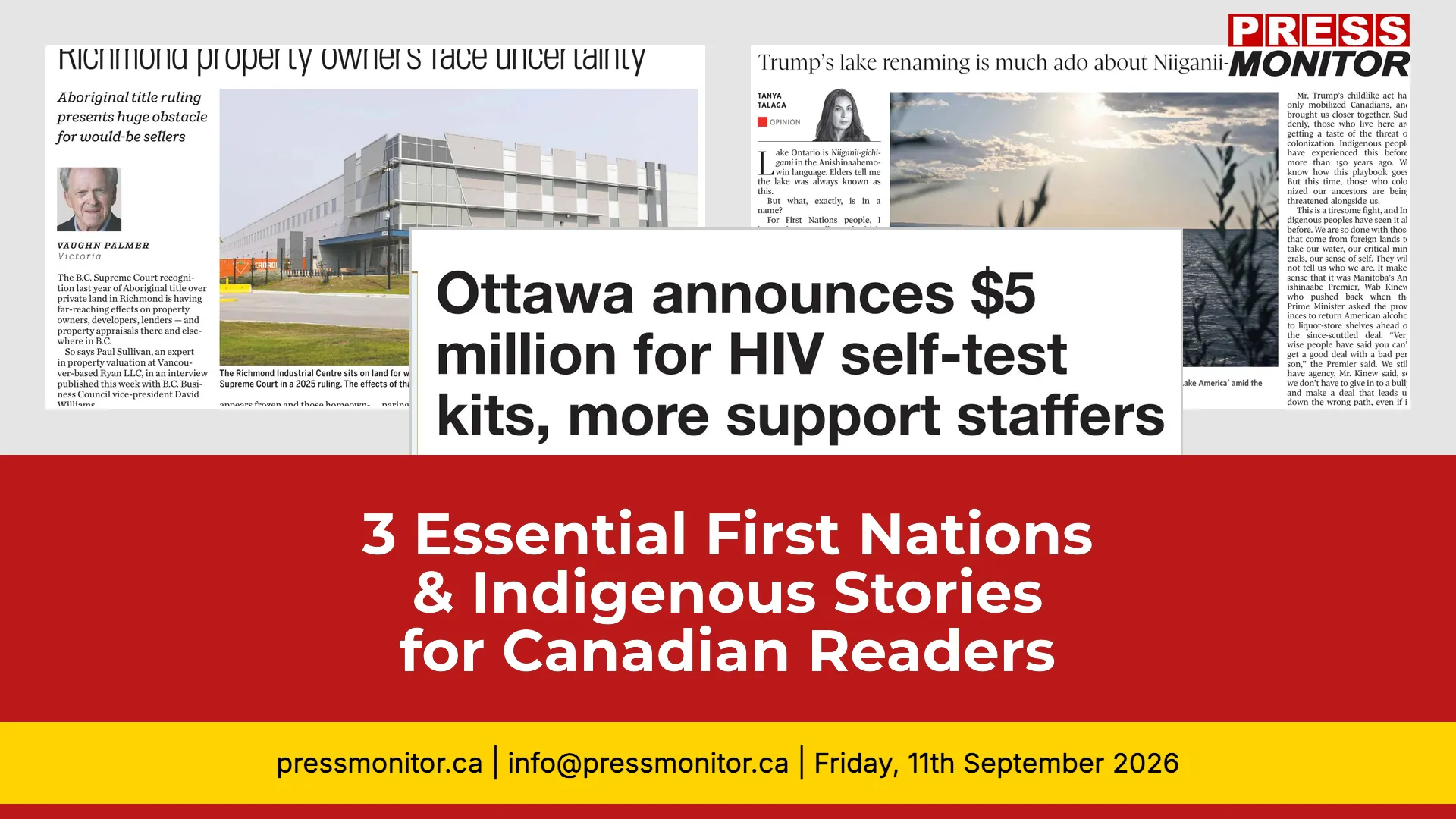
According to Press Monitor's tracking of Canadian publications, today's print media monitoring reveals three essential stories shaping the First Nations and Indigenous landscape across Canada. These stories span property rights, cultural sovereignty, and public health — each reflecting the urgent need for informed press review and media intelligence.
1. Cowichan Title Ruling Freezes Richmond Property Market
Vancouver Sun reports that the B.C. Supreme Court decision from August 7, 2025 recognized Cowichan Aboriginal title over private fee simple land in Richmond, creating dual claims on property. Property appraisal expert Paul Sullivan notes that zero recorded sales in the affected area reflect buyers stepping back due to unresolved title certainty, with hypothetical valuations dropping to 30-60 cents on the dollar for commercial properties. Appraisers are inserting B.C.-wide disclaimers, the provincial $150 million mortgage backstop is deemed fiscally insignificant against three trillion dollars in assessed real estate, and the B.C. Assessment Authority has not lowered property valuations in the claim area.
A B.C. Supreme Court decision recognizing Cowichan Aboriginal title over private fee simple land in Richmond has created dual claims on property, freezing the local market. This news on the Cowichan title ruling highlights how unresolved title certainty is already deterring buyers — with zero recorded sales in the affected area and hypothetical valuations dropping to 30-60 cents on the dollar for commercial properties. Appraisers are inserting B.C.-wide disclaimers, and the provincial $150 million mortgage backstop is deemed fiscally insignificant against three trillion dollars in assessed real estate. The B.C. Assessment Authority has not lowered property valuations in the claim area, leaving owners and investors in limbo. Why it matters: every commercial transaction in the affected zone now carries title risk that no insurer has priced. Source: Vancouver Sun, Vaughn Palmer, August 7, 2025.
2. Trump Renames Lake Ontario Lake America
The Globe And Mail reports that U.S. President Donald Trump signed an executive order renaming Lake Ontario as 'Lake America' amid the continuing trade war between the United States and Canada. The opinion piece discusses the Indigenous Anishinaabeg perspective, noting that the lake has been known as Niiganii-gichigami in Anishinaabemowin for centuries, and argues that an American President can never take away the name of a lake that was never his.
U.S. President Donald Trump signed an executive order renaming Lake Ontario as Lake America, igniting debate over Indigenous sovereignty and cultural heritage. This news on the Lake Ontario renaming centers the Anishinaabeg perspective, noting that the lake has been known as Niiganii-gichigami in Anishinaabemowin for centuries. As trade tensions between the United States and Canada escalate, the move underscores a broader pattern of disregarding Indigenous place names. An American President, the opinion argues, can never take away the name of a lake that was never his. Why it matters: the renaming sets a precedent that could extend to other Indigenous-named waterways. Source: The Globe and Mail, Tanya Talaga.
3. Canada Deploys 80000 HIV Self-Test Kits
Winnipeg Sun reports that the federal government is dispatching 80,000 HIV self-test kits across Canada to expand access to HIV prevention. Ottawa will provide 5 million Canadian dollars to increase access to the kits and to hire peer-based support workers for communities facing the highest burdens of HIV, with 2 million Canadian dollars for the tests and 3 million Canadian dollars for peer support networks. The initiative targets Indigenous populations, men who have sex with men, Black communities, and people who inject drugs, as Manitoba declared a public health emergency over HIV rates three times higher than the rest of Canada.
The federal government is dispatching 80,000 HIV self-test kits across Canada, backed by 5 million Canadian dollars in funding — 2 million for the tests and 3 million for peer support networks. This news on HIV self-test kit deployment targets Indigenous populations, men who have sex with men, Black communities, and people who inject drugs. Manitoba declared a public health emergency over HIV rates three times higher than the rest of Canada, making this initiative a critical step toward equity in healthcare access. Peer-based support workers will be hired to serve communities facing the highest burdens. Why it matters: the funding split between testing and community support signals a shift toward culturally grounded prevention. Source: Winnipeg Sun, Brittany Hobson, The Canadian Press, September 10, 2026.
These three stories illustrate the intersecting challenges facing First Nations and Indigenous communities across Canada — from land rights and cultural recognition to public health equity. Press Monitor's print media monitoring continues to deliver the press review and media intelligence that matters. Which of these stories will you be following most closely?