3 Essential First Nations Stories for Policy Leaders


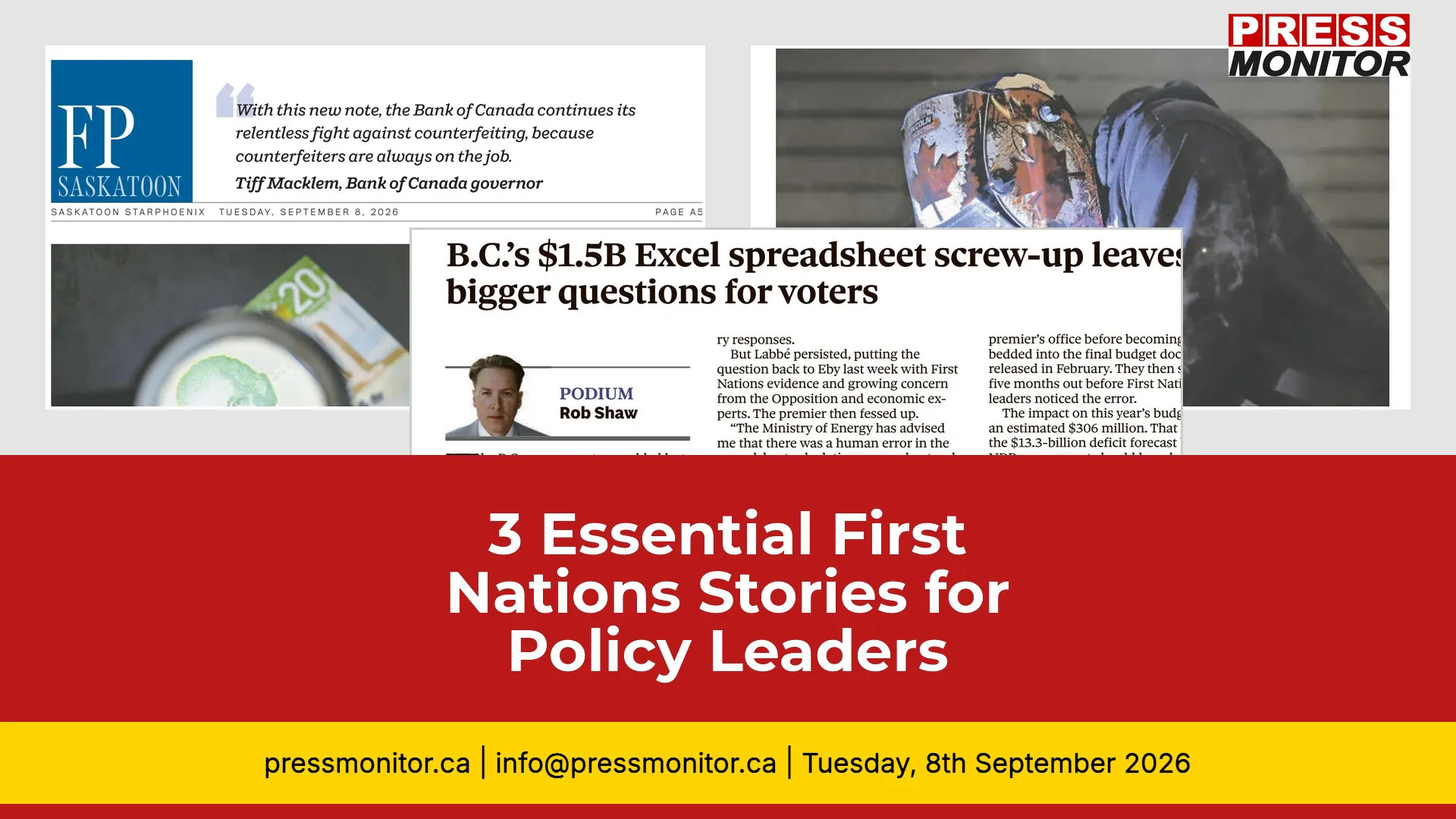
First Nations and Indigenous governance stories are dominating Canadian print media this week. According to Press Monitor's tracking of Canadian publications, this press review draws on media monitoring of print outlets to highlight the most consequential developments shaping policy, governance, and reconciliation across Canada. These stories on news on First Nations governance and Indigenous rights demand attention from every stakeholder in the Canadian media landscape. The following print media monitoring analysis covers three developments that will shape the sector's future.
1. New $20 Bill Incorporates Indigenous Cultural Elements
Saskatoon Starphoenix reports that the Bank of Canada unveiled its new vertical $20 banknote on Thursday, featuring King Charles III and enhanced security features. The note will enter circulation next February and includes the Canadian National Vimy Memorial on the back to honour First World War veterans. Governor Tiff Macklem emphasized the relentless fight against counterfeiting while incorporating Indigenous cultural elements and floral emblems from each province and territory.
The Bank of Canada's unveiling of the new vertical $20 banknote represents a significant moment for Indigenous representation in Canadian currency. Governor Tiff Macklem highlighted the inclusion of Indigenous cultural elements alongside floral emblems from each province and territory, while the reverse features the Canadian National Vimy Memorial honouring First World War veterans. This move signals a broader institutional commitment to recognizing Indigenous heritage within national symbols.
Why it matters: Currency design shapes national identity. The integration of Indigenous cultural elements into everyday currency normalizes Indigenous presence in Canada's public infrastructure and sets a precedent for future commemorative designs.
Key detail: The note enters circulation next February and includes enhanced security features alongside Indigenous motifs.
Source: Saskatoon Starphoenix, September 8, 2026
Next step: Watch for reactions from Indigenous leaders and First Nations organizations on the cultural representation in the new design.
2. Canada Imports 3 Billion Cubic Feet of Natural Gas Daily
Financial Post Magazine reports that Canada imports three billion cubic feet of natural gas each day, with ninety percent destined for Ontario and Quebec. The article notes that policy-makers may restart cancelled pipeline projects like the proposed Energy East pipeline to enhance energy security and reduce reliance on trade negotiations as a bargaining chip. Analysts suggest government subsidies could incentivize new infrastructure, but success depends on political will to prioritize energy security over market forces.
Canada's import of three billion cubic feet of natural gas each day, with ninety percent destined for Ontario and Quebec, raises urgent questions about energy security and Indigenous land rights. The Financial Post Magazine reports that policy-makers may restart cancelled pipeline projects like the proposed Energy East pipeline, directly affecting First Nations communities along proposed routes.
Why it matters: Energy infrastructure decisions have profound implications for Indigenous communities whose treaty rights and traditional territories intersect with pipeline corridors. The potential restart of the Energy East pipeline reignites debates about consent, consultation, and Indigenous sovereignty.
Key detail: Ninety percent of imported gas flows to Ontario and Quebec, making these provinces heavily dependent on cross-border energy trade.
Source: Financial Post Magazine, September 8, 2026
Next step: Monitor which First Nations communities may be affected by renewed pipeline proposals and their positions on energy projects.
3. B.C. Government's $1.5 Billion Spreadsheet Error Raises Questions About Treaty Nation Consultation
Business in Vancouver reports that a human error in an Excel spreadsheet caused a $1.5 billion overestimation of natural gas royalties in B.C.'s provincial budget. The error, which included double currency conversion and incorrect unit conversions, was acknowledged by Premier David Eby after persistent questioning by reporter Stefan Labbé. The mistake, which went unchecked through multiple ministry levels for five months, has raised serious concerns about fiscal competence and led to a referral to the auditor general.
A human error in an Excel spreadsheet caused a $1.5 billion overestimation of natural gas royalties in B.C.'s provincial budget, with the mistake going unchecked through multiple ministry levels for five months. Premier David Eby referred the matter to the auditor general after concerns from Treaty 8 Nations chiefs about technical errors in provincial revenue estimates that affect resource-sharing agreements.
Why it matters: Fiscal errors in resource revenue estimation directly impact the funds that flow to First Nations communities through treaty agreements and resource-sharing frameworks. The Treaty 8 Nations' concerns highlight the intersection of government accounting accuracy and Indigenous economic rights.
Key detail: The budget deficit widened from $13.3 billion to $13.6 billion as a result of the overestimation, affecting public services and Indigenous funding allocations.
Source: Business in Vancouver, September 8, 2026
Next step: Follow the auditor general's review and assess how the revenue correction impacts treaty obligations to First Nations communities in B.C.
This media intelligence review demonstrates why sustained media monitoring of Canadian print publications remains essential for understanding the evolving landscape of Indigenous policy, governance, and reconciliation. As these stories develop, stakeholders across government, industry, and Indigenous organizations must stay informed through reliable sources.